The University of Kansas

Inside Spencer: The KSRL Blog

Books on a shelf

Welcome to the Kenneth Spencer Research Library blog! As the special collections and archives library at the University of Kansas, Spencer is home to remarkable and diverse collections of rare and unique items. Explore the blog to learn about the work we do and the materials we collect.

This blog may contain archived web content. This blog may link to catalog records which no longer exist as of a software change in 2026.

That’s Distinctive!: Lewis Lindsay Dyche’s Panorama

June 2nd, 2023

Check the blog each Friday for a new “That’s Distinctive!” post. I created the series because I genuinely believe there is something in our collections for everyone, whether you’re writing a paper or just want to have a look. “That’s Distinctive!” will provide a more lighthearted glimpse into the diverse and unique materials at Spencer – including items that many people may not realize the library holds. If you have suggested topics for a future item feature or questions about the collections, feel free to leave a comment at the bottom of this page.

This week on That’s Distinctive! we share some photos from the KU Natural History Museum’s collection within University Archives. In the library we house many photographs from the museum from throughout their years as well as some of their records. The photos we share this week show early displays of the museum’s panorama from 1893. From the museum’s website:

“The Panorama is an American cultural treasure, a 360-degree-view exhibit that embodies a historic first in the representation of nature for the public. As part of the official Kansas Pavilion in the 1893 World’s Columbian Exposition in Chicago, it was unique and revolutionary in depicting, for the first time, mounted groups of North American mammals in their natural surroundings. Lewis Lindsay Dyche created this exhibit on the cusp of growing scientific awareness of ecological systems and the need to conserve natural resources for the better good…the exhibit has grown over the years to include more different environs and species. The Panorama represents the university’s early efforts to document and understand the life of the planet — research that continues today through the KU Biodiversity Institute.”

Sepia-toned photographs of two large animals, probably moose, locking antlers.
–
Sepia-toned photograph of two large animals (probably moose) locking antlers with a variety of smaller animals in the background.
–
Sepia-toned photograph of many animals, large and small, in a lightly-wooded environment with a tall rock feature in the background.
–
Sepia-toned photograph of the entire diorama, taken from across a hallway.
Views of the panorama created by Lewis Lindsay Dyche, 1893. University Archives Photos. Call Number: RG 33/0 1893: Museum of Natural History (Photos). Click images to enlarge.

More on the history of the panorama and other exhibits can be found on the Natural History Museum’s website. Spencer Research Library also houses material on Lewis Lindsay Dyche, including his personal papers.

What made me choose the museum for this week? Well, I am a science lover by nature being an Anthropology major. But, the museum is also a great community resource. Not only for learning cool things, but for bonding and making memories.

The KU Natural History Museum offers four floors of exhibits for visitors of all kinds. The museum is open from 9am to 5pm, Tuesday-Sunday for the summer, with suggested donations upon entrance. The museum also offers “Museum from Home” options for those who are unable to visit.

Tiffany McIntosh
Public Services

That’s Distinctive!: Amazing Stories

May 26th, 2023

Check the blog each Friday for a new “That’s Distinctive!” post. I created the series because I genuinely believe there is something in our collections for everyone, whether you’re writing a paper or just want to have a look. “That’s Distinctive!” will provide a more lighthearted glimpse into the diverse and unique materials at Spencer – including items that many people may not realize the library holds. If you have suggested topics for a future item feature or questions about the collections, feel free to leave a comment at the bottom of this page.

For our science fiction lovers out there, this week we highlight Amazing Stories by Hugo Gernsback. According to Wikipedia, Amazing Stories is an American science fiction magazine that was first published in 1926. The magazine was the first of its kind in being solely devoted to science fiction, which helped launch a new genre of pulp fiction. Gernsback’s contributions to the genre as a publisher were so significant that he is sometimes called “The Father of Science Fiction.” Annual awards presented at the World Science Fiction Convention are named the “Hugos,” in his honor.

Here at Spencer, we have many copies of Amazing Stories from throughout its long publishing history. This week we include just a small sample of early covers from the library’s large collection. The magazines offer a fun array of cover scenes that can be fun to flip through along with the contents of the magazines as well.

Color illustration of a man being confronted by two insects that are larger than him.
–
Color illustration of two large insects shooting lasers at a dinosaur.
The front covers of Amazing Stories, October 1926 (top) and February 1929 (bottom). You can see on the latter cover that Gernsback referred to the genre as “scientifiction” rather than “science fiction.” Call Number: ASF CURR D3. Click images to enlarge.
Color illustration of a man in a space suit tangled in and fighting vines.
–
Color illustration of a woman running from a giant insect standing over a mid-century car.
The front covers of Amazing Stories, August (top) and November (bottom) 1958. Call Number: ASF CURR B23. Click images to enlarge.

Tiffany McIntosh
Public Services
Ringle Conservation Internship: Cornish Studio Collection

May 23rd, 2023

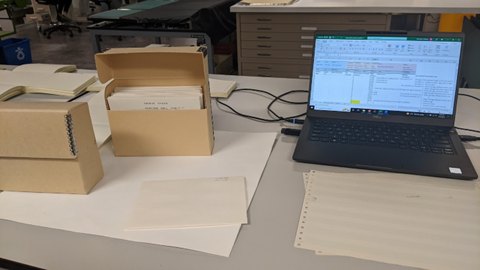
Becoming the Ringle Conservation Intern has been an incredible learning experience both on its own and as an expansion of the work I have been fortunate enough to do during my two years as a student employee at the Kenneth Spencer Research Library Conservation Lab. Since September of 2022, I have assessed, lightly cleaned, and re-housed over 900 individual glass plate negatives, and at least 100 flexible negatives, taken by the George Cornish Studio (based in Arkansas City, Kansas) between 1890 and 1945. With the guidance of Marcella Huggard, Charissa Pincock, Whitney Baker, and Roberta Woodrick, I have contributed 833 entries to the ongoing finding aid that include the subject of the photo (if identifiable) and the condition of each plate. My hope is that, when the collection is complete with its partner collection (the Hannah Scott Collection), history and photo enthusiasts will be able to enjoy the wide range of portraiture, landscape, and urban life photography contained within the collection.

Inventorying the Cornish Studios Collection, RH MS 1342, Kenneth Spencer Research Library, University of Kansas Libraries.
Creating a spreadsheet with information about the negatives in the Cornish Studio collection.

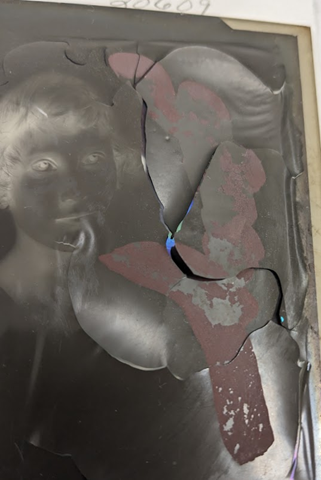
The Ringle project began with a massive shifting project. Roberta Woodrick, Grace Awbrey, Hannah Johnson, Rory Sweedler, Sarah Jane Dahms, and I moved the Cornish, Scott, and several other glass plate negative collections in advance of the heating, ventilation, and air conditioning (HVAC) updates in the stacks. During this shifting, we saw how both age and the heat from the old furnace, located under the floor where the glass plates had been held, had affected the collections. There were clear indicators that re-housing these collections was necessary. On some glass plates there was flaking emulsion and discoloration, and some flexible negatives were experiencing “vinegar syndrome” (the strong smell of deteriorating acetate film) and leaving liquid residue on the shelves (from the chemical separation of the emulsion on the plastic).

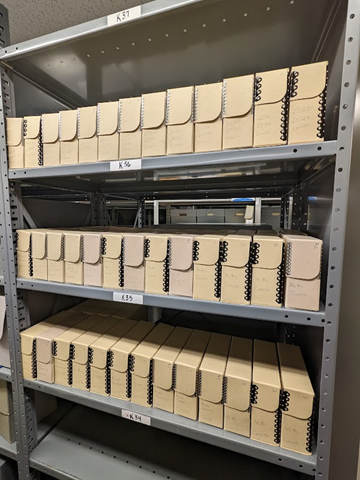
Boxes of glass plate negatives in the stacks of Kenneth Spencer Research Library, University of Kansas Libraries.
Glass plate negatives from the Cornish Studio collection housed in boxes in the stacks.
Damage to a glass plate negative. Cornish Studios Collection, RH MS 1342, Kenneth Spencer Research Library, University of Kansas Libraries.
Flaking emulsion on one glass plate negative in the Cornish Studio Collection.

The Cornish Studio was located in Arkansas City, Kansas, 8 miles north of Chilocco, Oklahoma, where the Chilocco Indian School operated, and about 200 miles southwest of Lawrence. The studio was opened by George Cornish in 1905 and was run jointly from 1912 onward by Cornish and his assistant Edith Berrouth (to whom he would leave the practice in 1946 after his death.) In 1993, attorney Otis Morrow, whose practice was in the building that had once been Cornish’s studio, donated the 8 boxes of glass plates, photo registrars, and even George Cornish’s autobiography of running the studio (called “My Life on Fifth Avenue”) to the Kenneth Spencer Research Library. (More about the history of the collection can be found at the Collections Overview.)

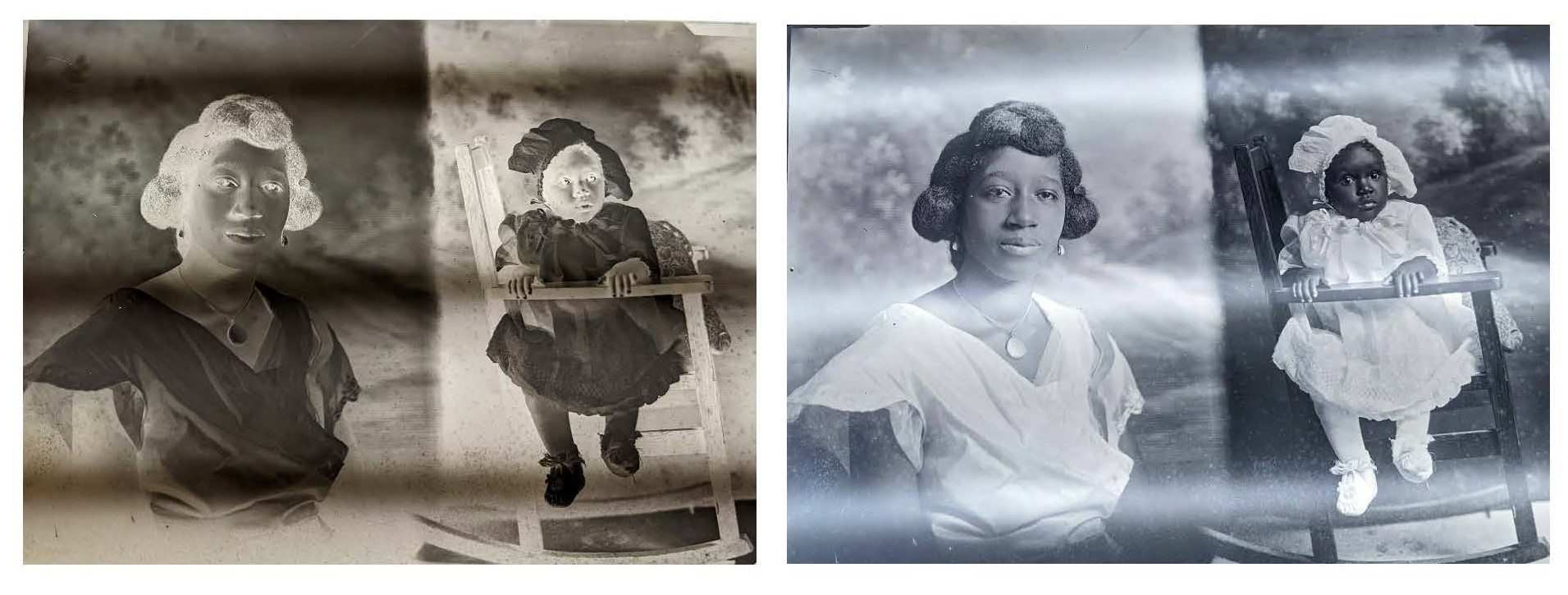
Many of the glass plates in the Cornish collection have some degree of damage – they’ve existed through a wide range of temperature and humidity fluctuations – but at over 100 years old for many of them, they generally look remarkably good. The subjects in the photos are almost all visible, and the excitement on their faces in these century old photographs endures. It’s clear that the people who went to the Cornish Studio for their portraits, or for the portraits of their young children (babies make up a significant portion of the plates from the 1910s-20s), were happy to have the opportunity to have their photos taken. They couldn’t have known that their likeness would be preserved for longer than them, but I like to think it would make them happy to know their investment in a photograph might provide returns to scholars today.

Negative and positive images of Letha Thomas and baby, Cornish Studio Collection, Kenneth Spencer Library, University of Kansas Libraries.
Negative and reversed positive image of Letha Thomas and baby, circa 1919, Cornish Studio Collection.

Before me, several Ringle interns worked on an impressive collection of projects over timespans of six weeks to three months. So far, I have been working with the Cornish Collection for nine months and will continue to do so for another two. Having almost a full year has been immensely valuable – each plate must be placed individually into a four-fold wrapper before being re-housed in boxes, and many plates between 1917 and 1930 have subjects that could be researched (which I did, especially when there might be the opportunity to identify the women in couples’ portraits who were usually identified as Mrs. (Man’s Name.)). Having now completed the 5 x 7 plates, I continue to work on the 8 x 10 plates which represent a shift from traditional studio portraiture and into street scenes in Ark City and the surrounding area. These images, and this collection, offer a valuable slice-of-life view of Southwest Kansas across a period of American history with rapid changes.   

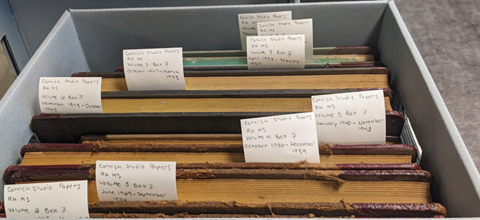
Registers from the Cornish Studios Collection, RH MS 1342, Kenneth Spencer Research Library, University of Kansas Libraries.
Cornish Studio ledgers that record information about some of the subjects featured on the negatives in the collection.

Brendan Williams-Childs
2022-2023 Ringle Conservation Intern
Conservation Services

Adjustable Conservation Book Support: An open-design conservation tool arrives at KU Libraries

May 16th, 2023

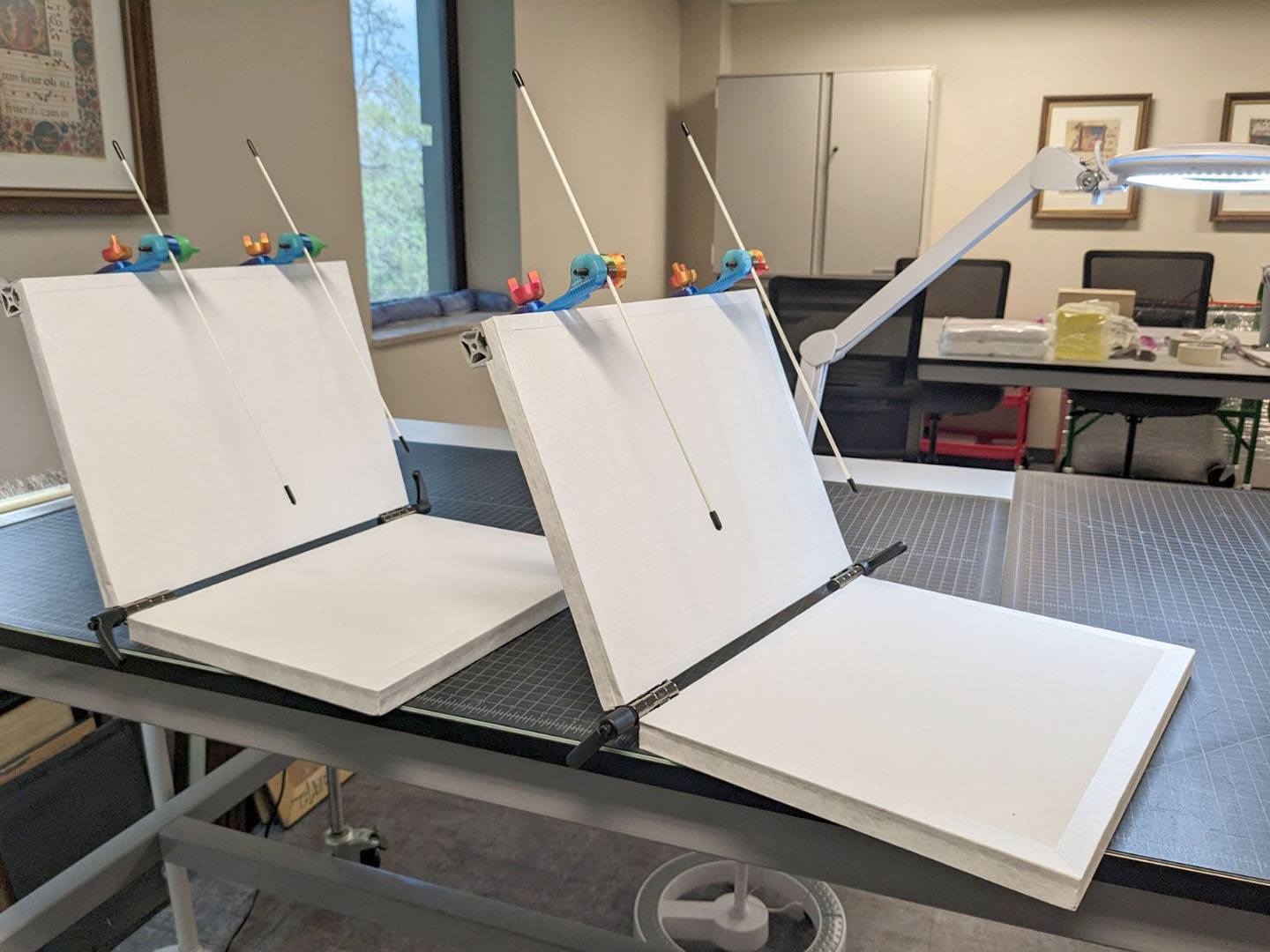
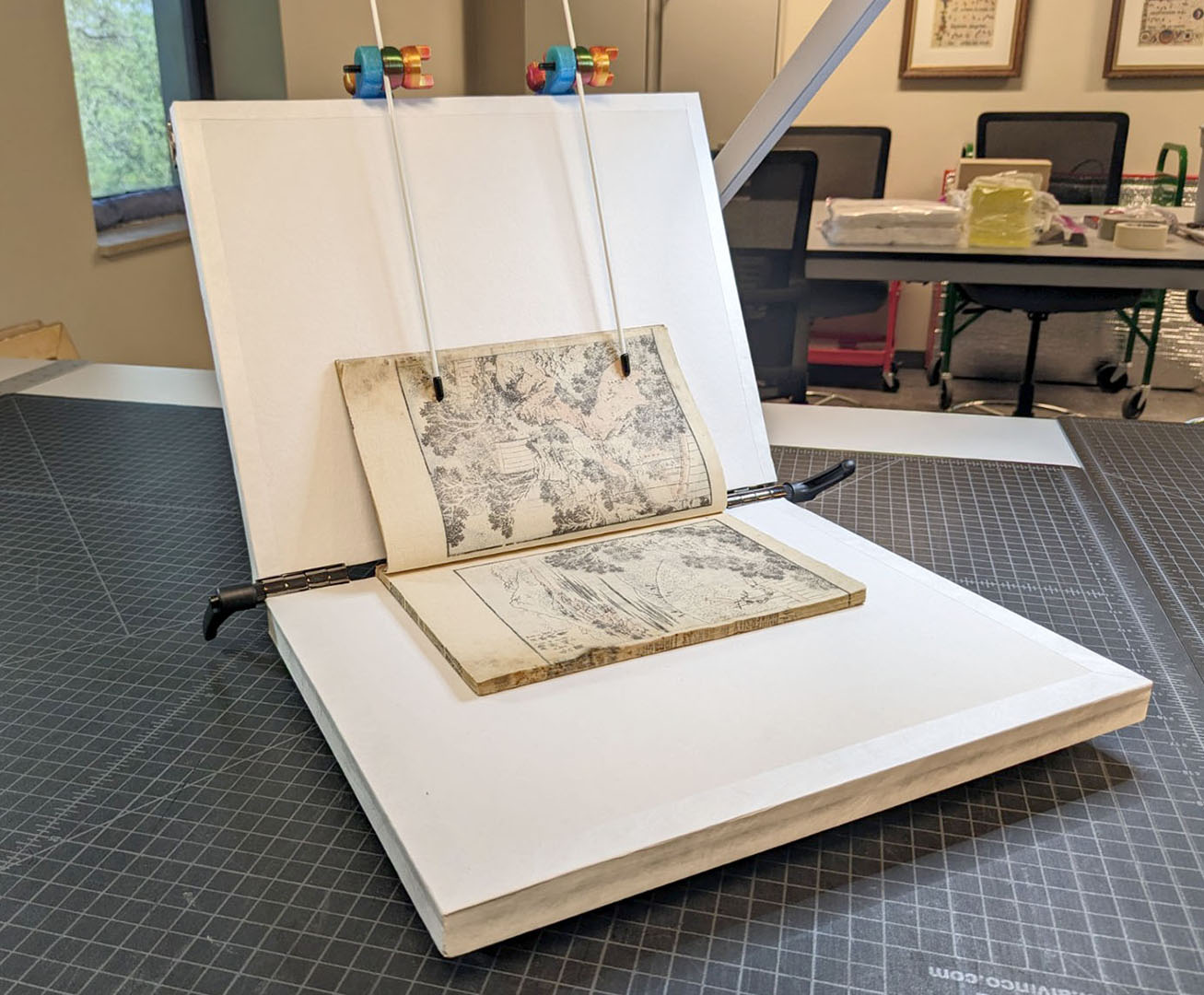
The conservation lab at the University of Kansas Libraries is now home to a pair of Adjustable Conservation Book Supports, or ACBS’s. The ACBS is a hinged cradle that supports a book during conservation treatment; fiberglass rods gently hold the book open in almost any desired position, a feat that can be difficult or impossible to achieve with our usual system using weights and fixed cradles or foam wedges, or other rigged-up arrangements. The ACBS was designed and developed at Northwestern University by conservator Roger Williams in collaboration with students in Northwestern’s School of Engineering. Williams wrote about the process in this blog post: Collaborating with engineering students to create an open-design conservation tool – LIBRARIES | Blog (northwestern.edu). We learned about the ACBS when Williams presented a webinar about the project during the COVID-19 pandemic, at a time when many conservators were unable to work in their labs. We and our colleagues around the world spent much of our pandemic work-at-home time learning and sharing on online platforms, saving up the new knowledge to try out when we were back in our workspaces.

One of Williams’ goals when creating the ACBS was to make it freely available and customizable  – an open-design tool that could be built with readily available supplies and that could be adapted and improved upon by the conservation community through use and experimentation. Conservators at the Auckland War Memorial Museum in New Zealand took up this challenge and created an (also open access!) alternative design for the two clamps that sit at the top of the ACBS. The 3D-printed Auckland clamp design increases the range of motion of the fiberglass rods, adding even more functionality to the ACBS. (See their blog post: Newest Trick in the Book – Blog – Auckland War Memorial Museum (aucklandmuseum.com))

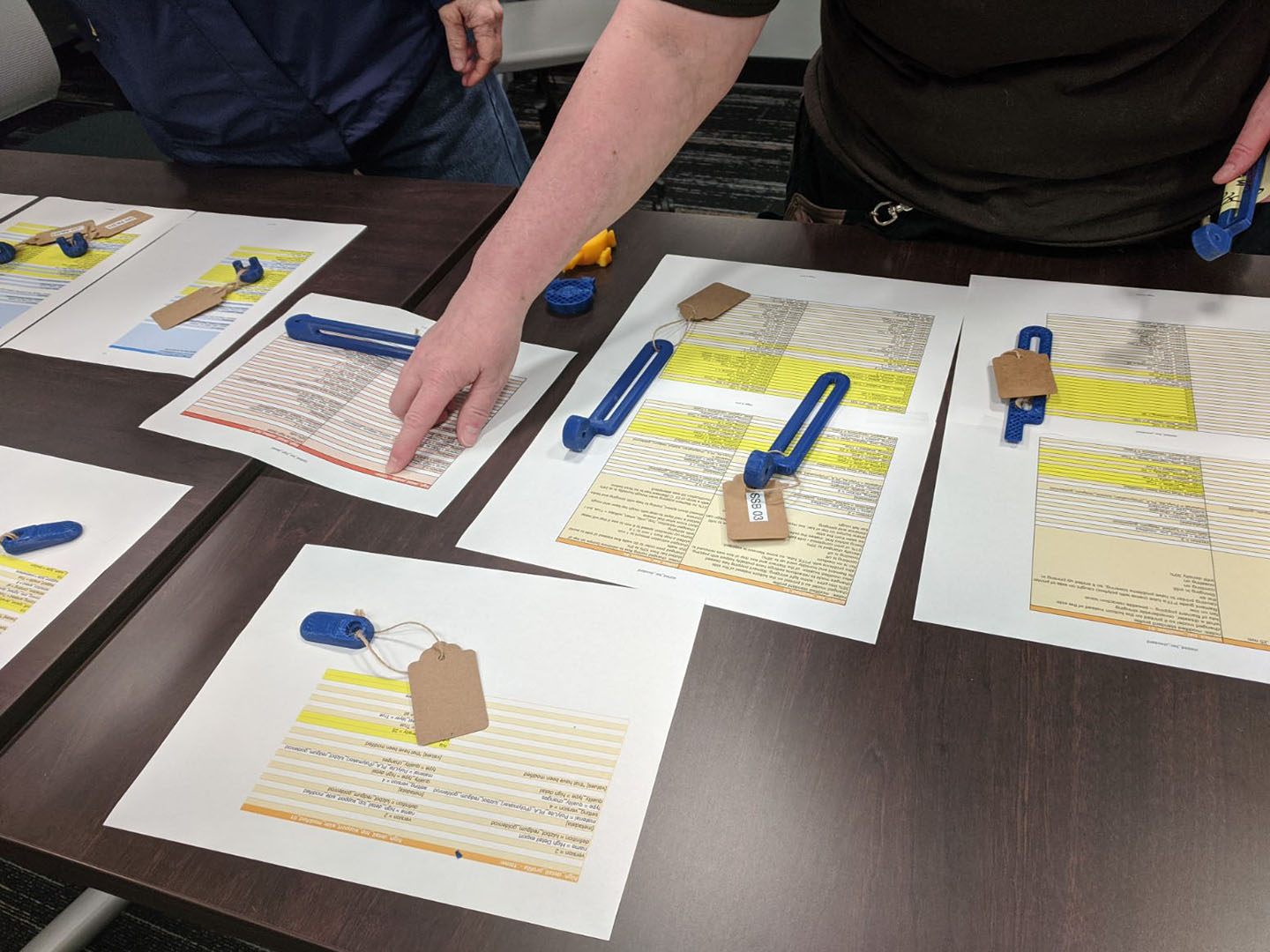
We wanted to build an ACBS for our lab, and we definitely wanted those clamps! We knew that KU Libraries had a 3D printer in our new Makerspace, so we reached out to Associate Librarian Tami Albin for her help. The Makerspace was in its early days, and Tami had been experimenting with the 3D printer, getting to know its capabilities and the properties of different filaments. We downloaded the files for the Auckland clamps and sent them to Tami. While Tami worked on the clamps, collections conservator Roberta Woodrick ordered the rest of the parts we needed for our ACBS’s (we had decided to build two), and she and I assembled them up to the point of adding the clamps. A few weeks later, Roberta and I visited the Makerspace to see the results of Tami’s first tests. Tami described how the 3D printer works, showed us the printed clamp parts, and explained how the type of filament affects the finished 3D print. She had printed an assortment of sample parts for us; we brought them back to the lab and examined each one to find those that had the look, feel, and weight that suited us, and to test the fit on the ACBS’s.

Two people whose faces are out of the frame stand next to a table laid with 3D printed samples of clamp parts for an adjustable book cradle.
Reviewing test prints of the clamp parts with Tami Albin at the Makerspace. Click image to enlarge.

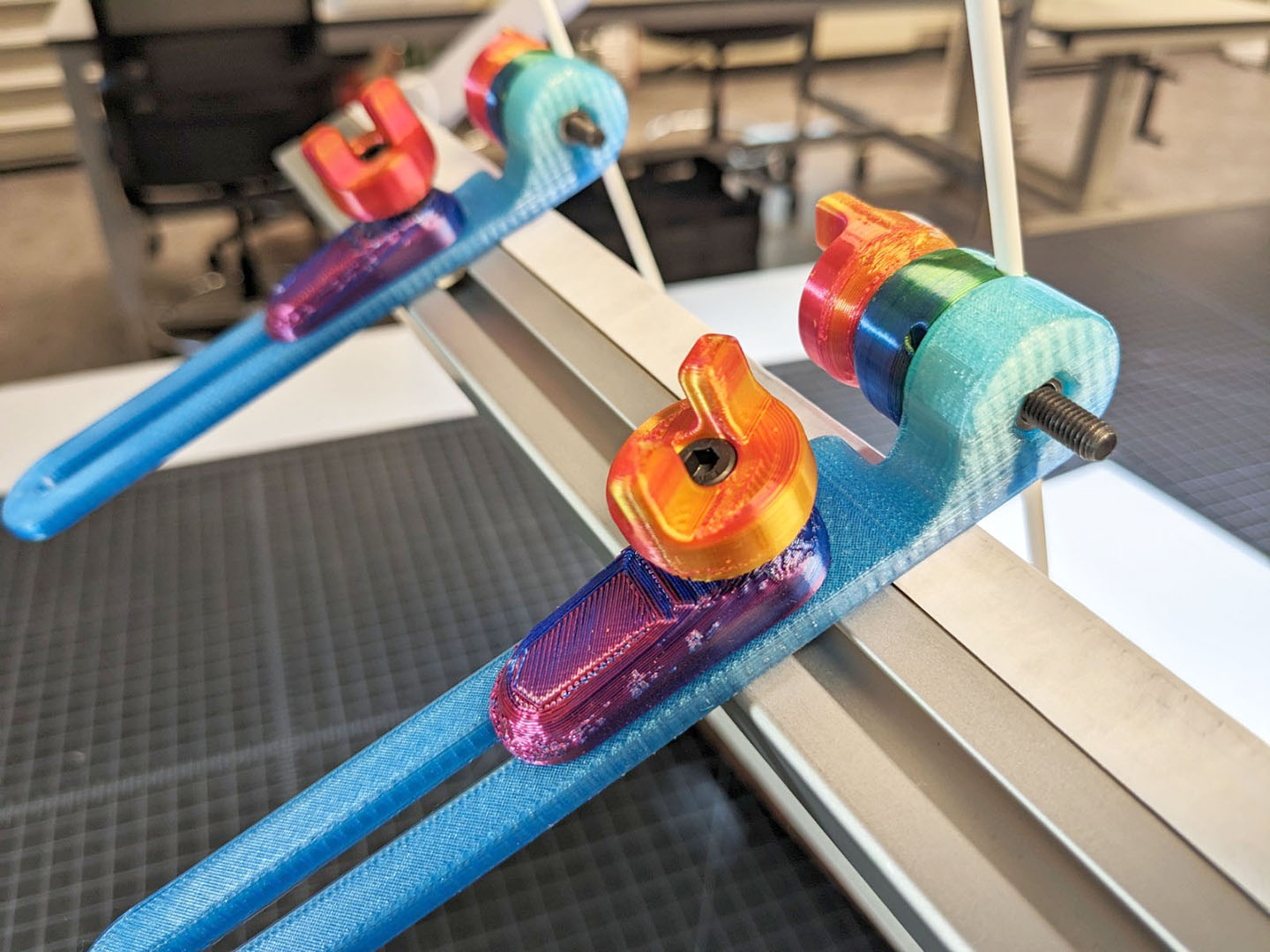
After we’d selected the samples that we liked best, we reported back to Tami and she set to work printing the final pieces. We were excited to get the email from her letting us know that the parts were ready! We gave Tami free rein to choose the filament colors, and she came through with a selection of bright, cheerful colors that add some fun and personality to our ACBS’s.

Close up image of colorful 3D printed clamps on an adjustable book cradle.
Detail of the clamps in their beautiful colors. Click image to enlarge.

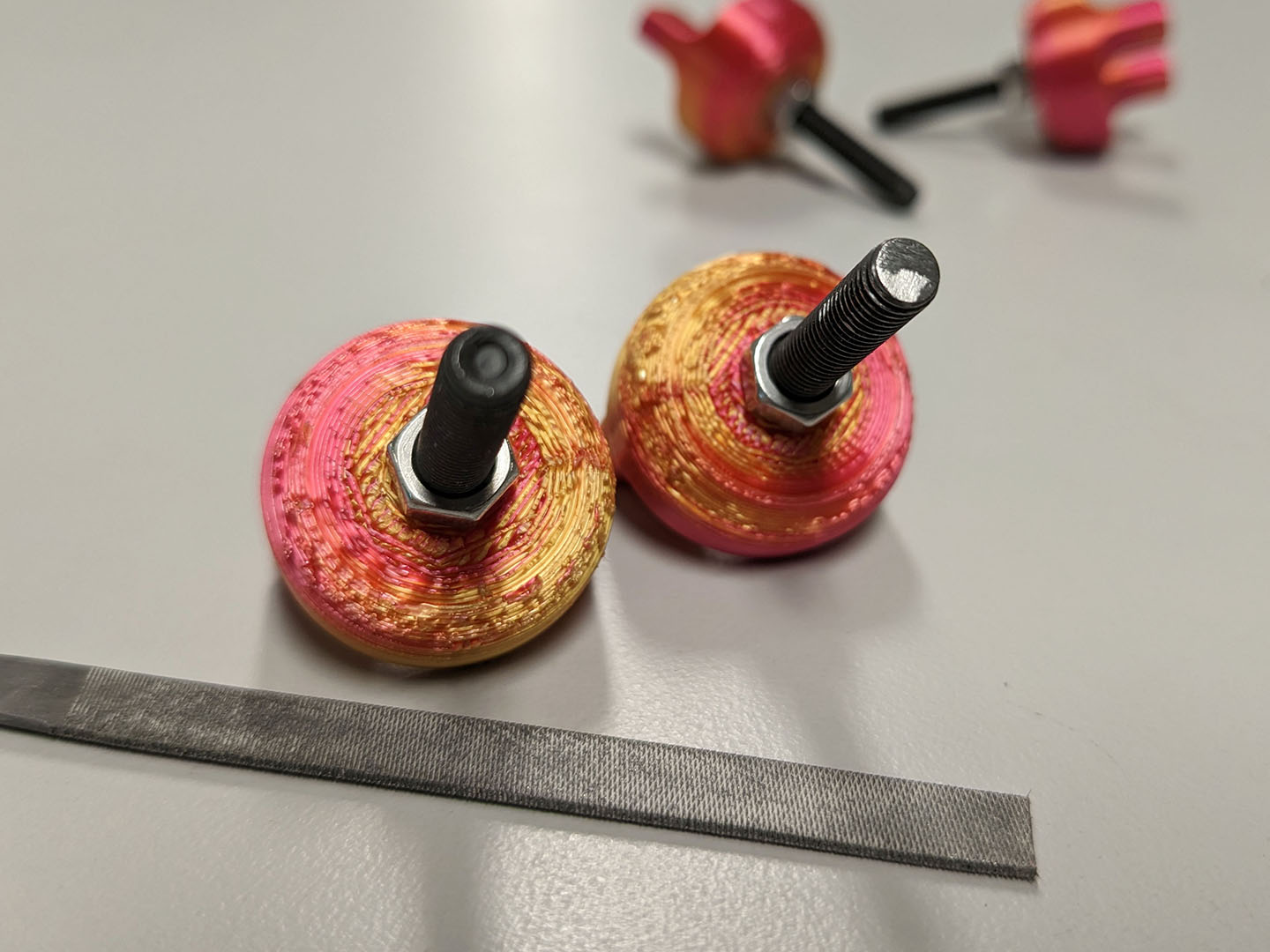
With the clamp parts in hand, we had a few more steps to go before the ABCS’s would be ready to use. I put together the clamp assembly and found that our off-the-shelf bolts were about 1mm too long, preventing the clamps from being fully tightened. I found my set of jeweler’s rasps (saved from a metals elective I took back in art school – conservators love to appropriate tools of many trades!) and used one to file down the ends of the bolts until they fit correctly.

Two black metal bolts, each with a small silver hex nut and large red-and-yellow 3D printed nut on its end, sit on a table next to a small metal rasp. The end of the bolt on the left has been filed down smooth.
A too-long bolt, left, and a filed-down bolt, right. Click image to enlarge.

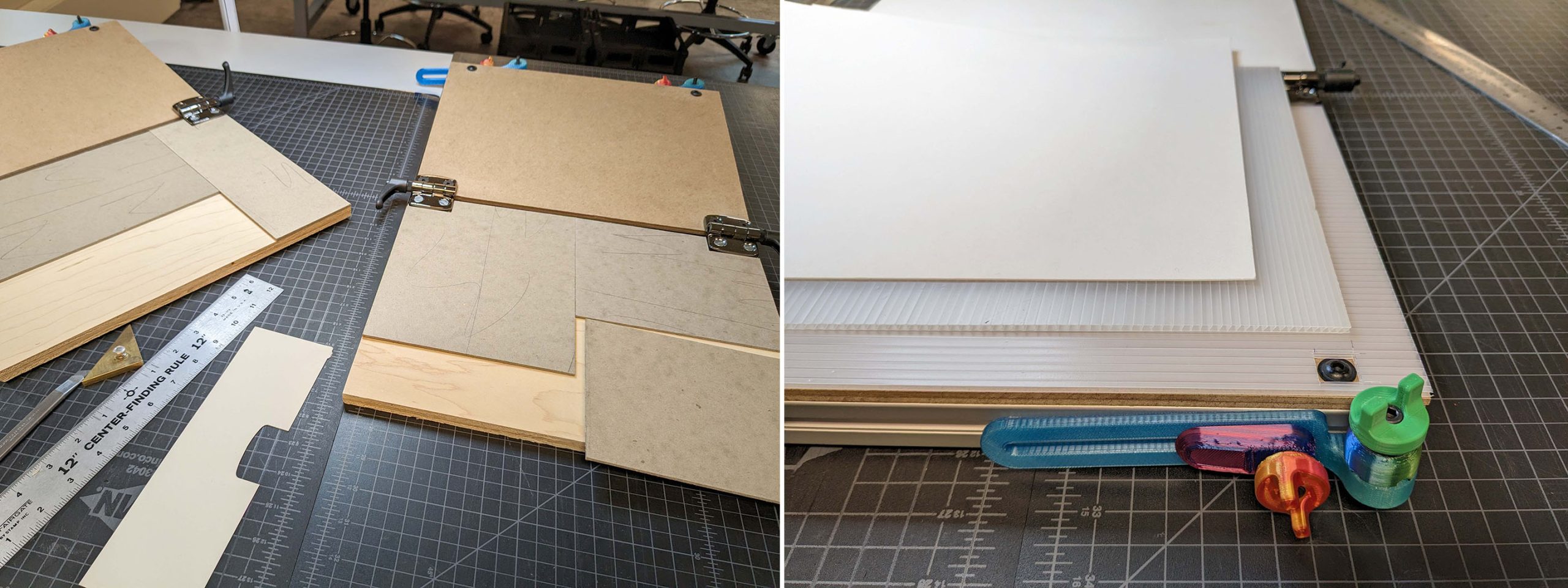
With the clamps assembled, the last step was to fill in the sides of the ACBS’s to bring the surfaces level with the thick hinges. Per Williams’ instructions, I filled the lower boards of the ACBS’s with scraps of binder’s board, a heavier material, and the upper board with corrugated plastic, a lighter material, to help balance the ACBS. I then covered each side with blotter and sealed the edges all around with Tyvek tape.

A split image: on the left, two adjustable book cradles atop a workbench with a utility knife, a triangle, and a ruler; on the right, a close-up of an adjustable book cradle lined with corrugated plastic.
Filling in the lower board with scraps of binder’s board, left, and the upper board with corrugated plastic, right. Click image to enlarge.

Conservation is always a collaborative effort, and we are so grateful for Tami’s contribution to this project. We are looking forward to all the ways that we can put these new tools to use in our work caring for KU Libraries’ collections.

Two adjustable book cradles sit atop a workbench in a conservation lab.
Our two new ACBS’s! Click image to enlarge.
A thin Japanese book is held by fiberglass rods in an adjustable book cradle.
The fiberglass rods are strong but gentle enough for delicate materials. Katsushika Hokusai, Denshin kaishu Hokusai manga. Call Number: C22291. Kenneth Spencer Research Library, University of Kansas. Click image to enlarge.

That’s Distinctive!: Diary of a Kansas Farm Wife

May 12th, 2023

Check the blog each Friday for a new “That’s Distinctive!” post. I created the series because I genuinely believe there is something in our collections for everyone, whether you’re writing a paper or just want to have a look. “That’s Distinctive!” will provide a more lighthearted glimpse into the diverse and unique materials at Spencer – including items that many people may not realize the library holds. If you have suggested topics for a future item feature or questions about the collections, feel free to leave a comment at the bottom of this page.

There will be no That’s Distinctive! post next Friday, May 19. Posts will resume on May 26.

This week on That’s Distinctive! we offer a glimpse into a day in the life of Maude Egbert (1878-1955). The library houses a diary of hers that documents an entry a day for five years. This five-year diary kept by Maude Egbert of Clyde, Cloud County, Kansas, provides a regular accounting of her life as a farm wife during World War II. Activities or events she noted include sewing, entertaining and visiting friends and family, cooking, house cleaning, canning, personal health, farm activities like threshing, acquiring a swarm of bees, creek and river flooding, and the weather. Throughout the diary she calls her husband “Dad.”

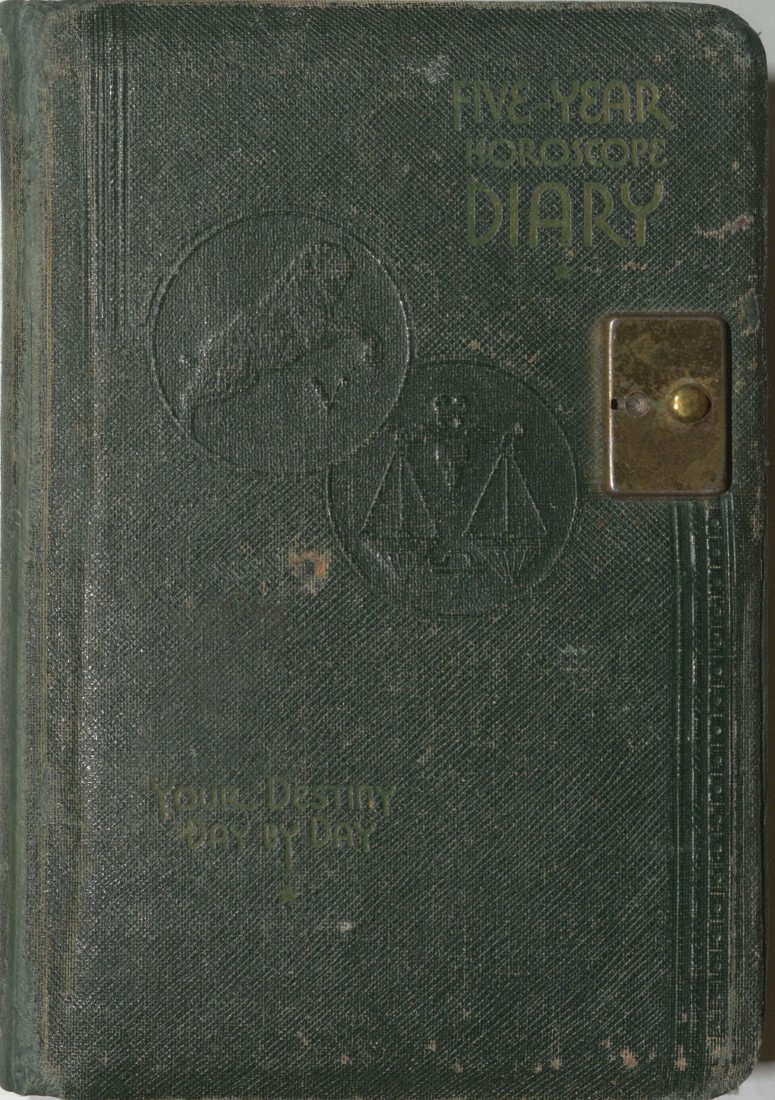
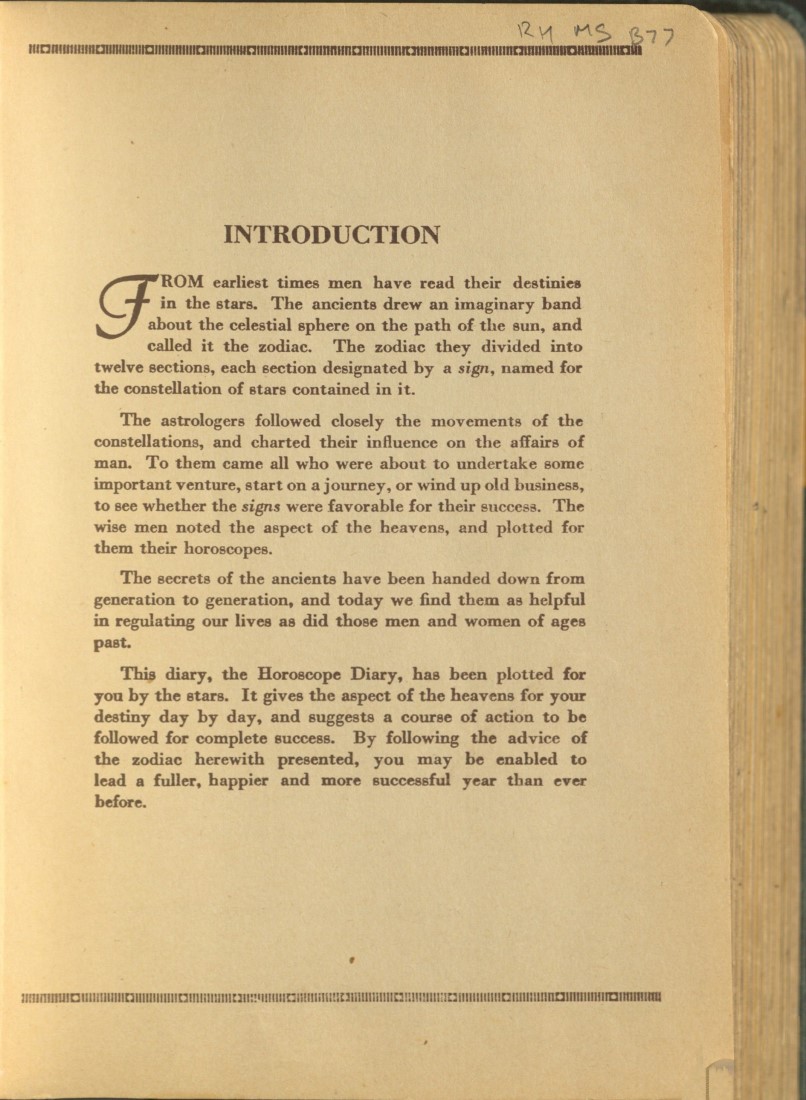
The diary Maude used is called Five-Year Horoscope Diary: Your Destiny Day by Day. It was written by Samuel Nisenson and published in 1936 by World Syndicate Publishing. Maude used her diary from 1943 to 1948, although there are some large gaps where she did not fill it out. There are also some pages where the years are written out of order.

Title in faded gold letters against a black background, with a key lock.
The front cover of Maude Egbert’s diary, Five-Year Horoscope Diary: Your Destiny Day by Day, 1943-1948. Call Number: RH MS B77. Click image to enlarge.
Black text against a tan background.
The introduction of Maude Egbert’s diary, 1943-1948. Call Number: RH MS B77. Click image to enlarge.
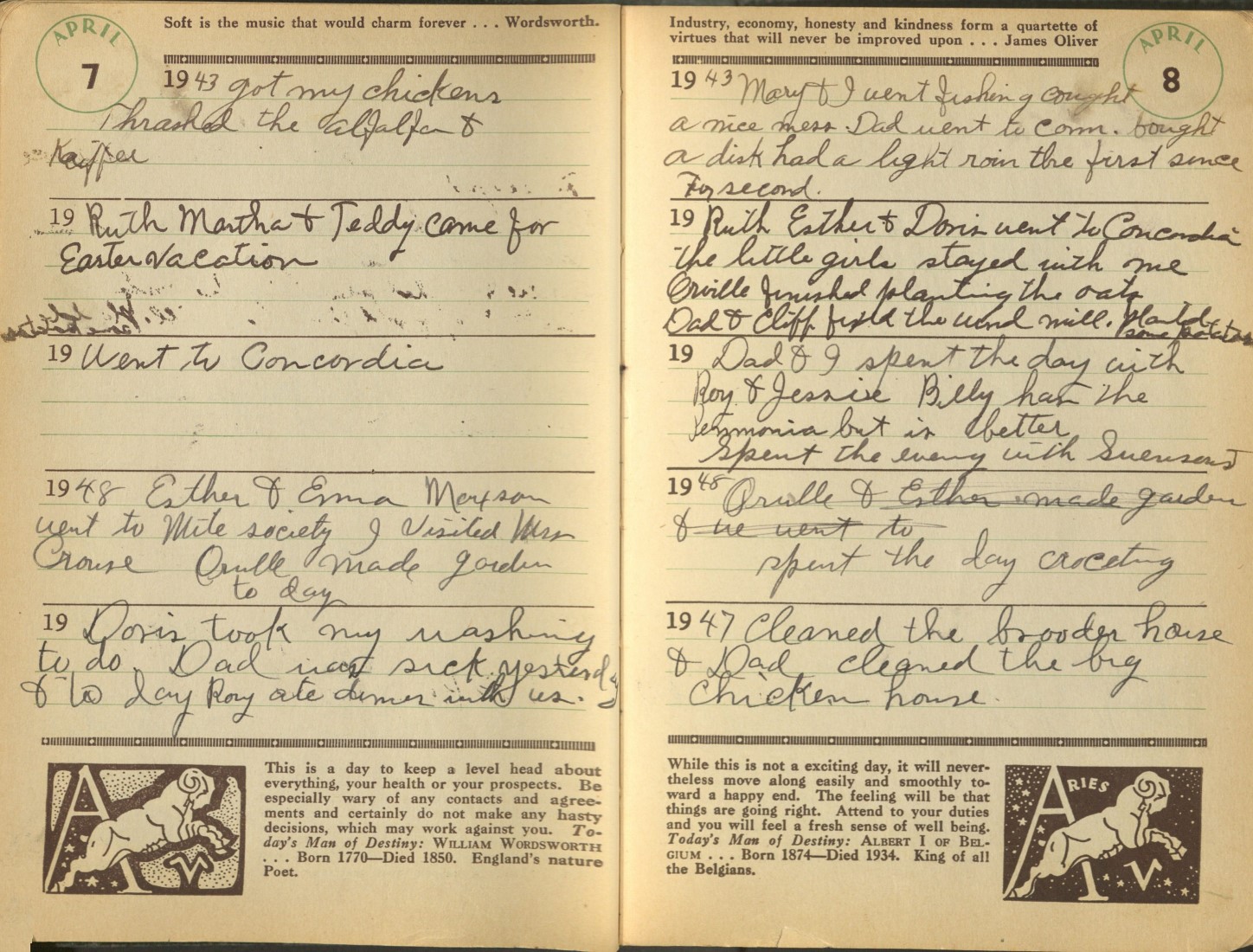
Two-page spread with rows of handwritten text on each. Typed quotations at the top and bottom of each page.
The pages for April 7th and 8th in Maude Egbert’s diary, 1943-1948. Call Number: RH MS B77. Click image to enlarge.

April 7, 1943 got my chickens
Thrashed the alfalfa & [kaiffer?]

19[44] Ruth Martha & Teddy [Maude’s daughter and granddaughters] came for
Easter vacation

19[45] Went to Concordia

1948 Esther & Emma [Mayson?]
Went to Mile Society I visited Mrs
Crouse Orville [Maude’s son] made garden
to day

19[47] Doris [Maude’s granddaughter] took my washing
to do Dad was sick yesterday
& to day Roy ate dinner with us

April 8, 1943 Mary [Maude’s granddaughter] & I went fishing cought
a nice mess. Dad went to [illegible]. bought
a disk had a light [rain?] the first since
[illegible] second

19[44] Ruth Esther & Doris [Maude’s daughter, daughter-in-law, and granddaughter] went to Concordia
the little girls stayed with me
Orville finished planting the oats
Dad and Cliff fixed the wind mill. Planted some potatoes

19[45] Dad and I spent the day with
Roy and Jessie Billy has the
Penmonia [pneumonia] but is better
Spent the evening with [illegible]

1948 Orville & Esther made garden
& we went to
spent the day croceting [crocheting]

1947 Cleaned the brooder house
& Dad cleaned the big
Chicken house

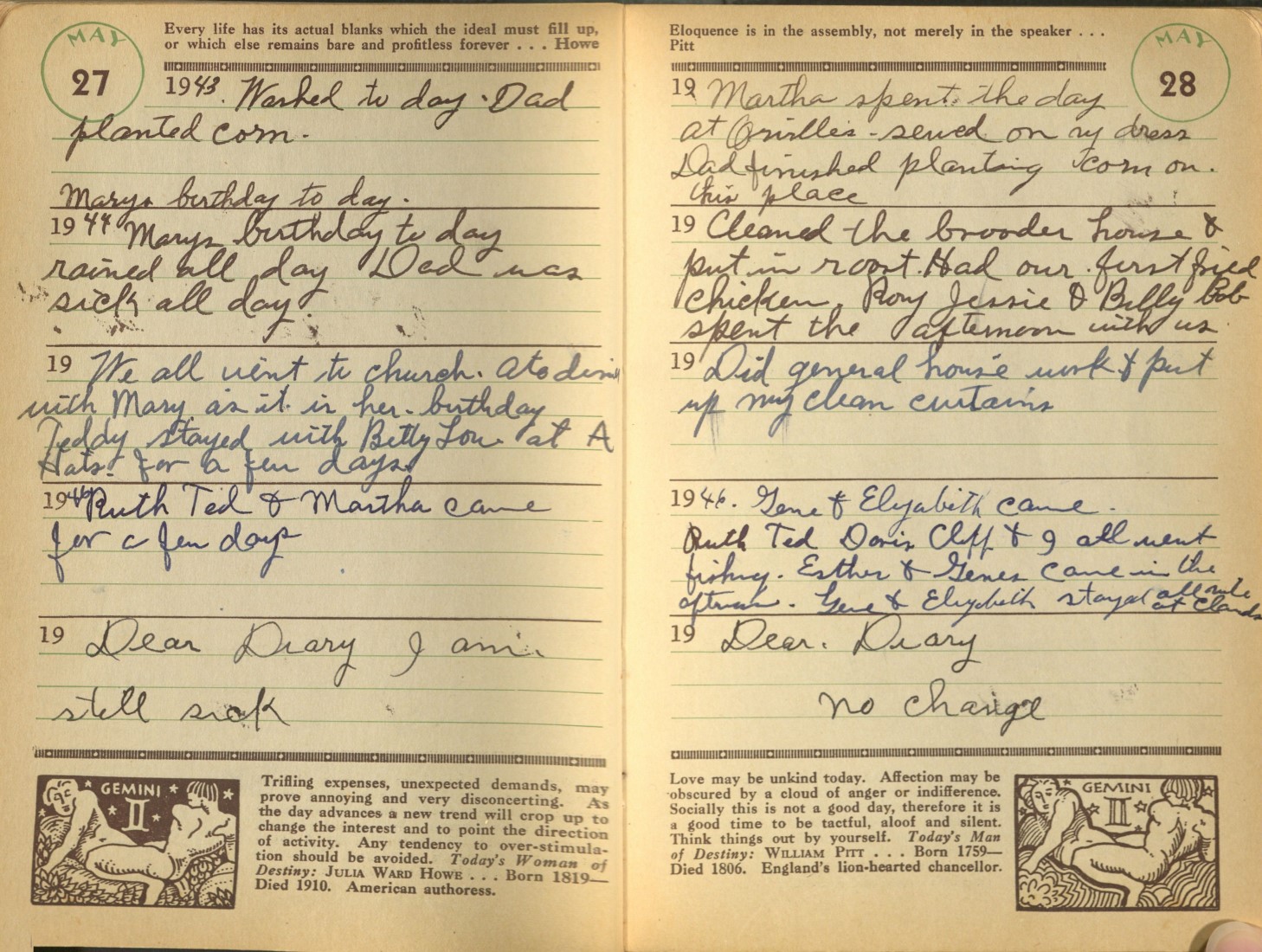
Two-page spread with rows of handwritten text on each. Typed quotations at the top and bottom of each page.
The pages for May 27th and 28th in Maude Egbert’s diary, 1943-1948. Call Number: RH MS B77. Click image to enlarge.

May 27, 1943 Washed to day. Dad
planted corn.
Marys [Maude’s granddaughter] birthday to day.

1944 Marys [Maude’s granddaughter] birthday to day
rained all day Dad was
sick all day

19[45] We all went to church. ate dinner
with Mary [Maude’s granddaughter] as it is her. birthday
Teddy [Maude’s granddaughter] stayed with Betty Lou at A
[Hats]. for a few days

1946 Ruth Ted & Martha [Maude’s daughter, son-in-law, and granddaughter] came
for a few days

19[47] Dear Diary I am
still sick

May 28, 19[43] Martha [Maude’s granddaughter] spent the day
at Orvilles [Maude’s son]. Sewed on my dress
Dad finished planting corn on.
this place

19[44] Cleaned the brooder house &
put in roost. Had our. first fried
chicken. Roy Jessie and Billy Bob
spent the afternoon with us.

19[45] Did general house work & put
up my clean curtains

1946. Gene and Elizabeth came.
Ruth Ted [Maude’s daughter and son-in-law] Doris [Maudes’ granddaughter] Cliff & I all went
fishing. Esther and Genes came in the
afternoon. Gene and Elizabeth stayed all [illegible] at [illegible]

19[47] Dear, Diary
no change

Tiffany McIntosh
Public Services