The University of Kansas

Inside Spencer: The KSRL Blog

Books on a shelf

Welcome to the Kenneth Spencer Research Library blog! As the special collections and archives library at the University of Kansas, Spencer is home to remarkable and diverse collections of rare and unique items. Explore the blog to learn about the work we do and the materials we collect.

Throwback Thursday: Assassination Commemoration Edition

April 5th, 2018

Each week we’ll be posting a photograph from University Archives that shows a scene from KU’s past. We’ve also scanned more than 34,800 images from KU’s University Archives and made them available online; be sure to check them out!

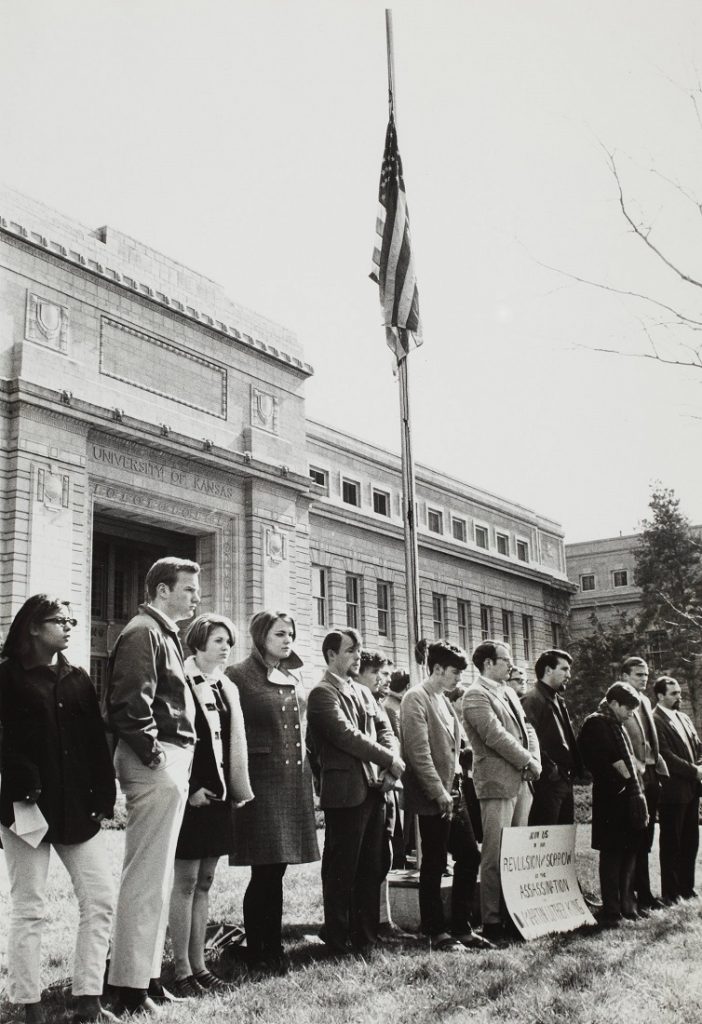
This week’s photograph commemorates the fiftieth anniversary of the assassination of Dr. Martin Luther King, Jr.

Photograph of a Martin Luther King, Jr. assassination demonstration, 1968

KU students in front of Strong Hall honoring Dr. Martin Luther King, Jr., April 5, 1968.
Lawrence Journal-World Photo Collection, University Archives Photos.
Call Number: RG LJW 71/18 1968-04-06: Student Activities:
Student Protests (Photos). Click image to enlarge (redirect to Spencer’s digital collections).

The sign the students are holding – more visible in other photos of the events that took place on campus and in Lawrence on April 5, 1968 – says “Join us in our revulsion and sorrow at the assassination of Dr. Martin Luther King.”

An article in the Lawrence Daily Journal-World described the events of the day.

About 700 persons, mainly Kansas University faculty members and students, this morning participated in ceremonies honoring Dr. Martin Luther King Jr., the nonviolent prophet of the civil rights movement who was slain Thursday in Memphis, Tenn.

The vigil in front of KU’s Strong Hall began at 9:10 this morning as seven KU students lowered to half-staff the flag in front of the university administration building. They held a sign which said “Join us in our revulsion and sorrow at the assassination of Dr. Martin Luther King.”

By 10 a.m., there were 22 persons standing in front of the lowered flag. The group swelled to 61 by 11:15 a.m., and to about 100 persons by 11:20 a.m. Then, as classes changed, hundreds of persons approached the area to participate in a previously-announced memorial service sponsored by the KU Religious Advisors.

The final attendance estimate was made by Rev. Tom Rehorn of the Methodist Wesley Foundation.

Nicholas Gerren, Wilberforce, Ohio, junior at KU, read a eulogy, which said in part: “My black brother is dead. His only sin was a desire for peace, his only wrong was a love for the black man. Here in America, the land of the free press, the land of free speech, he took a stand, fought, spoke, and died for what he believed.”

The 15-minute ceremony ended at 11:45 this morning as Rev. Rehorn announced there would be a silent march in Dr. King’s honor. The march which began at Strong Hall ended in South Park. Leading several hundred persons en route down Mass. St. were two KU students who carried a sign which said “Martin Luther King –1929-1968.”

Earlier this morning, a group of KU students set up a booth in the main lobby of the Kansas Union, where they urged passers-by to send telegrams urging passage of civil rights legislation to their congressmen. The booth was placed in front of a large sign which said “Let’s Make This Tragedy Work for Peace – Help Pass the Bill.”

Tom Miller, Paola senior at KU, said he and Ned Valentine, Clay Center senior, organized the “telegram movement” Thursday night. He said they telephoned friends at various colleges around the nation, asking students to send telegrams to congressmen using passage of civil rights legislation bottled up in a House committee.

Students for [Democrat Eugene] McCarthy and Students for [Democrat Robert F.] Kennedy [in the 1968 election] both are helping with the “telegram movement,” Miller said.

While Miller and others were busy in the Union, a group of 36 Negro students were marching down Jayhawk Boulevard singing “We Shall Overcome.” The students, some wearing black armbands, gathered in front of Strong Hall for silent prayer at about 9:20 a.m. The brief ceremony ended at 9:30 a.m.

Caitlin Donnelly
Head of Public Services

World War I Letters of Forrest W. Bassett: April 2-8, 1918

April 2nd, 2018

In honor of the centennial of World War I, we’re going to follow the experiences of one American soldier: nineteen-year-old Forrest W. Bassett, whose letters are held in Spencer’s Kansas Collection. Each Monday we’ll post a new entry, which will feature selected letters from Forrest to thirteen-year-old Ava Marie Shaw from that following week, one hundred years after he wrote them.

Forrest W. Bassett was born in Beloit, Wisconsin, on December 21, 1897 to Daniel F. and Ida V. Bassett. On July 20, 1917 he was sworn into military service at Jefferson Barracks near St. Louis, Missouri. Soon after, he was transferred to Fort Leavenworth, Kansas, for training as a radio operator in Company A of the U. S. Signal Corps’ 6th Field Battalion.

Ava Marie Shaw was born in Chicago, Illinois, on October 12, 1903 to Robert and Esther Shaw. Both of Marie’s parents – and her three older siblings – were born in Wisconsin. By 1910 the family was living in Woodstock, Illinois, northwest of Chicago. By 1917 they were in Beloit.

Frequently mentioned in the letters are Forrest’s older half-sister Blanche Treadway (born 1883), who had married Arthur Poquette in 1904, and Marie’s older sister Ethel (born 1896).

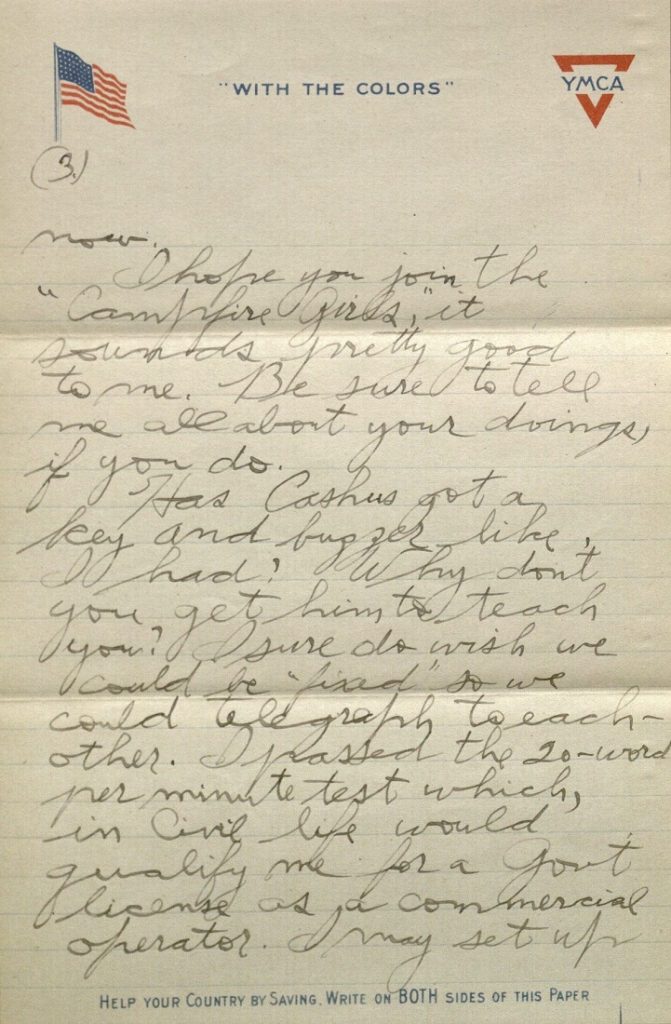
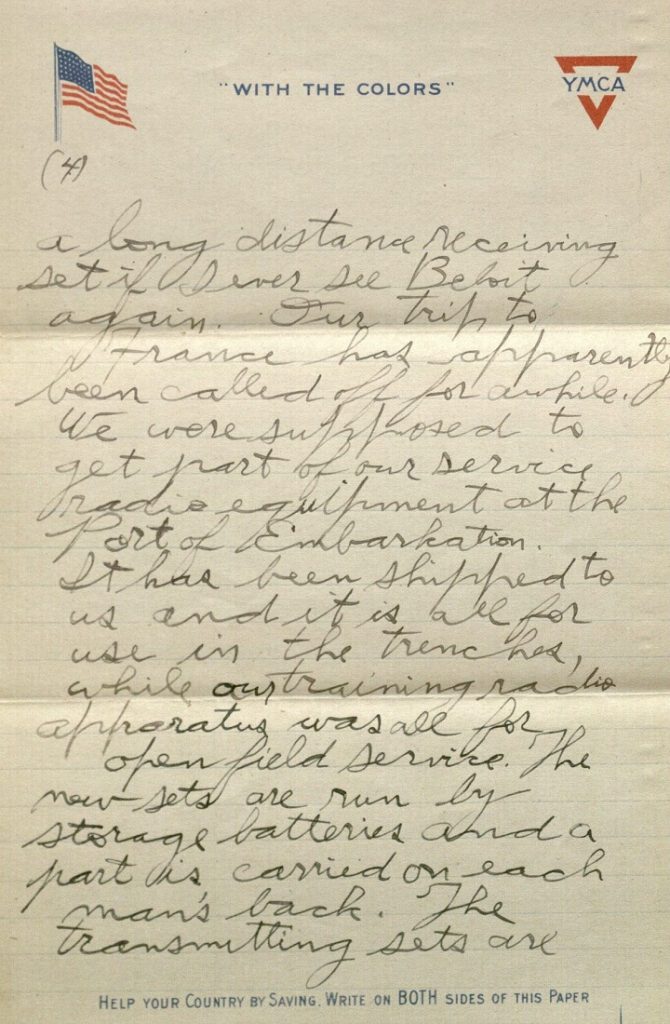
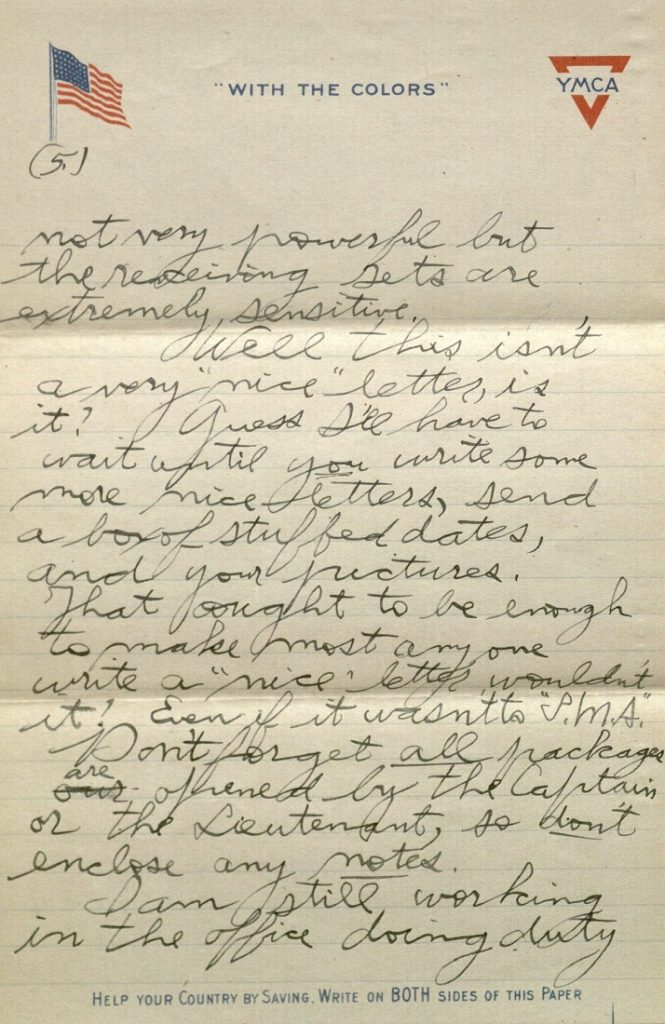
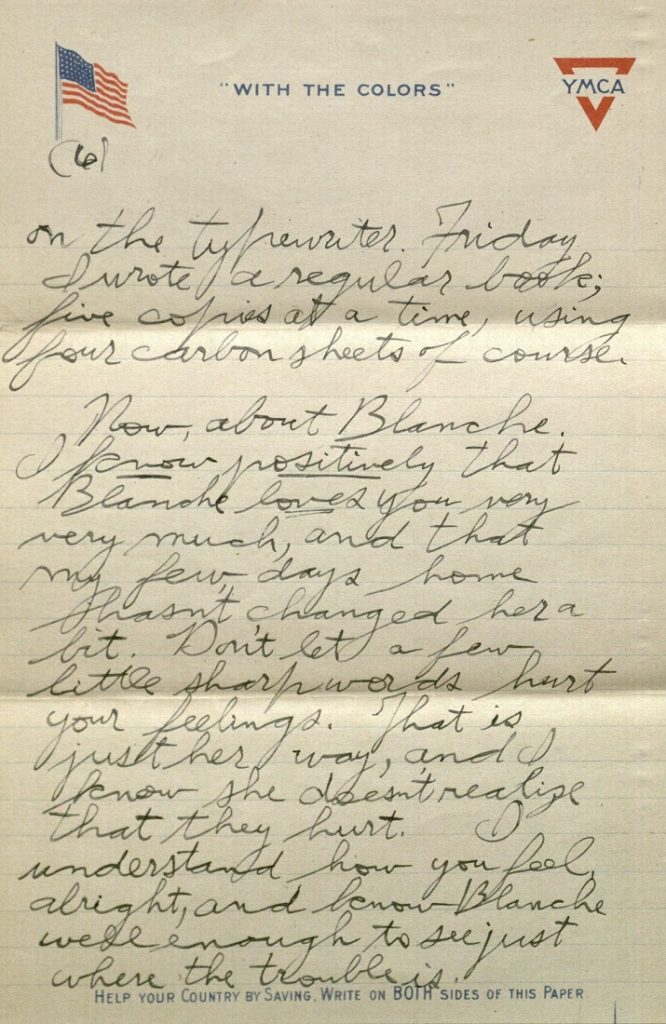
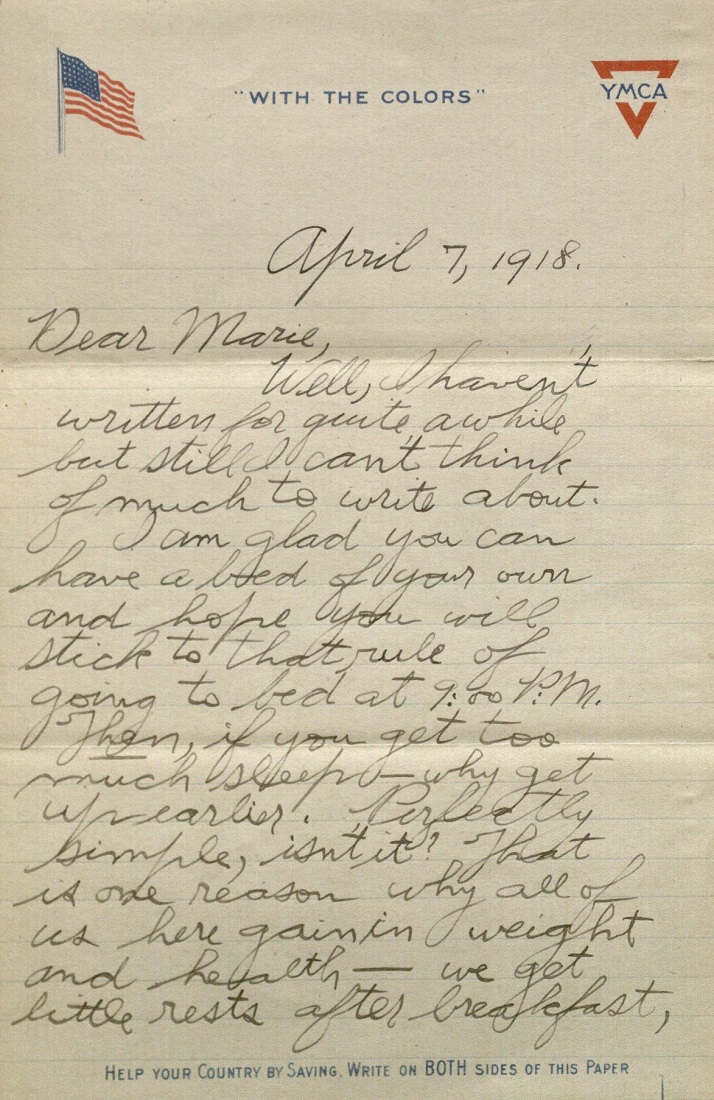
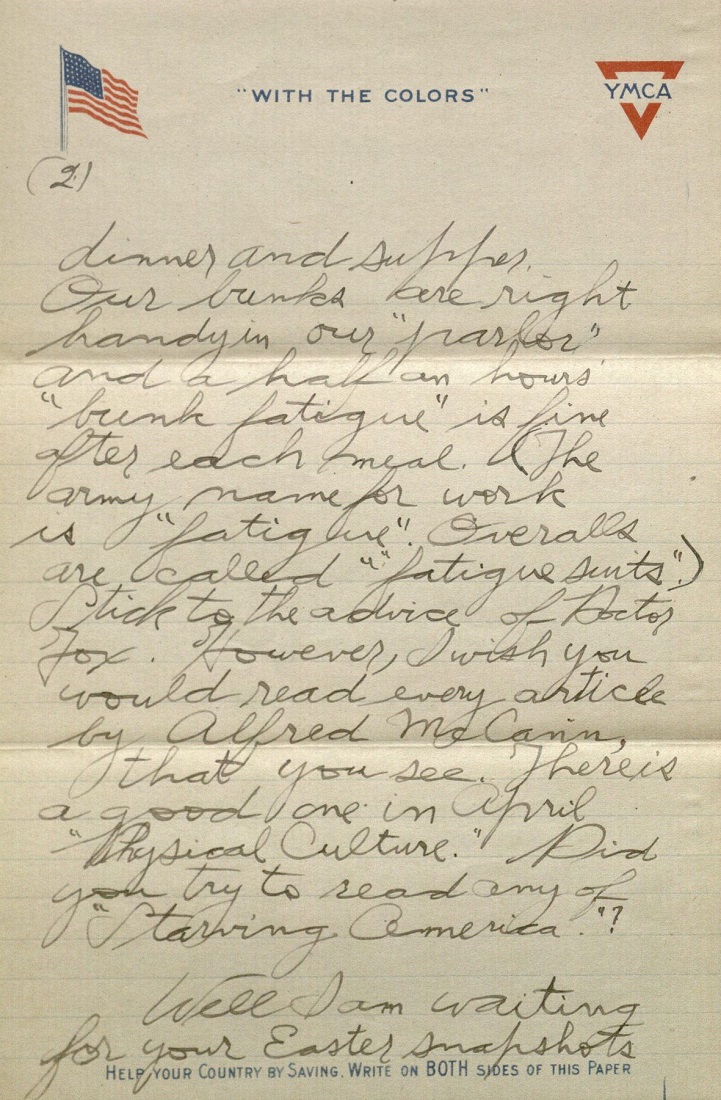
Highlights from this week’s letters include Forrest arguing for the importance of sleep to good health (“that is one reason why all of us here gain in weight and health”), discussing new service radio equipment (“it is all for use in the trenches, while our training radio apparatus was all for open field service”), and advising Marie about his sister Blanche (“don’t let a few little sharp words hurt your feelings”).
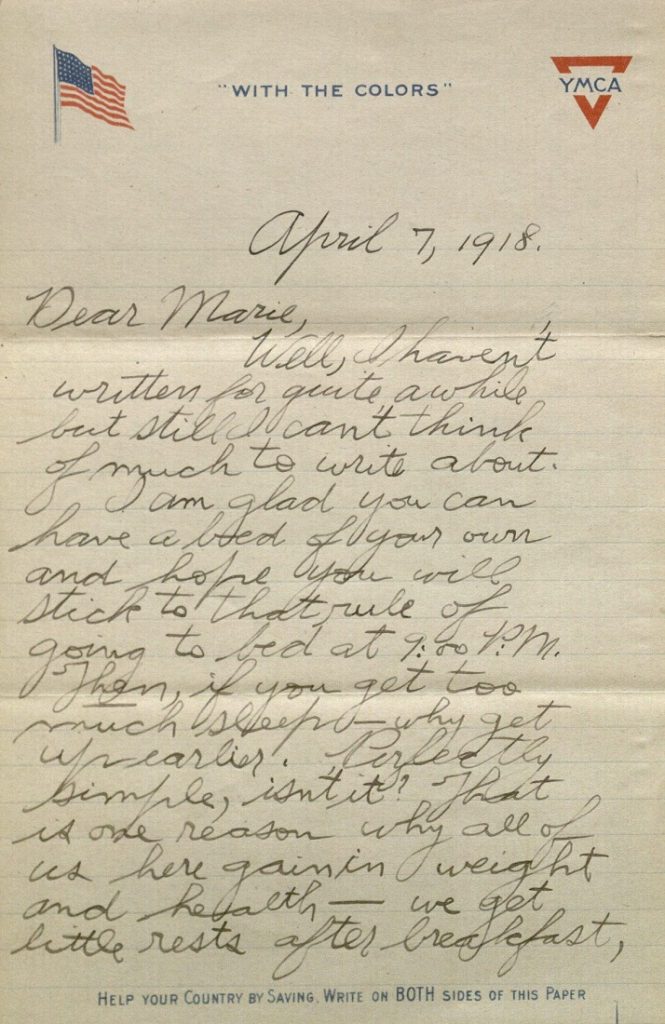
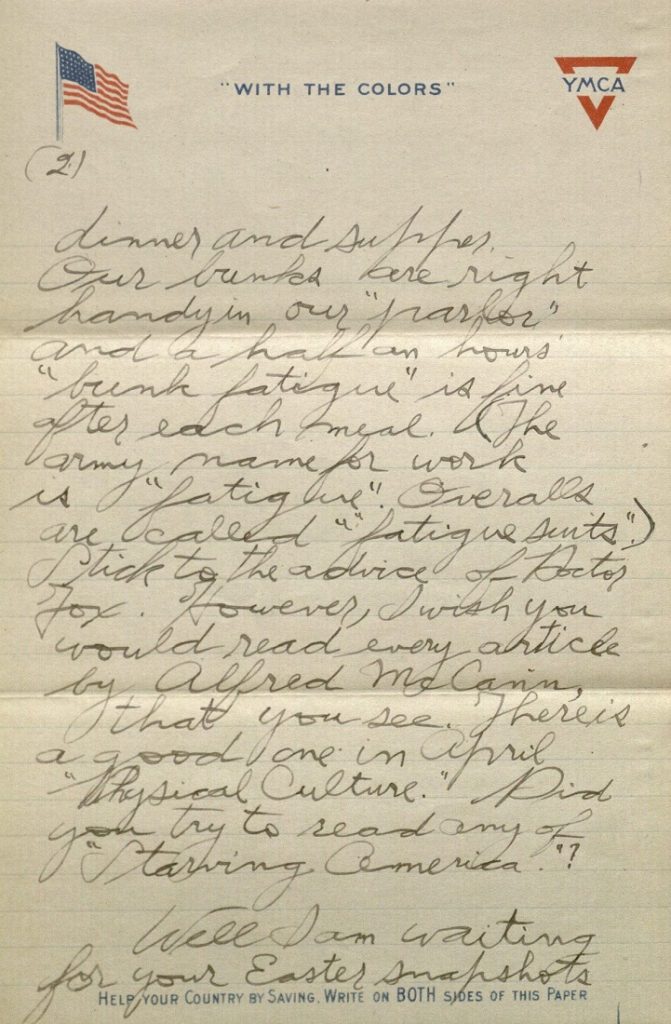
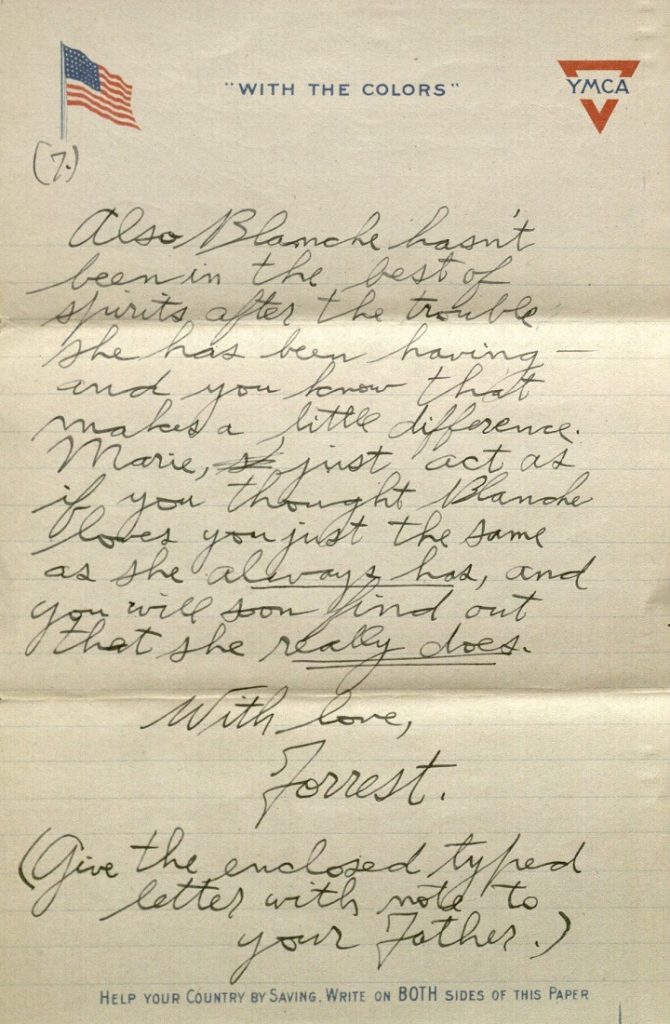
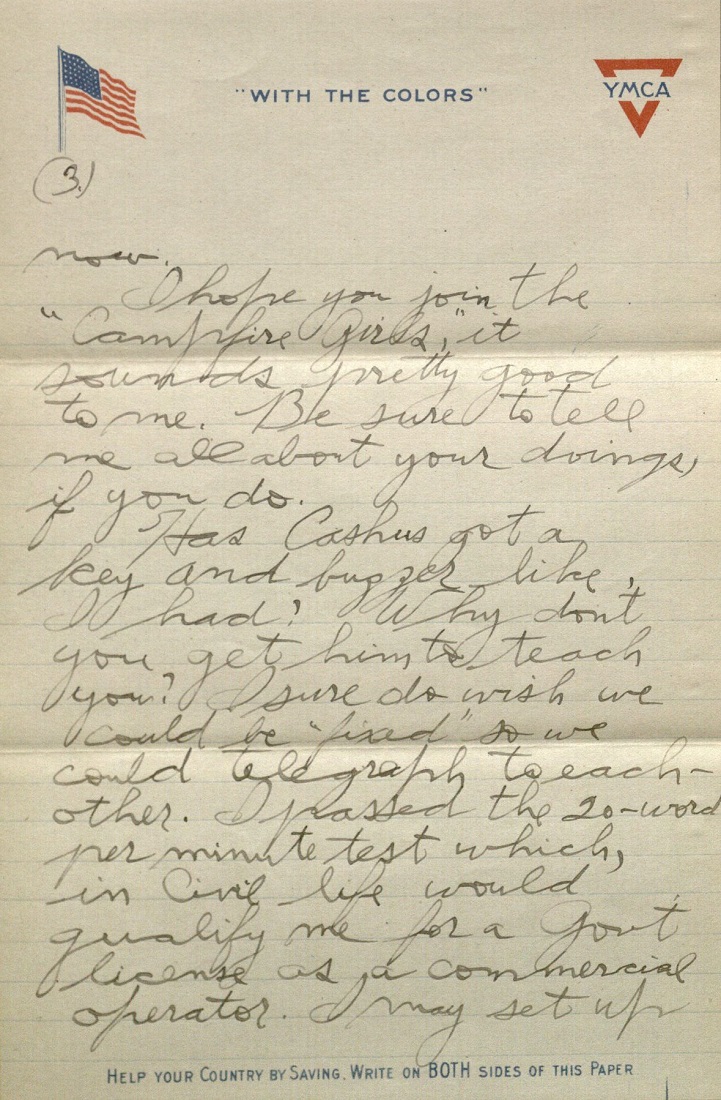
Image of Forrest W. Bassett's letter to Ava Marie Shaw, April 7, 1918 Image of Forrest W. Bassett's letter to Ava Marie Shaw, April 7, 1918

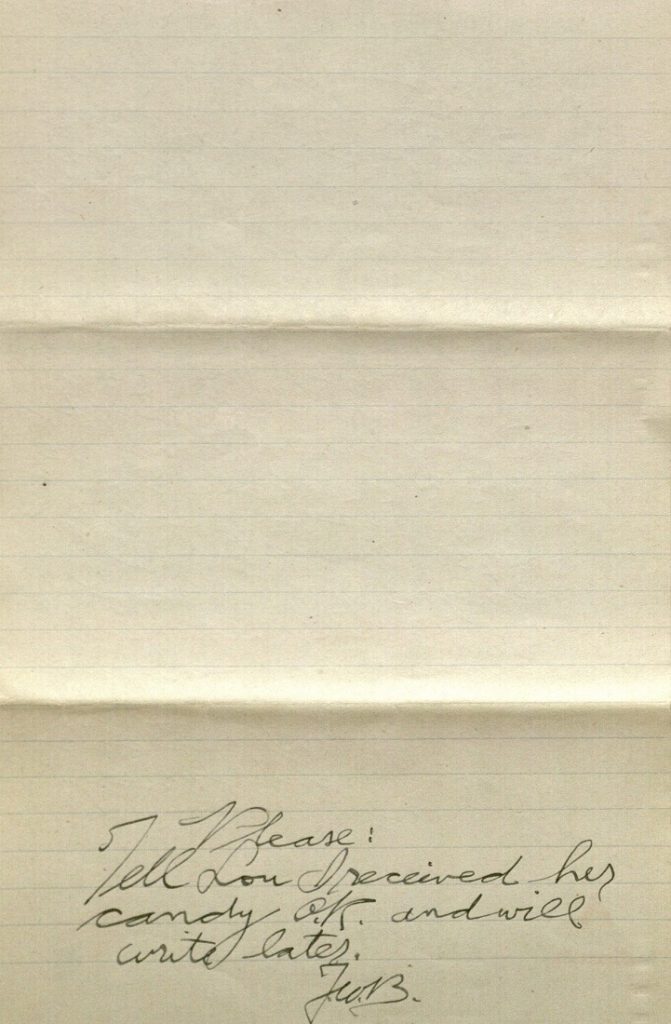
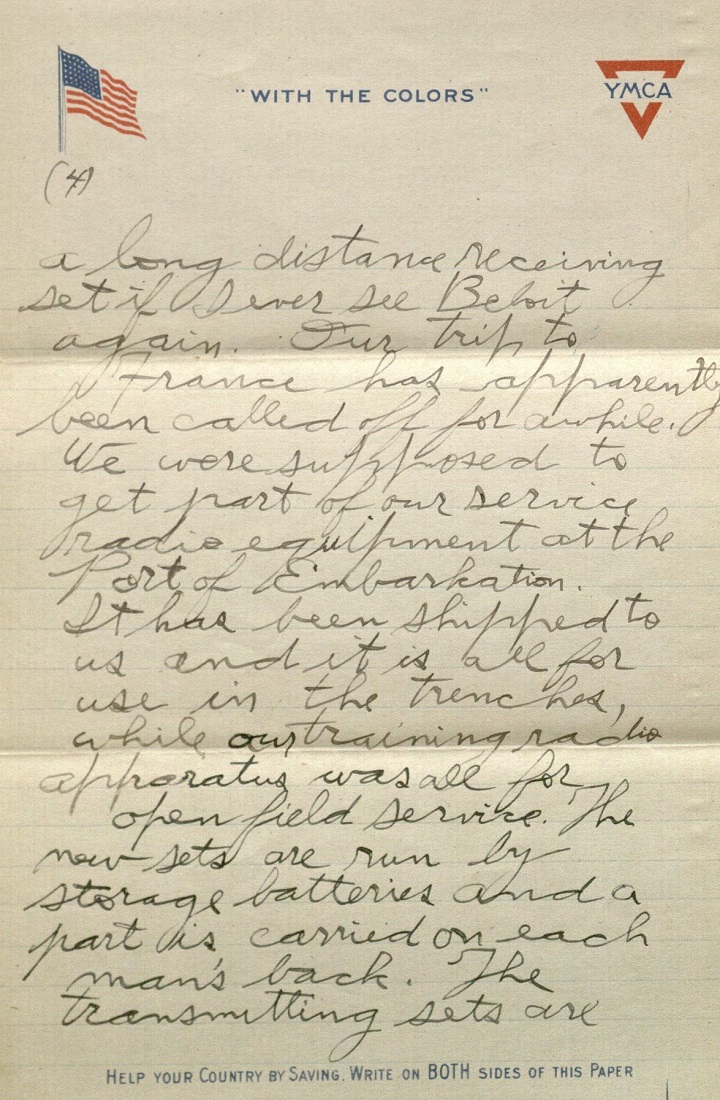
Image of Forrest W. Bassett's letter to Ava Marie Shaw, April 7, 1918 Image of Forrest W. Bassett's letter to Ava Marie Shaw, April 7, 1918

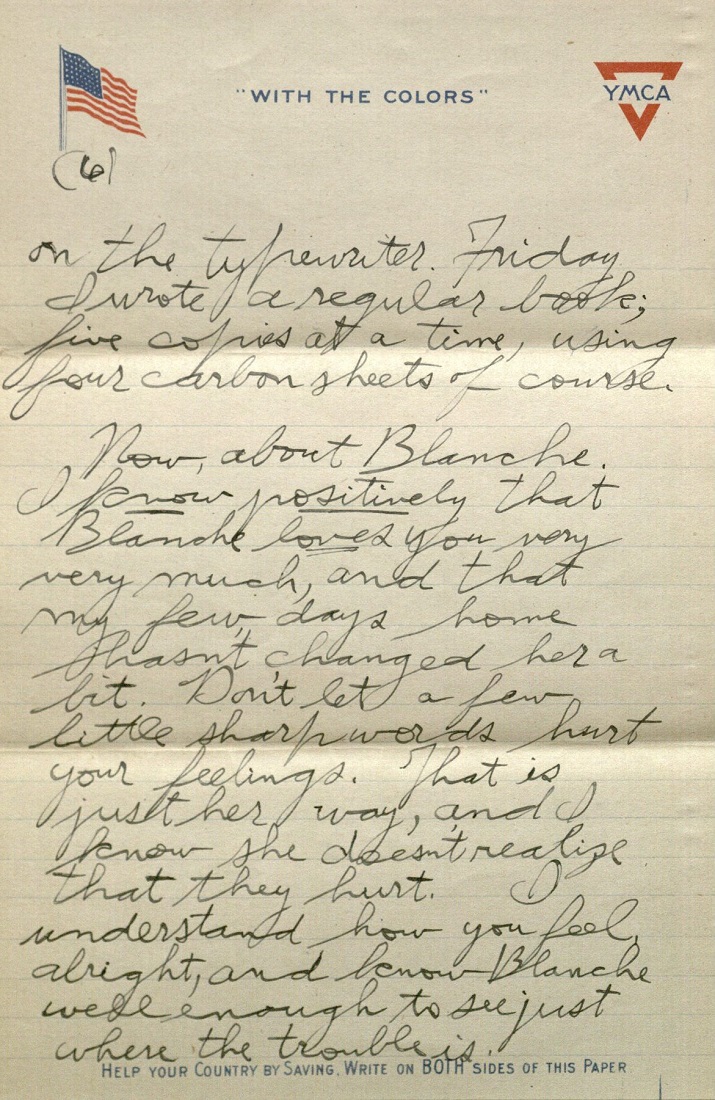
Image of Forrest W. Bassett's letter to Ava Marie Shaw, April 7, 1918 Image of Forrest W. Bassett's letter to Ava Marie Shaw, April 7, 1918

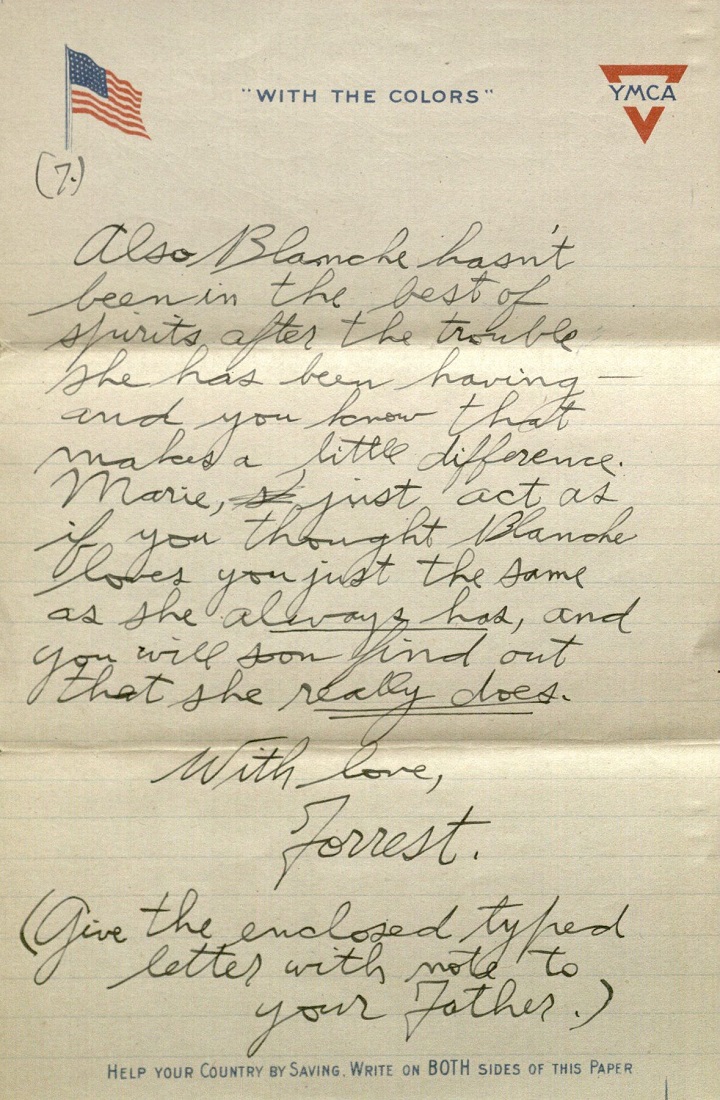
Image of Forrest W. Bassett's letter to Ava Marie Shaw, April 7, 1918 Image of Forrest W. Bassett's letter to Ava Marie Shaw, April 7, 1918

Click images to enlarge.

April 7, 1918.

Dear Marie,

Well, I haven’t written for quite awhile but still I can’t think of much to write about.

I am glad you can have a bed of your own and hope you will stick to that rule of going to bed at 9:00 P:M. Then, if you get too much sleep – why get up earlier. Perfectly simple, isn’t it? That is one reason why all of us here gain in weight and health – we get little rests after breakfast, dinner and supper. Our bunks are right handy in our “parlor” and a half an hours “bunk fatigue” is fine after each meal. (The army name for work is “fatigue.” Overalls are called “fatigue suits.”) Stick to the advice of Doctor Fox. However, I wish you would read every article by Alfred McCann, that you see. There is a good one in April “Physical Culture.” Did you try to read any of “Starving America”?

Well I am waiting for your Easter snapshots now.

I hope you join the “Campfire Girls,” it sounds pretty good to me. Be sure to tell me all about your doings, if you do.

Has Cashus got a key and buzzer like I had? Why don’t you get him to teach you? I sure do wish we could be “fixed” so we could telegraph to eachother. I passed the 20-word per minute test which, in civil life would qualify me for a Gov’t license as a commercial operator. I may set up a long distance receiving set if I ever see Beloit again. Our trip to France has apparently been called off for awhile. We were supposed to get part of our service radio equipment at the Port of Embarkation. It has been shipped to us and it is all for use in the trenches, while our training radio apparatus was all for open field service. The new sets are run by storage batteries and a part is carried on each man’s back. The transmitting sets are not very powerful but the receiving sets are extremely sensitive.

Well this isn’t a very “nice” letter, is it? Guess I’ll have to wait until you write some more nice letters, send a box of stuffed dates, and your pictures. That ought to be enough to make most anyone write a “nice” letter wouldn’t it? Even if it wasn’t to “S.M.A.” Don’t forget all packages are opened by the Captain or the Lieutenant, so don’t enclose any notes.

I am still working in the office doing duty on the typewriter. Friday I wrote a regular book; five copies at a time, using four carbon sheets of course.

Now, about Blanche [Forrest’s older half-sister]. I know positively that Blanche loves you very much, and that my few days home hasn’t changed her a bit. Don’t let a few little sharp words hurt your feelings. That is just her way, and I know she doesn’t realize that they hurt. I understand how you feel, alright, and know Blanche well enough to see just where the trouble is.

Also Blanche hasn’t been in the best of spirits after the trouble she has been having – and you know that makes a little difference. Marie, just act as if you thought Blanche loves you just the same as she always has, and you will soon find out that she really does.

With love,
Forrest.

(Give the enclosed typed letter with note to your Father.)

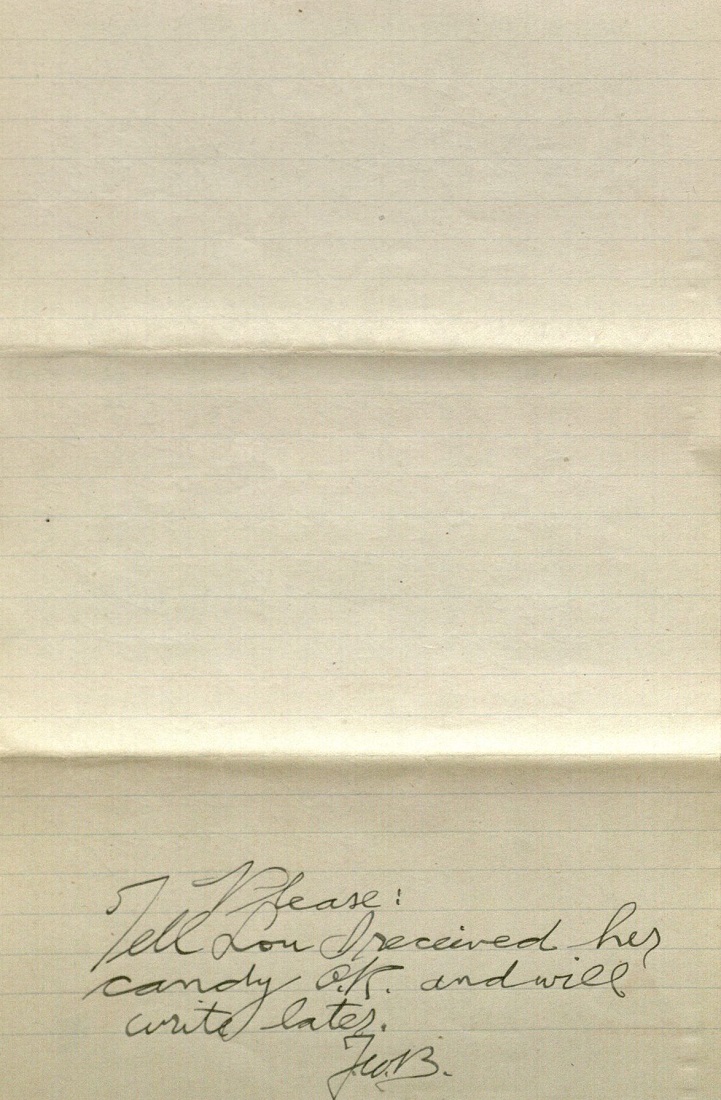
Please: Tell Lou I received her candy O.K. and will write later.  FWB.

Meredith Huff
Public Services

Emma Piazza
Public Services Student Assistant

On the Research Trail: Blue Books

March 30th, 2018

The diversity of the Spencer Research Library collections is explored through the description of a search process related to a research question or theme.

After having two encounters with items called “blue books” in as many days, I wondered what the origin of the term blue book is. I turned to a resource found in the Reference section of the Spencer Reading Room, i.e., the Webster’s New International Dictionary of the English Language. According to this edition published in 1959, a blue book is defined as follows:

  1. In England, a parliamentary publication, so called from its blue paper covers; in some other countries, any similar official publication. Hence, also, an authoritative report or manual issued by a department, organization, or party.
  2. Colloq., U.S. a A register or directory of persons of social prominence. b In certain colleges, a blue-covered booklet used for writing examinations.
  3. [caps.] Trade-mark for a guidebook entitled Official Automobile Blue Book, showing roads, routes, etc., esp. for automobile tourists; also [sometimes not caps.], the guidebook itself. U.S.

Would it be possible to find an example of each type of blue book described in the dictionary definition by looking solely in the collections available at the Spencer Library? I wanted to find out.

I started with a search online at the KU Libraries website. First, I clicked on the Advanced Search button below the Quick Search box because I wanted to limit my search to the Spencer Research Library.

Screenshot of the Primo search box on the KU Libraries homepage

Click image to enlarge.

I typed in “blue book” (without quotation marks) in the first box to find items that contain those keywords. Next, I selected Library from the dropdown menu and typed in “Spencer” (without quotation marks) in the next box to limit the search to items showing Spencer Research Library as the location.

Screenshot of Primo advanced search page

Click image to enlarge.

This led to 2,476 results. In a quick scan of my first few pages of search results, I did not immediately find irrelevant items, i.e., those that might contain the word blue and the word book somewhere in the catalog record but not together. (Note: selecting is exact from the dropdown menu instead of contains has the same effect as using quotation marks around the words blue book. The system searches for both words together as a phrase, bringing the search results down to 2,370 results.)

Definition 1: Official Publications and Authoritative Reports

As I scanned through my search results, I looked for items that might be examples of official or authoritative publications. Several of the items in the list were from the Little Blue Book series published by the Haldeman-Julius Press from 1919 to 1951.

Image of the cover of a Little Blue Book, "How to Find What You Want in a Library," 1929

Cover of How to Find What You Want in a Library
by Lloyd E. Smith, 1929. Call Number: RH H-J 1473 Little.
You can learn more about Little Blue Books in
Spencer’s North Gallery exhibit. Click image to enlarge.

I decided to filter my search results to remove all or most of the Little Blue Books in order to identify more easily other types of blue books in the list. On the left side of KU Libraries’ page, next to the search results, I found the Narrow My Results heading. As shown in the screenshots below, I clicked on More options under Author/Creator. Then, I selected to “Exclude” the Haldeman-Julius Company and some of the authors who contributed to the Little Blue Book series. After I clicked on Continue, my search results were reduced to 159 items.

Screenshot of the "Author/Creator" option on the KU Libraries advanced search page Screenshot of the "Exclude" function on the KU Libraries advanced search page

Click images to enlarge.

The example shown below is an additional authoritative or official blue book selected from my search results.

Image of the cover of Woman Suffrage: History, Arguments, and Results, 1917 Image of the title page of Woman Suffrage: History, Arguments, and Results, 1917

Cover (left) and title page (right) of “The Blue Book”; Woman Suffrage, History,
Arguments and Results
, 1917. Call Number: Howey B2835. Click images to enlarge.

In an attempt to find a British parliamentary blue book, I went back to the top of the search results page and added the word parliament to my search terms.

Screenshot of Primo advanced search page

Click image to enlarge.

This resulted in four search results including The Parliamentary Register, an eighteenth-century history of the proceedings and debates of the House of Commons and the House of Lords, shown below.

Image of the cover of the Parliamentary Register, 1779 Image of pages of the Parliamentary Register, 1779

Although it has faded, the cover of The Parliamentary Register (1779) is blue.
The KU Libraries catalog record explains that the volumes are “as issued,” i.e., “unopened,
in printed blue paper wrappers.” See in the image above how the pages
have not been cut open at the top. Call Number: Bond C291.

Definition 2a: Directory of Persons of Social Prominence

Having found examples of blue books from the 18th and 20th centuries, I hoped to find a social register from the 19th century. I went back to my list of 159 search results and narrowed my results again, this time by date. I typed in a date range of 1800 to 1899.

Screenshot of the date filter option on the KU Libraries advanced search page

Click image to enlarge.

I found the blue book shown below which was published in 1898.

Image of the cover of The Society Blue Book of Kansas City, Mo., 1898Image of the title page of The Society Blue Book of Kansas City, Mo., 1898

The Society Blue Book of Kansas City, Mo., 1898. Call Number: RH B30. Click image to enlarge.

Definition 2b: Booklet for Exams

I determined that a good place to look for an example of a blue book used for a college exam would be in a collection of unpublished, personal papers. I started my search online using the search interface for finding aids on the Spencer website. I typed “blue book” (with quotation marks to search for both words together as a phrase) into the Search for field. I retrieved nineteen results.

Screenshot of the Spencer Research Library finding aid search page

Click image to enlarge.

The third item in the results list seemed to be the type of blue book I was hoping to find.

Screenshot of a result on the Spencer Research Library finding aid search page

Click image to enlarge.

I clicked on this item and viewed the finding aid which further confirmed that the blue book was from course work in 1937 and identified in which box and folder I would find it.

Screenshot of a portion of the finding aid for the Cowell family papers

Click image to enlarge.

The exam blue book is shown below.

Image of the cover of a blue book from the Ellen Cowell School Papers, 1937

Cover of Pauline Rawlings’s blue examination book, 1937.
Ellen Cowell School Papers. Call Number: RH MS 1337.
Click image to enlarge.

Definition 3: Automobile Guide

Going back to the KU Libraries’ search results list of 159 items, I was able to locate a fascinating example of an automobile blue book, The Official Automobile Blue Book 1923, shown below.

Image of the title page of the Official Automobile Blue Book, Volume 4, 1923

Title page of the Official Automobile Blue Book, Volume 4, 1923.
At the time, not all roads were paved or marked.
Getting from one city to another sometimes meant paying close attention
to the mileage from one turn or fork in the road to the next.
Call Number: C11263. Click image to enlarge.

My search process was a success! In the Spencer Research Library collections, I was able to locate examples of each type of blue book that is described in the dictionary definition. Often, research leads to more questions. I found myself wondering about the choice of blue paper for the covers of the British parliamentary publications. Why blue? Sounds like a great topic for a new search and another blog post!

Stacey Wiens
Reference Specialist
Public Services

Throwback Thursday: Final Four Edition

March 29th, 2018

Each week we’ll be posting a photograph from University Archives that shows a scene from KU’s past. We’ve also scanned more than 34,800 images from KU’s University Archives and made them available online; be sure to check them out!

We’re super excited about Saturday’s game against Villanova. Rock Chalk!

Photograph of KU basketball fans holding a sign, 1988

KU basketball fans during the NCAA tournament, 1988.
The sign reads “Hawks soar cats hit the floor KU is in the final four.”
University Archives Photos. Call Number: RG 71/66/13 1988-04 Negatives:
Student Activities: Sports: Basketball (Photos).
Click image to enlarge (redirect to Spencer’s digital collections).

As many fans likely remember, KU defeated Kansas State in the Midwest regional final of the 1988 NCAA tournament. The Jayhawks then beat Duke in the Final Four and won the championship with a win over Oklahoma.

Caitlin Donnelly
Head of Public Services

Throwback Thursday: Hooray for Spring Edition

March 22nd, 2018

Each week we’ll be posting a photograph from University Archives that shows a scene from KU’s past. We’ve also scanned more than 34,800 images from KU’s University Archives and made them available online; be sure to check them out!

Photograph of the May Day Fete, 1921

A participant in the May Day Fete, 1921.
Photo by the KU News Bureau. University Archives Photos.
Call Number: RG 71/10 1921 Prints: Student Activities: May Day (Photos).
Click image to enlarge (redirect to Spencer’s digital collections).

First held in 1908, the KU May (or May Day) Fête was a spring festival that included maypoles, music, dances, and games. It replaced the more violent KU tradition of the May Day Scrap. The last mention of the May Fête occurred in the Kansan student newspaper on May 23, 1923.

Caitlin Donnelly
Head of Public Services