The University of Kansas

Inside Spencer: The KSRL Blog

Books on a shelf

Welcome to the Kenneth Spencer Research Library blog! As the special collections and archives library at the University of Kansas, Spencer is home to remarkable and diverse collections of rare and unique items. Explore the blog to learn about the work we do and the materials we collect.

Collection Snapsot: A Presidential Pardon

February 21st, 2013

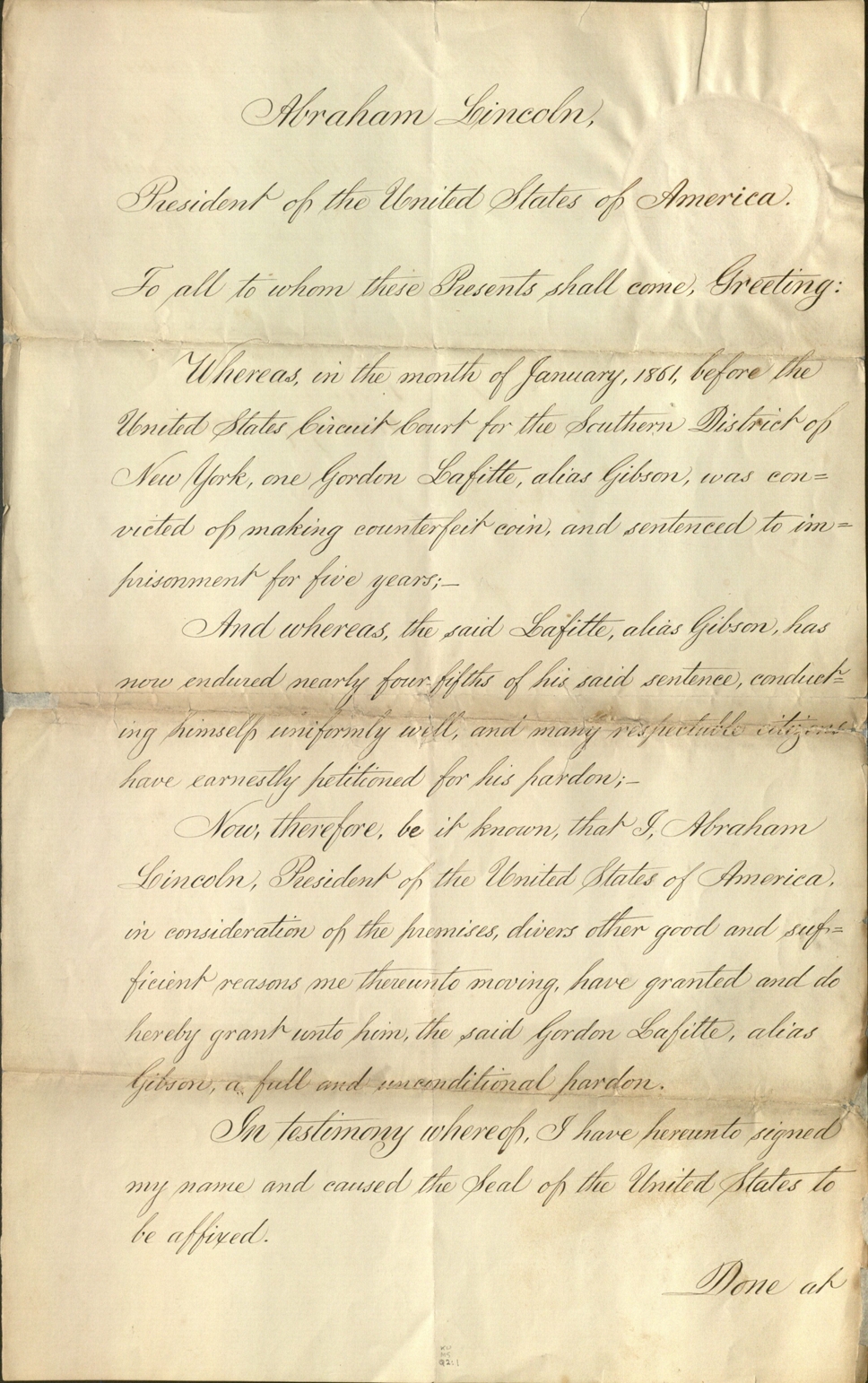
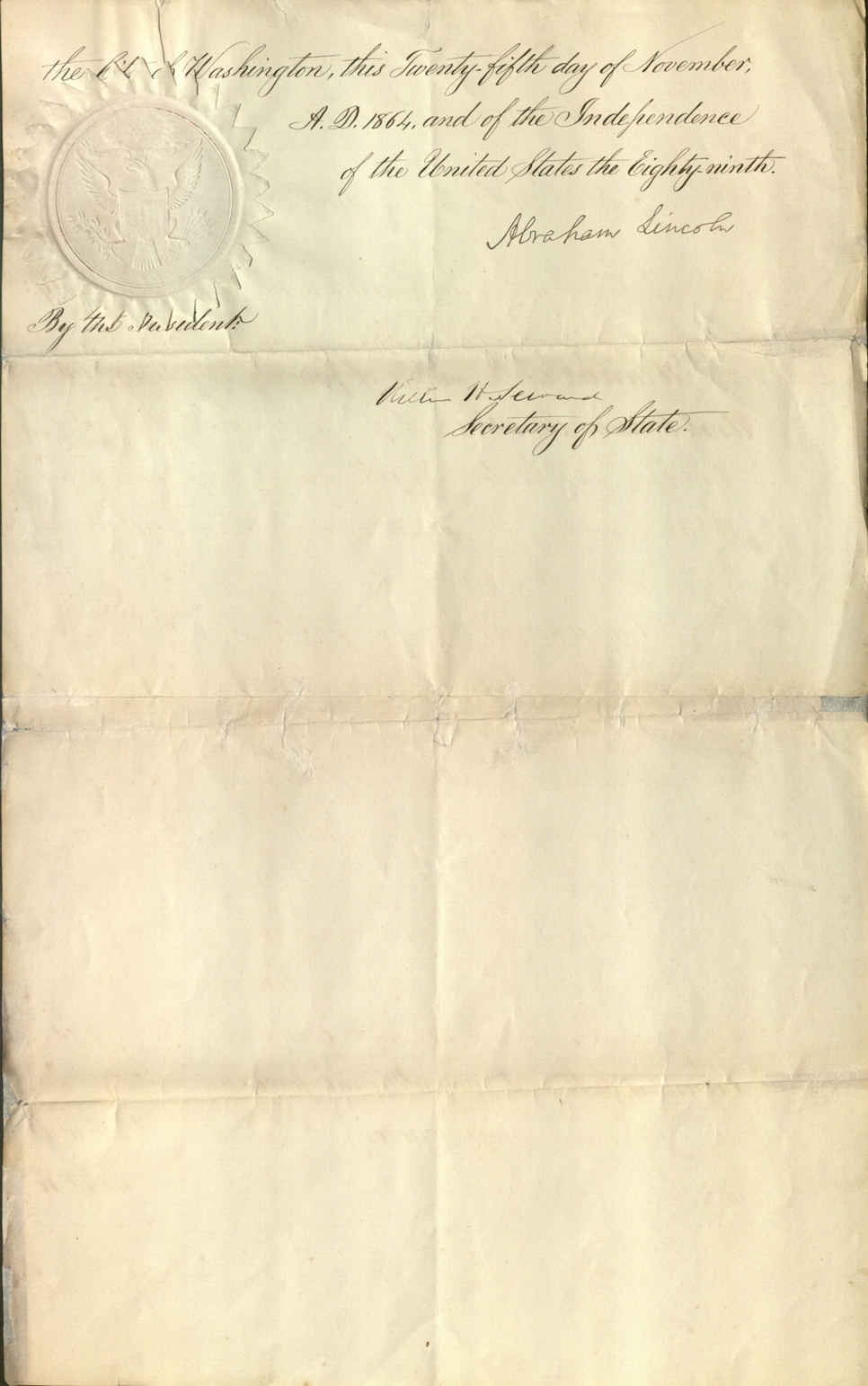
In honor of Presidents’ Day (and the upcoming Academy Awards with a certain Lincoln movie in the lead with twelve nominations), we highlight this Presidential pardon signed by Abraham Lincoln on November 25, 1864.

He pardoned one Gordon Lafitte, alias Gibson, for “making counterfeit coin.” Mr. Lafitte had served 4/5ths of his 5 year sentence and was pardoned for good behavior while behind bars.

Photograph of Lincoln Pardon of Gordon Lafitte (p. 1)  Photograph of Lincoln Pardon of Gordon Lafitte (p. 2)

Pardon for Gordon Lafitte. Signed by Abraham Lincoln and William H. Seward. November 25, 1864.
Call number: MS Q2:1. Click images to enlarge.

Whitney Baker
Head, Conservation Services

Crispy Critters

February 8th, 2013

Pliny the Elder, that most famous and trustworthy of the ancient Roman naturalists, was too curious about natural phenomena for his own good; as every school-child knows, he was asphyxiated by volcanic dust and gasses when he went to investigate the same eruption of Vesuvius that destroyed Pompeii in 79 A.D.

Aristotle and Pliny are the names that come to mind when we think of naturalists of the ancient world.  Aristotle was the originator of biological classification; in contrast to the Biblical groups of animals as “clean” or “unclean,” he established categories based primarily on anatomical and other observable characteristics. His was a coherent natural system. The Spencer Library has several editions of Aristotle’s Historia Animalium, the earliest printed in 1493.

The only surviving work of Pliny is the encylopedic Naturalis Historia, the earliest extant manuscript of which dates from the 10th century.** His work was a compilation of all the animals and plants that he knew of or had heard about, and contained little that was original. He was not yet a systematist and there was little order in his arrangement, but we have him to thank for the survival of some of the writings of others, and he is regarded as THE authority on natural history from the days of Imperial Rome through the Middle Ages.

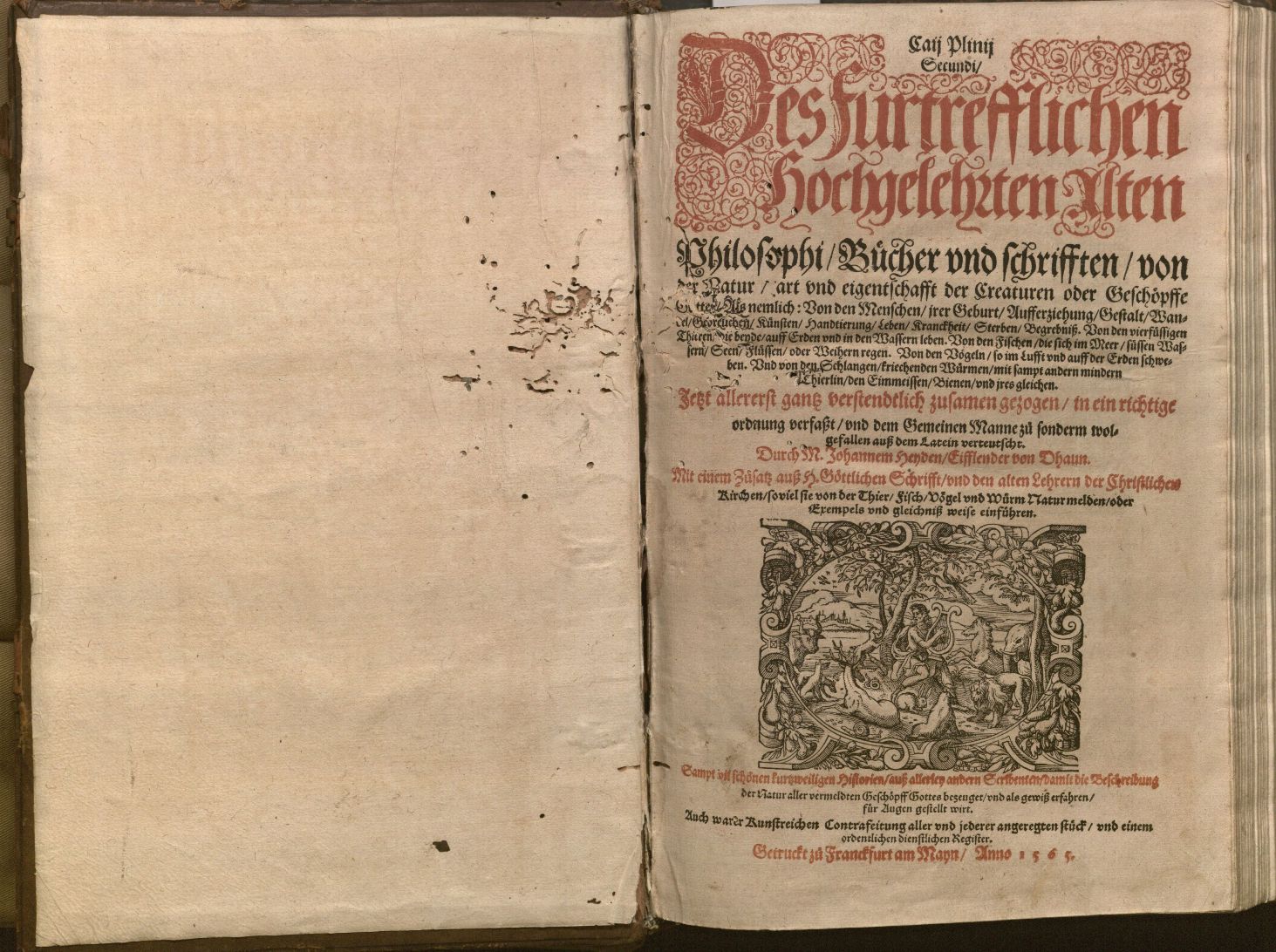
Image of title page for Bücher und Schrifften von der Natur (1565)

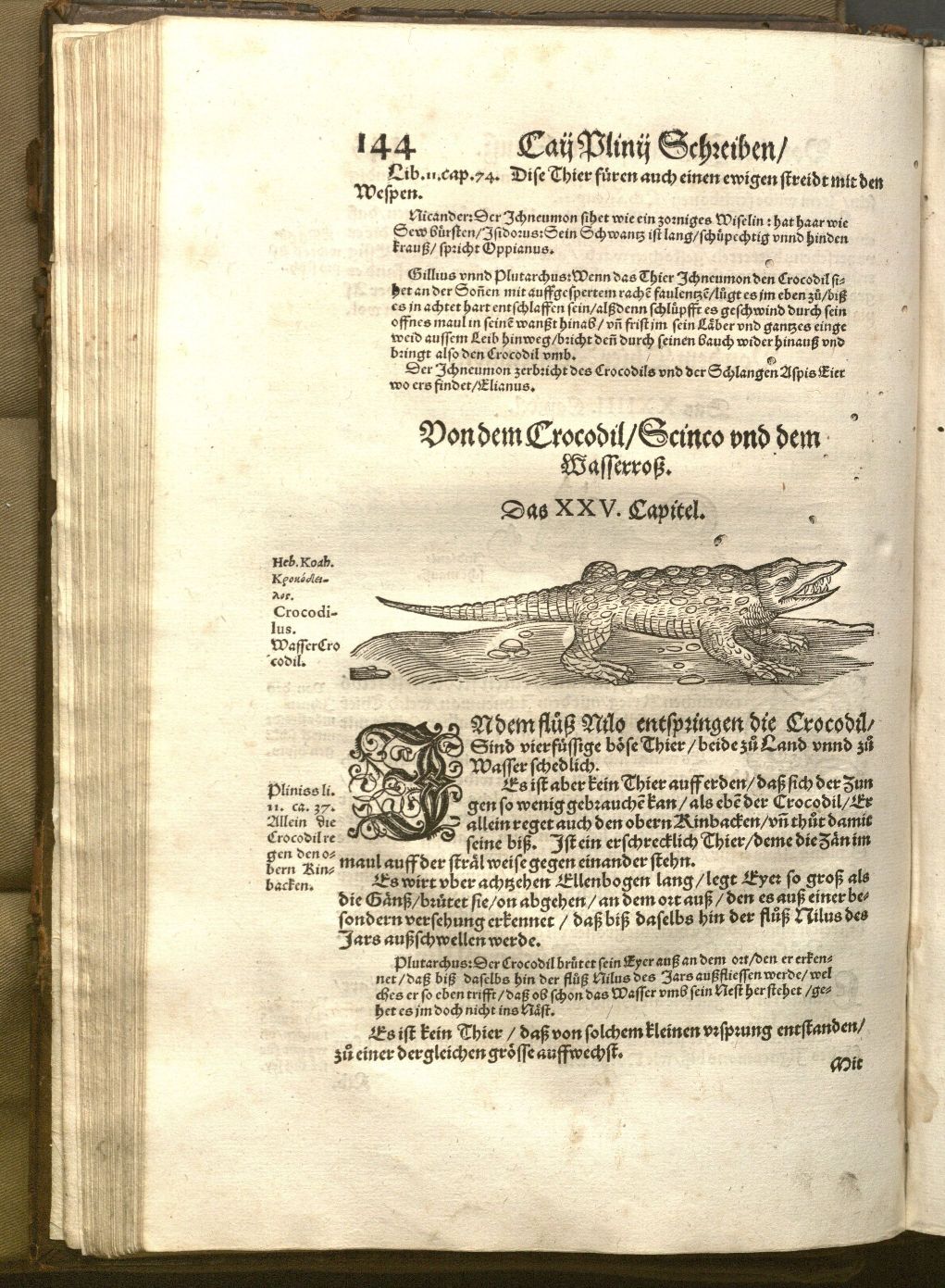
Photograph of page 144 from Bücher und Schrifften von der Natur, featuring a section on crocodiles

Pliny, the Elder. Caji Plinii Secundi … Bücher und Schrifften von der Natur, Art und Eigenschafft der Creaturen oder Geschöpfe Gottes … [Naturalis historia. German.] Franckfurt am Mayn : Feyrabend und Hüter, 1565. Call Number: Summerfield E1059. Click images to enlarge.

Beginning with the earliest printing of Pliny in 1469, there were at least 42 printings in numerous languages, including English, before 1536. The Kenneth Spencer Research Library houses 21 separate editions produced between 1476 and 1685. This German version contains books 7-10 and part of book 11. The translation was made by J. Heyden Eifflender von Dhaun and is illustrated with woodcuts by Jost Amman and Virgil Solis.

Sally Haines
Rare Books Cataloger
Adapted from her Spencer Research Library exhibit and catalog, Slithy Toves: Illustrated Classic Herpetological Books at the University of Kansas in Pictures and Conservations

**Author’s Note: This is the information we had at the time of publication of Slithy Toves in 2000; Mr. Roger Pearse has recently pointed out that in fact there do exist fragments of 5th century codices of Pliny.

Deconstructed Book

January 4th, 2013

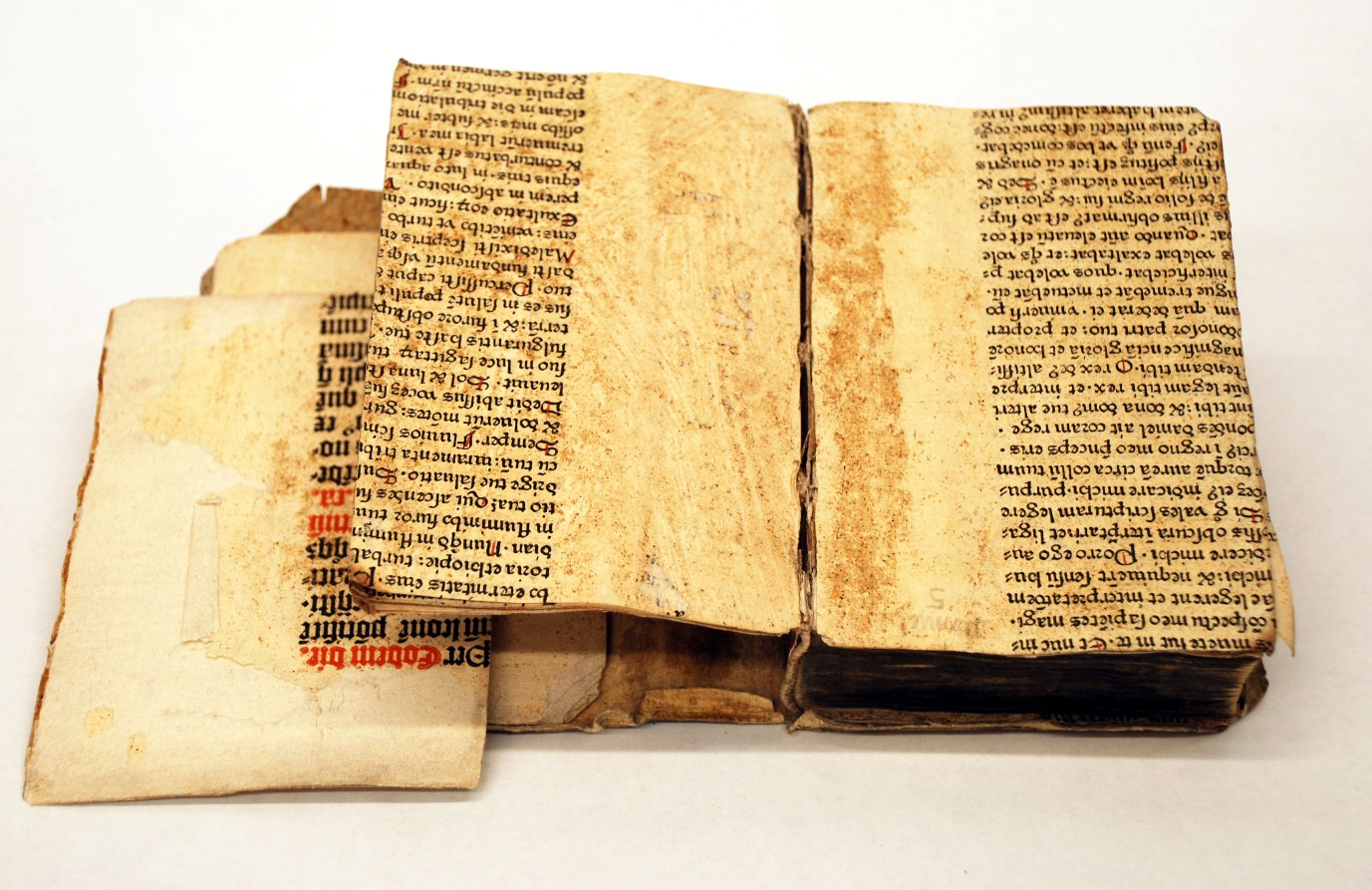
Sometimes deterioration can be a useful tool for discovering how a book was made. This example, in poor condition, allows us to see how the book’s boards were constructed. Rather than one piece of wood or paperboard, the boards are made from layers of stiff paper glued together with starch paste. Each board is comprised of twelve layers of “printer’s waste,” or discarded pages from other books available for use by the bookbinder. The printed pages used were printed in both black and red ink, probably dating from a 15th century bible.

Image of MS B38: open to see insides Photograph of MS B38: (later) title page for manuscript

Photograph of MS B38: open to show layers of board

Andreas Fabricius. Chemnicensis. [Germany?, 1549?]. [Bound with printed work: Joachim Camerius, 1500-1574 . Capita pietatis et religionis Christianae versibus Graecis comprehensa ad institutionem puerilem […], Lipsiae: V. Papa, 1547]. Call number: MS B38. Left: binding open to see the book’s insides; Right: title page for the manuscript; Bottom: book open to show the layers of board.  Click images to enlarge.

The tooled pigskin cover is detached, allowing us to see how the book was sewn on three pairs of linen cords. The cord ends were frayed out and glued to the outside of the “boards.” Linen cords were used as a core to sew on decorative endbands at the head and tail (top and bottom) of the spine.

Photograph of MS B38: tooled pigskin binding Photograph of MS 38: detail of frayed cords

Left: the book’s tooled pigskin cover; Right: detail of frayed cords.  Click images to enlarge.

The text of this book is a combination of printed and manuscript pages. The subject appears to be a handbook of logic, grammar, and rhetoric. It is a true composite object!

Click on the thumbnails below for additional  images:

Photograph of MS B38: detail of paper for board Photograph of MS B38: close-up open to see the spine

Whitney Baker
Head, Conservation Services

Note: For more detailed information regarding the contents of this volume, please see entry M115 in A Checklist of Medieval Manuscripts in the Department of Special Collections at the Kenneth Spencer Research Library (Revised edition, 1996), which is available in the library’s reading room.

St. Petersburg High…

December 27th, 2012

The only image of St. Petersburg more plentiful in western books about 19th century Russia than the bronze horseman, is the ice hill, or “flying mountain,” a peculiarly Russian entertainment that may have something to do with the fact that Petersburgers are flatlanders. Paris, Rome, Athens, and Lawrence have their high points, hogbacks, and hills, but at no point on the delta on which Peter built his city is there a spot over thirty feet above sea-level. Of all the ailments that have plagued that city – typhoid fever, typhus, cholera, giardia, influenza, malaria, diphtheria, syphilis, smallpox, and the common cold – altitude sickness has not been one of them, and actually the hill provides some relief from high barometric pressure if not from a queasy stomach.

Image of title page and frontispiece of Scenes in Russia [...], 1814 (Call number: Children A933)

Scenes in Russia; Describing the Manners, Customs, Diversions, Modes of traveling, &c. of the Inhabitants of that Country. London: printed for J. And E. Wallis, 1814. Call Number: Children 5310  (click image to enlarge).

Image of Scenes in Russia Frontispiece

This contraption seems to be a combination of ski-jump and roller coaster: each person climbs into a small 4-wheeled shallow sided box at the top of a platform and careens downhill on a track. Sometimes ridges (moguls?) are added to increase velocity coming down enough to send them up the other side. When the River Neva is frozen the flying mountains are erected on the ice.

Adapted from the Spencer Research Library exhibit, Frosted Windows: 300 Years of St. Petersburg Through Western Eyes.

Sally Haines
Rare Books Cataloger

Lastest Finding Aids and Additions to Finding Aids

December 20th, 2012

Trying to decide what you would like to do over the winter holidays?  Why not get a head start on your research?  Here is a list of the newest finding aids and additions to finding aids available at the Kenneth Spencer Research Library.  Please scroll down for images from three of these collections.

Image of "Free the KU Twelve" buttons

Image of Letter from Jennie Johnson to Will Johnson, January 26, 1886  Image of Letter from Ernest Boyd to Kenneth Reddin, October 14, 1936.

Top: “Free the KU Twelve” buttons. Gail J. Hamilton Collection. Call Number: PP 497: Box 1, Folder 26; Left: Letter from Jennie Johnson to Will Johnson, January 26, 1886. Jennie Johnson Collection. Call Number: RH MS P909: Folder 1; Right: Letter from Ernest Boyd to Kenneth Reddin, October, 14, 1936. Kenneth Reddin Collection. Call Number: MS 14: Box 3, Item C1. Click images to enlarge.