The University of Kansas

Inside Spencer: The KSRL Blog

Books on a shelf

Welcome to the Kenneth Spencer Research Library blog! As the special collections and archives library at the University of Kansas, Spencer is home to remarkable and diverse collections of rare and unique items. Explore the blog to learn about the work we do and the materials we collect.

Bloomsday 2013: Buck Mulligan / Oliver Gogarty Edition

June 16th, 2013

Each June 16th, fans of James Joyce’s Ulysses celebrate “Bloomsday” in commemoration of the day on which the novel is set.  The annual fête (often marked by marathon readings) takes its name from the modernist classic’s central character, Leopold Bloom.

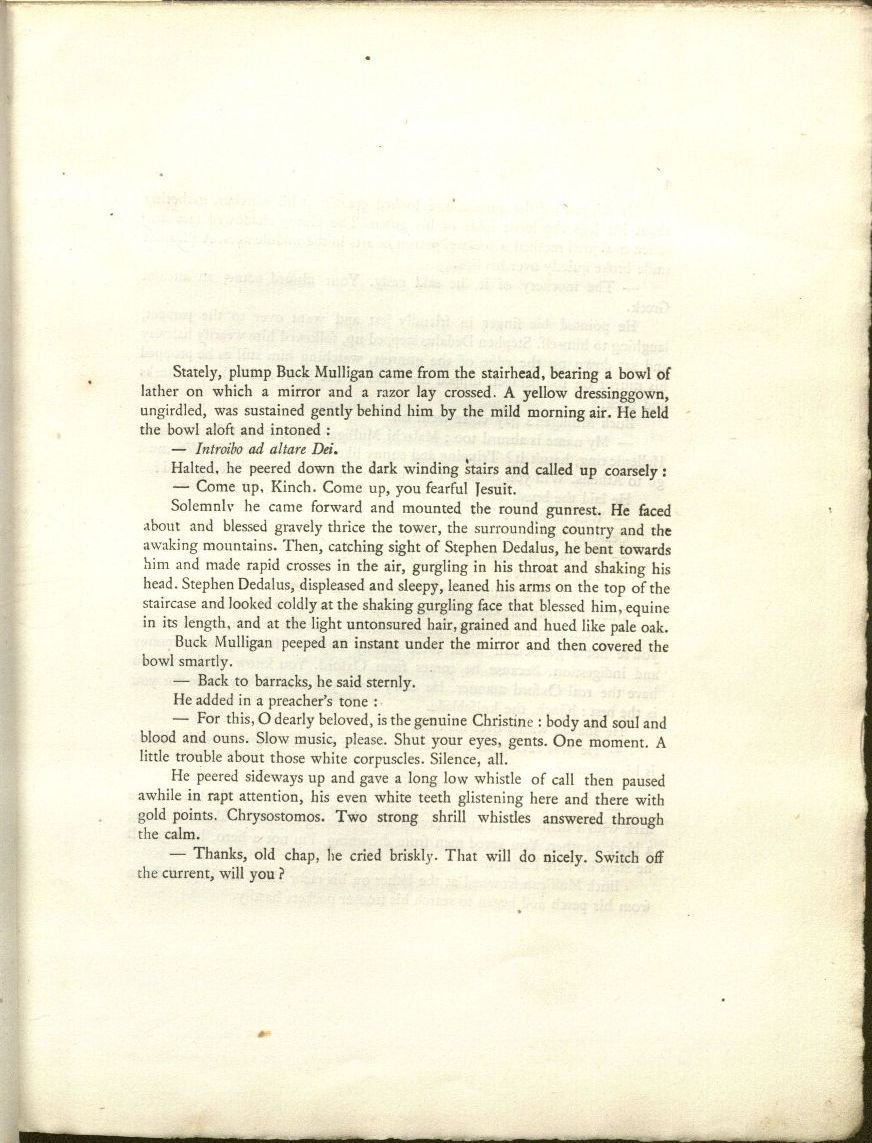
Though the novel belongs primarily to Bloom, Stephen Dedalus, or (in the last episode) Molly Bloom, it is another character who graces its famous first sentence: “Stately, plump Buck Mulligan came from the stairhead, bearing a bowl of lather on which a mirror and a razor lay crossed.”

Picture of the first page of the first episode of Ulysses (1922)

First page of the first episode of Ulysses by James Joyce. Paris: Shakespeare and Company, 1922.
Call Number: Joyce Y116. Click image to enlarge.

Buck Mulligan, the flippant friend of Stephen Dedalus, was in part modeled after a friend from Joyce’s younger days, Oliver St. John Gogarty.  According to Joyce’s biographer, Richard Ellmann, the two young men met at the National Library of Ireland when Joyce was approximately twenty.  Both had medical aspirations and wrote poetry, though only Gogarty would go on to become a doctor.   While Gogarty admired Joyce’s writing, Joyce was less enthusiastic about his new friend’s, which he felt lacked weight and depth.  Joyce did, however, appreciate the satire and bawdiness of Gogarty’s more humorous poems, and he incorporated this into Mulligan’s verse in Ulysses.

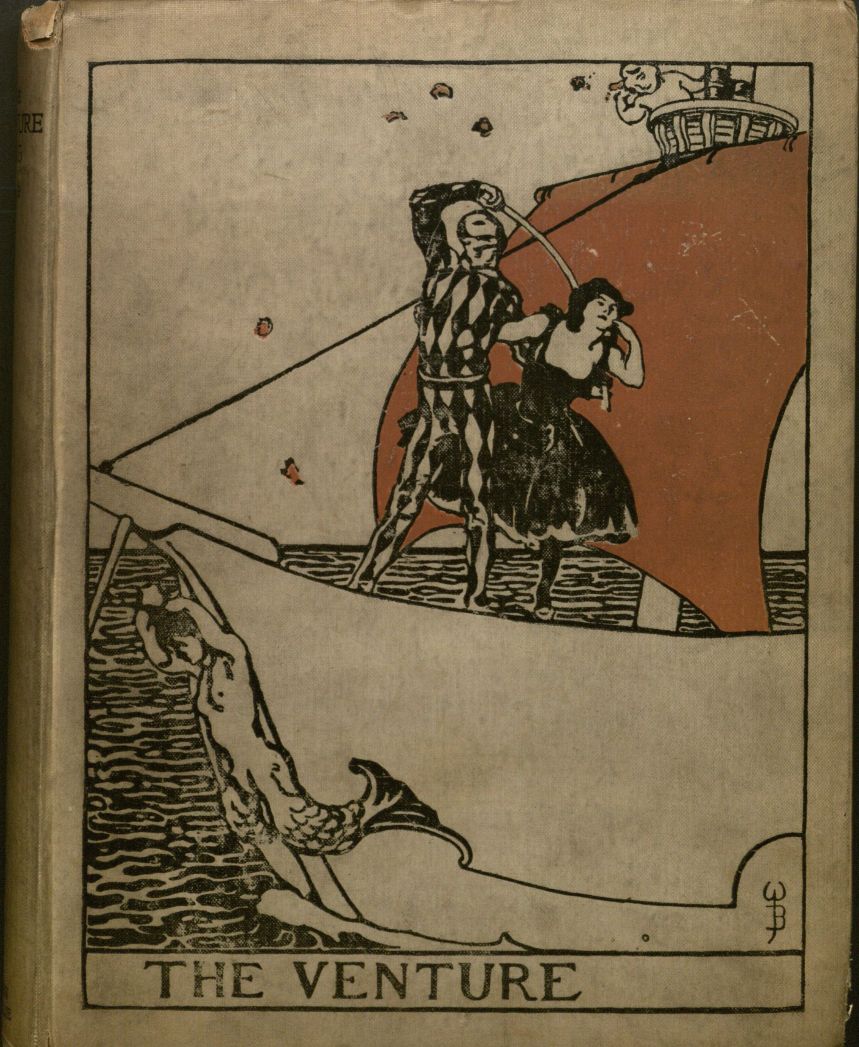
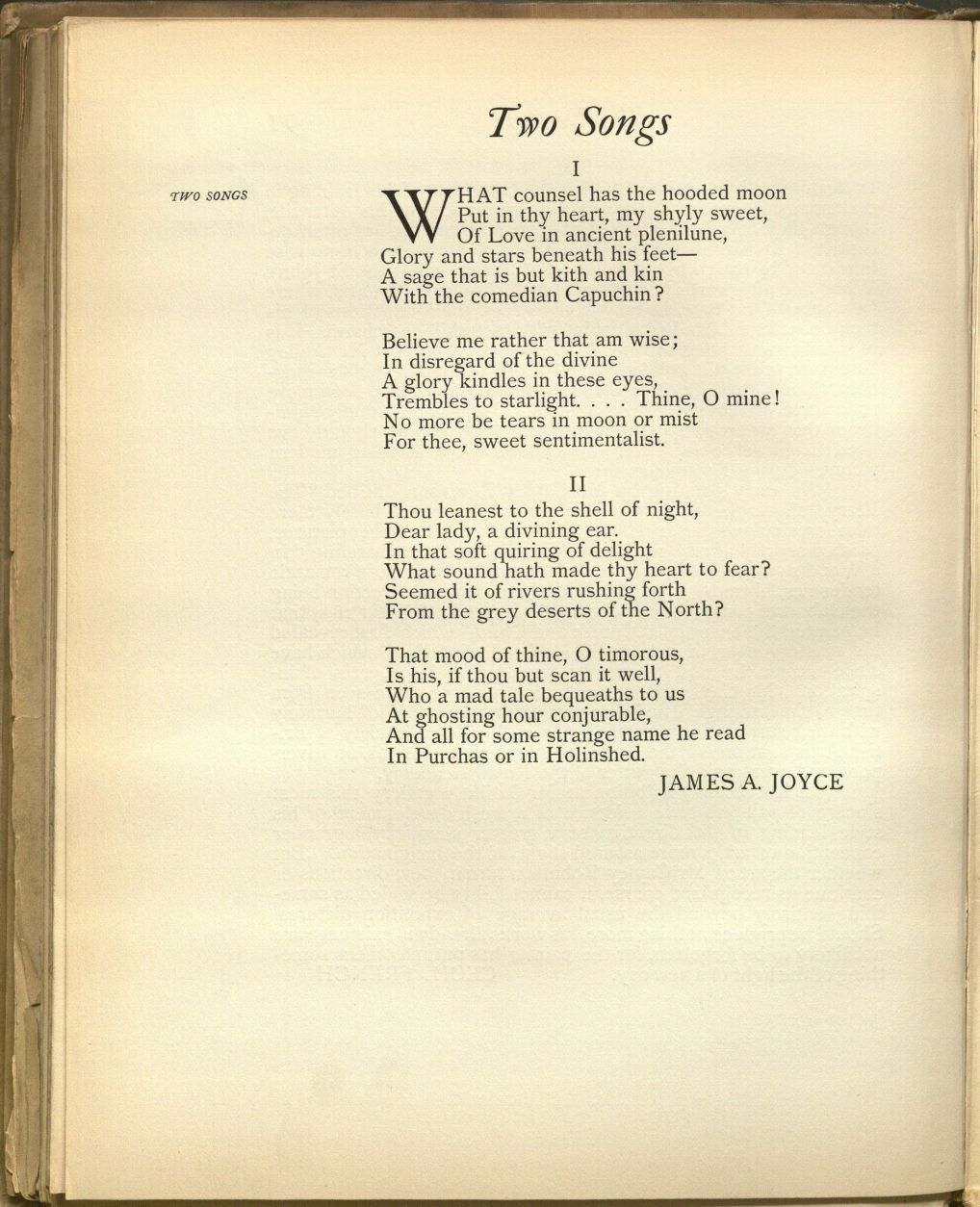
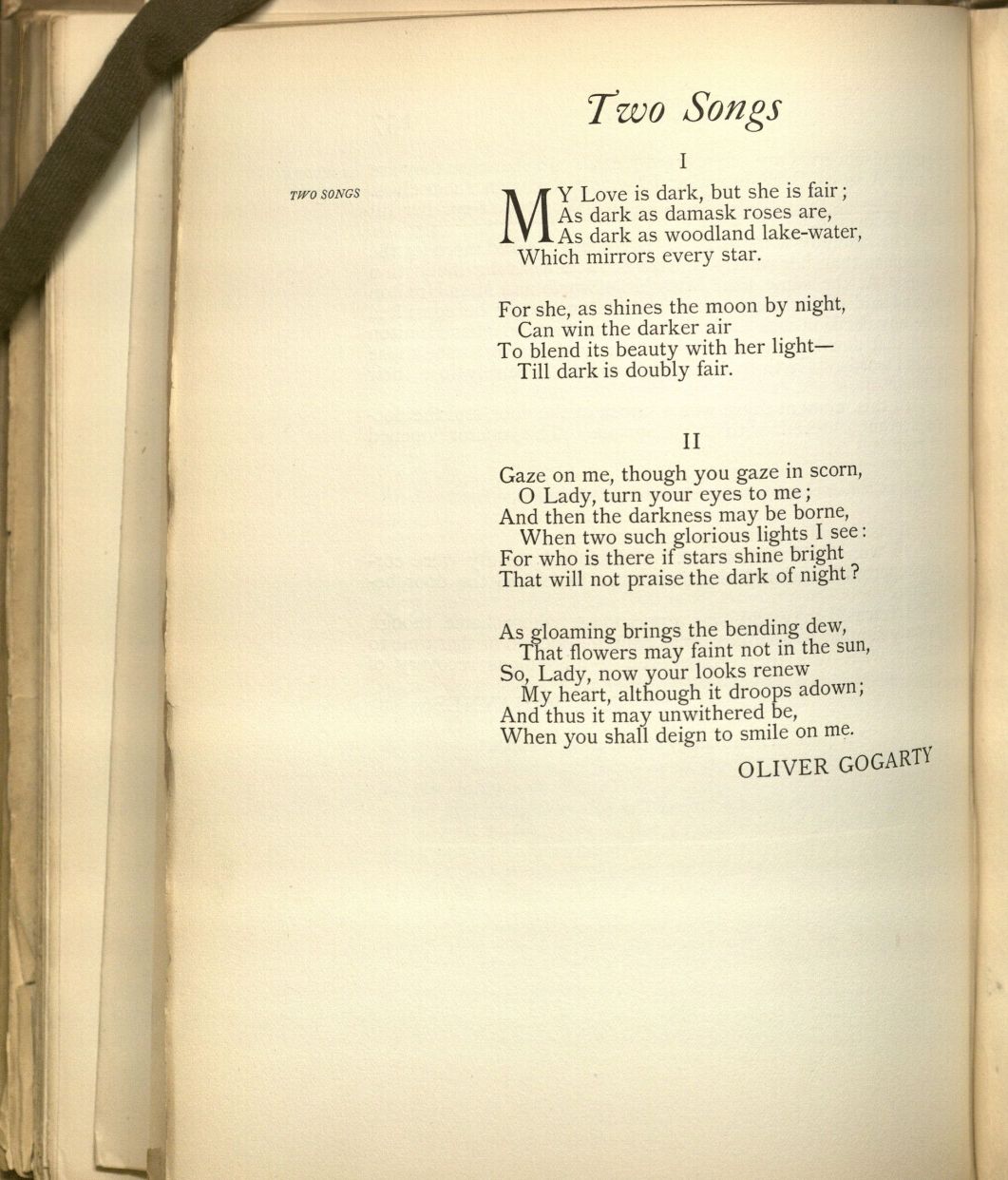
Perhaps somewhat to his chagrin, Joyce found himself in Gogarty’s company in his first book appearance. Both men had poems titled “Two Songs” published in the annual anthology The Venture (1905). By this time, Joyce and Gogarty had already fallen out.  Ellmann notes that from the outset the friendship between the two would-be writers was also a rivalry. The character of Buck Mulligan in Ulysses is entertaining in his wit and pleasure-seeking, but he is also depicted as insensitive and disloyal.

Image of the cover of The Venture, 1904

Image of Two Songs by James Joyce, published in The Venture (1905)  Image of "Two Songs" by Oliver St. John Gogarty

Which young writer’s poems are more to your taste?: “Two Songs” by James Joyce and “Two Songs” by Oliver
St. John Gogarty from The Venture; An Annual of Art and Literature. London: John Baillie, 1905, p. 92, p. 138.
Call Number: Joyce Y243. Click images to enlarge and read poems.

Readers curious to investigate Gogarty through his own words will find plenty to peruse in Spencer’s collections. Gogarty published verse, plays, novels, and memoirs. His book, As I Was Going Down Sackville Street: A Phantasy in Fact (1937), offers depictions of writers he knew, including Joyce, Yeats, and George Moore, as well as the politicians with whom he associated, such as Arthur Griffith and Michael Collins (Gogarty performed the autopsies on both of these men and subsequently served as a Free State senator).

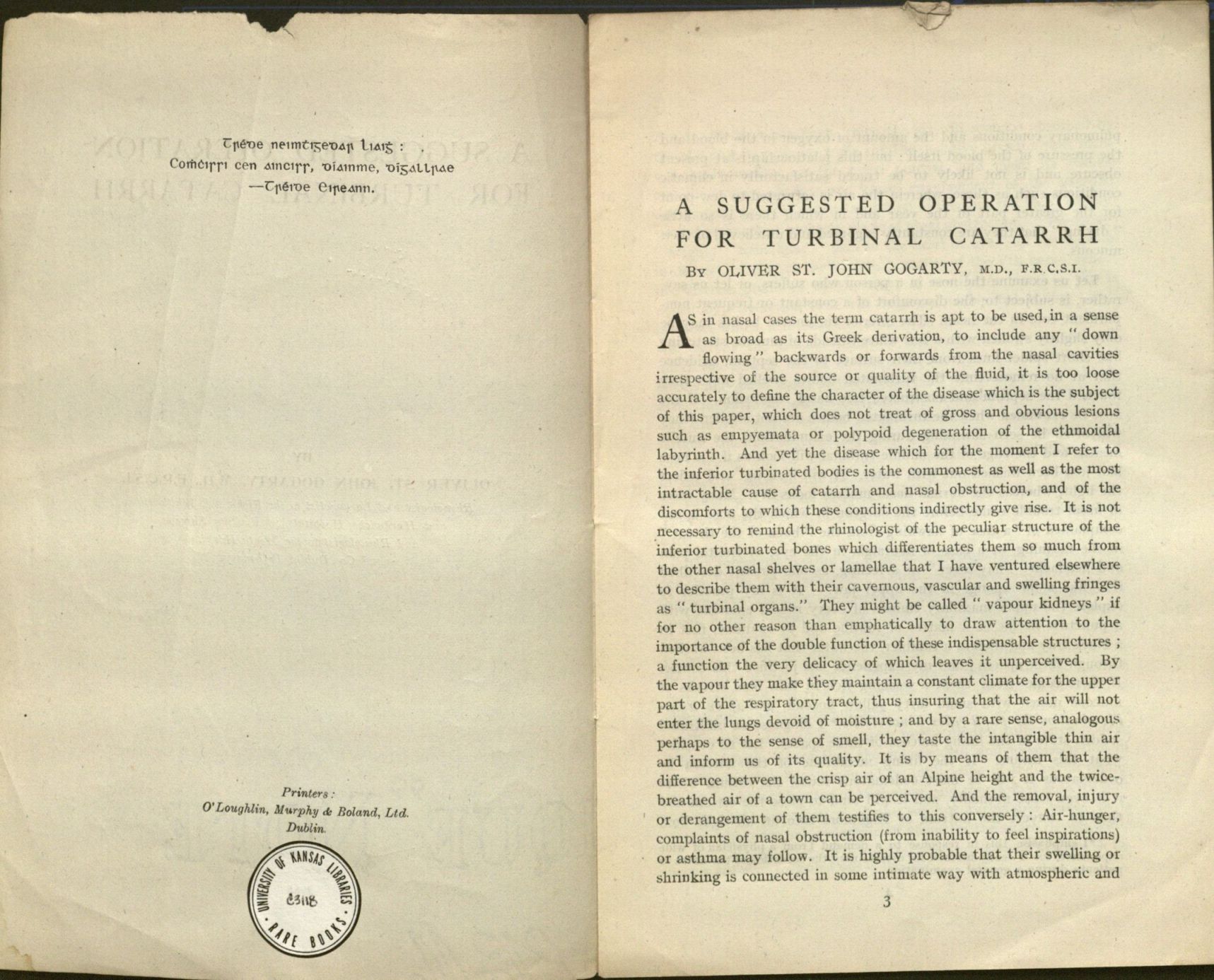
For those eager to delve into Gogarty’s more obscure writings, Spencer Research Library holds a copy of his play Blight the Tragedy of Dublin: An Exposition in 3 Acts (1917), published under the pseudonym “Alpha and Omega.” Even scarcer is Gogarty’s eight-page pamphlet, “A Suggested Operation for Turbinal Catarrh” (1921), which provides insight into his work as a doctor.

Image of the medical pamphlet, "A Suggested Operation for Turbinal Catarrh" by Oliver St. John Gogarty

“A Suggested Operation for Turbinal Catarrh” by Oliver St. John Gogarty. Dublin: pr. for the author, 1921.
Call Number: C3118. Click image to enlarge.

Since this medical pamphlet is indeed rare (the only other copy recorded in WorldCat is housed at the National Library of Ireland) we’ve scanned it and posted it in its entirety here.  So this is what “Buck Mulligan” was up to when he wasn’t composing ribald rhymes!

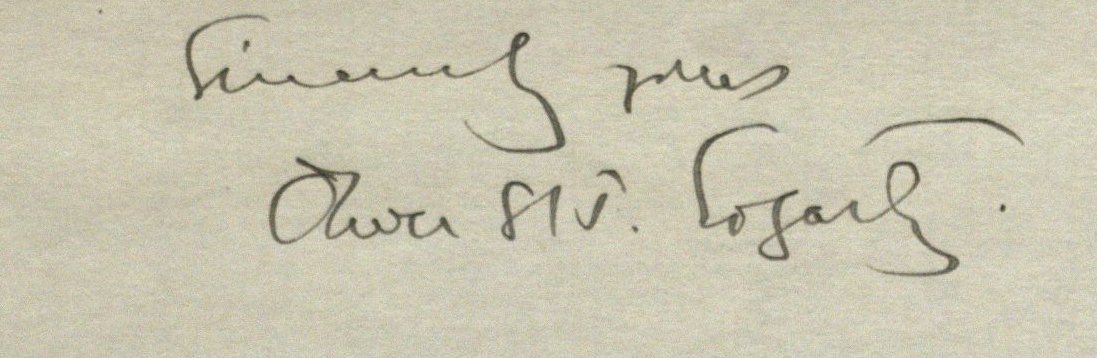
Photograph of Oliver St. John Gogarty's signature from a 1924 letter to P. S. O'Hegarty.

Signature of Oliver St. John Gogarty, taken from a letter to P. S. O’Hegarty,
17 September, 1924. Call Number: MS P415:1a.

Searching for more Bloomsday fun?  For a list of Ulysses “firsts,” check out last year’s Bloomsday post.

Elspeth Healey
Special Collections Librarian

Representing the Countess: Constance Markievicz in the Poetry of Eva Gore-Booth & W. B. Yeats

April 25th, 2013

This week’s post comes from undergraduate public services student Meaghan Moody, who during this last week of National Poetry Month examines poetic depictions of Irish nationalist Countess Constance Markievicz.

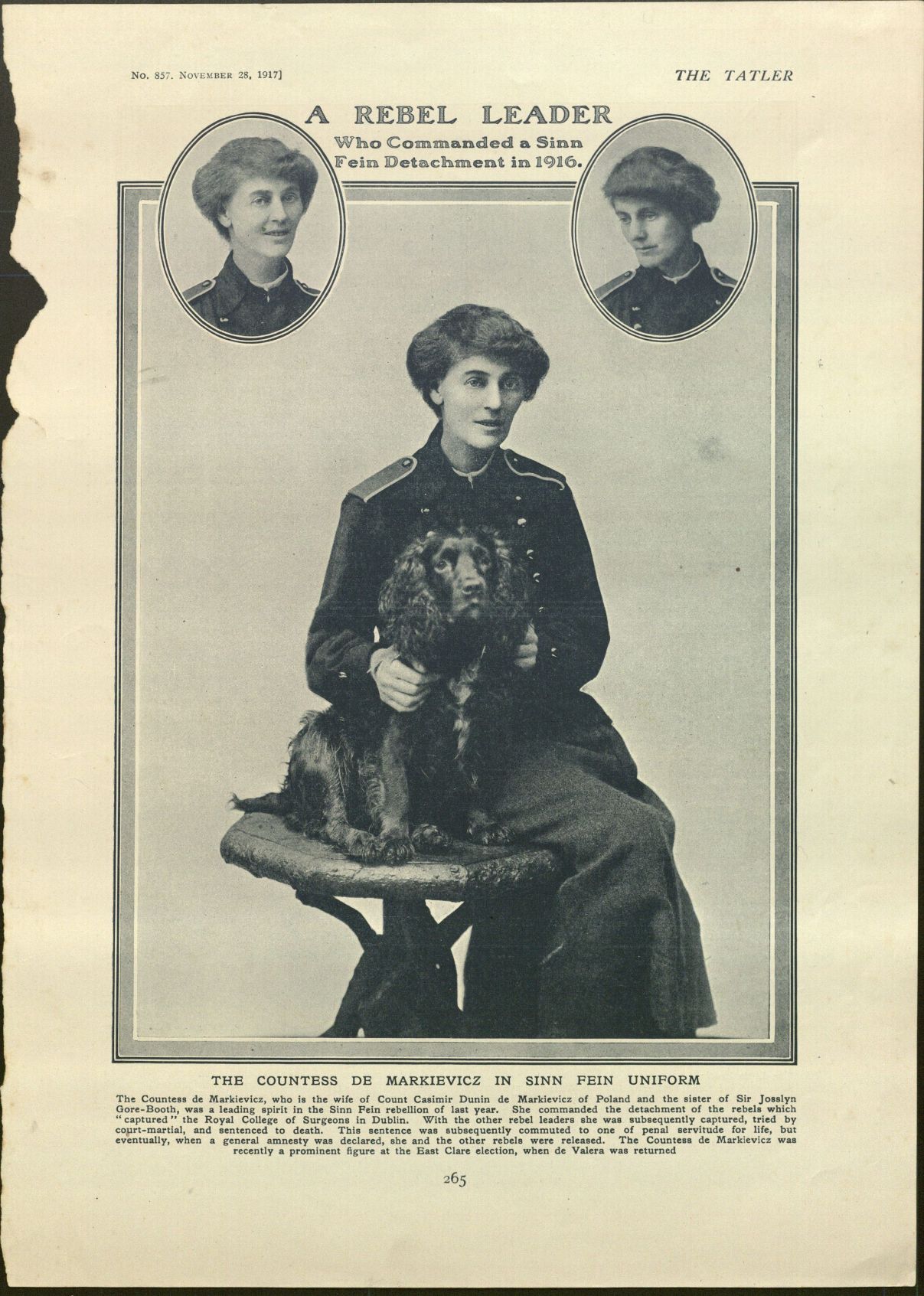
On Monday, April 24th, 1916, Irish nationalists seized strategic infrastructure in Dublin to expel the British and establish an independent Irish Republic. Among these insurgents was Constance Markievicz (1868-1927), who served as second in command under Michael Mallin of the Citizen Army force in St. Stephen’s Green.  Markievicz was sentenced to death for her involvement in what became known as the “Easter Rising,” but the sentence was later commuted to life in prison based solely upon her sex. Markievicz is remembered and celebrated for her fearlessness, her intrepid nature, and her radical military dress. In the image below, you can see her in her full military regalia.

Image of Constance Markievicz excized from the Tatler, Nov. 28, 1917.

“A Rebel Leader” (Constance Markievicz) [image excised from the Tatler, Nov. 28, 1917]. Call Number: O’Hegarty Q38.

While conducting research for my English 530 course, Irish Renaissance Literature, I came across two strikingly similar depictions of the Countess by two Irish writers with diverging political beliefs. W.B. Yeats, a cultural nationalist, and Eva Gore-Booth, a pacifist suffragist and Constance’s sister, both fundamentally condemned the Rising and its resulting violence. They both also depict Markievicz and her subsequent imprisonment in their poetry.

W.B. Yeats knew Markievicz in her youth. He preferred his memory of her innocent beauty and rejected her involvement in politics.

Cover of  Yeat's Michael Robartes and the Dancer  Image of Yeats's poem "On A Political Prisoner"

Cover and “On A Political Prisoner” from W. B. Yeats’s Michael Robartes and the Dancer. Churchtown, Dundrum: The Cuala Press, 1920. Call Number: Yeats Y45. Click images to enlarge.

Eva Gore-Booth, too, disapproved of her sister’s involvement, but, unlike Yeats, depicted Constance as an ethereal, spiritual being, as seen in this poem that she sent the imprisoned Constance for Christmas.

Image of Cover of Eva f Gore-Booth's Broken Glory  Image of Eva Gore-Booth's poem "To Constance--In Prison"

Cover and “To Constance–In Prison” from Eva Gore-Booth’s Broken Glory. Dublin; London: Maunsel, 1918. Call Number: B11104. Click images to enlarge.

In her prison letters, Markievicz reflected on herself as a poetical inspiration, remarking, “I love being in poetry and feel so important!”

Though she recognized her sister’s aversion to violence, Markievicz took pride in the role she played in the Easter Rising and felt a sense of honor in her subsequent incarceration. She wrote to Eva, “Don’t worry about me. I am quite happy. It is in nobody’s power to make me unhappy. I am not afraid, either of the future or of myself.”

Meaghan Moody
Public Services Student Assistant

Source consulted: Weihman, Lisa. “Doing My Bit for Ireland: Transgressing Gender in the Easter Rising.”  Éire-Ireland 39.3&4 (2004) 228-249.

Celebrating Ronald Johnson and Poetry In Kansas

April 12th, 2013

April is National Poetry Month, and in honor of this KU Libraries will host an event celebrating Ronald Johnson and poetry in Kansas at the Kenneth Spencer Research Library on Tuesday, April 16.

Revered as a poet’s poet, Ronald Johnson (1935-1998) was born and raised in Ashland, Kansas. Though he spent much of his literary career away from Kansas, first on the East Coast and then in San Francisco (where he lived for over two decades), his literary papers have long acted as a physical tie to his birth state.

The Kenneth Spencer Research Library acquired its first cache of the poet’s papers in April of 1969. By this time, Johnson had already published his early collections A Line of Poetry, A Row of Trees (1964) and The Book of the Green Man (1967), but was still building his reputation as a poet. Subsequent major installments followed in 1971 and 1987, culminating with a final acquisition of papers from Johnson’s literary estate in March of this year (2013).

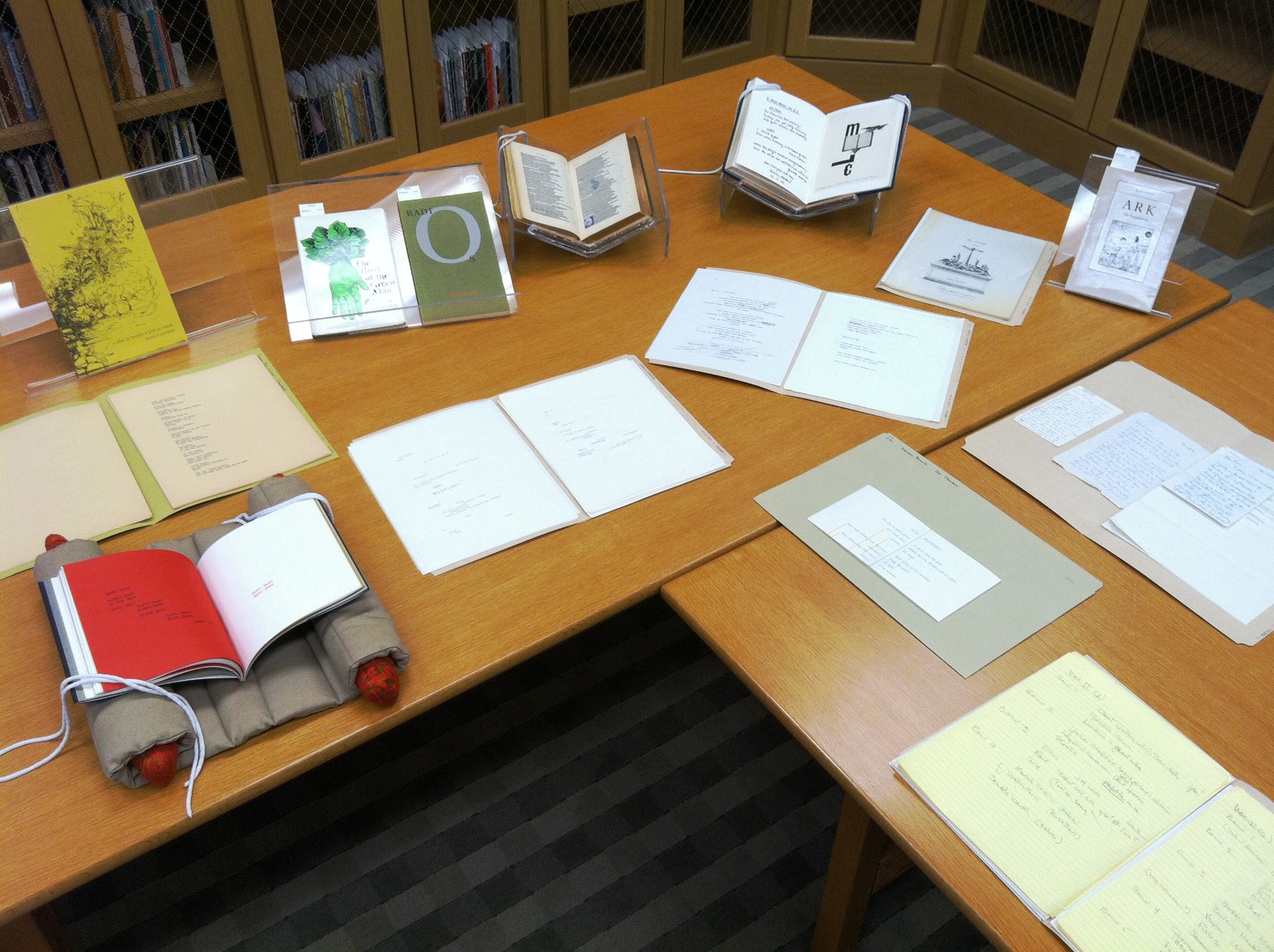
Photograph of a selection of book and manuscript holdings for Ronald Johnson

The papers are a magnificent record of Johnson’s life and literary endeavors. They include,

  • multiple drafts of his poetic works, such as his erasure poem Radi os (a re-writing of sections of Milton’s Paradise Lost by excision), and ARK, a long poem composed over twenty years (which will be republished by Flood Editions later this year)
  • drafts and prototypes for his concrete poetry (poetry which emphasizes and plays upon the visual element)
  • correspondence with friends, loved ones, and literary peers, such as writer Guy Davenport, a great champion and admirer of Johnson’s writing; Jonathan Williams, Jargon Society publisher, poet, and former love; and fellow poets such as Ian Hamilton Finlay, Louis Zukofsky, Mary Ellen Solt, and Robert Creeley.
  • materials documenting Johnson’s “other” career as a chef, caterer, and cookbook writer, including drafts of his popular cookbooks, such as The American Table and The Aficionado’s Southwestern Cooking, and (in the most recent accession) correspondence with food writer M. F. K. Fisher
  • research notes and writing journals
  • photographs and audio recordings of Johnson

One of the highlights of the new acquisition are drafts of Johnson’s The Shrubberies, poems which he composed upon returning to Kansas from San Francisco.  These were collected, edited, and posthumously published by his friend and literary executor, poet Peter O’Leary.  The poems were inspired in part by Ward-Meade Park in Topeka, where Johnson had worked before succumbing to brain cancer and where a plaque now stands in his honor.

Though the materials that arrived in March are not yet cataloged, an online guide exists for the twenty-nine boxes of Johnson’s earlier papers.  The library also houses a large number of Johnson’s published works, many of which exist in scarce and limited editions. These materials complement Spencer’s New American Poetry holdings and its wealth of materials for Kansas writers.

The celebration on April 16 will feature three Kansas poets renowned in their own right: Joseph Harrington and Kenneth Irby, Professors in KU’s Department of English, and Denise Low, Kansas Poet Laureate, 2007-2009.  These speakers will fête Johnson by reading favorite passages from his works alongside poems of their own.  A selection of materials from the library’s Ronald Johnson holdings will be on display during the event.

Elspeth Healey
Special Collections Librarian

Gossip and Literary Celebrity, Circa 1871

March 21st, 2013

Though public figures in late nineteenth-century England might not have had to contend with paparazzi or gossip bloggers, their lives and personal writings were nonetheless a subject of interest and speculation.  What might begin innocently as a jovial private communication between friends could one day find itself before a much wider circle of readers, or so Pre-Raphaelite artist and poet Dante Gabriel Rossetti (1828-1882) warned his friend and fellow poet Algernon Charles Swinburne (1837-1909).

Photogravure of Dante Gabriel Rossetty by G. F. Watts.        Image of black and white reproduction of Dante Gabriel Rossetti's portrait of Algernon Charles Swinburne

Left: Dante Gabriel Rossetti from photogravure by G. F. Watts;  Right: Black and white photograph of Dante Gabriel Rossetti’s portrait of Algernon Charles Swinburne, both reproduced in H. C. Marillier’s Dante Gabriel Rossetti: An Illustrated Memorial of his Art and Life. London: George Bell and Sons, 1899. Call Number: E1470.

In a letter likely dating from November 1871, Rossetti cautioned Swinburne,

[…] You seem to think that such things are likely to be restricted to the circle of their recipients. Why, my dear fellow, every line you have ever written will one day be religiously raked up by greedy & often doubtless malevolent exploiteurs, and it is very hard for those who receive these wonderfully funny things of yours to resolve on taking the only safe course with them for your sake — that is, to destroy them after they have been abundantly laughed over by a circle of friends who know what mere fun they are. (Call Number: MS 23D:3.2)

Though we can only hope that Rossetti wouldn’t have considered the staff at the Spencer Research Library to be greedy and malevolent “exploiteurs”–he had in mind perhaps critics of the day, publishers, or members of the periodical press–time has proven the validity of his concern.  For example, a number of Rossetti’s own private communications now reside in Spencer’s collection of Rossetti Family Correspondence (MS 23).  This collection includes letters by his father, Gabriele Rossetti, his sister, the poet Christina Georgina Rossetti, his brother, critic William Michael Rossetti, and his sister-in-law, painter and biographer Lucy Madox (nee Brown) Rossetti.  These letters are a boon to scholars, students, and the general public, even if their creators might not have wished for all of them to reach our prying eyes.

To read Rossetti’s letter to Swinburne, click on the thumbnails below to enlarge:

Image of Rossetti to Swinburne [circa Nov. 1871p.1]  Image of page 2 of Letter from Rossetti to Swinburne.  Image of page 3 of letter from Rossetti to Swinburne  Image of page four of letter from Rossetti to Swinburne

Letter from Dante Gabriel Rossetti to Algernon Charles Swinburne. [Shortly after 6 Nov. 1871?]. Rossetti Family Correspondence. Call Number: MS 23D:3.2. Click images to enlarge.

Elspeth Healey
Special Collections Librarian

From Spencer’s Irish Collections: Internment Camp Autograph Book

March 14th, 2013

St. Patrick’s Day is this Sunday, March 17, so we thought we would highlight a fascinating artifact from the Kenneth Spencer Research Library’s rich Irish holdings.

Image of cover of Ballykinlar Internment Camp Autograph Book

This autograph book, dating from 1921, contains entries by inmates at Ballykinlar Internment Camp.  Located in County Down in what is now Northern Ireland, Ballykinlar was a British-run camp that housed Irish prisoners during the Anglo-Irish War, also known as the Irish War of Independence (1919-1921).

Image of the Autograph Book open to an embellished credit ticket and an inscription bearing a patriotic sentiment.

Image of Opening featuring quotation from Pearse and an inscription in Irish.

Photograph of an opening featuring an inscription in shorthand and a sketch.

Top: opening featuring an embellished camp credit ticket (left); Middle: opening featuring an inscription in Irish (right); Bottom: opening featuring a sketch and an inscription in shorthand.  Autograph Book, Ballykinlar Internment Camp, 1921. Call Number: MS K19. Click images to enlarge.

The book’s pages are filled with the internees’ inscriptions, drawings, patriotic sentiments, quotations, and poems (composed in English, Gaelic, and even shorthand).  Prisoners were housed in huts, as depicted in the sketch below, and many, like the author of the poem on the facing page, included their hut numbers when they signed their names.

Page containing the poem "The Angelus Bell" Last stanza of the poem “The Angelus Bell”, written in the autograph book by a Ballykinlar internee:

[….]

Falls soft the light on the Altar white
When fragrant flowers and incense blend
And as the Aves raise in devout appraise
Men’s souls to Mary, the sinner’s friend.
But faint’s the knell of the Angelus bell,
So the prisoner turns in his barbed-wire pen
To wait the day whenev’r Risings may [?],
The sun of Freedom shall shine again.

Image of a page containing a sketch of the camp's huts.

Poem “The Angelus Bell”  inscribed by an internee and facing page sketch of the camp. Autograph Book, Ballykinlar Internment Camp, 1921. Call Number: MS K19. Click images to enlarge.

This manuscript volume came to the Spencer Library from Ireland as part of the 25,000 item collection of Irish nationalist, civil servant, and book collector, P. S. O’Hegarty (1879-1955).  The collection is particularly strong in publications and ephemera related to Irish politics as well as literature of the Irish Literary Renaissance.  O’Hegarty’s  library contains another internment camp autograph book from the early twentieth century.  This second book belonged to a man named Paul Cusack, who was first a prisoner at Frongoch Internment Camp in Wales in 1916 following the Easter Rising and then later at Mountjoy Prison in Dublin in 1921 (Call Number: MS K18).  The portion of Cusack’s autograph book that dates from 1916 includes an inscription that appears to be by fellow Frongoch inmate Terence MacSwiney.  MacSwiney later became Lord Mayor of Cork and died during a hunger strike while incarcerated in Brixton Prison in 1920.  Autograph books such as these offer insight into an important period in Irish history.

To learn more about the Kenneth Spencer Research Library’s Irish Collections, visit the overview of Spencer’s Irish holdings on our website or delve deeper with our Irish Collections Lib Guide (especially helpful for identifying our Irish manuscript holdings).

Looking for St. Patrick’s Day-themed activities in town?  Lawrence’s annual St. Patrick’s Day parade will take place on March 17, 2013 at 1:30pm. On March 23, the Irish Roots Cafe will host a musical event at the Grenada, which will include Sean Nós style song in the Irish language.

Elspeth Healey
Special Collections Librarian