The University of Kansas

Inside Spencer: The KSRL Blog

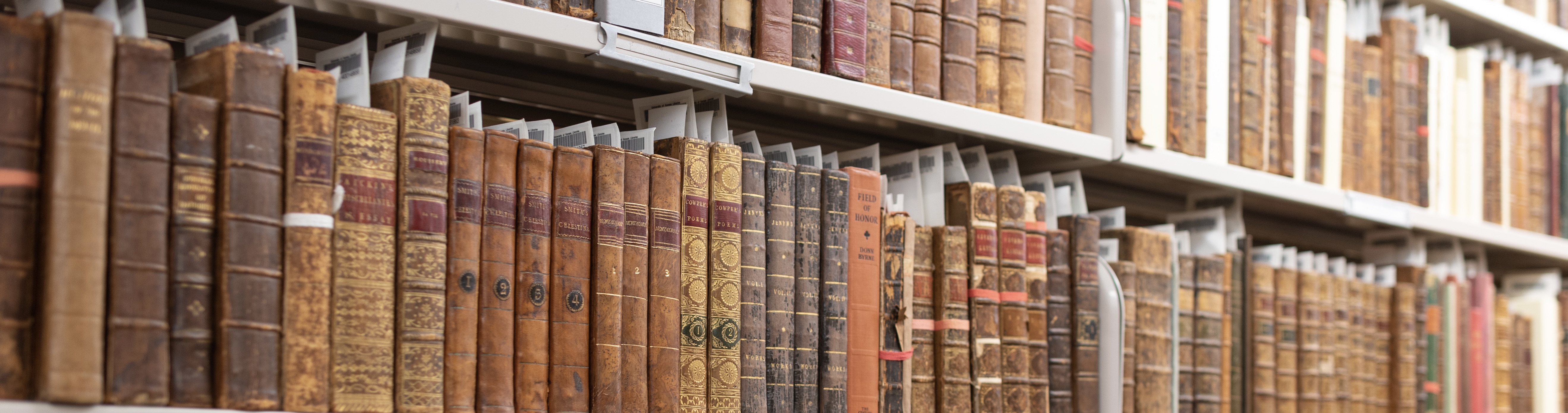
Books on a shelf

Welcome to the Kenneth Spencer Research Library blog! As the special collections and archives library at the University of Kansas, Spencer is home to remarkable and diverse collections of rare and unique items. Explore the blog to learn about the work we do and the materials we collect.

Physical/Digital Archives: Teaching with Spencer Manuscripts

April 2nd, 2019

This week’s post is by Dr. Whitney Sperrazza, Digital Humanities Postdoctoral Research Fellow at KU’s Hall Center for the Humanities.

Digital methods offer a new way to teach with and in the archives. I designed my Fall 2018 course, “Digital Feminist Archives,” around this conviction, aiming to build a class that worked at the intersection of archival and digital practices.

For sixteen weeks, twelve students from a wide range of KU departments (English, Women, Gender, and Sexuality Studies [WGSS], History, Humanities, Museum Studies, and Theater) met at the Spencer Research Library to study, transcribe, and develop projects on one object from the library’s holdings: Elizabeth Dyke’s Booke of Recaits (dated 1668).


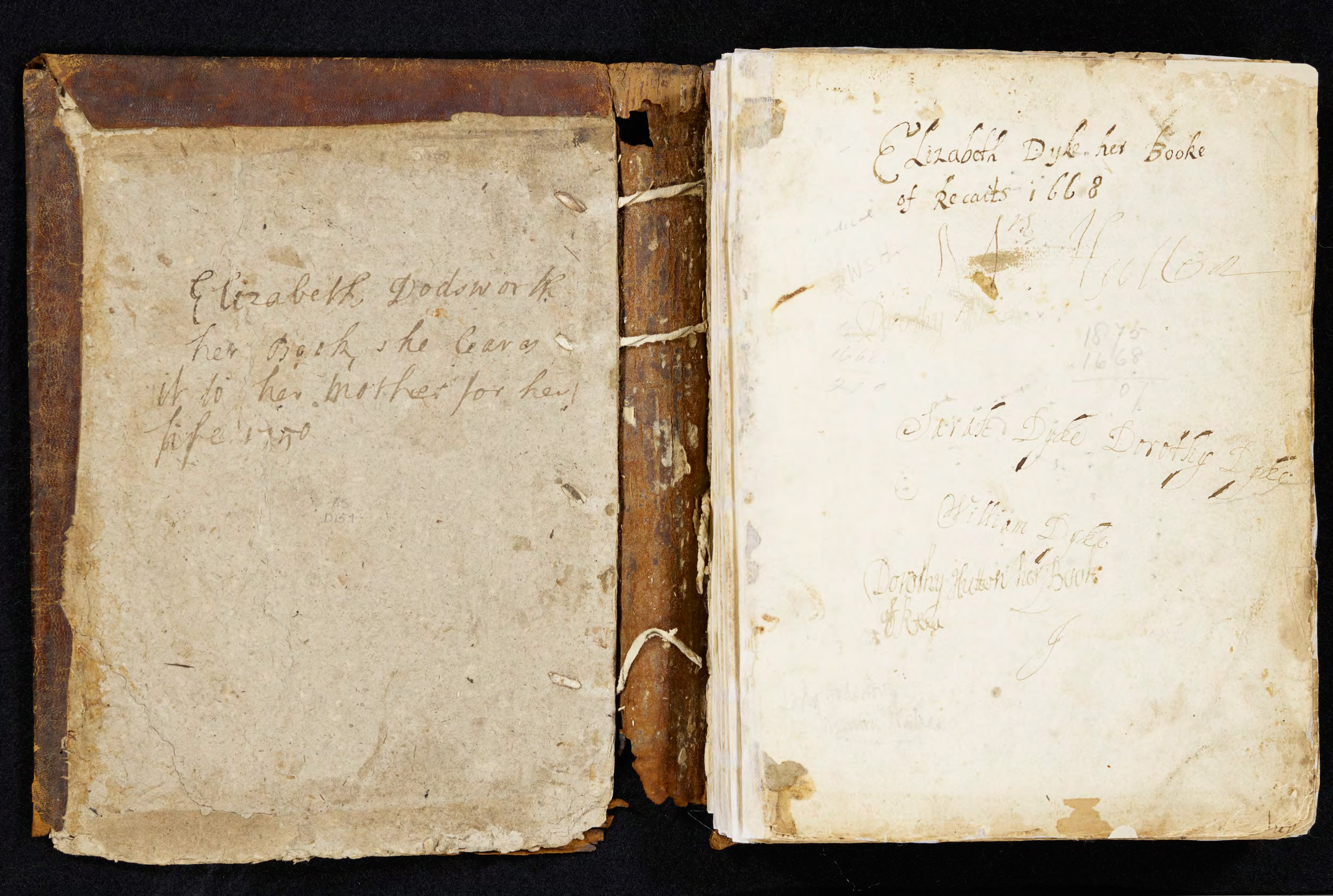
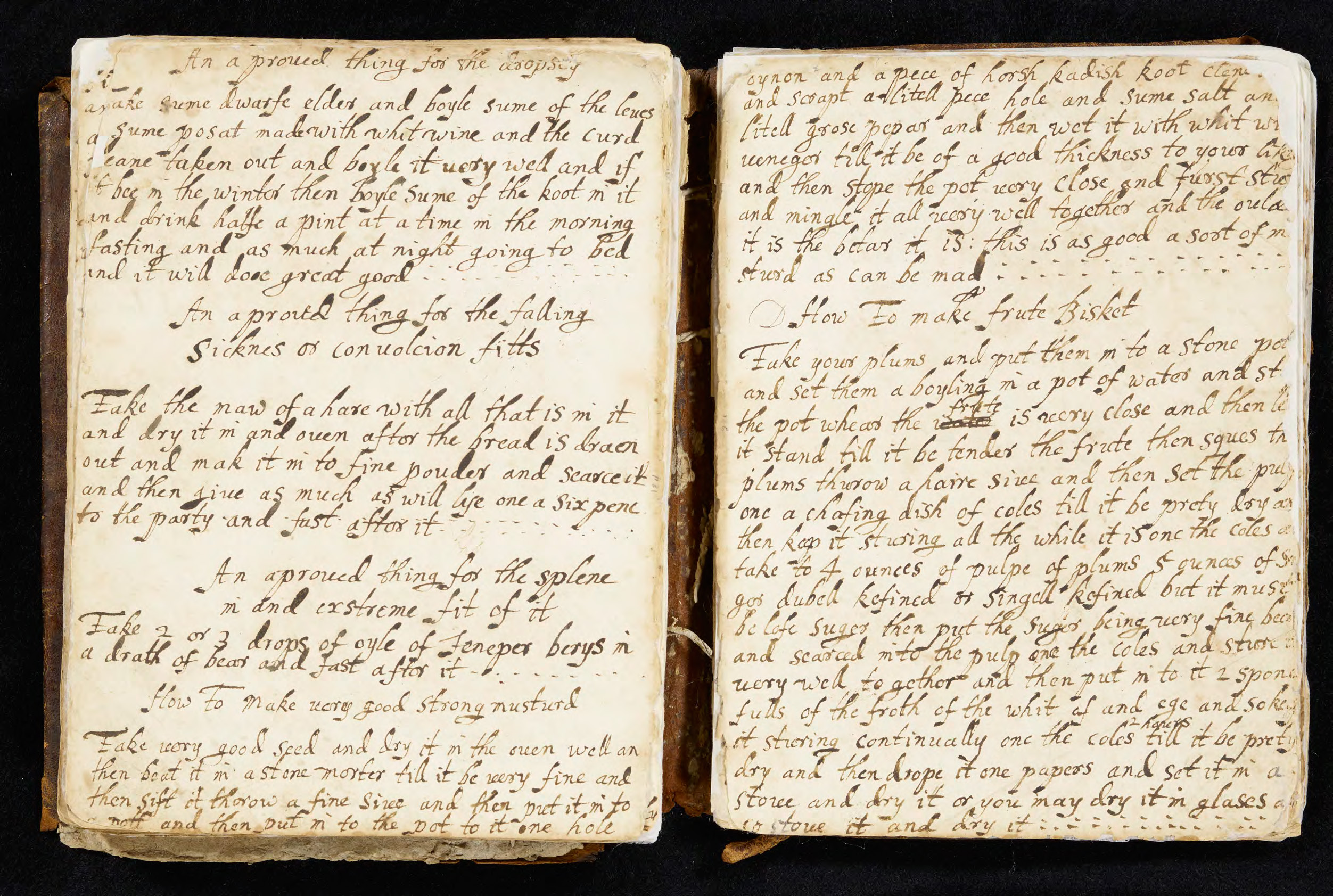
Image of ownership inscriptions in the front board and first page of "Elizabeth Dyke, her Booke of Recaits 1668" (MS D157)

Family Ownership inscriptions in “Elizabeth Dyke, her Booke of Recaits 1668.” England, approximately 1668.
Call Number: MS D157, Opening 2. Click image to enlarge.

Early Women’s Recipes

Are you interested in learning more about early Western remedies for headaches? What about the effectiveness of rose water in preventing plague (56)? Did you know that pickled cucumbers were made frequently in seventeenth-century English households (86) and that powdered hazelnuts were used to stanch bleeding (43)? Or, as Elspeth Healey asks in her blog post on the manuscript, are you simply looking for some seventeenth-century dietary advice?

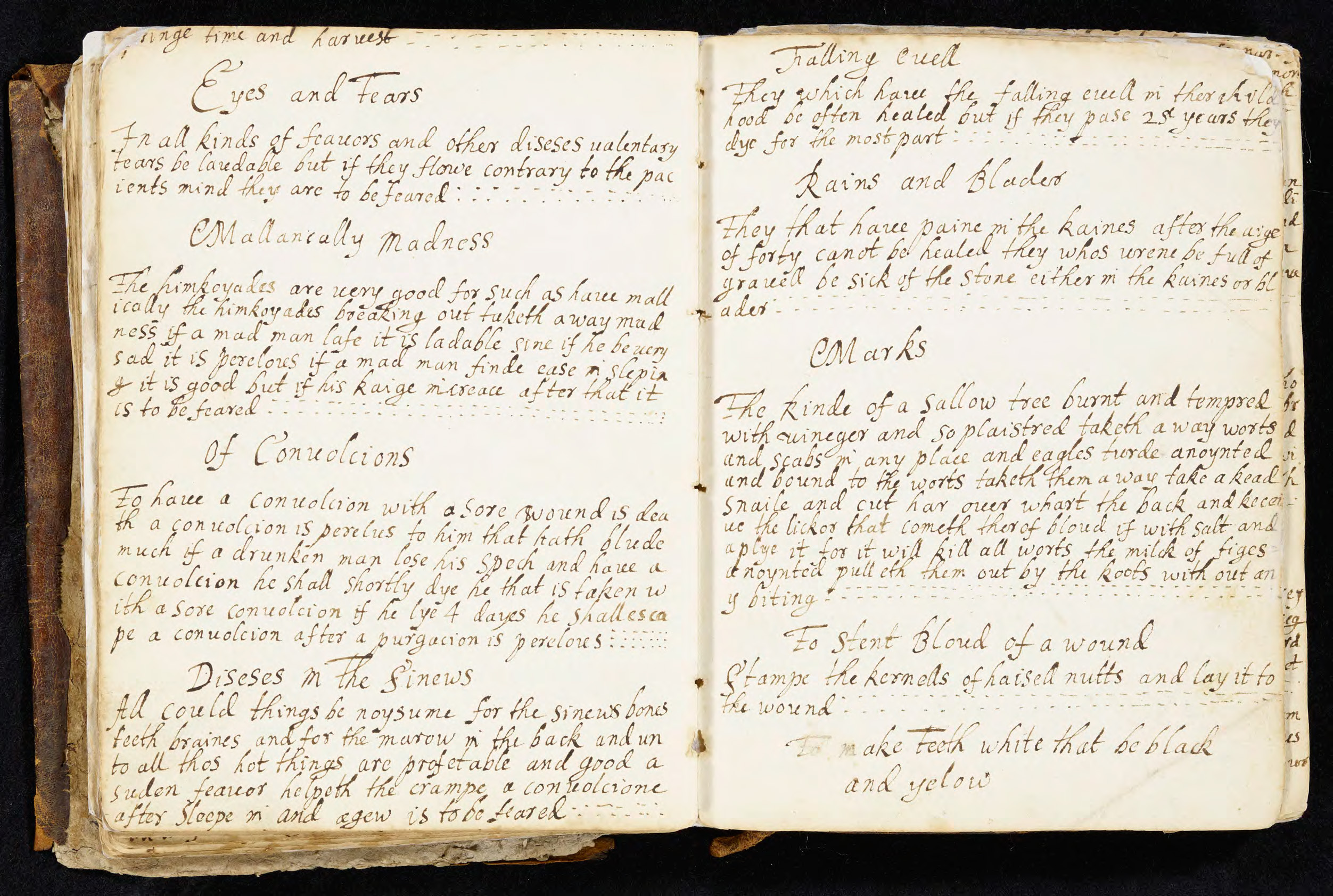
Image of remedy using hazelnuts to stanch bleeding in Elizabeth Dyke, her Booke of Recaits 1668." (MS D157)

Hazelnuts to stanch bleeding? From “Elizabeth Dyke, her Booke of Recaits 1668.” England, approximately 1668.
Call Number: MS D157, Opening 43. Click image to enlarge.

This is just a taste of the wealth of information we collected from Dyke’s Booke of Recaits, which contains over 700 culinary and medicinal recipes. But the manuscript is so much more than a recipe archive. It is a document of familial and social networks and a record of cultural practices.

On the manuscript’s opening page (see photo above), several women catalogued their ownership of the book—Sarah Dyke, Dorothy Dyke, Elizabeth Dodsworth—suggesting that the text was passed down through the family’s female line. Like many surviving recipe books from the period, the titles of the recipes themselves also include names of women and men, either to note the original creator of the recipe (“Lady Rivers’ recipe for orange or lemon cakes”) or to mark the recipe’s effectiveness (“A very good green salve and ointment proved often times by goodwife Wesens”).

The Spencer Library acquired the manuscript in 1977 from UK bookseller, Henry Bristow Ltd, and it was recently featured in an exhibition titled, “Histories of the English Language” (Summer 2017). While the manuscript has long been available for visitors to the Spencer, it is now available as part of the KU Libraries digital collections and as a fully searchable (original spelling only) transcription on the “Digital Feminist Archives” course site.

Collaborative Close Reading

I designed the course syllabus to build gradually toward the students’ final digital projects, so the first eight weeks were dedicated to close study and transcription of the manuscript’s content. The students became experts on this archival object through their transcription work and their conversations with each other on the manuscript’s content and structure.

The students each transcribed and encoded a section of manuscript pages and, one day per week, we structured the class as a large-scale text encoding project meeting. Students came to class with examples and questions from their assigned pages and we dedicated these class sessions to collective conversation about encoding standards and transcription problems. We started with basic observations—things like, “this is what Dyke’s r looks like”—but the conversations quickly became more complicated and critically rich: should we include content that’s been crossed out? how should we note text that’s been lost due to page damage?

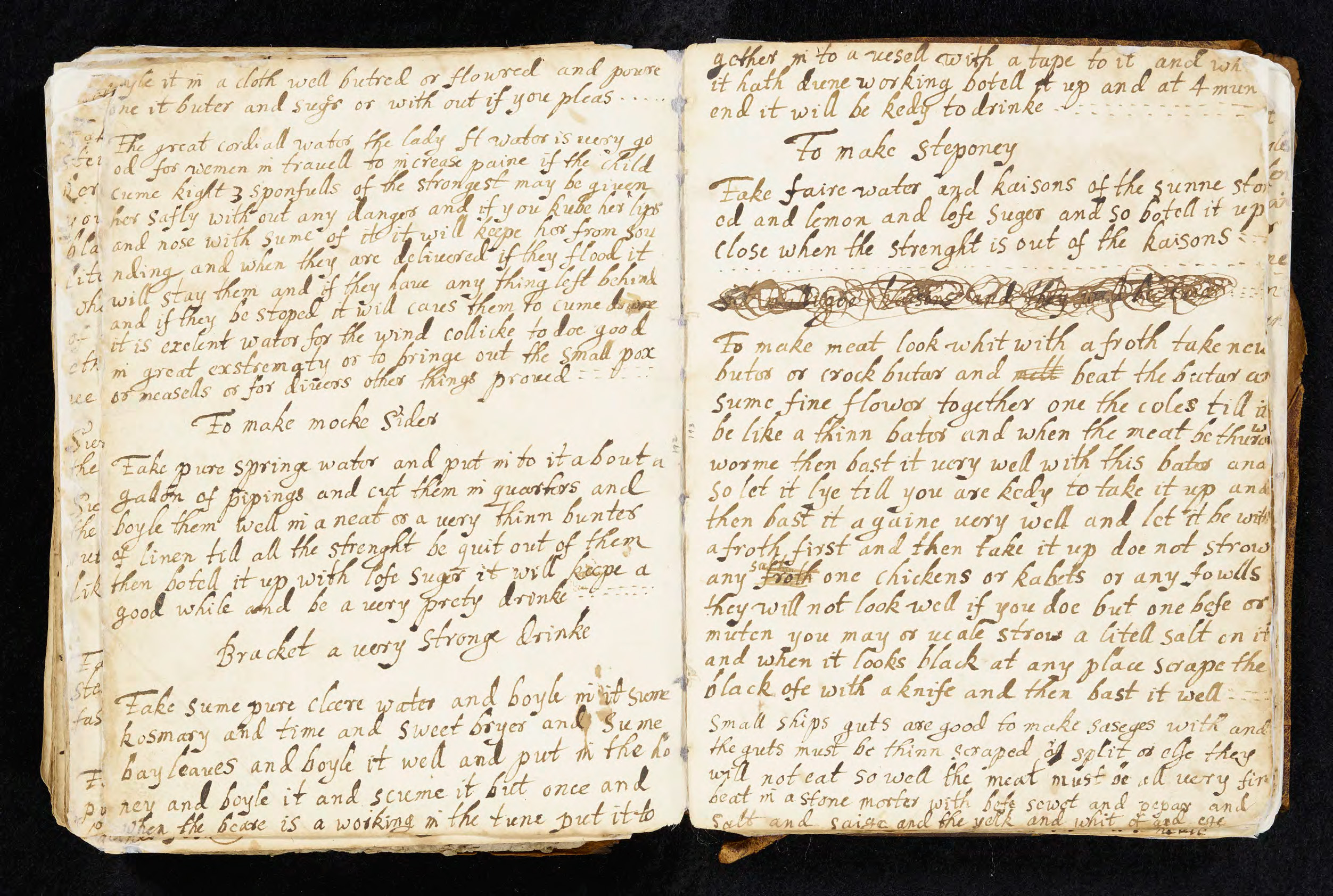
Examples of loss of text in Elizabeth Dyke's Booke of Recaits (MS D157)

Photograph of crossed out text in Elizabeth Dyke's "Booke of Recaits" (MS D157)

Example of lost text (top) and crossed out text (bottom) in “Elizabeth Dyke, her Booke of Recaits 1668.” England, approximately 1668.
Call Number: MS D157, Openings 95 and 99. Click images to enlarge.

As an instructor, it was thrilling to participate in these student-driven discussions and listen as the students grappled with the critical and methodological decisions that go into transforming a physical object into digital content. Our focus was on the process rather the product, and part of that process was working together to really know this archival object. In addition to giving students insight into the logistics of digital project development, these lab sessions became opportunities for collaborative reading of the manuscript’s content as students shared interesting passages, unexpected recipe titles, and common ingredients.

Interdisciplinary Networks

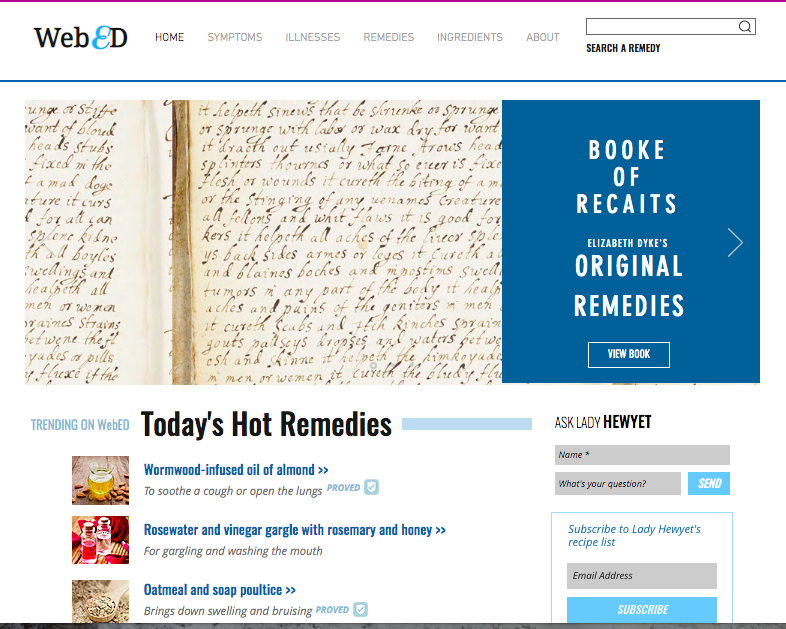
The students’ collective transcription work became the basis for their final project development. Through their projects, the students animated this archival material. One group transformed Dyke’s medicinal recipes into a crowd-sourced ailments and remedies platform modeled on WebMD (WebED).

Screenshot of WebEd, a crowd-sourced ailments and remedies platform modeled on WebMD.

WebEd, a student project centered on Elizabeth Dyke’s Booke of Recaits for ENGL 590 | ENGL 790 | HUM 500 | WGSS 701: Digital Feminist Archives, Fall 2018. Click image to enlarge.

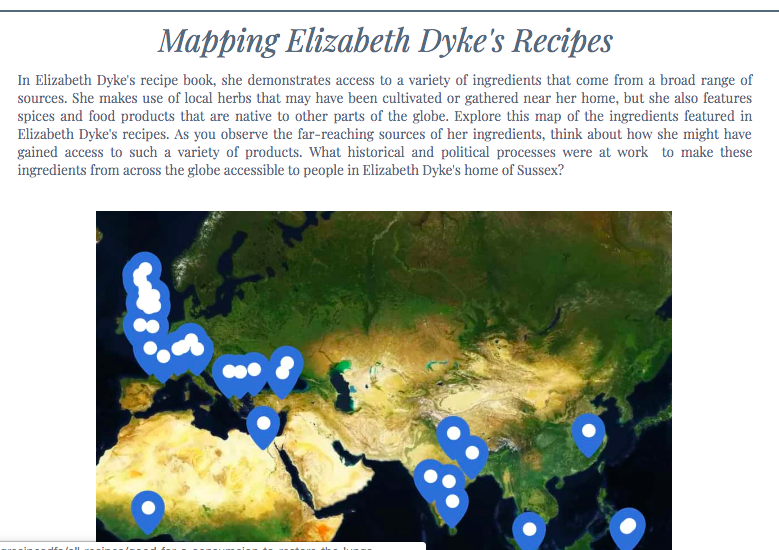
One group tried their hand at making some of the recipes, using Dyke’s directions to capture the historical experience (Cooking 17th-Century Recipes). Another group developed teaching resources and updated versions of the recipes to explore how Dyke’s recipes remain relevant for today’s audiences (Using Early Modern Recipes Today). Finally, one group mapped the availability of several of Dyke’s ingredients, tracking how the ingredients would have been traded across different parts of the world (Mapping Elizabeth Dyke’s Recipes).

Screenshot of "Mapping Elizabeth Dyke’s Recipes" site.

Mapping Elizabeth Dyke’s Recipes,” a student project for ENGL 590 | ENGL 790 | HUM 500 | WGSS 701: Digital Feminist Archives, Fall 2018. Click image to enlarge.

The students’ transcription work and project development built on ongoing digital work on early modern recipes (for instance, the Early Modern Recipe Online Collective and The Recipes Project), connecting the students’ original research to wider networks across the country. Most crucial, though, were the lessons we gained from the interdisciplinary networks at work in the classroom. With this archival object as our focal point, we all found ways to draw on and expand our particular areas of interest and expertise.

Digital projects require significant time, labor, and resources. If I learned anything from designing and leading this course, it’s that one semester is not long enough for such an endeavor. We merely scratched the surface of what’s possible with such a rich archival object and, hopefully, our efforts will be a starting point for much more work to come.

Whitney Sperrazza
Digital Humanities Postdoctoral Research Fellow
Hall Center for the Humanities

[Thank you to everyone at KU who worked hard to make this class possible and offered support for the students’ work at various stages: Elspeth Healey, Brian Rosenblum, Whitney Baker, Jocelyn Wehr, Erin Wolfe, Jonathan Lamb, and Scott Hanrath. And, of course, my sincerest gratitude to the “Digital Feminist Archive” students, all of whom brought so much energy to this process: Brianna Blackwell, Gwyn Bourlakov, Mallory Harrell, Yee-Lum Mak, Jodi Moore, Sarah Polo, Elissa Rondeau, Kate Schroeder, Phoenix Schroeder, Suzanne Tanner, Rachel Trusty, and Chris Wright.]


Ireland’s Most Beloved Painter? Irish Art for St. Patrick’s Day

March 15th, 2019

With St. Patrick’s Day falling on Sunday, this week we highlight some original artwork in Spencer’s collections by a notable Irish artist, Frederic William Burton (1816-1900).

Photographic portrait of Frederic William Burton inlaid in Madonna Pia volume (MS E184)
Portrait of Frederic William Burton inlaid in Madonna Pia volume. Sir Theodore Martin Collection. Call Number: MS E184. Click image to see full volume page.

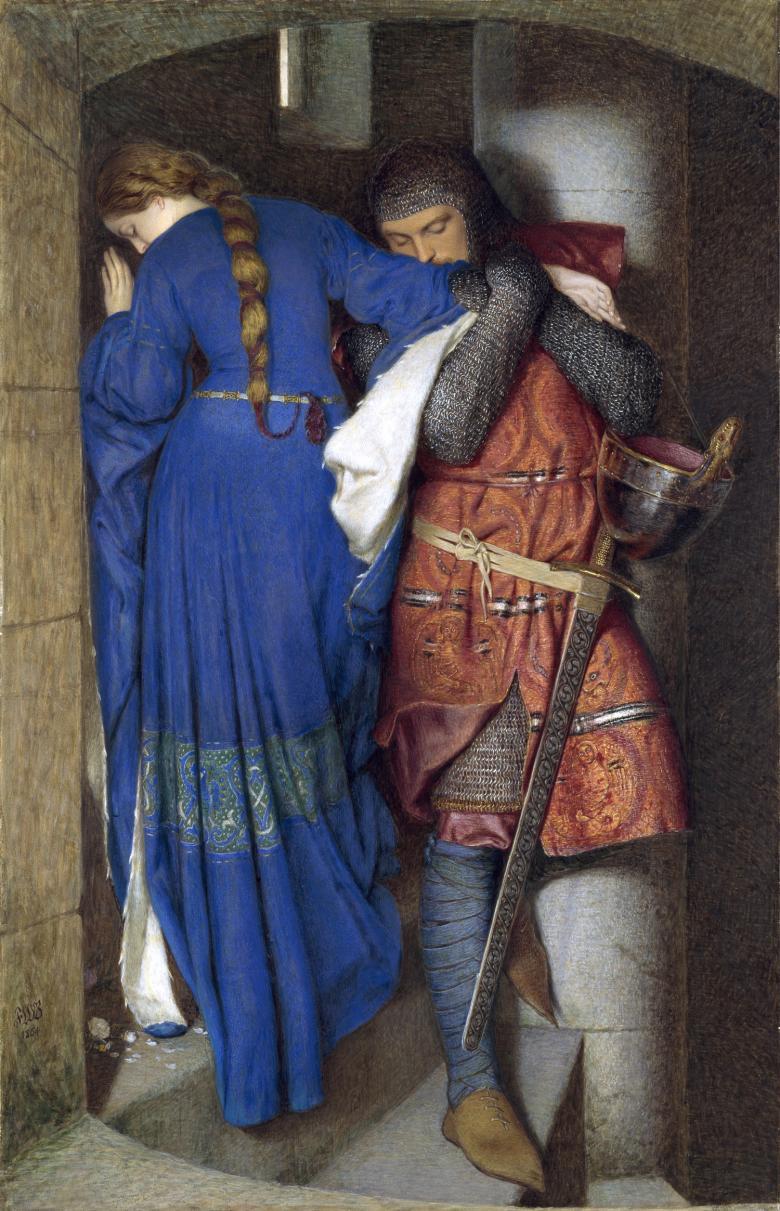
Though Burton may not be a household name in the United States, his best-known work, “Hellelil and Hildebrand, the Meeting on the Turret Stairs” (1864), was voted Ireland’s favorite painting in a 2012 RTÉ poll.

That painting, housed at the National Gallery of Ireland, draws its theme from a medieval Danish ballad. As the museum’s label explains, the ballad tells the story of “Hellelil, who fell in love with her personal guard Hildebrand, Prince of Engelland. Her father disapproved of the relationship and ordered her seven brothers to kill the young prince.” Burton’s painting captures a moment of longing: a final fleeting meeting between the ill-fated couple.

Frederic William Burton (1816-1900), 'Hellelil and Hildebrand, the Meeting on the Turret Stairs', 1864. © National Gallery of Ireland.
Frederic William Burton (1816-1900), ‘Hellelil and Hildebrand, the Meeting on the Turret Stairs’, 1864. © National Gallery of Ireland. Click image to enlarge.

One of the more astonishing aspects of the painting is that it is a watercolor (Burton always worked in watercolors rather than oils). To protect the painting from light damage, the National Gallery of Ireland has it on display for just two hours a week, keeping it behind protective panels the remainder of the time.

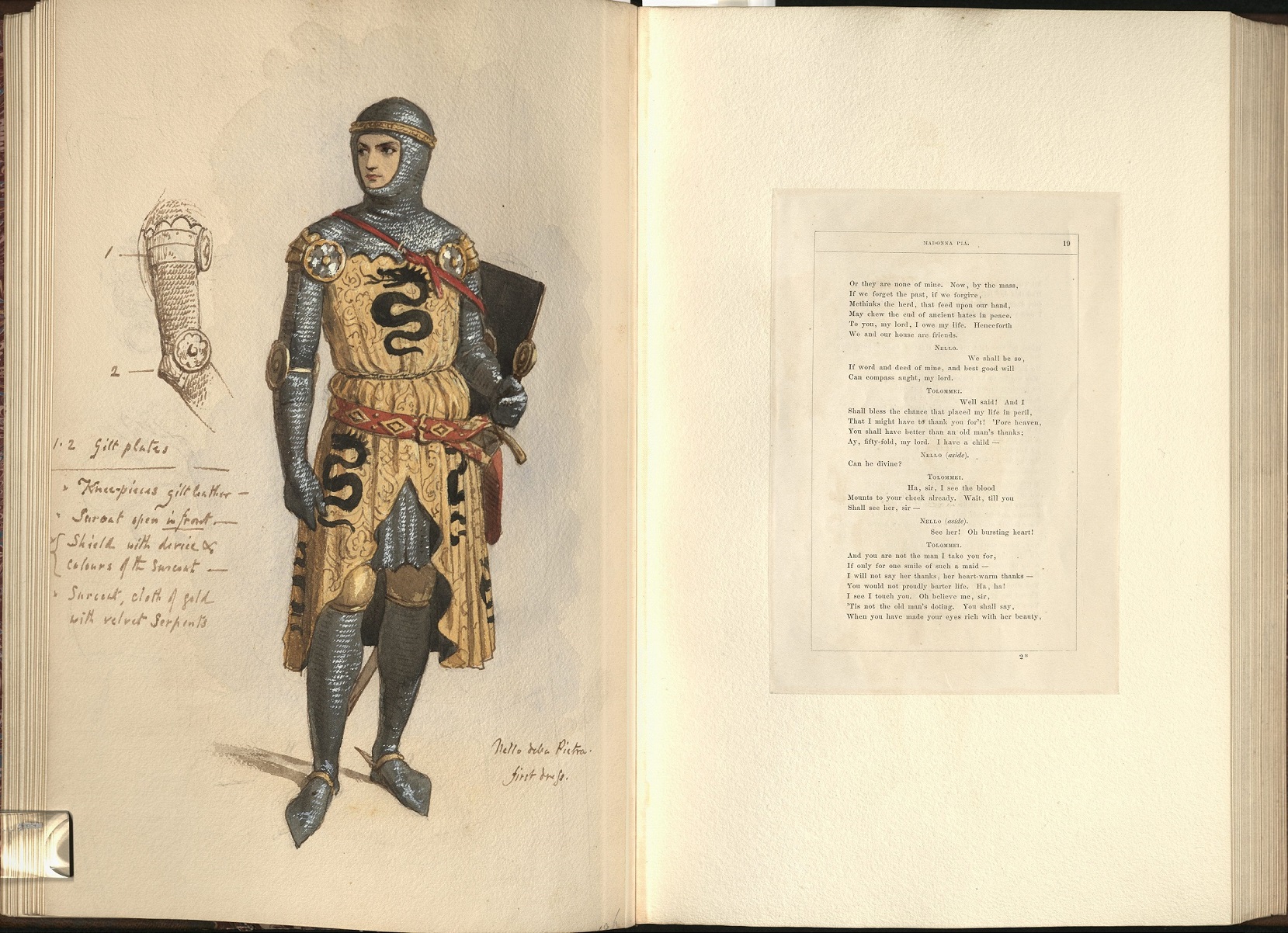
A more modest example of Burton’s artistry in watercolors resides at the Kenneth Spencer Research Library in a series of costume designs he made for a play by the writer Theodore Martin (more on this soon).

A native of Co. Clare, Frederic William Burton was born to a wealthy land-owning family. He moved to Dublin at ten and by sixteen had exhibited at the Royal Hibernian Academy.  His early career was as a miniaturist and portraitist, always working in watercolors.

Through his friendship with the Irish antiquarian, George Petrie, Burton was inspired to turn to the Irish landscape and consider Irish subjects in his paintings, as in his 1841 watercolor The Aran Fisherman’s Drowned Child.  

Burton’s connection to another friend, Thomas Davis, a leader of the nationalist Young Ireland movement, resulted in his contribution of the illustrated title page for The Spirit of the Nation (1845), an anthology of ballads and songs by Davis and other writers associated with periodical The Nation. At the time, however, Burton kept his contribution anonymous, reluctant to enter into the fray of politics. In a memorial tribute, Lady Gregory would recall that Burton had been in favor of Ireland’s union with England and did not share Davis’s nationalist politics, but that he had undertaken the title page to please his friend, “ there was nothing in the world he would not have done for Davis” [1].  Spencer Research Library’s multiple copies of The Spirit of the Nation deserve a St. Patrick’s Day post of their own.  The copy pictured below contains two inserted leaves of inscriptions of Young Irelanders Terence Bellew MacManus, Thomas Francis Meagher, Patrick O’Donohoe, and William Smith O’Brien, signed from Clonmel Gaol in Tipperary, following their 1848 attempted nationalist rising. The signature of O’Brien is visible on the leaf tipped in next to Burton’s illustrated title page.

Image of Burton's illustration design for The Spirit of the Nation (1845), with tipped in inscription by Willliam S. O'Brien, Clomel Gaol, November 1848
Burton’s illustration design in The Spirit of the Nation (1845), with tipped-in leaf inscribed by young Ireland leader William Smith O’Brien, in Clonmel Gaol, Nov. 1848. Dublin: Published by James Duffy, 23 Anglesea-Street, 1845. Call Number: O’Hegarty C458. Click image to enlarge.

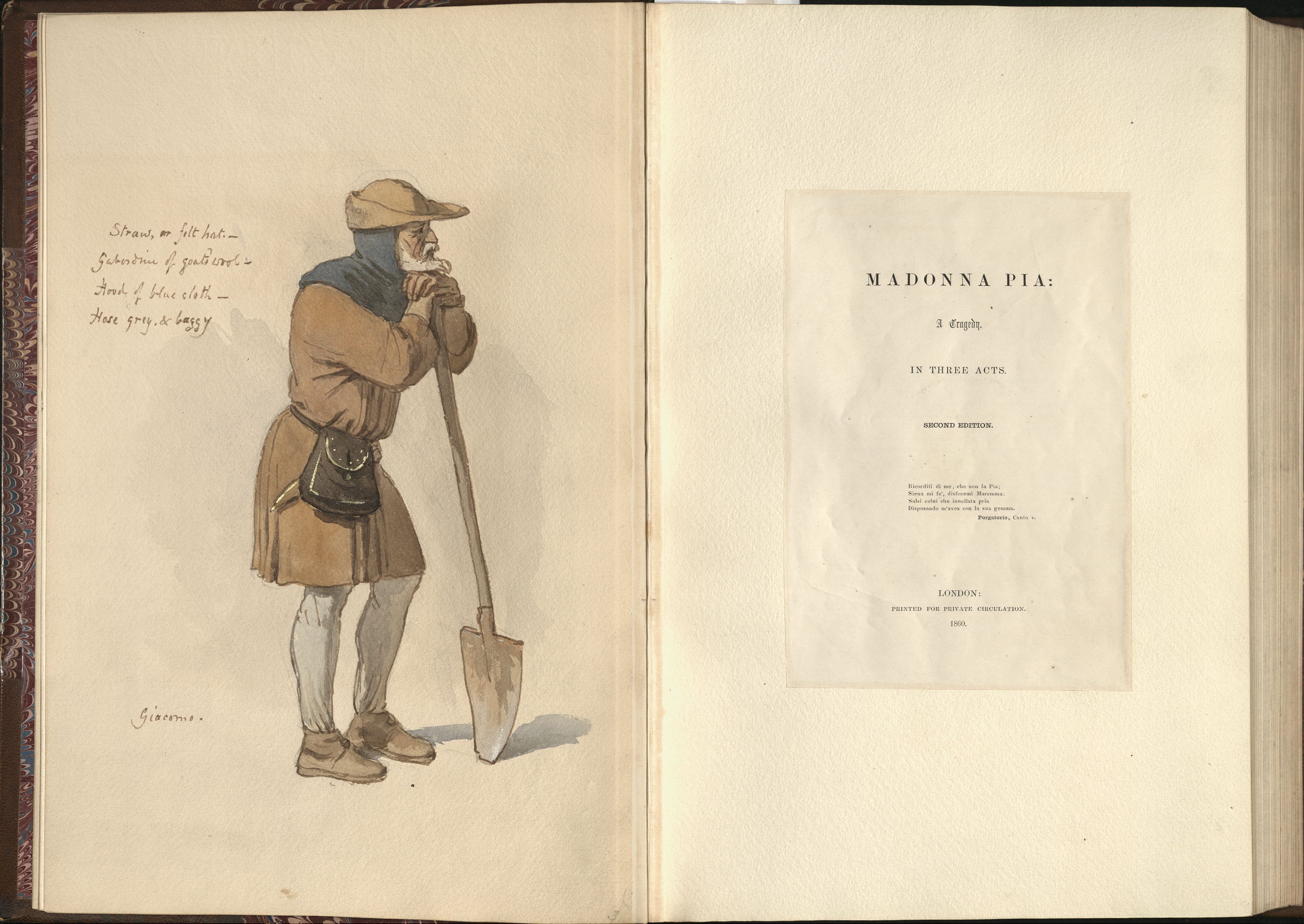
As noted earlier, Spencer Library’s collections also reveal another dimension of Burton’s career as an artist. We hold a copy of a special volume belonging to the attorney and writer Sir Theodore Martin (with his bookplate).  It comprises pages of the 1860 privately printed second edition of Martin’s play Madonna Pia: A Tragedy juxtaposed with 11 original watercolors of costume designs. Though the sketches are not signed, Martin included in his special volume a manuscript letter from the artist signed “FWB” alongside a portrait of Burton, signaling his identity as the artist. The letter was sent in November 1855, the date of the first edition of Martin’s play, from Munich, where Burton was serving as curator of the Royal collection for Maximilian II of Bavaria.

Image of the Madonna Pia title page with a watercolor and gouache painting of Giacomo's costume, with costuming notes
Frederic William Burton’s watercolor and gouache painting of the costume for “Giacomo.” [Munich, 1855], bound with the title page of Theodore Martin’s Madonna Pia (1860, second edition). Sir Theodore Martin Collection. Call Number: MS E184. Click image to enlarge.

In the letter, likely addressed to Martin’s wife, the actress Helena Faucit, Burton apologizes for the quality of his watercolors. He self-deprecatingly explains:

These hasty sketches are not indeed what I had intended – but just as I was engaged about them the Fine Arts were under a cloud from weather such as ever you Londoners need not have envied us. They are very scribbly & coarse — & I fear none of them will answer, – but you will gratify me by giving them to any little relatives you may have under five years of age to amuse themselves by sticking pins through them.

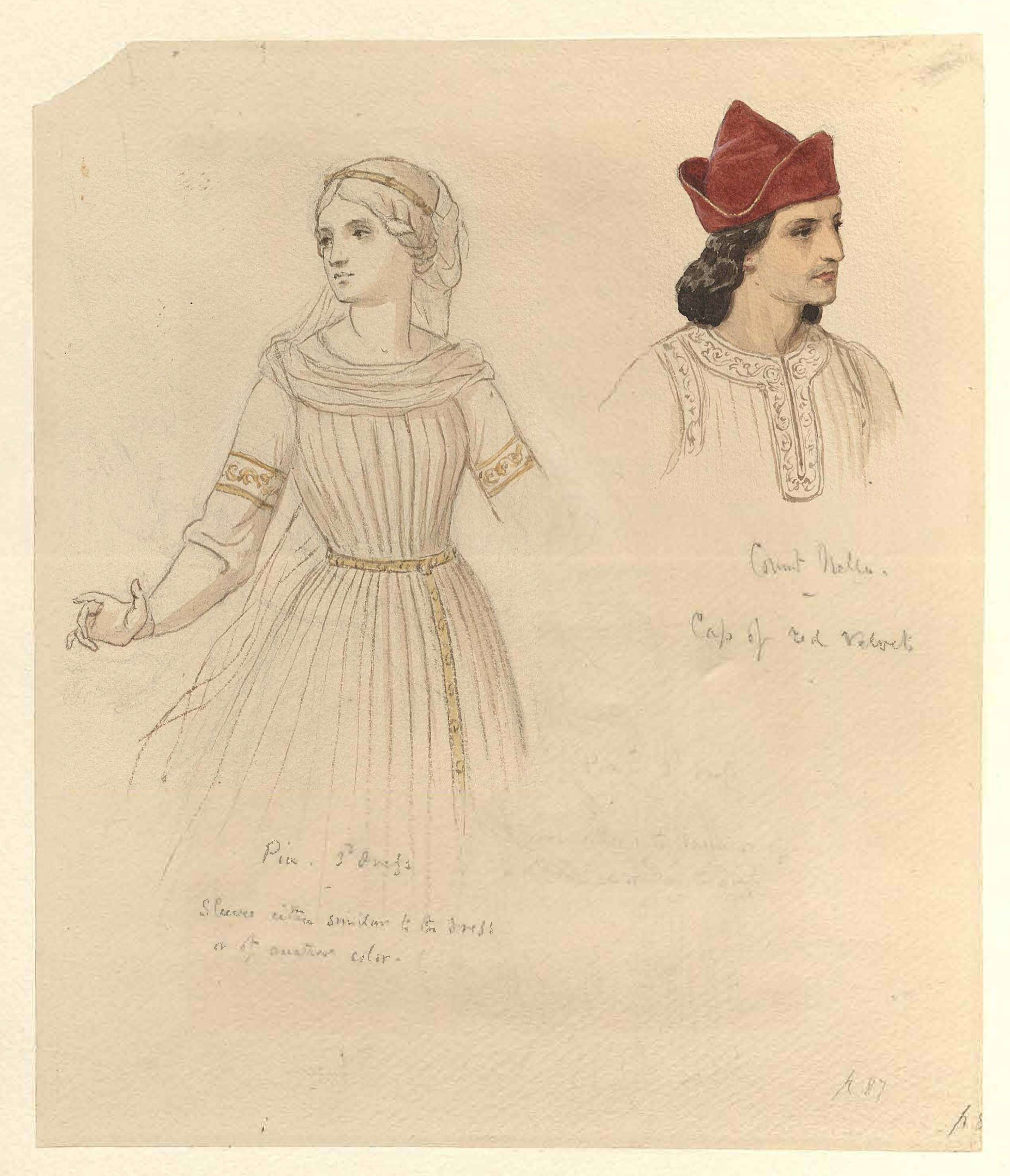
Frederic William Burton's watercolour and gouache painting of Madonna Pia in gold dress costume, with pencil notes on costuming
Pencil, watercolor, and gouache sketch of "Pia 3d Dress" and "Count Nello"
Burton’s watercolor and gouache painting and sketch of the costumes for “Madonna Pia / 2d dress” and “Pia 3d dress” and “Count Nello” [Munich, 1855], bound with Theodore Martin’s Madonna Pia (1860, second edition). Sir Theodore Martin Collection. Call Number: MS E184. Click images to enlarge.
Image of Frederic William Burton's watercolor and gouache costume painting for Nello della Pietra, with facing text
Frederic William Burton’s watercolor and gouache painting for the costume of “Nello della Pietra,” bound with Theodore Martin’s Madonna Pia (1860, second edition). Sir Theodore Martin Collection. Call Number: MS E184. Click image to enlarge.

Fortunately for us, Martin preserved the watercolors and bound them together with a later edition of his play.  Madonna Pia takes its inspiration from a passage in Dante’s Purgatorio to tell the story of Pia’s imprisonment and poisoning by her jealous husband, Count Nello della Pietra. It was a popular subject during the Victorian era; KU’s Spencer Museum of Art holds a later painting, Pia de’ Tolomei, by pre-Raphaelite artist Dante Gabriel Rossetti that references the same tale from Dante.

Three years after Frederic William Burton executed his “hasty sketches,” he took up residence in London. There, he was part of the circle of Rossetti and other Pre-Raphaelite artists, and it was during this time that he painted “Hellelil and Hildebrand, the Meeting on the Turret Stairs.” In 1874, Burton was made director of London’s National Gallery, and he retired from painting. Though he died in London on the day before St. Patrick’s Day in 1900, Burton returned to Ireland in death. He was buried in Dublin’s Mount Jerome Cemetery, and his work was exhibited at Dublin’s National Gallery later that same year.  In her remembrance, Lady Gregory wrote that despite his years spent abroad, which left him “almost forgotten” in Dublin, Burton’s “heart was Irish to the last” [2].

Come examine Frederic William Burton’s watercolor sketches for Madonna Pia at Spencer Research Library, and then continue on to explore other materials in our Irish Collections.  Not certain where to start? Take a glance at some past blog posts or explore our Irish Collections LibGuide.

Elspeth Healey
Special Collections Librarian

[1] Gregory, Lady Augusta.  “Sir Frederic Burton.” The Leader: A Review of Current Affairs, Politics, Literature, Art and Industry. Vol 1, no. 15 (8 December 1900): 231. Call Number: O’Hegarty E98.

[2] ibid.

Works consulted include:

Caffrey, Paul. “Burton, Sir Frederic William (1816–1900), watercolour painter and art administrator.” Oxford Dictionary of National Biography. September 23, 2004. Oxford University Press. Date of access 11 Mar. 2019, http://www.oxforddnb.com/view/10.1093/ref:odnb/9780198614128.001.0001/odnb-9780198614128-e-4127.

Clarke, Frances. “Burton, Sir Frederic William.” Dictionary of Irish Biography. James McGuire, James Quinn, Editors. Cambridge, United Kingdom: Cambridge University Press, 2009. http://dib.cambridge.org/viewReadPage.do?articleId=a1216.

Spencer Research Library and Archaeology

February 19th, 2019

This month’s temporary exhibit in Spencer’s North Gallery – titled “Spencer Research Library and Archaeology”features a collection of materials available through Spencer that could or have proven to be useful in archaeological research. Spanning from tomes written during the developmental days of archaeology as a science to modern articles on the forefront of archaeological investigations, the collections at Spencer Research Library offer a broad assemblage of knowledge not available through most library settings.

The first display case demonstrates the spectrum of resources available to archaeological researchers by highlighting a sample from each of Spencer’s collections. This includes documents of early Old World archaeology, books on regional archaeology, archaeological reports, and serial clippings and publications featuring archaeological findings and collections. Such materials are often used as supplementary materials in extant studies, though there is plenty potential for new studies to be conducted as well.

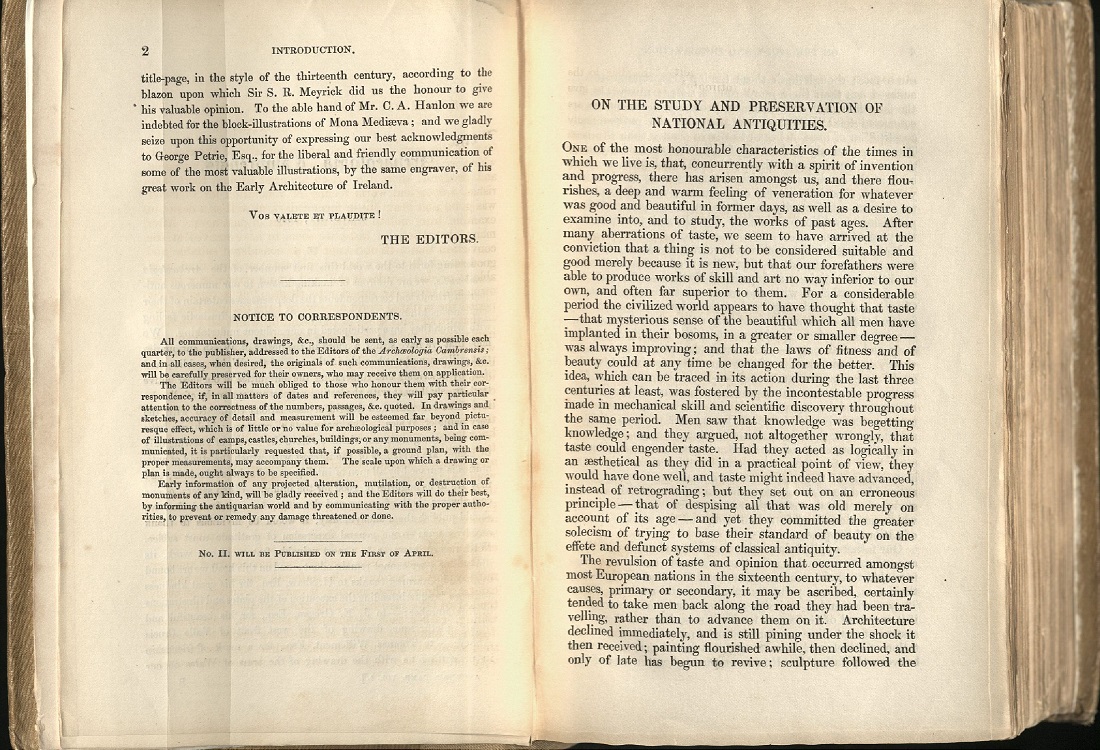
Image of pages from Archaeologia cambrensis, January 1846

Archaeologia cambrensis (Welsh Archaeology), volume 1, number 1, January 1846.
Published by the Cambrian Archaeological Association with the goal of interpreting cultural significance
over material value, Archaeologia cambrensis illustrates a transitional period
in the development of archaeology as a science. Call Number: C16530. Click image to enlarge.

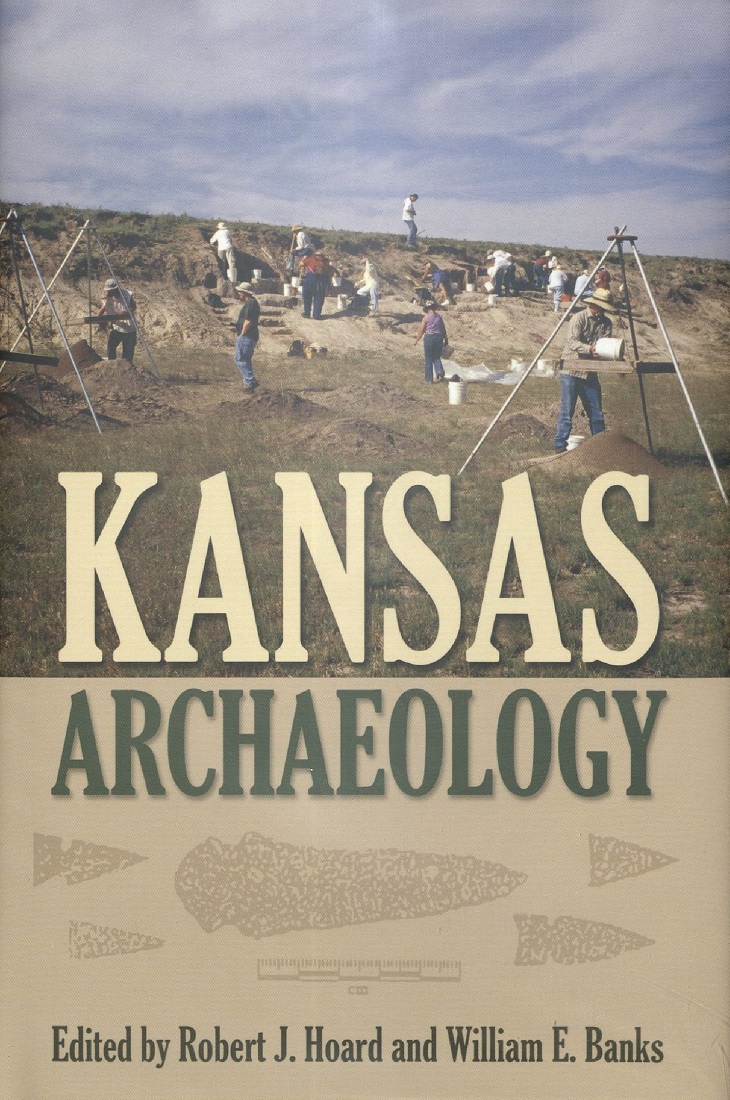
Cover of the book Kansas Archaeology, 2006

Kansas Archaeology, 2006. This work offers a broad perspective of the
archaeological history of Kansas. It is accessible to those with or without a
strong background in archaeology. Call Number: RH C11685. Click image to enlarge.

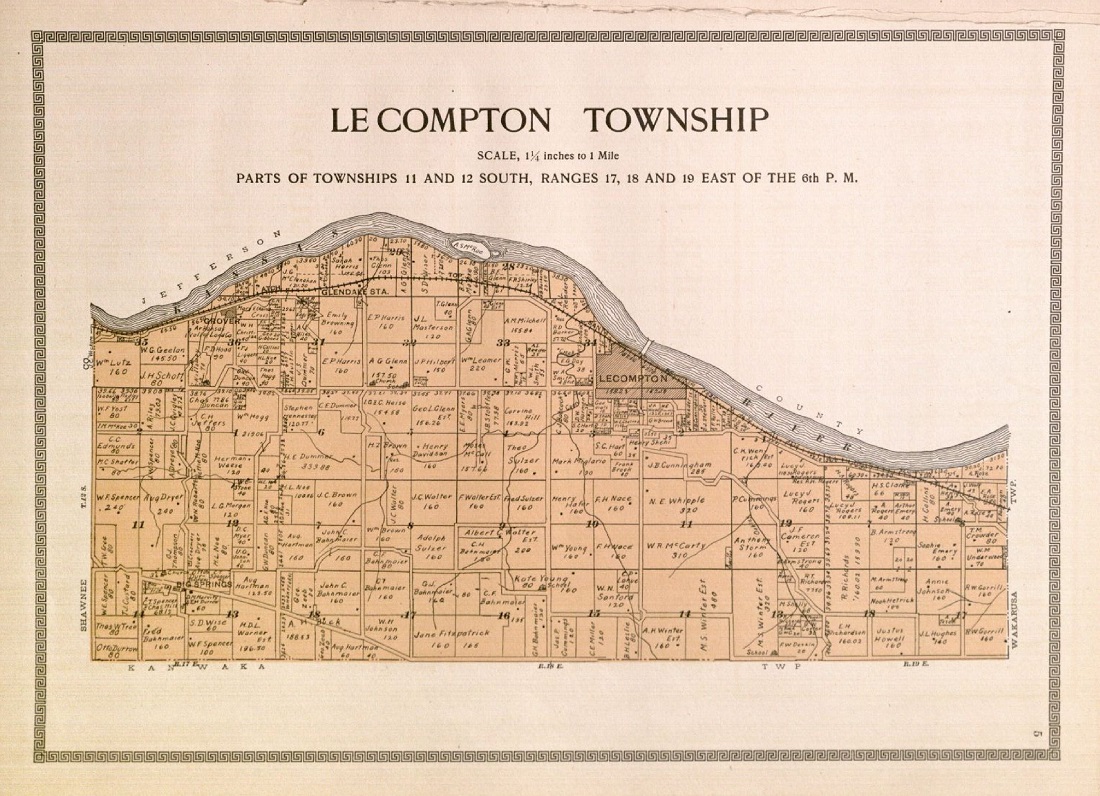
The second display case features materials available at Spencer Research Library that have been used in archaeological projects. One such project is the Douglas County Cellar Survey, known colloquially as the “Caves Project.” The Caves Project is a survey funded by the Douglas County Natural and Cultural Heritage Grant Program with the goal of locating and documenting stone arched cellars. The cellars (referred to as “caves”) – constructed from the 1850s into the 1920s – represent a cultural phenomenon unique to the region; thus, archaeologists hope to properly document these caves before they are lost to time. The Caves Project has utilized Spencer Research Library materials such as plat maps, deed records, and topical books on regional history.

Map of Lecompton Township, 1909

Plat map of Lecompton Township in Plat Work and Complete Survey of Douglas County, Kansas, 1909.
This map was used in the Caves Project to locate potential cave structures. In addition to
revealing site locations, the map was also superimposed with older plat maps of the same area to
indicate images that were no longer extant. Call Number: RH Atlas G32. Click image to enlarge.

Also included in the second display case is an artifact, known as a projectile point base, that comes from the Clovis Paleoamerican culture of North America. Likely a broken spear tip, this artifact is likely around 13,000 calendar years old. Found during a 1976 pedestrian survey of site 14DO137 near Clinton Lake in Douglas County, Kansas, this point base is one of the only remaining items left by some of – if not the – first people to ever walk in eastern Kansas. Reviewed as part of an ongoing survey of literature for the Caves Project, multiple archaeological reports indicated that the point was donated to the University of Kansas Archaeological Research Center. Thanks to their cooperation, the point has been loaned to Spencer Research Library for this current exhibit and, as seen below, three-dimensionally scanned. The point has been used in a number of archaeological investigations, including a report on the presence of Clovis people in southeastern Kansas by KU’s Dr. Jack Hofman.

https://sketchfab.com/3d-models/14do137-02823a31be3c479291888da220191b9a

Frank Conard
Spencer Research Library Public Services Student Assistant and KU Anthropology Major

Viagra is a world-renowned brand that helps millions of men worldwide – Buy Viagra without a prescription in the USA

Color Our Collections – Round 2!

February 6th, 2019

Color Our Collections logo, 2019

Color Our Collections is back! Started by the New York Academy of Medicine Library in 2016, Color Our Collections is a week of coloring craziness where libraries, archives, and other cultural institutions around the world share free coloring pages featuring their collection materials.

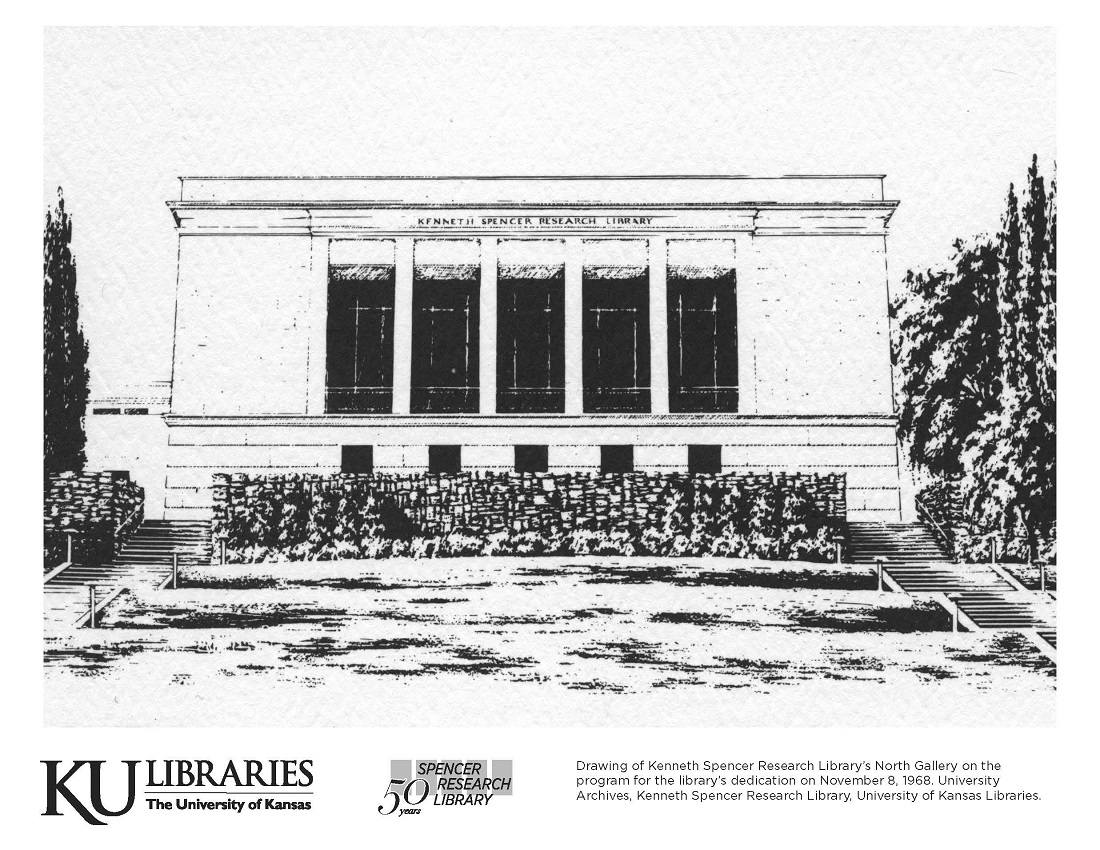
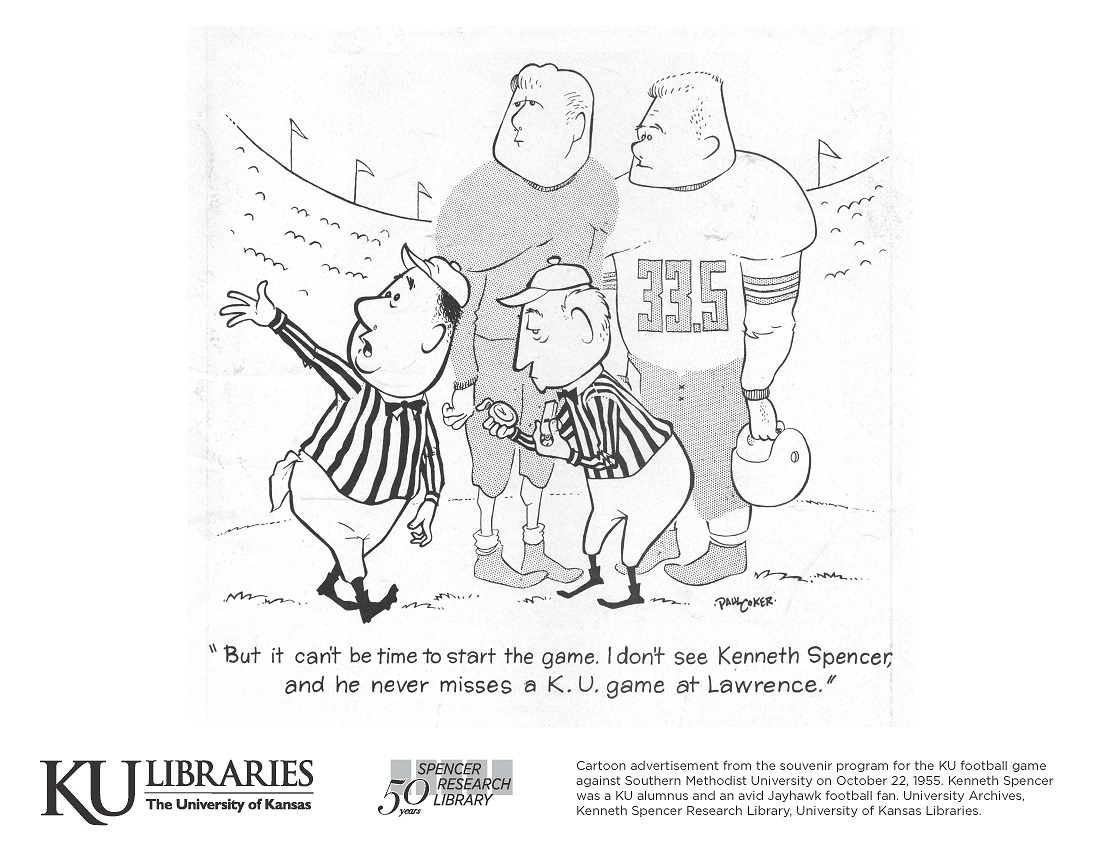
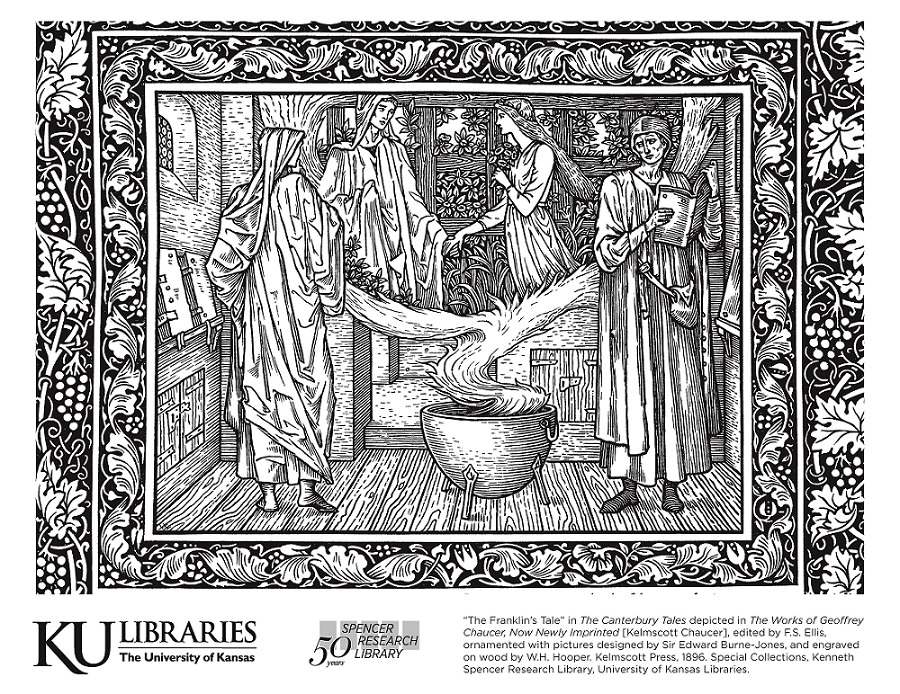
KU Libraries participated for the first time last year, and this year we have another coloring book to share! Featuring materials at the Spencer Research Library, this year’s book even includes two pages celebrating the Spencer’s 50th anniversary. You can download and print the book via the Color Our collections website. While you are there, be sure to check out the submissions from our colleagues at other institutions!

As a preview, here are three pages from the book.

Spencer Research Library image in the KU Libraries coloring book, 2019

Spencer Chemical and P&M advertisement in the KU Libraries coloring book, 2019

Kelmscott Chaucer image in the KU Libraries coloring book, 2019

Happy coloring, everyone!

Emily Beran
Public Services

January 1, 1804: Haiti Declares Independence

January 1st, 2019

January 1st is celebrated in both the United States and Haiti as the start of the New Year, but it is an important holiday in Haiti for another reason. January 1st is the day in 1804 that Haiti declared its independence from colonial rule. Freeing itself from French control, Haiti became the first nation to be founded by formerly-enslaved people having successfully revolted through a series of uprisings starting in 1791.

Haiti is the focus of the 2018-2019 KU Common Book, a shared reading experience that is part of the university’s First-Year programming. In the selected book, Create Dangerously: The Immigrant Artist at Work, the author Edwidge Danticat points out that the United States did not immediately recognize Haiti as a free state. Thomas Jefferson, President of the United States from 1801 to 1809, expressed concerns about the impact the slave revolt in Haiti might have on the U.S. A brief overview of the American political perspectives on the Haitian Revolution is available online from the Office of the Historian of the United States Department of State.

Historic maps often interestingly reflect a particular political perspective. The map shown below is from Spencer Research Library’s Special Collections. It is a map of the United States published in 1816 (and “improved to the 1st of January 1818”) in Philadelphia. The map includes “the contiguous British and Spanish possessions” and has an inset of the West Indies.

Image of the "Map of the United States with the Contiguous British and Spanish Possessions," 1816

Image of the title of the "Map of the United States with the Contiguous British and Spanish Possessions," 1816 Closeup of the title of the "Map of the United States with the Contiguous British and Spanish Possessions," 1816

The map (top) with closeups of its title (bottom), which reads as follows: “Map of the United States with the
contiguous British & Spanish possessions / Compiled from the latest & best Authorities by John Melish / Entered
according to Act of Congress the 6th day of June 1816. / Published by John Melish Philadelphia. / Improved
to the 1st of January 1818.” Call Number: N8 Orbis #127. Click images to enlarge.

An inset showing the West Indies on the "Map of the United States with the Contiguous British and Spanish Possessions," 1816

St. Domingo shown on the "Map of the United States with the Contiguous British and Spanish Possessions," 1816

An inset showing the West Indies (top) and a closeup of “St. Domingo” (bottom).
Modern-day Haiti occupies the western side of the island of Hispaniola.
The eastern side is the Dominican Republic. Hispaniola is part of the Greater Antilles
in the West Indies. Call Number: N8 Orbis #127. Click images to enlarge.

Although Haiti had established itself as a republic in 1804 and had discarded its former name as the French colony of Saint-Domingue, this American map from 1816 shows the entire island of Hispaniola labeled as “St. Domingo.” A “Statistical Table of the Several Countries Exhibited on the Map” (shown below) includes the states and territories of the United States and other countries with the subcategories of British possessions, Spanish possessions, and an unlabeled grouping that lists St. Domingo as controlled by “Natives,” Guadaloupe controlled by the French, St. Bartholomew controlled by the Swedes, and St. Thomas and Santa Cruz controlled by the Danes.

A statistical table shown on the "Map of the United States with the Contiguous British and Spanish Possessions," 1816 Closeup of a statistical table shown on the "Map of the United States with the Contiguous British and Spanish Possessions," 1816

The map’s statistical table. Call Number: N8 Orbis #127. Click images to enlarge.

It was not until 1862, during the presidency of Abraham Lincoln, that the United States government officially recognized Haitian independence.

Stacey Wiens
Reference Specialist
Public Services

The Hindu Coupons are designed to save you money when you shop online. This store offers a wide variety of products that are made by reputable brands. They often show a large number of coupon campaigns, which can save you a lot of money on items you would otherwise purchase. You can also get discounts on items if you spend a certain amount.