The University of Kansas

Inside Spencer: The KSRL Blog

Books on a shelf

Welcome to the Kenneth Spencer Research Library blog! As the special collections and archives library at the University of Kansas, Spencer is home to remarkable and diverse collections of rare and unique items. Explore the blog to learn about the work we do and the materials we collect.

‘Dead Coloring’ Revived Again: John Gould’s Hand-Colored Bird Lithographs

September 22nd, 2014

Over the centuries a number of techniques for creating graphic images have outlived their original technology, successfully migrating to new imaging technologies. I was recently reminded of this while planning Kenneth Spencer Research Library’s exhibition, “Ornithological Illustration in the Age of Darwin: The Making of John Gould’s Bird Books” (open September 11-November 15, 2014 on weekdays 9-5 and Saturdays 9-1, except October 11).

John Gould, an English ornithologist, published illustrated books about birds from 1830 until his death in 1881. The Library has recently digitized its holdings of Gould’s 47 large-format volumes, as well as nearly 2000 preliminary drawings, watercolor paintings, tracings, lithographic stones, and proofs.

When searching the new digital John Gould Ornithological Collection (accessible at the University of Kansas Libraries website at http://lib.ku.edu/gould), I happened to compare the published hand-colored print of the Horned Lark or Otocoris alpestris with the black printing image on lithographic stone. “What a great example of dead coloring!” I exclaimed.

Image of Otocoris alpestris / Horned lark

Otocoris alpestris / Horned lark. Lithographic crayon on stone by
John Gould and Henry Constantine Richter.
Reference: ksrl_sc_gould_2387.tif.
Call number: Gould Drawing 2387. Click image to enlarge.

Image of Otocoris alpestris / Horned lark

Otocoris alpestris / Horned lark. Lithograph and watercolor by
John Gould and Henry Constantine Richter.
Reference: ksrl_sc_gould_gb_1_3 (n77).
Birds of Great Britain, 1st edition, volume 3, plate 18.
Call number: Ellis Aves H131. Click image to enlarge.

So what is dead coloring? It involves underpainting shapes in a neutral hue, then finishing the oil painting with transparent colored glazes, and was often used by late-18th-century English painters. Early painters in watercolor, a medium gaining popularity in England during the late 18th century, employed a similar approach.

However, dead coloring also had a place in European printmaking. Mezzotint and aquatint, new methods of intaglio printmaking capable of the tonal gradations necessary for dead coloring, were invented in the mid-17th century and increased in use thereafter. John James Audubon’s hand-colored aquatints of American birds published in the early 19th century were outstanding examples.

During the early 19th century yet another new printing technology, lithography, spread from Germany, where it had been invented in 1798, across Europe to England. Working with a waxy crayon on a block of lithographic limestone with a fine-textured surface was similar to drawing on rough-textured paper. The lithographic crayon caught on the tips of the grained stone surface, creating a random pattern of irregular dots. Viewed with the naked eye, the tiny dots merge into shades of gray.

Lithographic drawing was much easier to learn than mezzotint and aquatint and was the obvious choice for illustrating John Gould’s ornithological books. Elizabeth Gould (his wife), an amateur artist, rapidly mastered crayon lithography under the tutelage of Edward Lear, a younger but more experienced artist employed by Gould. She illustrated Gould’s books until her death in 1841, after which he employed a succession of professional artists.

Image of Melanopitta sordida

Melanopitta sordida. Watercolor and lithographic crayon drawing by
William Hart. Reference: ksrl_sc_gould_1264.tif.
Call number: Gould Drawing 1264. Click image to enlarge.

Image of Melanopitta sordida

Melanopitta sordida. Colored lithographic proof by
William Hart. Reference: ksrl_sc_gould_1265.tif.
Call number: Gould Drawing 1265. Click image to enlarge.

Artist William Hart executed his drawing of Melanopitta sordida in lithographic crayon and watercolor, thus rehearsing his final drawing on lithographic stone for printing and hand coloring. Colored by hand using watercolors, Gould’s lithographic prints are successful examples of dead coloring. By the time of Gould’s death in 1881, color printing was taking over the reproduction of graphic images, bringing the hand-colored lithographic revival of dead coloring to a close.

Karen S. Cook
Special Collections Librarian

Vivak Exhibition Cradles

September 8th, 2014

Soon, Spencer Library will unveil its latest exhibition, on the work of John Gould and his atelier. Conservation Services staff support exhibition design by helping the curators present the items in their best light. For bound volumes this work often involves the construction of a supportive cradle.

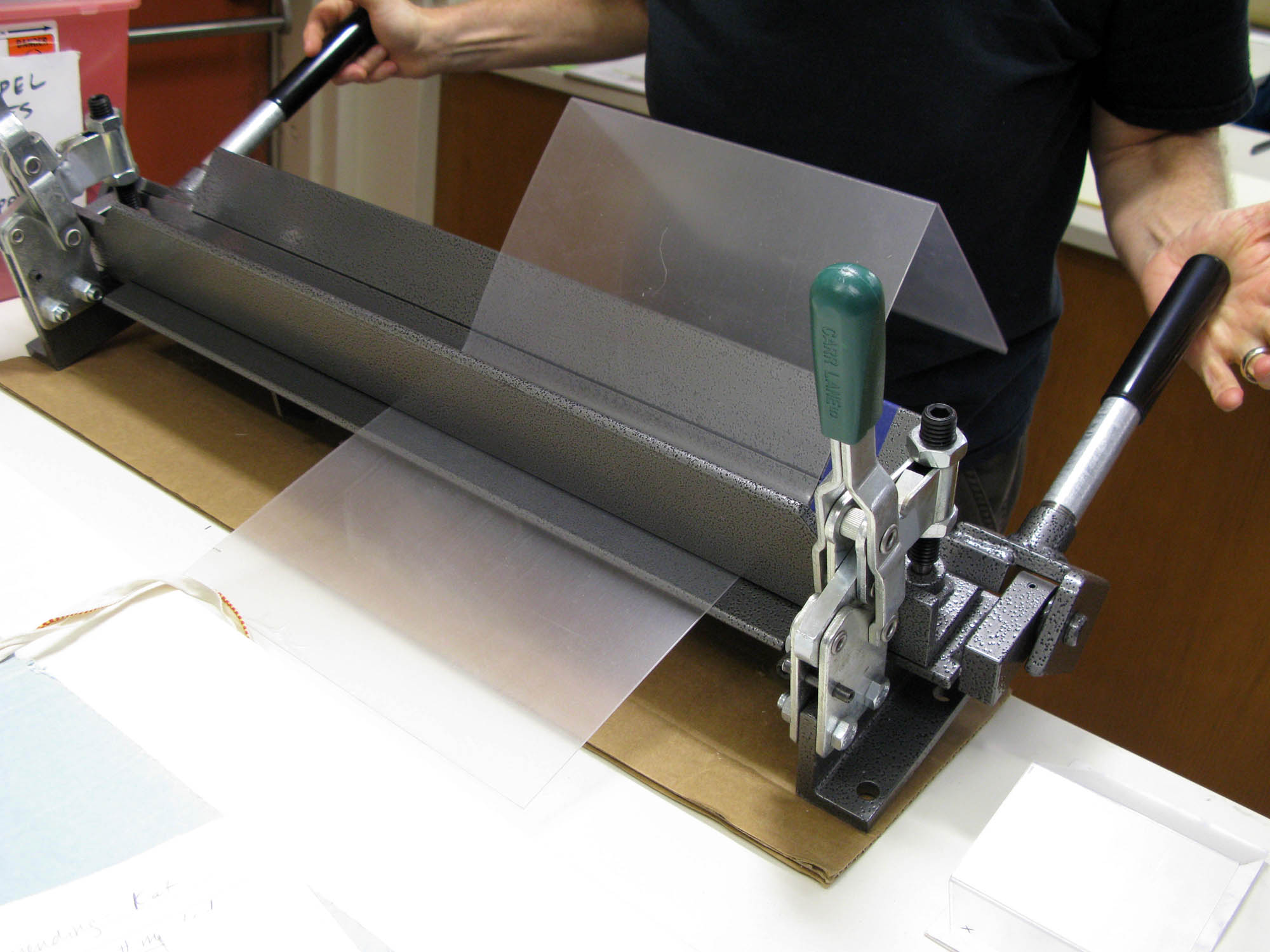
Many library conservation labs construct cradles and supports from Vivak, a transparent, cold-bendable, PETG plastic. Unlike the more traditional Plexiglas, Vivak can be cut on our board shear (no scoring required).

Cutting Vivak to make exhibit cradle.

Cutting a piece of Vivak on the board shear.

Once the sheet is cut, the locations for bending are transferred from a paper template to the Vivak sheet. Vivak comes with a protective plastic film that is left in place until the final installation to prevent scratching of the soft plastic.

Transferring paper template marks to the Vivak.

Transferring marks from a paper template to the Vivak.

The plastic can be bent by hand, but we use a sheet metal bender to make the process easier. Plexiglas requires heat to bend, so we are happy to avoid that step and the accompanying fumes that result. Making cradles with Vivak is much quicker and less toxic.

Using sheet metal bender to bend Vivak for cradle.

Bending the plastic using a sheet metal bender


Completed Vivak book cradle.

A finished Vivak cradle.

Vivak is not as sturdy as the Plexiglas we used to use, but if stored properly cradles can be reused for multiple exhibits.

Whitney Baker
Head, Conservation Services

Kangaroos on Machu Picchu?

August 29th, 2014

The late marsupialist John A.W. Kirsch was interviewed by a local (Peruvian) newspaper while on a collecting trip in South America back at the end of the 1960s. He described the kinds of animals he was looking for and was shocked to see the headline a few days later: KANGAROOS ON MACHU PICCHU.

While it’s true that the mammal group we call marsupials includes the kangaroos, wallabies, wombats, koalas, and bandicoots that are usually associated with Australia, and that the New World once did boast a rich and diverse marsupial fauna, most of the New World forms are now extinct and, sad to say, there are no kangaroos on Machu Picchu.

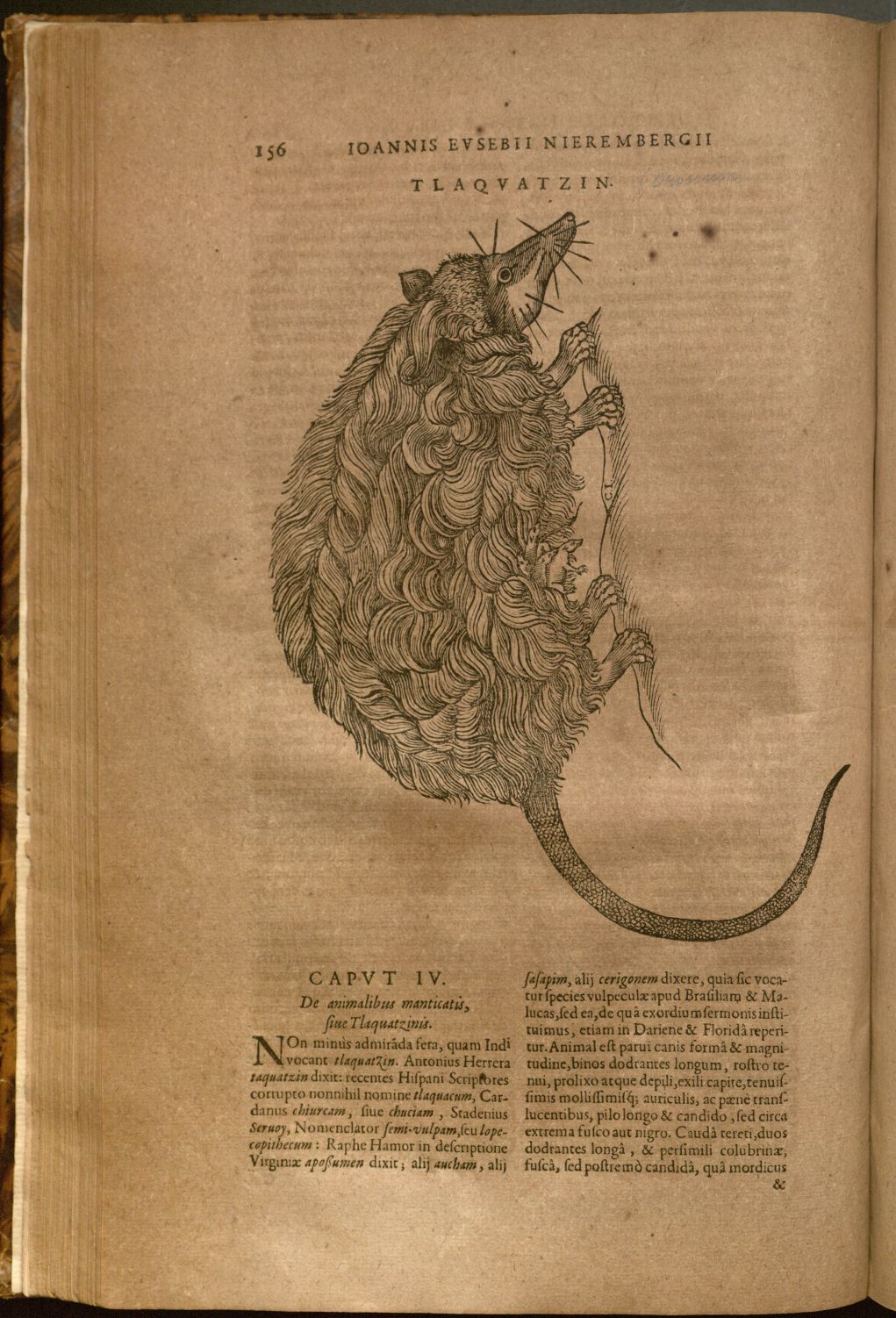
Image of an Opossum from Nieremberg's Historia naturae (1635).

Opossums (and yes, there are several pictured above): Juan Eusebio Nieremberg (1595-1658).  Historia naturae. Antverpiae: ex Officina Plantiniana Balthasaris Moreti, 1635. Call Number: Summerfield E1105. Click image to enlarge (and reveal the well-camouflaged opossum young.)

The marsupial heyday began to end circa three million years ago when a land bridge over the Isthmus of Panama provided for northern migration of animals including the ancestors of our familiar opossum, who dates back to around 35 million years ago and looks today pretty much the same as he did then. During the same period, some of the northern placental mammals migrated south over the same land-bridge. Thus, for example, it appears that the placental sabre-toothed tiger from the North began to compete with the marsupial sabre-toothed tiger and soon put him on the road to extinction. But the marsupials are survivors, nevertheless, and the American opossum, the only one of the family in North America, is just one of seventy some opossum species to survive; the ‘possum family is restricted to the New World, and except for Didelphis virginiana, whose range extends from southern Canada into Central America, the rest of the family is restricted to Central and South America.

Earlier travel accounts and herbals had described the plants and animals of the New World, but Juan Eusebio Nieremberg’s account was the first comprehensive natural history of the area, dealing primarily with Mexico and the West Indies. This illustration of the Virginia or American opossum is the earliest printed portrait of the earliest discovered (by Europeans, at least) marsupial anywhere.

Sally Haines
Rare Books Cataloger

Adapted from her Kenneth Spencer Research Library exhibit, The Haunted Forest: New World Plants & Animals (1992).

Collection Snapshot: A Book of Polish Costume

August 8th, 2014

A number of works in the Kenneth Spencer Research Library’s collection of Polonica are a good source for the study of Polish costume: the chromolithographs by Racinet, engraved colored plates by Jacquemin, colored and uncolored plates in the two volumes of Zaydler, and plates in the costume books by Kretschmer and Vecellio.

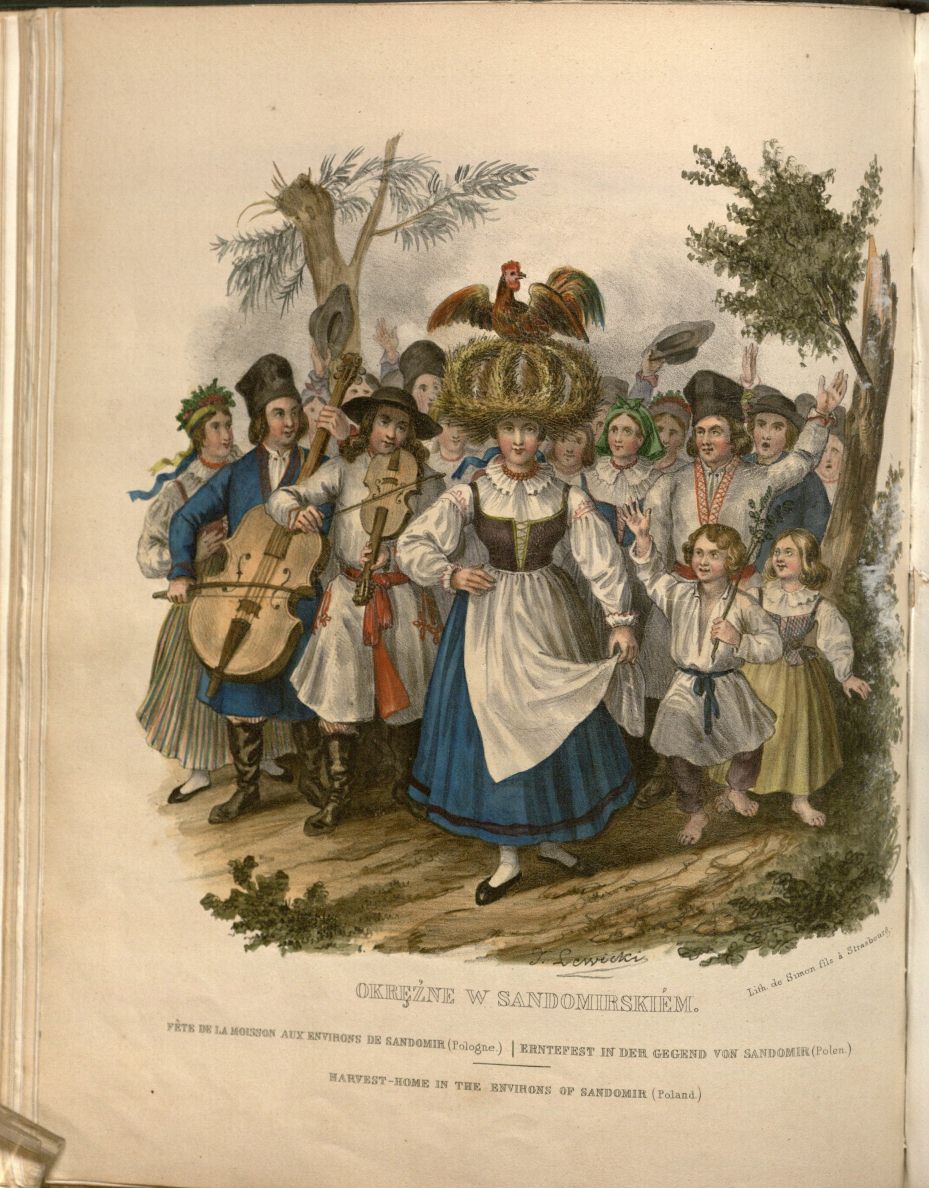
image of the plate "Harvest-home in the environs of Sandomir"

“Harvest-home in the environs of Sandomir” from Jozef Zienkowicz’s Les costumes du peuple Polonais.  A Paris: Librairie Polonaise; A Strasbourg: chez l’éditeur; A Leipzig: chez F.A. Brockhaus, 1841.  Call Number: D819. Click image to enlarge.

The colored lithographs of Zienkowicz’s Les costumes du peuple Polonais are particularly interesting: “Harvest-home in the environs of Sandomir” (above) illustrates the rich harvest tradition of a country that until recently was primarily agricultural. Poles today celebrate an annual Harvest Festival in early September.  In olden days the best girl reaper would bestow on the master of the house the gift of a wreath of wheat and rye adorned with flowers, fruits, and ribbons; feasting and merry-making followed the ceremony. Although folk costumes are not now in general use in Poland and are worn mostly for festivals and national celebrations, Poles in rural areas wear folk dress on church holidays and for family celebrations such as weddings.

Sally Haines
Rare Books Cataloger

Adapted from her Kenneth Spencer Research Library exhibit, Poland: A Thousand Springtimes.

Anger

May 23rd, 2014

Aesop’s fables are directly descended from the 11th century Physiologus of Theobaldus and other medieval bestiaries, or treatises on birds and beasts who were blessed with certain moral, physical, and mental attributes.They were largely the creations of early Christian teachers and were a mix of natural history and Gospel Truth with snippets of folk-lore, travellers’ tales, and dimly understood scientific ideas thrown in, served up with all the authority of the Church behind them. They have continued to be popular long after they ceased to be used for religious instruction, and as has oft been pointed out, there’s a lot of “zoology” in them, and thus, they do deserve a niche in the history of science.

Howitt, Samuel. A New Work of Animals, 1818. Call number Ellis Aves E102. Kenneth Spencer Research Library, University of Kansas.

Howitt, Samuel. A New Work of Animals, 1818. Call number Ellis Aves E102. Kenneth Spencer Research Library, University of Kansas.
Text excerpt (top) and accompanying plate (bottom) from Howitt, Samuel. A New Work of Animals, 1818.
Call number Ellis Aves E102. Click images to enlarge.

Among the chief emblems of the original Physiologus were numerous herps including the sun lizard, viper, serpent, sea-tortoise, crocodile, frog, and salamander. In this fable about porcupine and snakes, there’s no bias against snakes; both herp and mammal behave badly.

Sally Haines
Rare Books Cataloger
Adapted from her Spencer Research Library exhibit and catalog, Slithy Toves: Illustrated Classic Herpetological Books at the University of Kansas in Pictures and Conversations

¿Habéiss oído hablar del medicamento comprar levitra online, entrega en 24 horas? La gente no podía imaginar su vida sin este medicamento, que les brinda confianza y la capacidad de pasar un tiempo inolvidable con su querida pareja.