The University of Kansas

Inside Spencer: The KSRL Blog

Books on a shelf

Welcome to the Kenneth Spencer Research Library blog! As the special collections and archives library at the University of Kansas, Spencer is home to remarkable and diverse collections of rare and unique items. Explore the blog to learn about the work we do and the materials we collect.

All Creeping Things: A History of Herpetological Illustration

May 26th, 2015

All Creeping Things: A History of Herpetological Illustration, Spencer Library’s newest exhibit, opened on May 14, 2015. Guided by Special Collections Librarian Karen Cook, students Megan Sims, Sydney Goldstein, and Ryan Ridder created and installed the exhibit for an exhibit planning and design course (MUSE 703). Whitney Baker, Head of Conservation Services at KU Libraries, Special Collections Librarian Sally Haines, and Caitlin Donnelly, Head of Public Services at Spencer, also assisted the students with their project.

The exhibit was developed in conjunction with the Society for the Study of Amphibians and Reptiles conference being held at the University of Kansas in July and features herpetological illustrations from seventeenth-, eighteenth-, and nineteenth-century books in Spencer Library’s Special Collections. Spencer has put on a few iterations of a similar exhibit for previous conferences. Each student had a unique perspective on their experience creating the exhibit.

Ryan Ridder

“One of our goals was to be distinct from Slithy Toves [a previous exhibit, by Sally Haines] and to present images that viewers familiar with that exhibition, and associated book, might not see as often. We ended up repeating a few irresistible images – the giant salamander, Agassiz’s turtles, and the famous frontispiece to Rössel von Rosenhof’s frog volume – but everything else you see is different. We thought touching on embryological illustrations would give our exhibit another unique slant.”

Photograph of Megan and Ryan installing books

Megan Sims and Ryan Ridder installing books in the cases. Click image to enlarge.

Sydney Goldstein

“I found this class to be both an overwhelming and an incredibly eye-opening experience. Coming from a graphic design background I’ve never gone through the steps of curating an exhibition or working off the computer. It was fun to rummage through a variety of books to select illustrations, figuring out how they will fit in the cases, selecting wall graphics, and working in a group. The most rewarding part was applying our vinyl title graphic ourselves. Overall, a great experience!”

Photograph of the MUSE 703 group hanging vinyl

Megan, Sydney, and Ryan hanging the vinyl title graphic.

Megan Sims

“I have installed many exhibits according to specific designs from clients, but this was my first experience selecting objects, designing signs and labels, and fabricating book mounts and wall graphics for an exhibit. Both the physical process and communication were challenging at times, but seeing the finished product was very rewarding. I’m excited for the conference members and the Lawrence community to see this exhibit!”

Photograph of the MUSE 703 exhibit team in front of title

Ryan Ridder, Sydney Goldstein, Megan Sims, and curator Karen Cook. Click image to enlarge.

All Creeping Things is free and open to the public through August 2015.

Megan Sims
Museum Studies Graduate Student

Love Apples: Guess the Fruit

March 30th, 2015

The first fruits (berries, botanically speaking) of these vines to be eaten in Europe were probably yellow varieties: “golden apples” the Italians called them. The Italians loved them, but the rest of the world needed more convincing of their merits because they were thought to be either poisonous or aphrodisiac “love apples”, not too surprising considering their resemblance to other dangerous members of the same plant family.

At any rate, as late as the nineteenth century in America Dr. George Washington Carver, interested in improving nutrition among the poor, got up on a stage and ate these in public in order to prove that they were not poisonous.

In the annals of medical mysteries there was a case involving one of these ‘berries’ that killed off some folks; mystery solved when it was discovered that its stems had been spliced to the stems of one of the poisonous members of the family, jimsonweed, not with any mal-intent (pun intended), apparently, just the desire for bigger, better, and juicier.

They should have waited; genetic engineers are now splicing away, but at the genetic level. But … caveat emptor:  in 1992, just prior to the mounting of the Haunted Forest exhibition in which this label originally appeared, the first President Bush announced that the government would allow the sale, without government testing – by 1993 – of the Flavr Savr, courtesy of Calgene, Inc. of Davis, California. Long story short, the experiment failed: rising costs prevented the company from becoming profitable, and the Flavr Savr was gone by 1997.

Have you guessed the identity of the fruit whose vine is pictured below?

The name of this common berry is… TOMATO (highlight the blank space to the left to reveal the plant’s name).

Plate for Solanum lycopersicum  (tomato) in  Kniphof's Botanica in originali seu Herbarum vivum (1757-1767).

Our mystery berry: Solanum Lycopersicum. Johann Hieronymus Kniphof (1704-1763). Botanica in originali
seu Herbarum vivum
. Hallae Magdeburgicae, 1757-1767.  Centur. 4, 1758. Linnaeana E15 Click image to enlarge.

This unusual-looking botany book is one of the earliest, if not the first work of any extent, to use the process known as nature printing, by which a plant is laid out flat, blackened with printer’s ink, and placed between two pieces of paper to which pressure is applied. The ink imparts an impression of veins and fibers which is then colored by hand. Like a number of the works shown in this exhibition, this is one of considerable bibliographical complexity and it exists in fewer than fifteen copies, not all of which are colored and no two appear to be alike. This herbarum vivum is notable for being perhaps the first botanical plate book to cite Linnaeus’s Species plantarum, 1753, in which binomials were first used consistently for naming plants.

Title page, featuring nature printing, for Centur III-IV of Kniphof's Botanica in originali seu Herbarum vivum

Title page for Centur III-IV of Kniphof’s Botanica in originali seu Herbarum vivum.
Hallae Magdeburgicae, 1757-1767.   Linnaeana E15 Click image to enlarge.

Sally Haines
Rare Books Cataloger

Adapted from her Kenneth Spencer Research Library exhibit, The Haunted Forest: New World Plants & Animals (1992).

Exhibiting Free Speech: The Wilcox Collection at 50

March 16th, 2015

This post is written to highlight the current exhibit at Spencer Library: Free Speech in America: The Wilcox Collection at 50. A reception will be held on March 25 at Spencer Library to celebrate the Wilcox Collection.

Fifty years ago Laird Wilcox was a student at the University of Kansas. He had started collecting political literature in his teen years, fueled in this interest by his diverse family leanings and volatile discussions over family meals. He wanted to understand what motivated people to believe the things they did and act on those beliefs.

In 1964 Laird entered and won the Elizabeth Taylor Book Collecting Contest sponsored by the KU Libraries. The Libraries purchased his collection in 1965 (then four filing cabinets of materials). Today the Wilcox Collection of Contemporary Political Movements is one of the largest assemblages of left and right wing U.S. political materials anywhere. There are thousands and thousands of pamphlets, books, newsletters, audio recordings, and political ephemera such as bumper stickers, posters, flyers, organizational membership mailings, and book catalogs, relating to some 10,000 organizations at the fringes of the political spectrum. There is also a growing component of manuscript collections as well, including Laird Wilcox’s personal papers.

1964 Contest Winners Laird Wilcox, Lawrence Morgan, and Jerry L. Ulrich, with Elizabeth M. Taylor.

The winners of the Taylor Book Collecting Contest, KU Libraries, 1964. Laird Wilcox, far left, and Elizabeth M. Taylor (sponsor of the contest), second from left. University Archives. Call Number: RG 32/40. Click image to enlarge.

Laird Wilcox in Wilcox Collection stacks, University of Kansas Libraries

Laird Wilcox standing in the Wilcox Collection stacks, Kenneth Spencer Research Library, KU, 1996. University Archives. Call number: RG P/LW. Click image to enlarge.

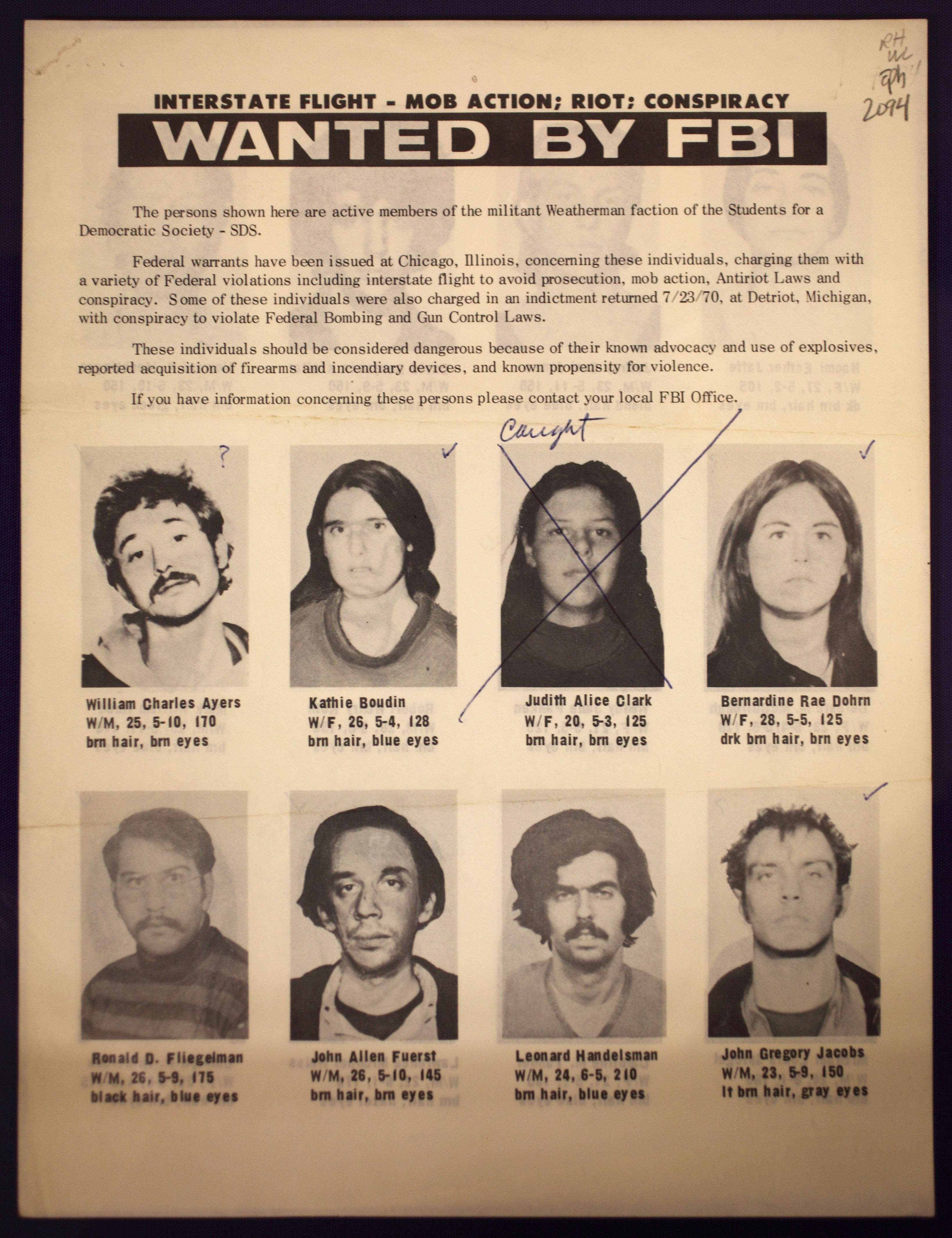
In 2015 an exhibit was mounted in Spencer Research Library to commemorate the 50th anniversary of the Wilcox Collection. The exhibit includes examples of books, newsletters, and ephemera, and highlights some of the many books that have resulted from research in the collection. Materials from the collection include items from a scrapbook that Laird kept as chair of the Student Union Association Minority Opinions Forum, a FBI wanted poster with photos of Bernadine Dohrn and William Ayers from the ephemera file of the Weather Underground, and examples of Laird’s many publications.

Flyer from Wilcox Collection depicting American flag

Poster for a documentary film shown at KU in 1964 focusing on the Committee on Un-American Activities (HUAC). From the Laird Wilcox scrapbook. Kansas Collection. Call number: RH WL MS Q5. Click image to enlarge.

Wanted poster from Wilcox Collection, University of Kansas Libraries

FBI wanted poster from the ephemera file of the Weather Underground which operated as an underground urban guerilla force. Kansas Collection. Call number: RH WL EPH 2094. Click image to enlarge.

One of the strongest features of the Wilcox Collection is ephemeral materials, including bumper stickers, buttons, and flyers. Because of their “throw-away” nature ephemera are often overlooked as an information source, but can provide the original message of the creator in a way that is often concise and colorful.  On display are materials from the National Youth Alliance, Community Churches of America, the American Education Lobby, the Lesbian/Gay Labor Alliance, the Student Mobilization Committee to End the War in Vietnam, T.R.A.I.N. (To Restore American Independence Now), Phyllis Schlafly’s Eagle Forum, Phoebe Courtney’s Tax Fax, and The Fact Finder published by Harry Everington. There are more than 200,000 pieces of ephemera in the Wilcox Collection.

Ephemeral materials from Wilcox Collection, Spencer Research Library, University of Kansas

Representative ephemera from the Wilcox Collection. Kansas Collection. Call number: RH WL EPH. Click image to enlarge.

The Wilcox Collection is a prime example of one of the world-class collections that reside within the Kenneth Spencer Research Library. Researchers from many parts of the globe have traveled to the KU campus to view this collection, an opportunity that is easily available to KU’s students and faculty.

Rebecca Schulte
University Archivist and Curator, Wilcox Collection

Sherry Williams
Curator of Collections and Curator, Kansas Collection


Appellation Spring

January 13th, 2015

Linnnaeus (whose citation at the end of a binomial is simply “L.”) invented a practical system for the classification of plants and animals; more importantly, he established a uniform method of referring to species by two Latin words–a reform that led eventually to binomial nomenclature. Although his classification system was superseded, his principles of nomenclature continue to provide the rules for application of names to thousands of species of animals and plants newly identified every year. Volume 1, Animalia, of the tenth edition of the Systema Naturae (1758), is one of the most important books in the history of science, for it marks the beginning of the modern zoological nomenclature and systematics. In it, Linnaeus first consistently applied binomial nomenclature to the whole animal kingdom.

Linneana B65 v.6:146

Image from Siren lacertina, 1766. Linneana B65 v.6:146, Special Collections

Unfortunately the great Linnaeus had little love for herps, thought them “disgusting,” and would have done well to adopt the classifcation system of John Ray. We quote, in rough translation, from the Systema: “Amphibia are loathsome because of their cool and colorless skin, cartilaginous skeleton, despicable appearance, evil eye, awful stench, harsh sound, filthy habitat, and deadly venom; and so God has not seen fit to create many of them.” Many of Linnaeus’s descriptions were based on those in books by Aldrovandus, Seba, Catesby, Jonstonus, and others. His use of the word “Amphibia” denoted not only all reptiles and amphibians, but also the cartilaginous fishes.

This work is the doctoral dissertation of one of Linnaeus’s students; it was the tradition of the day for a professor to write the thesis, but the student “respondent” had to defend it and pay for its publication.

Sally Haines
Rare Books Cataloger
Adapted from her Spencer Research Library exhibit and catalog, Slithy Toves: Illustrated Classic Herpetological Books at the University of Kansas in Pictures and Conservations

Imagination; Or, the Herp is in the Eye of the Beholder

September 29th, 2014

When it comes to creating an exhibition of illustrated books with a biological theme, a fabulous sea monster can be almost anything in the eye of the creator, and by power of suggestion, in the eye of the beholder. Some historians of biology have suggested that the basis-in-fact for the Scandinavian sea monster, Bishop Pontoppidan’s kraaken in this case, was a whale, so the image was used in a past show of whaling books in the Spencer Library. But Moby Dick‘s author, Herman Melville, as well as marine biologist Jacques-Yves Cousteau, thought it more likely that the real basis for the legends was the giant squid. For purposes of this post, it’s a sea serpent, but we intend to keep it in mind for our up-and-coming Squid Exhibit.

Erik Pontoppidan (1698-1764). The natural history of Norway. London: 1755. (Ellis Aves E333)

Image from Erik Pontoppidan (1698-1764). The natural history of Norway. London: 1755.
Call number: Ellis Aves E333, Special Collections.

The Danish original of this natural history was published in Copenhagen (1752-1754), and is of interest chiefly for its accounts of the myths connected with whales and other natural curiosities such as the fabeled kraaken.

Sally Haines
Rare Books Cataloger
Adapted from her Spencer Research Library exhibit and catalog, Slithy Toves: Illustrated Classic Herpetological Books at the University of Kansas in Pictures and Conservations