Welcome to the Kenneth Spencer Research Library blog! As the special collections and archives library at the University of Kansas, Spencer is home to remarkable and diverse collections of rare and unique items. Explore the blog to learn about the work we do and the materials we collect.
Check the blog each Friday for a new “That’s Distinctive!” post. I created the series because I genuinely believe there is something in our collections for everyone, whether you’re writing a paper or just want to have a look. “That’s Distinctive!” will provide a more lighthearted glimpse into the diverse and unique materials at Spencer – including items that many people may not realize the library holds. If you have suggested topics for a future item feature or questions about the collections, feel free to leave a comment at the bottom of this page.
In remembrance of Black Sunday, this week we share items from the personal papers of former KU history professor Lloyd Sponholtz. According to History.com, April 14, 1935, also known as Black Sunday, was the date of the worst dust storm documented during the Dust Bowl. The Dust Bowl, also known as the “dirty thirties,” was a period of severe drought in the Midwest and southern Great Plains. It began around 1930 and lasted for about a decade. By 1934, an estimated 35 million acres of formerly cultivated land had been rendered useless for farming, while another 125 million acres – an area roughly three-quarters the size of Texas – was rapidly losing its topsoil. Regular rainfall returned to the region by the end of 1939, bringing the Dust Bowl years to a close.
Black Sunday was the worst of the severe dust storms that were known as Black Blizzards. These storms included billowing clouds of dust that darkened the sky, sometimes for days at a time. In many places, the dust drifted like snow and residents had to clear it with shovels. Dust worked its way through the cracks of even well-sealed homes, leaving a coating on food, skin, and furniture. The storm of Black Sunday started in the Oklahoma Panhandle and moved east, with an estimated three million tons of topsoil blowing off the Great Plains.
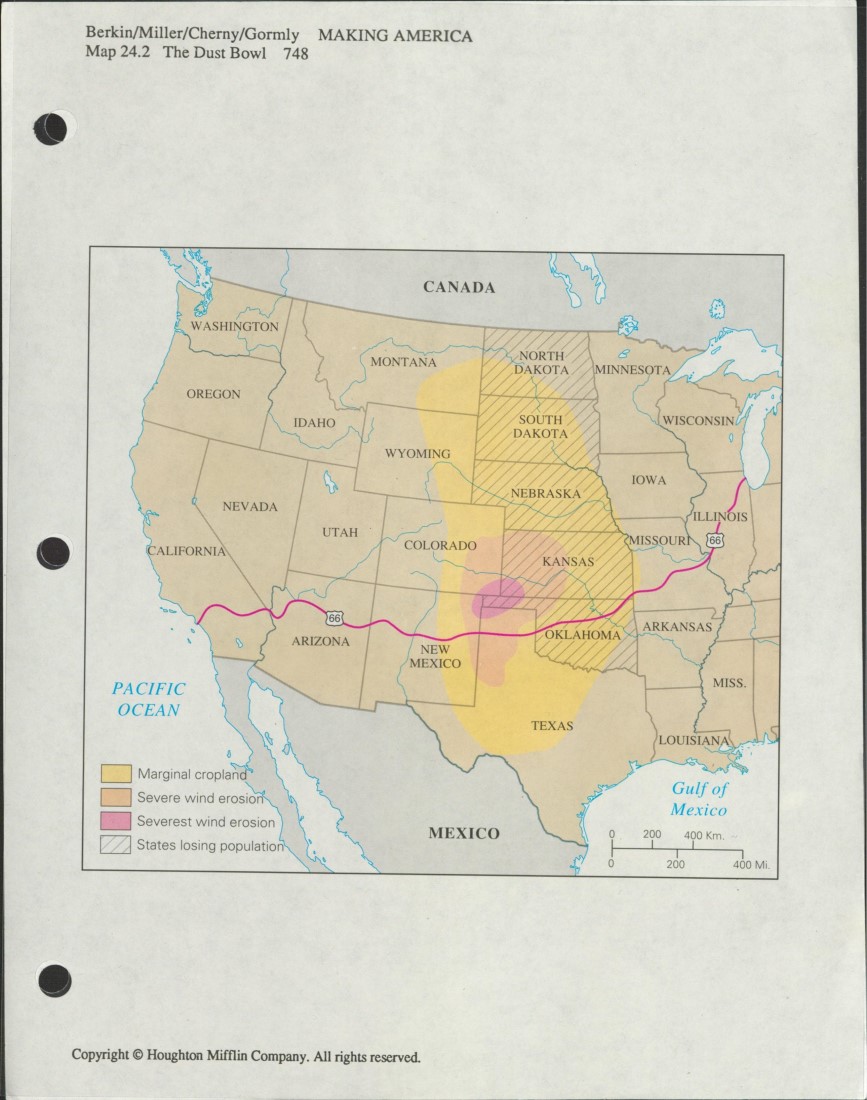
An overhead projector transparency showing a map of the Dust Bowl, from Making America: A History of the United States. Personal Papers of Lloyd Sponholtz. Call Number: PP 521, Box 11, Folder 32. Click image to enlarge.
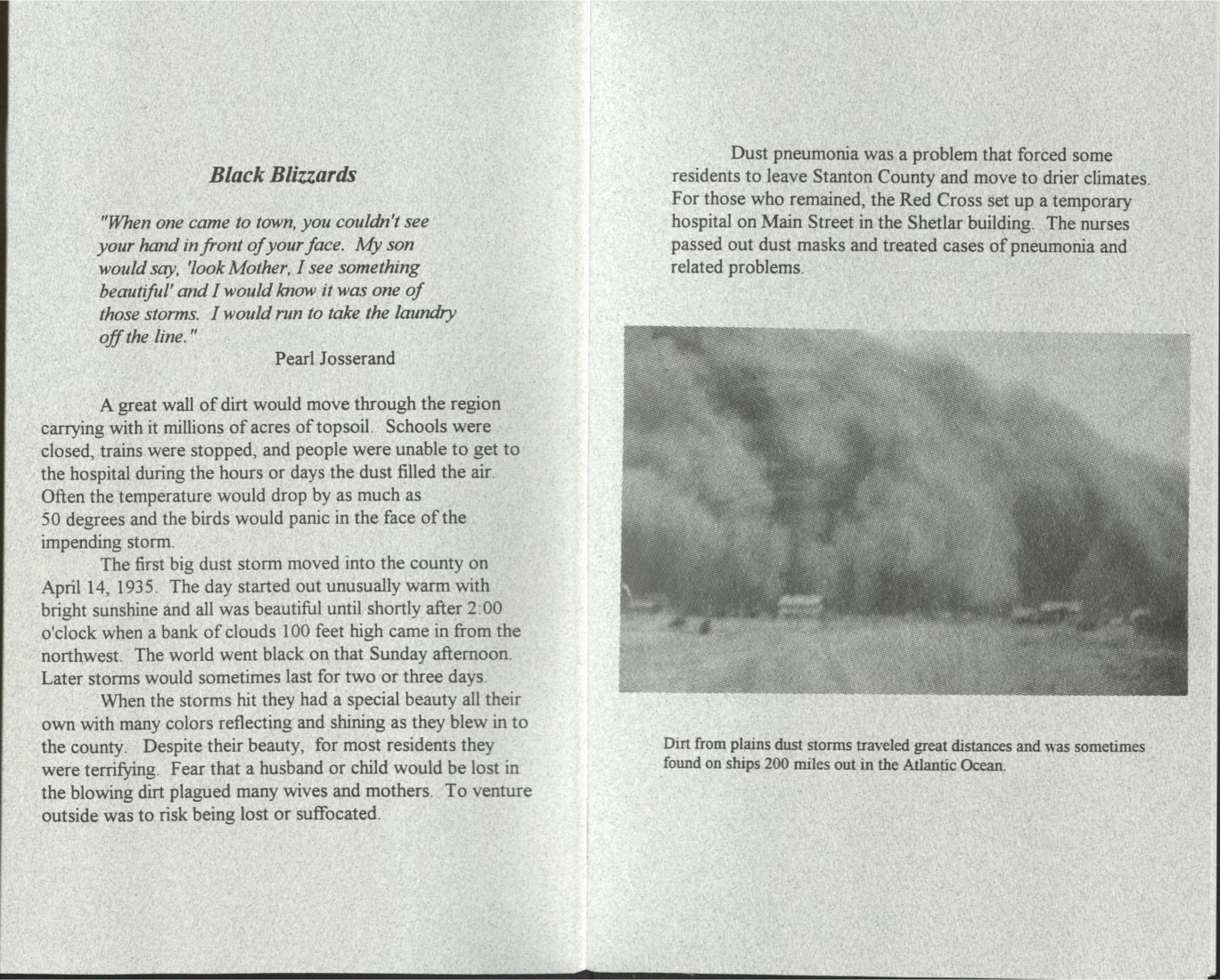
A description of Black Sunday and Black Blizzards in “You Couldn’t See Your Hand in Front of Your Face”: The 1930s in Stanton County, Kansas, August 1996. Personal Papers of Lloyd Sponholtz. Call Number: PP 521, Box 11, Folder 32. Click image to enlarge.
This is the latest installment in a series of posts introducing readers to student employees who make important contributions to the work of Spencer Research Library. Today’s profile features student assistantJenna Bellemere, who is the Cataloging and Archival Processing Department’s G. Baley Price Fellow this year. This is a student assistant position for undergraduate or graduate students interested in pursuing a career in archives and special collections or a career in which research in archives and special collections will play a prominent role. The fellowship is designed to give students hands-on experience organizing, cataloging, and preserving Kenneth Spencer Research Library’s materials and making them accessible to others. Jenna answered a few questions about the projects she works on at Spencer. Some editorial or clarifying comments from Spencer staff are [in brackets].
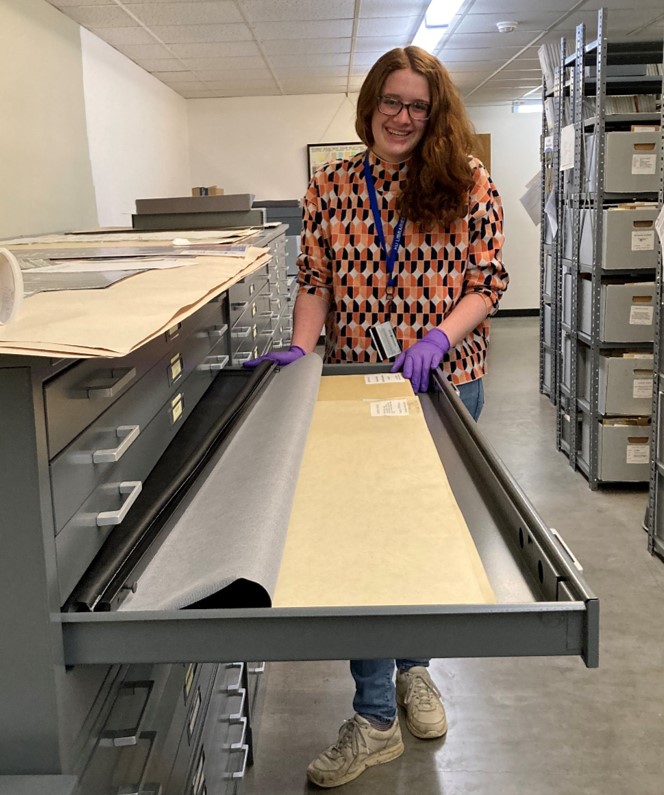
Jenna Bellemere inspects some of the many architectural drawings in University Archives for buildings that have been and still are on campus. These drawings will be added to the General record group (RG 0) finding aid soon; check back later to find out more! Click image to enlarge.
Please provide some brief biographical information about yourself.
I’m a junior at KU, majoring in Anthropology and Women’s, Gender, and Sexuality Studies. I started working at Spencer in February 2022.
What does your job at Spencer entail?
I’m working on updating our inventory of the University Archives, which means I spend a lot of time going through the documents we have in storage here and making sure that they’re all accounted for in our database [ArchivesSpace, our collection management system]. It’s been several years since the last update, which means there are a lot of new records in the archives that haven’t been fully catalogued yet. It’s my job to go through those records and write down all the important information about them so that researchers and the public can come to the Spencer and access them. I also write parts of the historical notes and finding aids summarizing our collections’ history and their contents.
Why did you want to work at Spencer Research Library?
In fall of 2021, I knew I wanted to get a job somewhere on campus, but I wasn’t sure where. I was looking for a job in one of the libraries on campus because I love to read and I wanted to work around books, and I stumbled across the posting from the Spencer. It wasn’t exactly what I had started out looking for, but I thought it looked interesting, so I applied. I’m interested in history, and the idea of getting to work directly with primary sources was interesting to me, so I felt confident it would be a good fit if I got the job.
What has been most interesting to you about your work?
When I have to explain to my friends why I think my job is so interesting, there’s one story I always tell them. It might be a little morbid, but it’s also a great demonstration of why I find archival work rewarding.
I was sorting through a fairly big series of faculty records [probably a series in the Faculty and Staff record group] and looking at some of the documents in more detail to get a better idea of what types of records researchers might expect to find there. Because I hadn’t been working at the archives for very long at that point, I was taking it pretty slow, and I remember pulling out one folder of records that had been kept by a professor during her time at KU. The first document was a typewritten rough draft of a speech she was planning to give, with revisions in notes scribbled in the margins in pencil. The second document was a handwritten note from her friends thanking her for helping them move into their new house. The third document was her obituary. Each paper was presented the same way: loose in the folder, with no extraneous labels or documentation. Completely matter of fact.
I think this memory epitomizes why I love places like the Spencer. The documents I found that day originated years apart from each other – decades of someone’s life, captured in the notes and paper scraps that she may have completely forgotten she had. We tend to talk about history on the biggest scale possible, focusing on the rousing speeches and the achievements of great leaders, but getting to see those stories in such a personal way, through the insignificant, interstitial moments of a subject’s life – worrying over their word choice in a speech, helping friends move into their new home – is a much rarer and more special experience. It may seem banal, but I don’t think I have ever experienced history in a way more unadulteratedly human than that moment.
What part of your job do you like best?
See my answer to the above question. Also, sometimes they have free snacks in the break room.
What advice would you offer other students thinking about working at Spencer Research Library?
Go for it! I wasn’t really thinking about the Spencer when I started applying for jobs at KU, but I’m so glad I applied here. I really only work in one small part of the archives – there’s so much more here, like the Kansas Collection [as well as Special Collections and the Wilcox Collection], that I haven’t even touched on. If you’re at all interested in history or museum studies – or if anything you’ve seen here just seems cool to you – I definitely recommend looking for a chance to work here.
Jenna Bellemere Cataloging and Archival Processing student assistant and G. Baley Price Fellow
Check the blog each Friday for a new “That’s Distinctive!” post. I created the series because I genuinely believe there is something in our collections for everyone, whether you’re writing a paper or just want to have a look. “That’s Distinctive!” will provide a more lighthearted glimpse into the diverse and unique materials at Spencer – including items that many people may not realize the library holds. If you have suggested topics for a future item feature or questions about the collections, feel free to leave a comment at the bottom of this page.
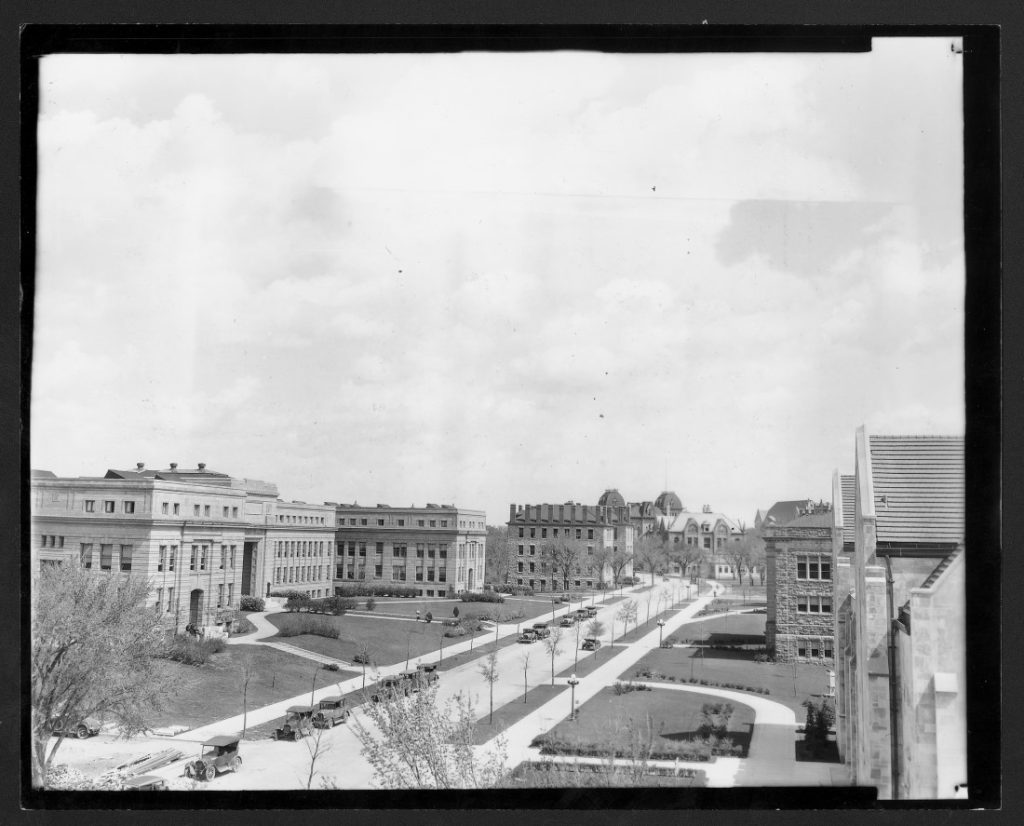
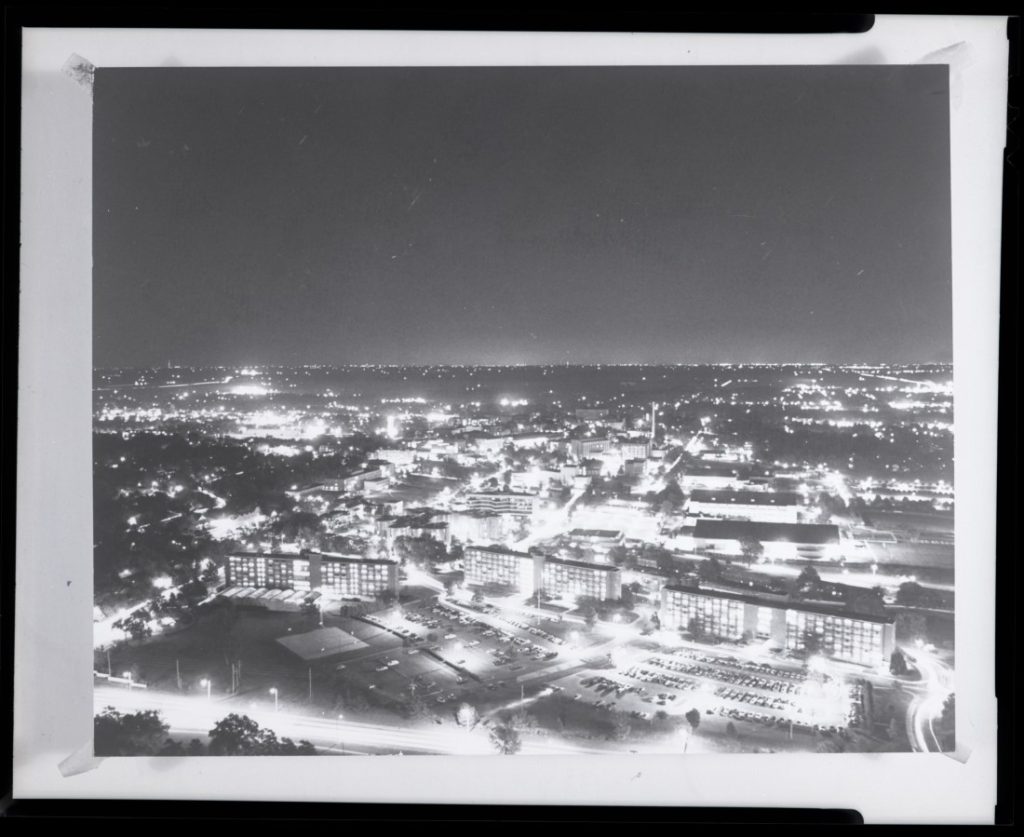
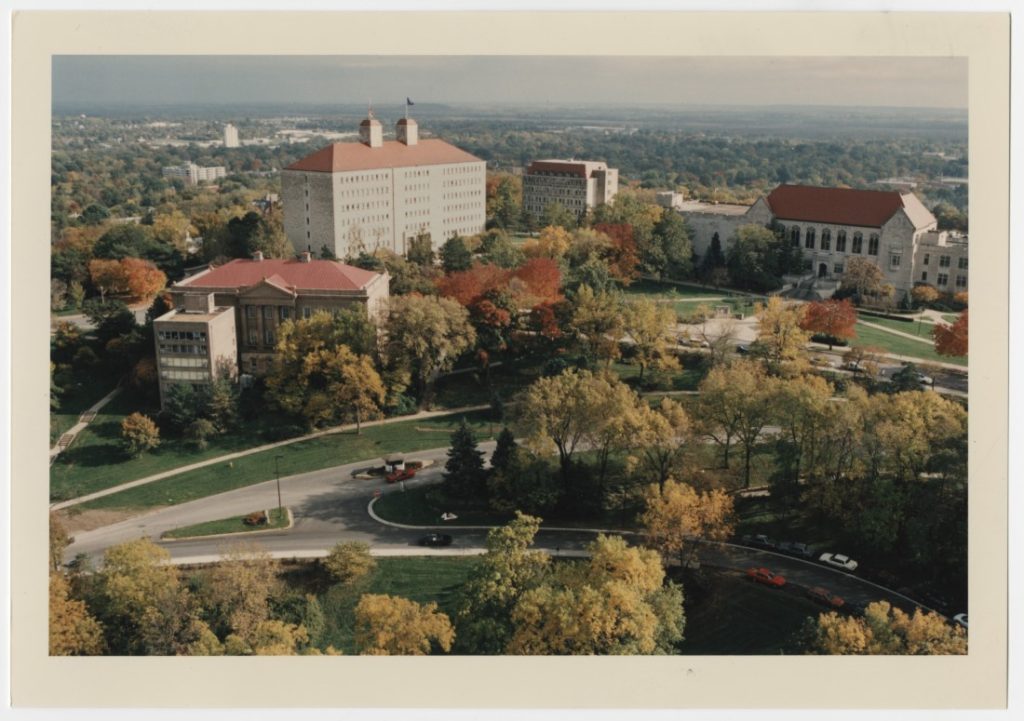
This week on “That’s Distinctive!” we will be highlighting photos from University Archives that show views of campus throughout the years. The University Archives houses over a million photographs along with departmental records, personal papers, university publications, and much more. Over 35,000 photos within University Archives have been digitized and can be browsed online. Many more photos of campus over the years can be found by using the search term “campus.”
Aerial of campus at night, 1987. The photo appears to have been taken from Iowa Street just south of Fifteenth/Bob Billings; the Daisy Hill residence halls are in the foreground. University Archives Photos. Call Number: RG 0/24/A 1987 Prints: University General: Campus: Campus Aerials (Photos). Click image to enlarge (redirect to Spencer’s digital collections).
Campus aerial, 1994. From left to right are Lippincott (Old Green) Hall, Fraser Hall, Blake Hall, and Watson Library. University Archives Photos. Call Number: RG 0/24/A 1994 Prints: University General: Campus: Campus Aerials (Photos). Click image to enlarge (redirect to Spencer’s digital collections).
If you are following the holidays we have correlated with previously and are still in the Valentine’s Day mood, check out our 2013 “Civil War Valentine” post by Whitney Baker, Head of Conservation Services at KU Libraries. It focuses on a handwritten poem titled “A Valentine” from one of Spencer’s regional history collections.
These items are meant to show that the library houses many things that many people may not realize. From books, to manuscripts, to maps and ephemera, if you can think of a topic, we likely have something related. Have a topic in mind? I have three unplanned weeks between March and April so please feel free to leave ideas/interests in the comment box below and I will see what items we may hold.
New to the blog this week is the first of many posts in a series called That’s Distinctive! I created the series because I genuinely believe there is something in our collections for everyone, whether you’re writing a paper or just want to have a look. That’s Distinctive! will provide a more lighthearted glimpse into the diverse and unique materials at Spencer – including items that many people may not realize the library holds. The series will be posted weekly on Friday with occasional breaks. If you have suggested topics for a future item feature or questions about the collections, feel free to leave a comment at the bottom of this page.
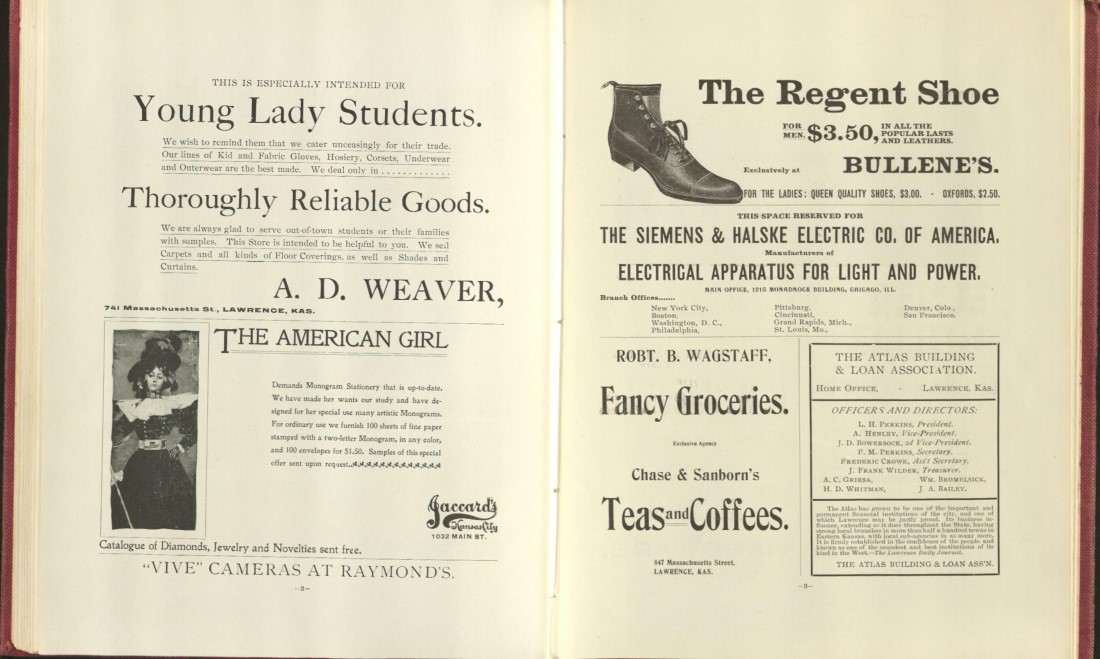
In honor of the return of students to campus, this week’s post highlights KU Jayhawker yearbooks. Here at the library, we have yearbooks ranging from 1874 to 2011, the last year it was a print publication (with a few missing here and there). While I am only highlighting a few this week, all of the yearbooks in Spencer’s holding are available for viewing in the Reading Room.
Selected pages of advertisements in the 1899 Jayhawker yearbook. University Archives. Call Number: LD 2697 .J3. Click image to enlarge.
Selected pages of advertisements in the 1918 Jayhawker yearbook. University Archives. Call Number: LD 2697 .J3. Click image to enlarge.
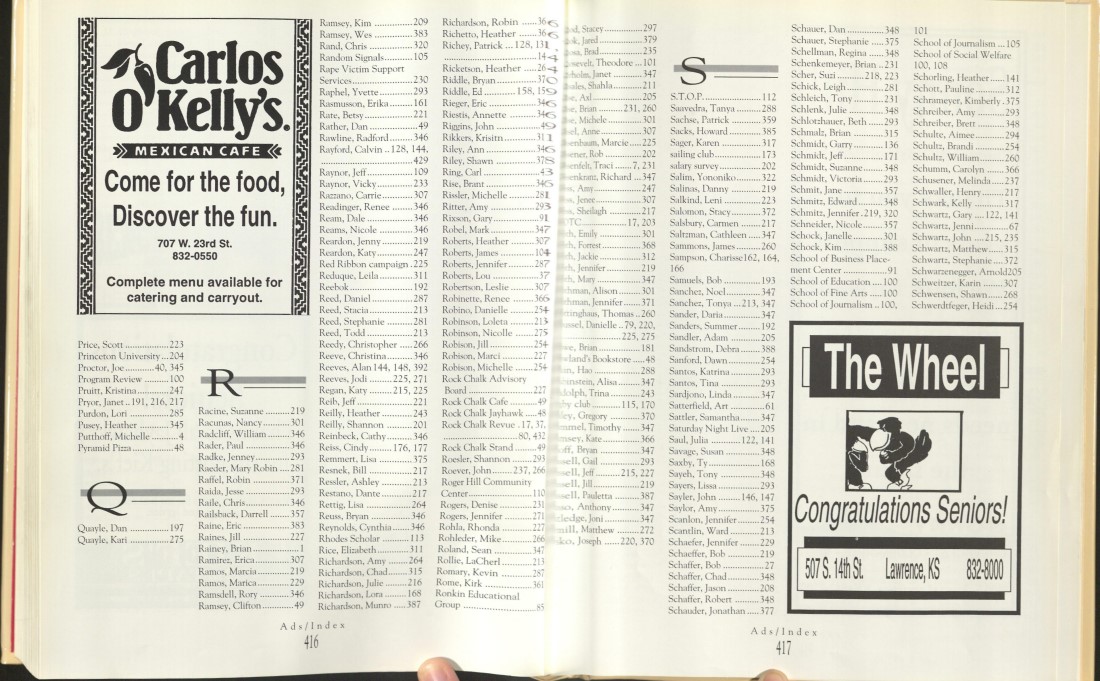
Selected pages of advertisements in the 1993 Jayhawker yearbook. University Archives. Call Number: LD 2697 .J3. Click images to enlarge.
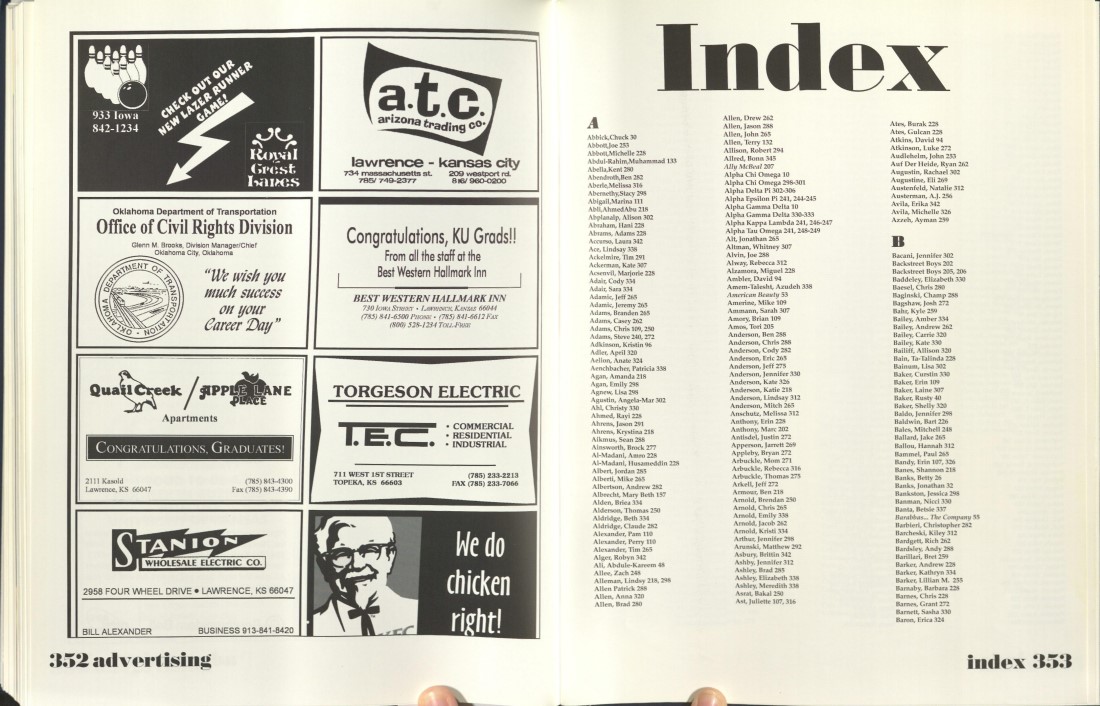
Selected pages of advertisements in the 2000 Jayhawker yearbook. University Archives. Call Number: LD 2697 .J3. Click image to enlarge.
These images show select pages from four yearbooks displaying the variety of advertisements located in/near the index of each book. As the years go on, each yearbook seems to feature fewer ads. It can be interesting to browse the various sections of the yearbooks, which can include clubs, headshots, ads, building photos, memories of the past year, and much more.
Like many institutions, KU Libraries (KUL) has come a long way in recognizing that we are not neutral and that our collecting practices, descriptive traditions, and operations are often not nearly as inclusive as we would like them to be. We have much, much further to go, but we are taking steps where we can. Libraries do not move quickly or easily when large-scale systems are on the line.
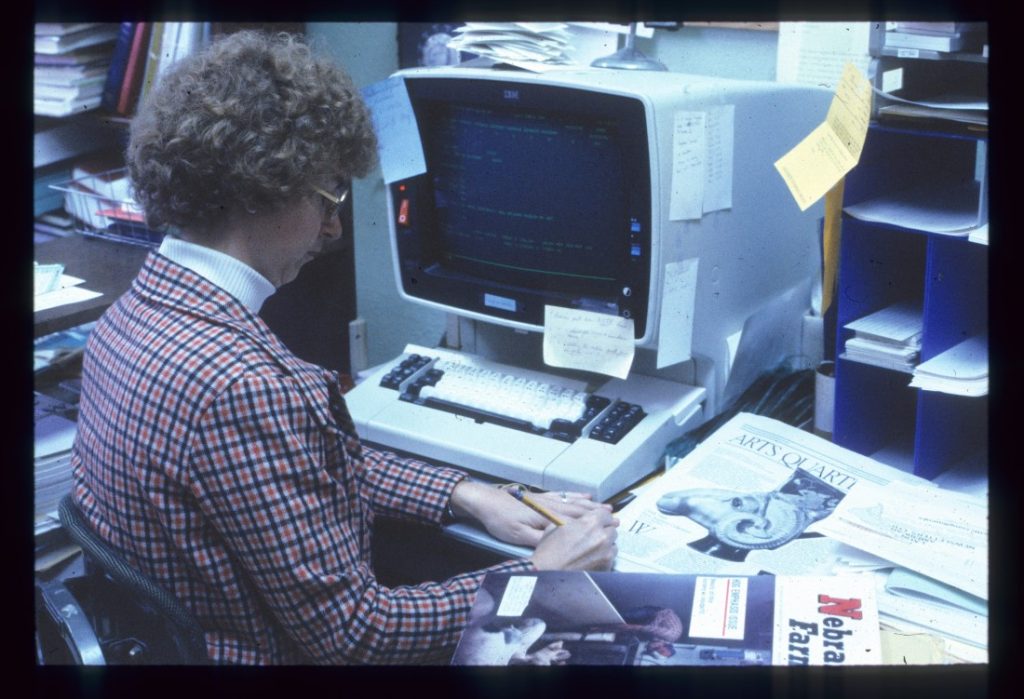
University Archives Photos. Call Number: RG 32/13: KU Libraries: Cataloging Department (Photos). Click image to enlarge (redirect to Spencer’s digital collections).
Realizing we should communicate transparently about our collections and practices, Spencer Research Library colleagues agreed we didn’t want to “disclaim” anything; we do not want to deny our responsibility to cover perceived liability or avoid a lawsuit. In fact, we are proud of our collections and the hard work that has gone into building them for decades. But in the world today, where images can be shared immediately, without context, and where intention is rarely assumed to be good, it was important to try to explain our work to those who might encounter our materials virtually.
Our reasons for collecting disturbing or offensive materials and making them available to users are grounded in library and archival best practices, our mission, and the mission of the larger university. In fact, sharing these materials with researchers, students, and the public around the world is our actual purpose for existing. If we don’t collect these materials, many of the perspectives they capture may not be represented elsewhere. Ignorance and secrecy rarely advance the best of our humanity.
But these reasons might not always be clear to folks outside the library, so we wanted to strike a balance between 1) providing information about why objectionable or even harmful material can be found in our library and 2) acknowledging that, even if we have good reasons to collect and share these materials, they have the potential to cause harm to users. Like libraries everywhere, we began by looking at what other institutions were doing.
We decided to call this work “contextual statements,” to make clear that we want to provide the context of our collections. We wanted to articulate our mission in a way that acknowledges that libraries are doing hard work in trying to capture voices and tell stories, even though we struggle to do enough with limited resources.
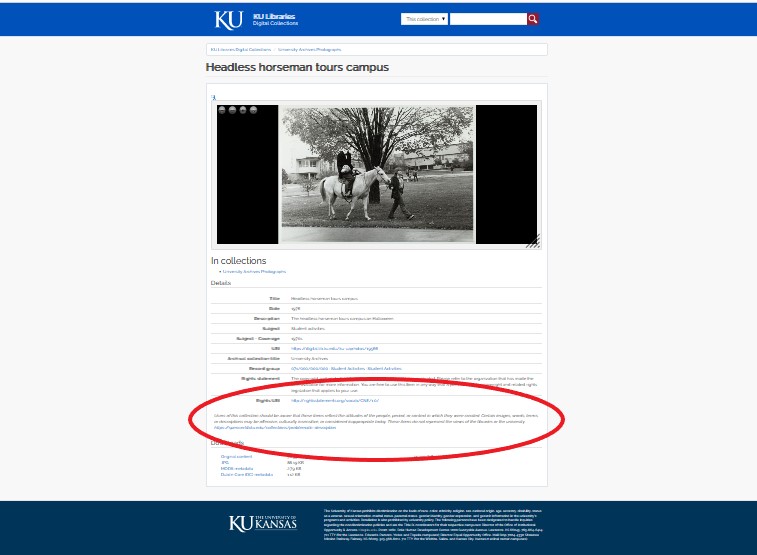
The first step was to add a phrase to all images from our collections in KU’s digital repository, where digitized versions of our collection materials are increasingly being made available to the world. This language was drafted by a small group and went through many revisions by the Spencer collections group, and was implemented by our colleagues in KUL Digital Initiatives:
“Users of this collection should be aware that these items reflect the attitudes of the people, period, or context in which they were created. Certain images, words, terms, or descriptions may be offensive, culturally insensitive, or considered inappropriate today. These items do not represent the views of the libraries or the university.”
An example of an image in the University Archives Photographs digital collection with the contextual statement about problematic language. Click image to enlarge (redirect to Spencer’s digital collections).
We also decided we needed a longer statement about our collections, and added more information to our previously published collection development statements, also freely available. Initial work came from Head of Public Services Caitlin Klepper and Head of Manuscripts Processing Marcella Huggard with input from a group from across Spencer.
Finally, we saw an opportunity, as have many of our peer institutions, to expose the work of description, a professional specialty that has long been hidden behind card catalogs and filing cabinets, frequently in the basements of buildings and at the end of a long series of tasks that take collections from the donor’s attic to the loading dock and to the shelves (or laptops). We published a statement about that as well, initially drafted by Caitlin Klepper and Marcella Huggard, based on the work of other institutions.
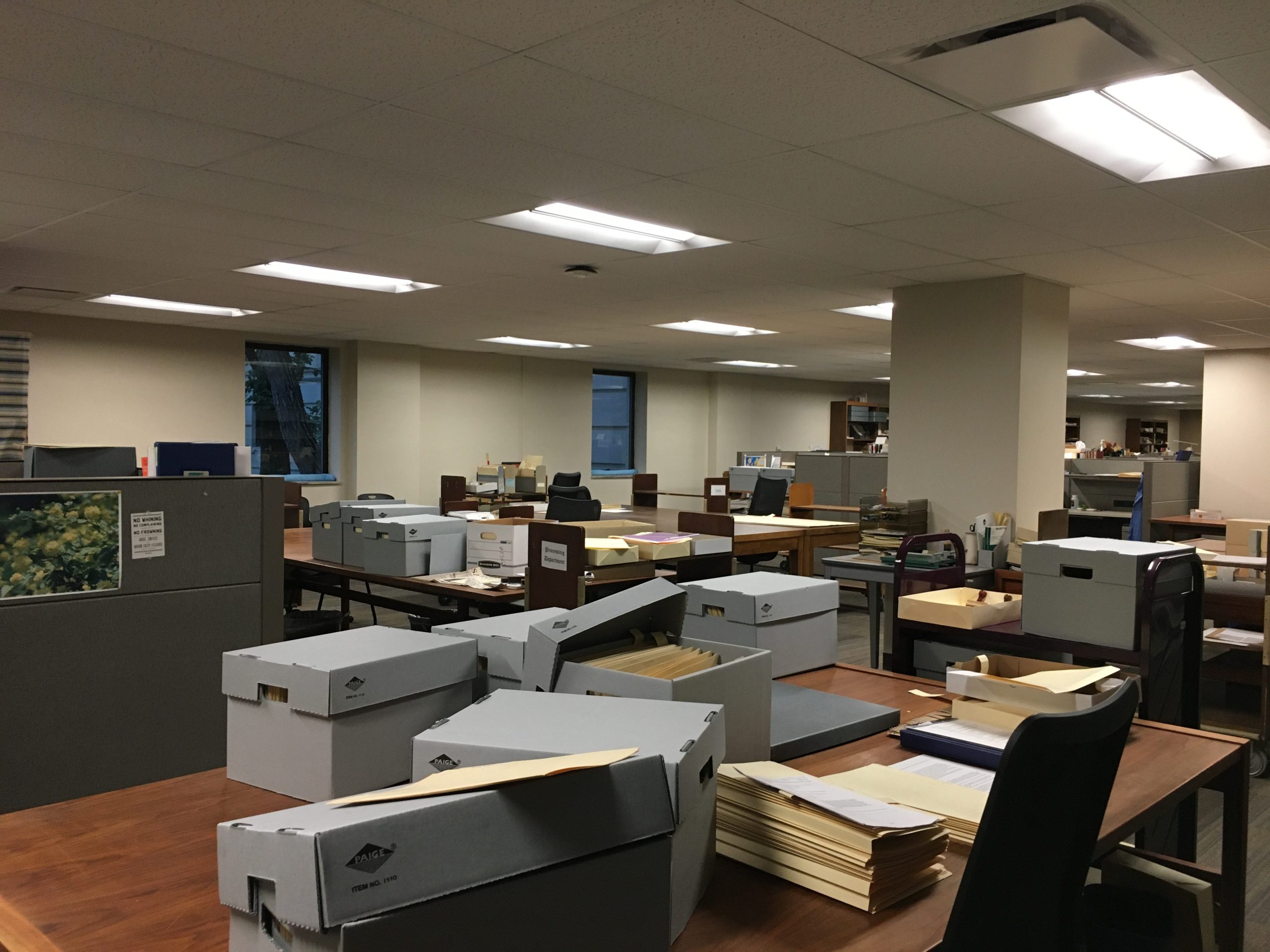
A view of the Processing and Cataloging workspace at Spencer Research Library. Click image to enlarge.
In all of this, we relied heavily on the good judgement and best efforts of colleagues at peer institutions. We realize that every environment is unique, so we tailored it to the KU world, talking with colleagues and, where we could, members of our communities. We hope to get feedback as we go, as we begin a larger conversation with those who use our collections in various ways—about what we collect and why, how we describe it, and how we use the impact of our collections to make a better, more just world.
Beth M. Whittaker Interim Co-Dean, University of Kansas Libraries Associate Dean for Distinctive Collections Director of Spencer Research Library