The University of Kansas

Inside Spencer: The KSRL Blog

Books on a shelf

Welcome to the Kenneth Spencer Research Library blog! As the special collections and archives library at the University of Kansas, Spencer is home to remarkable and diverse collections of rare and unique items. Explore the blog to learn about the work we do and the materials we collect.

World War I Letters of Forrest W. Bassett: February 19-25, 1918

February 19th, 2018

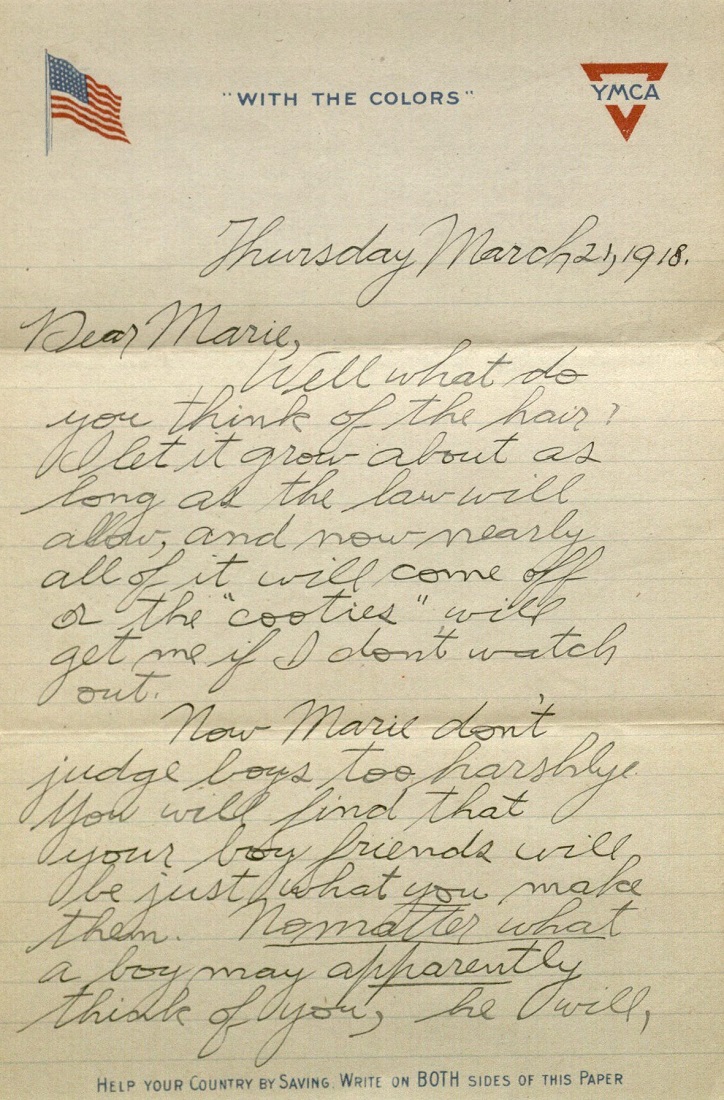
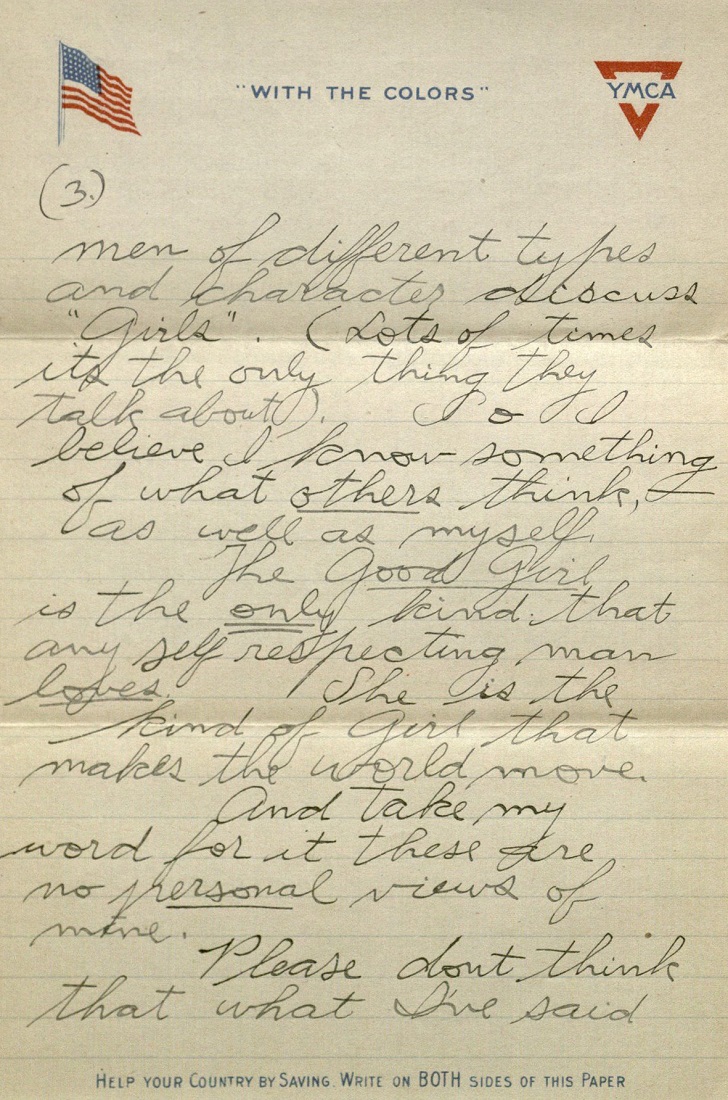
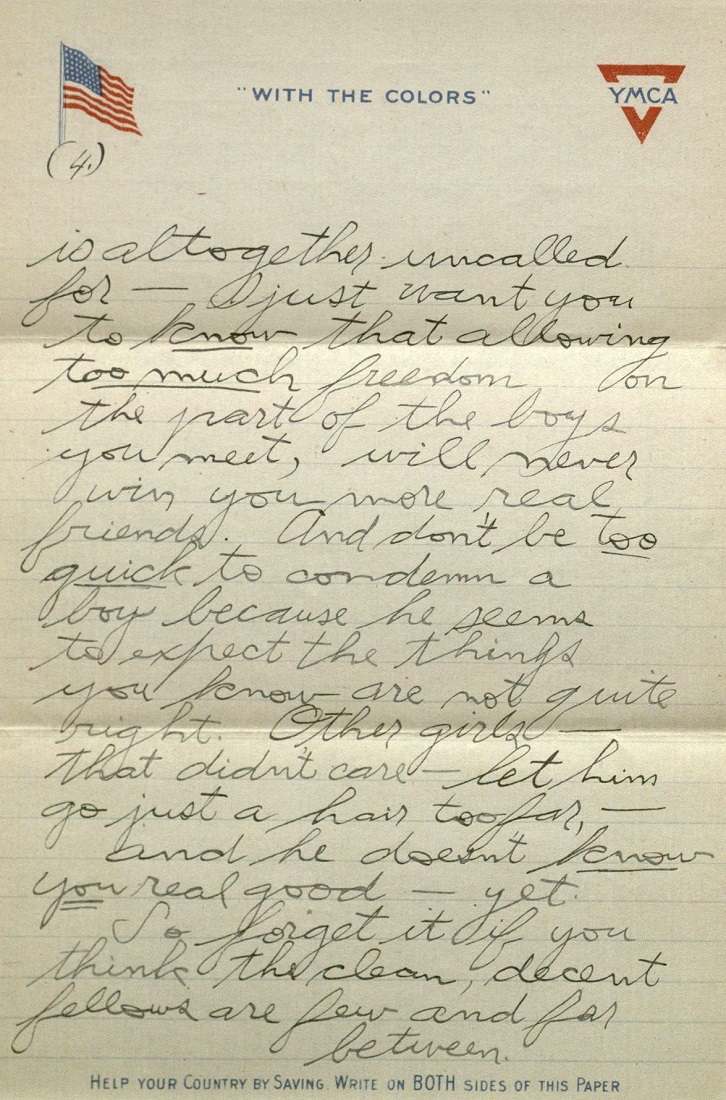
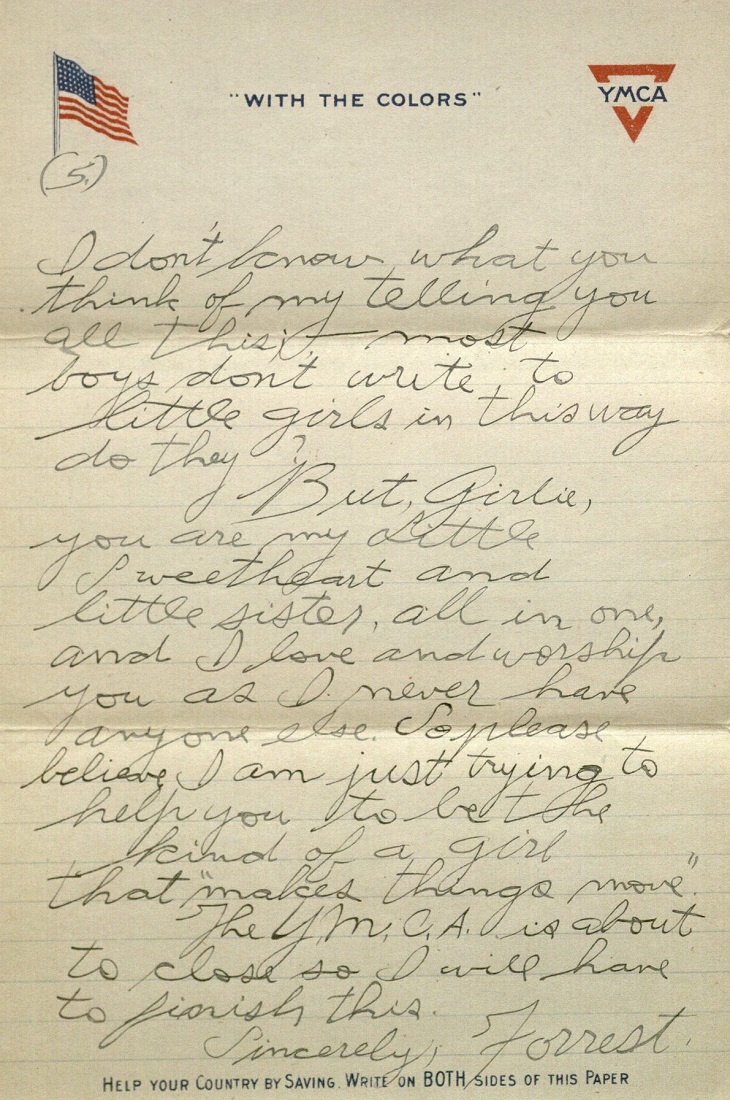
In honor of the centennial of World War I, we’re going to follow the experiences of one American soldier: nineteen-year-old Forrest W. Bassett, whose letters are held in Spencer’s Kansas Collection. Each Monday we’ll post a new entry, which will feature selected letters from Forrest to thirteen-year-old Ava Marie Shaw from that following week, one hundred years after he wrote them.

Forrest W. Bassett was born in Beloit, Wisconsin, on December 21, 1897 to Daniel F. and Ida V. Bassett. On July 20, 1917 he was sworn into military service at Jefferson Barracks near St. Louis, Missouri. Soon after, he was transferred to Fort Leavenworth, Kansas, for training as a radio operator in Company A of the U. S. Signal Corps’ 6th Field Battalion.

Ava Marie Shaw was born in Chicago, Illinois, on October 12, 1903 to Robert and Esther Shaw. Both of Marie’s parents – and her three older siblings – were born in Wisconsin. By 1910 the family was living in Woodstock, Illinois, northwest of Chicago. By 1917 they were in Beloit.

Frequently mentioned in the letters are Forrest’s older half-sister Blanche Treadway (born 1883), who had married Arthur Poquette in 1904, and Marie’s older sister Ethel (born 1896).

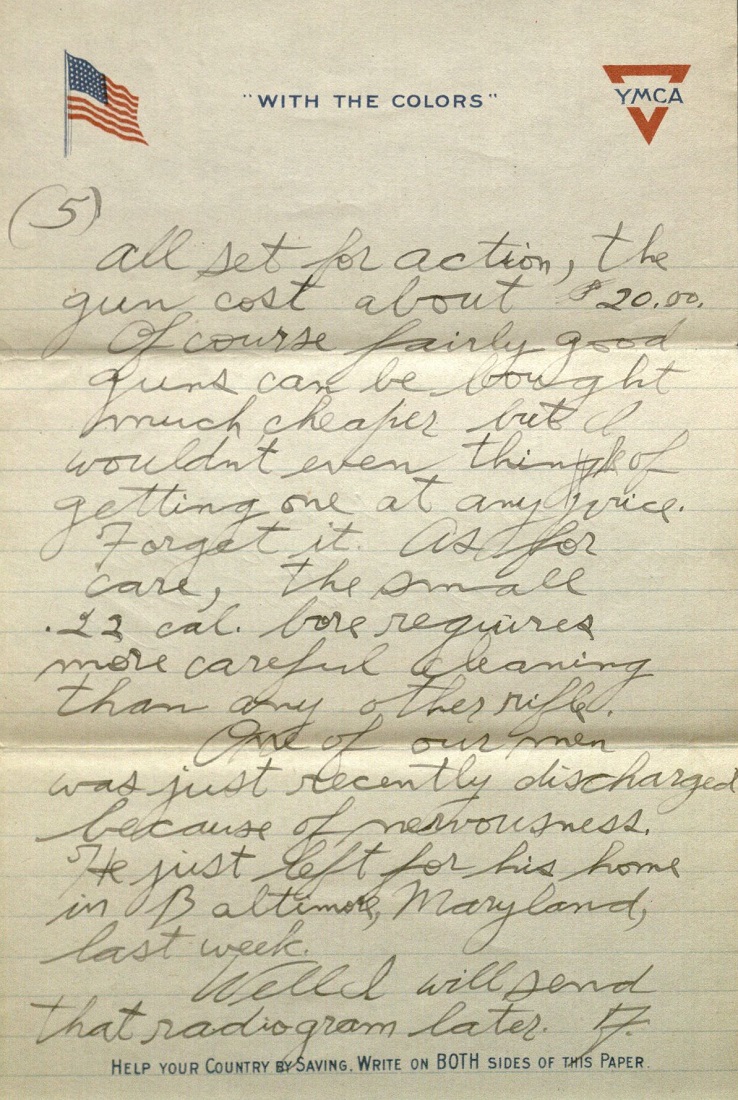
Highlights from this week’s letters include speculation that Forrest’s unit will soon leave for Europe, partially based on the departure of other soldiers from Fort Leavenworth, and discussion about the new .45 caliber Colt automatic pistol he was issued (“Now don’t you wish I could come home and go shooting with you? I can hardly wait for the target practice”).

Friday Feb. 22, 1918.

Dear Marie,

We are celebrating Washington’s birthday by taking the day off. We are having regular Spring weather after a short cold snap. Every few minutes this morning someone would remark “’Wish we had them durn horses back,” and believe me “them’s my sentiments,” too. You should see our radio class in the new stables. We have big tables and a number of buzzers and a large blackboard nailed on the wall. We have fifty minute periods, the same as in High School, do assigned problems in electricity, and have buzzer practice in here.

The Fifth Battalion, S.C. [Signal Corps] left for the coast a few days ago. There were quite a number of the boy’s mothers, wives and “best girls” to see them off. Believe me, those fellows looked pretty “blue.” Not very much “Where-do-we-go-from-here-boys” spirit in the whole outfit.

We expect to go within the next four weeks. Our mess sergeant has orders to be prepared to provide us with one days rations at the port of Embarkation and five days rations in England. I quit helping the Supply Sergeant Monday with the clerical and strong back stuff. We know now just what we lack and the requisition was sent in last week. We will get our guns in U.S. but new French radio equipment on the other side.

We were issued thirty .45 cal. Colt automatic pistols, yesterday, for practice on the range. These will be returned to the Ordnance Dept. before we leave. They sure are some guns. When you take the barrel of one out to clean it, it looks like a piece of young gas pipe. In appearance the .45 Colt is the same as yours, which is a .25 cal., but the working parts inside are altogether different. The hammer is outside and can be cocked with the thumb.(?) The .45 caliber bullet only lacks 5/100 of an inch of being twice the diameter of the .25 cal., so you can see how large the cartridge is. Now don’t you wish I could come home and go shooting with you? I can hardly wait for the target practice. Did you get the S.C. Drill book yet? I know the package got there alright.

No, I don’t care to learn to dance at any time. To have a share in making the Kaiser dance is the height of my ambition and I don’t care two whoops after that.

Glad you are having good luck with your elocution. Did “Bat” perform, he is “right there” when he does.

Stock is getting along great at Champaign, Ill. I will send his letter to Mother as soon as I answer it.

Say, if you ever get a chance to see Elsie Ferguson in “Rose of the World,” don’t miss it.

Well I must drop a line to Blanche.

Sincerely,
Forrest.

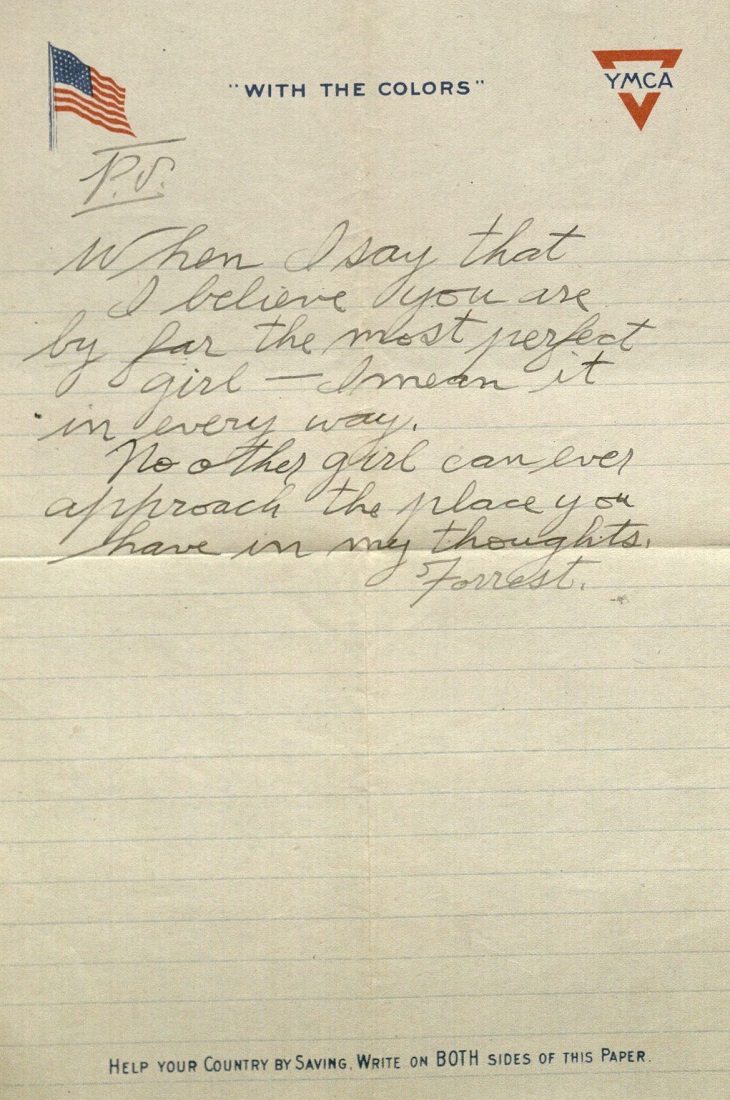
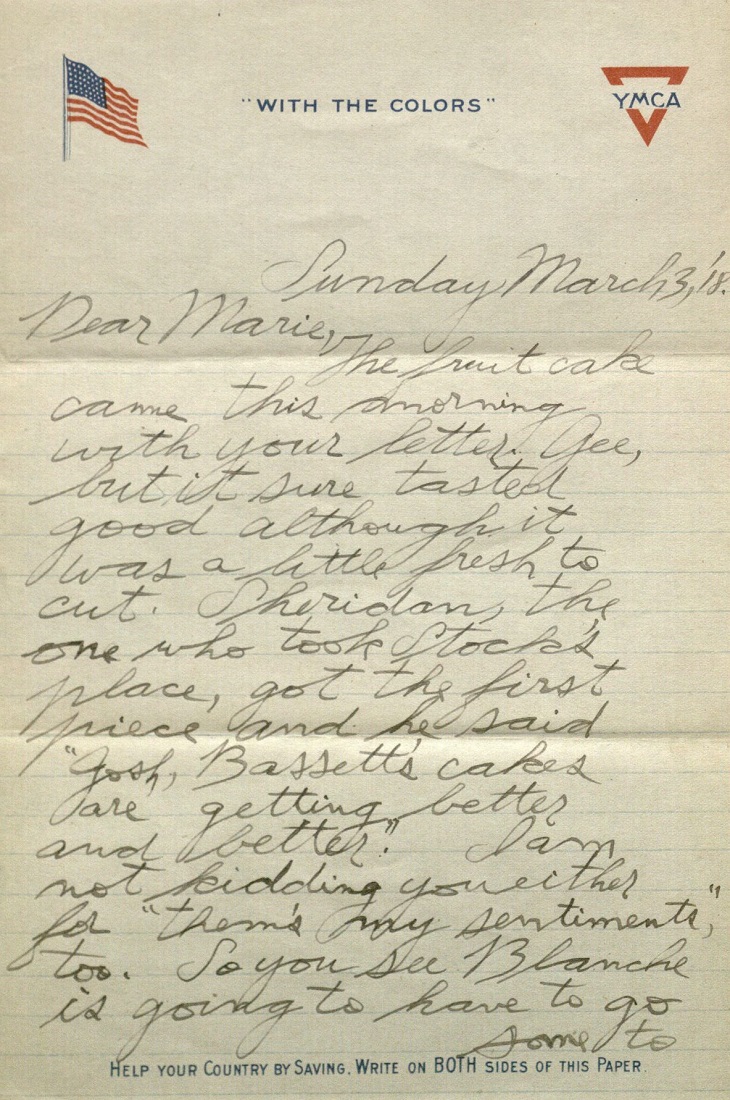
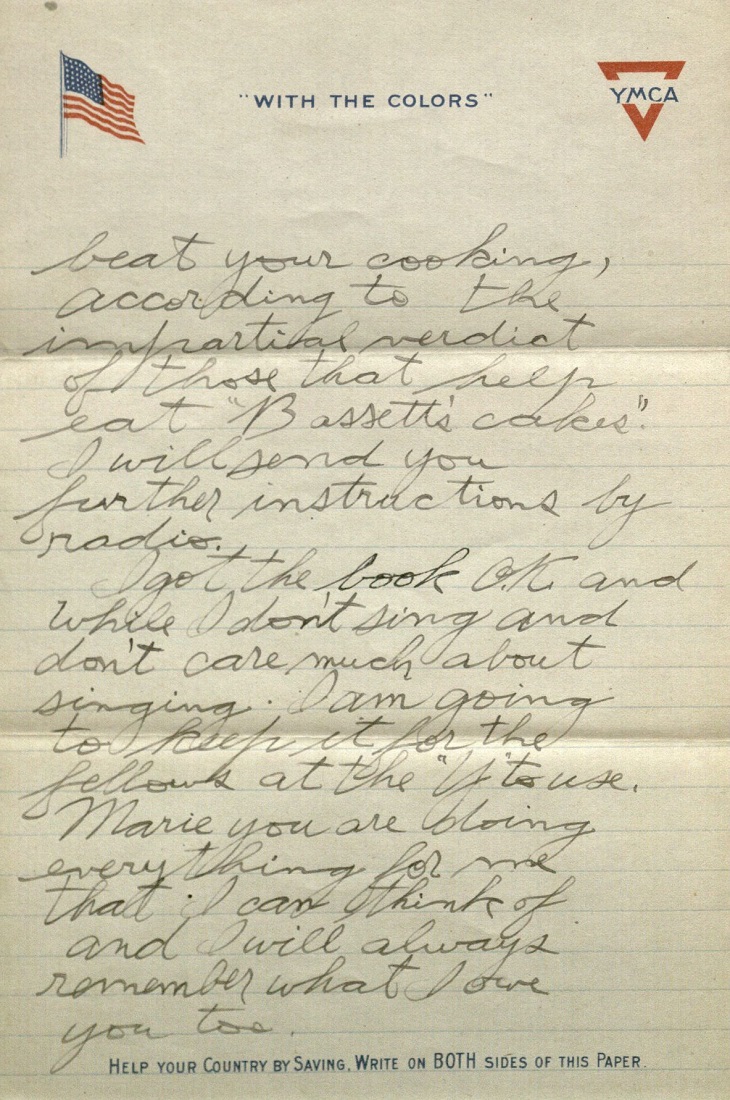
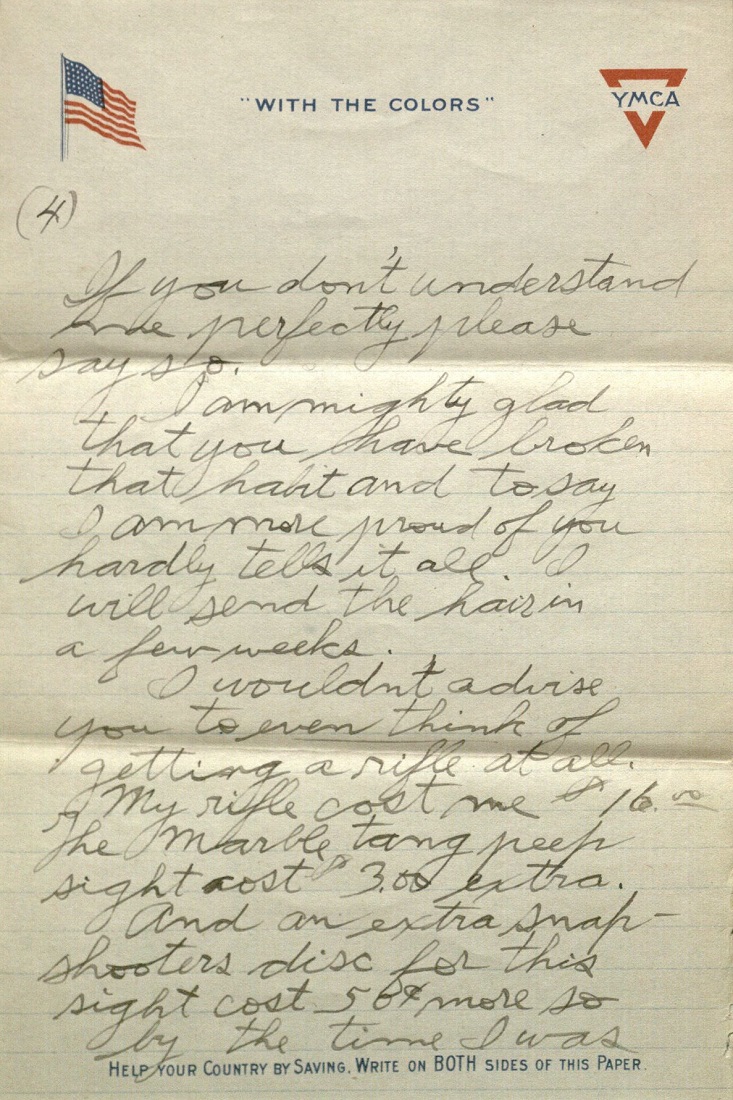
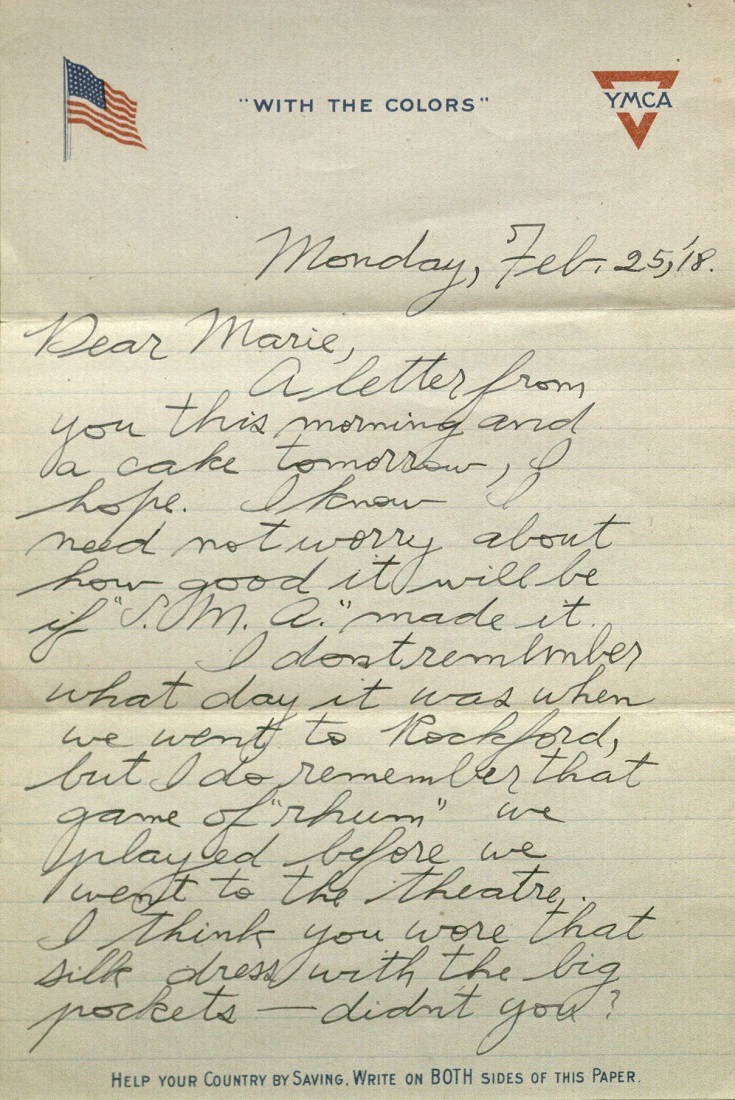
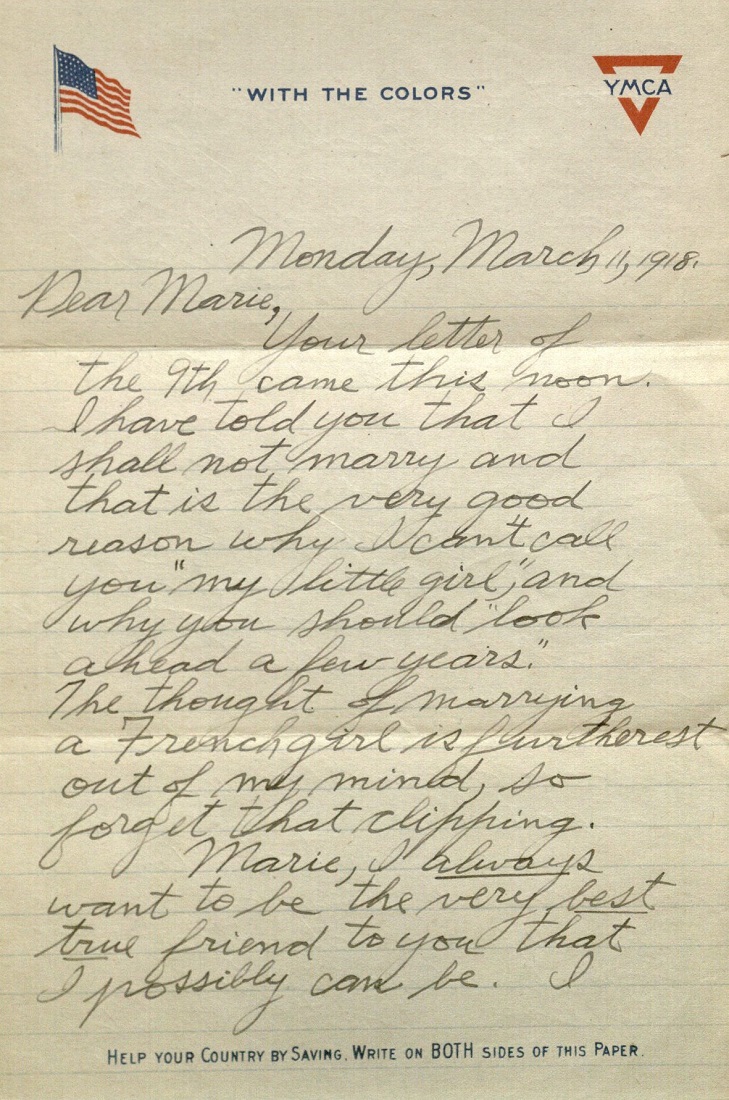
Image of Forrest W. Bassett's letter to Ava Marie Shaw, February 25, 1918 Image of Forrest W. Bassett's letter to Ava Marie Shaw, February 25, 1918

Image of Forrest W. Bassett's letter to Ava Marie Shaw, February 25, 1918

Click images to enlarge.

Monday, Feb. 25, ’18.

Dear Marie,

A letter from you this morning and a cake tomorrow, I hope. I know I need not worry about how good it will be if “S.M.A.” [Ava Marie Shaw, backwards] made it.

I don’t remember what day it was when we went to Rockford, but I do remember that game of “rhum” we played before we went to the theatre. I think you wore that silk dress with the big pockets – didn’t you? Anyway, I know how hard it was for me to keep from holding you tight in my arms for just a short second. But I didn’t dare to for fear you wouldn’t understand. What would you have done, can you tell me?

Gee, little Sweetheart I am mighty thankful that nothing ever did happen to spoil your trust in me.

I am thankful too that I can help you in the way you spoke of in your last letter. Please tell me when ever I can help you in any possible way. I am going to try and answer every letter you write from now on. It won’t be very long now until we leave. Tonight another trainload of Engineers pulled out. We could see them from the mess hall windows while we ate supper. It made me think of the last train I took to Chicago and then to You.

Well the “Y” Secretary just said ten minutes till lights out so goodnight.

With love, Forrest.

Meredith Huff
Public Services

Emma Piazza
Public Services Student Assistant
World War I Letters of Forrest W. Bassett: February 12-18, 1918

February 12th, 2018

In honor of the centennial of World War I, we’re going to follow the experiences of one American soldier: nineteen-year-old Forrest W. Bassett, whose letters are held in Spencer’s Kansas Collection. Each Monday we’ll post a new entry, which will feature selected letters from Forrest to thirteen-year-old Ava Marie Shaw from that following week, one hundred years after he wrote them.

Forrest W. Bassett was born in Beloit, Wisconsin, on December 21, 1897 to Daniel F. and Ida V. Bassett. On July 20, 1917 he was sworn into military service at Jefferson Barracks near St. Louis, Missouri. Soon after, he was transferred to Fort Leavenworth, Kansas, for training as a radio operator in Company A of the U. S. Signal Corps’ 6th Field Battalion.

Ava Marie Shaw was born in Chicago, Illinois, on October 12, 1903 to Robert and Esther Shaw. Both of Marie’s parents – and her three older siblings – were born in Wisconsin. By 1910 the family was living in Woodstock, Illinois, northwest of Chicago. By 1917 they were in Beloit.

Frequently mentioned in the letters are Forrest’s older half-sister Blanche Treadway (born 1883), who had married Arthur Poquette in 1904, and Marie’s older sister Ethel (born 1896).

Highlights from this week’s letters include Forrest’s ride through a trench tunnel like an amusement park ride.

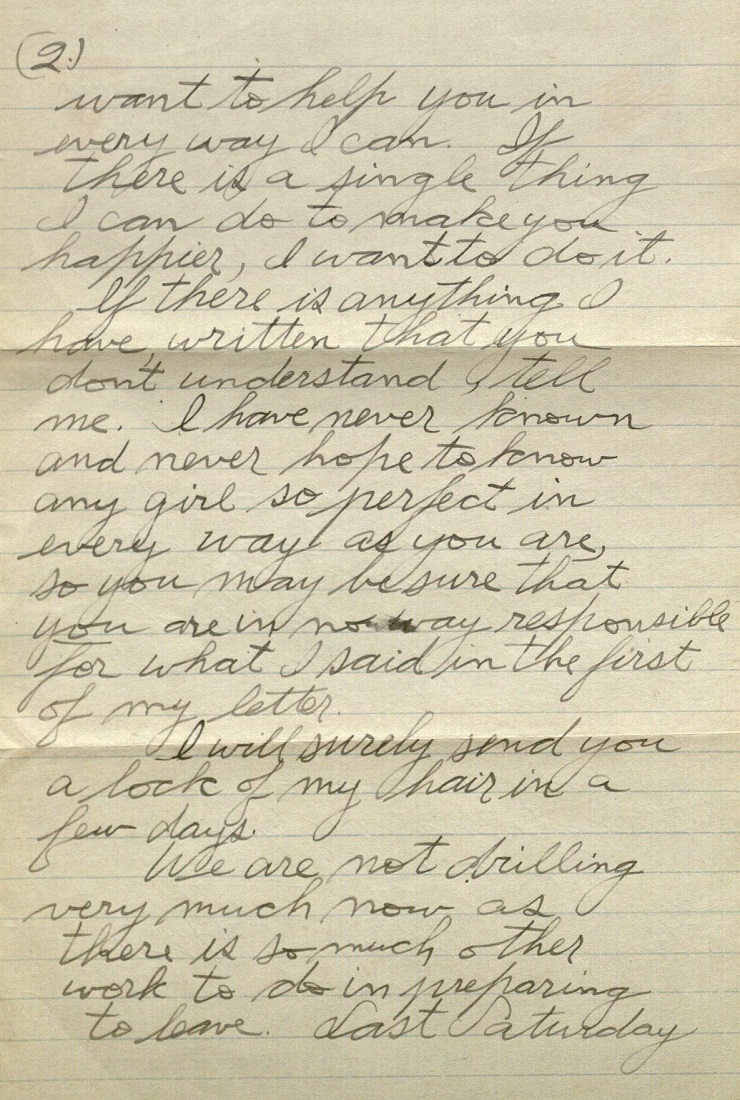
Tuesday, Feb. 12, 1918.

Dear Marie,

I am on a “light occupation” today, acting as Room Orderly at the Cantonment Y.M.C.A. The Company is on guard except a half a dozen, who are hauling coal, and others on special duty.

Yesterday, I passed the wigwag test with a perfect copy. I know I will have no trouble with the Radio or Acetylene lantern tests[.] Sunday afternoon, Sgt. Brown, Fritchie and Cp’l. Sundberg & I went out for some wigwag and semaphore practice. We got over a mile apart and used Sig. Cps. binoculars. After an hour of this, we looked over the Engineer’s new trenches. (These are shown in the 5×7 pictures of the radio men in the field, that I sent Mother. One tunnel is boarded on sides, roof & floor and has a track on which they run a little car to carry out the dirt. The tunnel is about 150 feet long and goes down hill. Sunberg & I got the car at the top and rode down the full length of the tunnel. We had a flashlight so we could tell when we were nearing the sandbags at the end of the tracks. When we were coming back, Fritchie surprised me with the remark, “This reminds me of riding the “figure 8” at Harlem Park.” I never had any idea he had ever been near Rockford. Do you remember riding the “dizzy dips” last summer. Gee, I wish we could have those good times again this year.

We have been having some great weather lately, and today is one perfect Spring day.

Most of us would give three months pay if we could have our horses back again.

We are spending nearly all of our time now with our technical work, radio and visual signaling. It sure is interesting. After the Battalion field maneuvers, of which I told you, Captain Murphy complimented the performance of Co. “A-6.” And, this morning Lt. Butler told us we were the best trained Radio Company in the Army. Class to us, huh. We are going to lose him as he has been promoted. Believe me, we are all sorry to see him go too.

I haven’t heard from Stock yet but I suppose he is very busy getting down to business at Urbana.

With love,
Forrest.

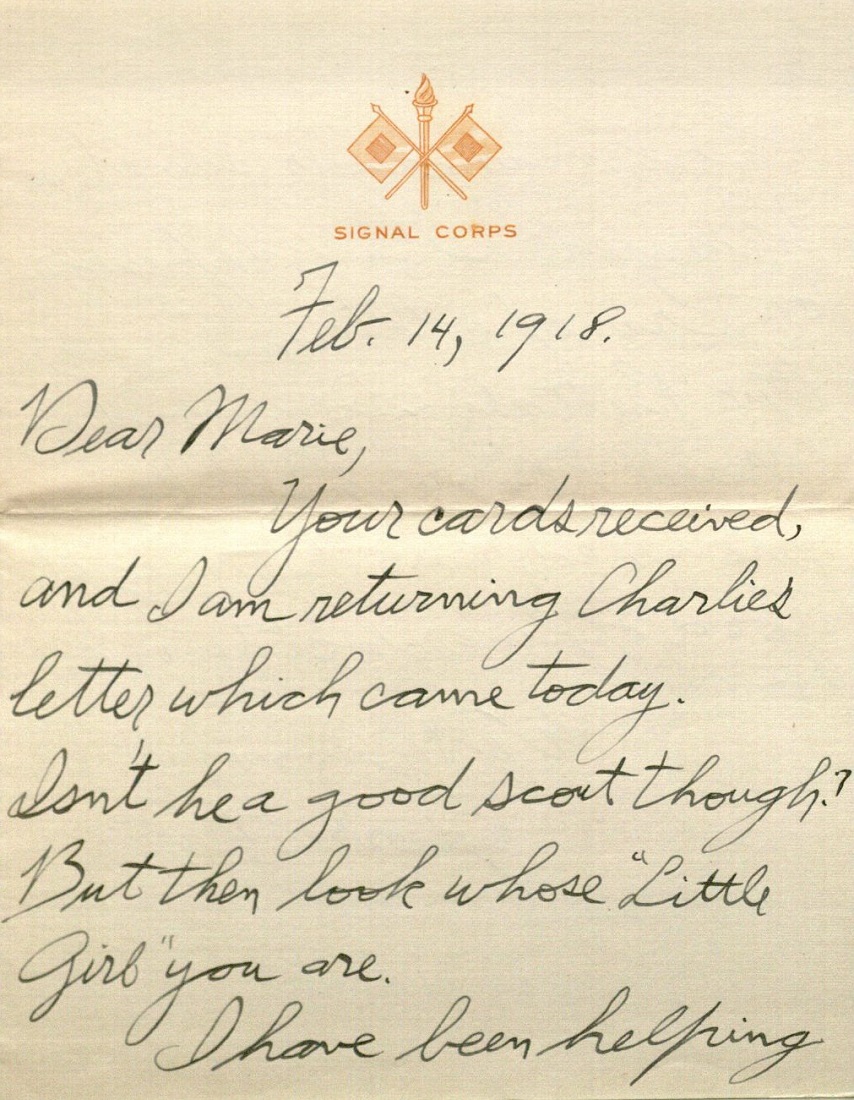
Image of Forrest W. Bassett's letter to Ava Marie Shaw, February 14, 1918

Image of Forrest W. Bassett's letter to Ava Marie Shaw, February 14, 1918

Click images to enlarge.

Feb. 14, 1918.

Dear Marie,

Your cards received, and I am returning Charlie’s letter which came today. Isn’t he a good scout though? But then look whose “Little Girl” you are.

I have been helping the Company Clerk and Supply Sergeant check up ordnance and clothing equipment yesterday and today: You have no idea of the enormous amount of “junk” it takes to outfit a Signal Company.

Everything is being straightened out ready for a “French Leave,” which may occur sometime this year. (?) It all depends on transportation.

Our Battalion Commander, Major Moore, has been promoted; another mighty good officer lost to us.

With love,
Forrest.

Meredith Huff
Public Services

Emma Piazza
Public Services Student Assistant
World War I Letters of Forrest W. Bassett: February 5-11, 1918

February 5th, 2018

In honor of the centennial of World War I, we’re going to follow the experiences of one American soldier: nineteen-year-old Forrest W. Bassett, whose letters are held in Spencer’s Kansas Collection. Each Monday we’ll post a new entry, which will feature selected letters from Forrest to thirteen-year-old Ava Marie Shaw from that following week, one hundred years after he wrote them.

Forrest W. Bassett was born in Beloit, Wisconsin, on December 21, 1897 to Daniel F. and Ida V. Bassett. On July 20, 1917 he was sworn into military service at Jefferson Barracks near St. Louis, Missouri. Soon after, he was transferred to Fort Leavenworth, Kansas, for training as a radio operator in Company A of the U. S. Signal Corps’ 6th Field Battalion.

Ava Marie Shaw was born in Chicago, Illinois, on October 12, 1903 to Robert and Esther Shaw. Both of Marie’s parents – and her three older siblings – were born in Wisconsin. By 1910 the family was living in Woodstock, Illinois, northwest of Chicago. By 1917 they were in Beloit.

Frequently mentioned in the letters are Forrest’s older half-sister Blanche Treadway (born 1883), who had married Arthur Poquette in 1904, and Marie’s older sister Ethel (born 1896).

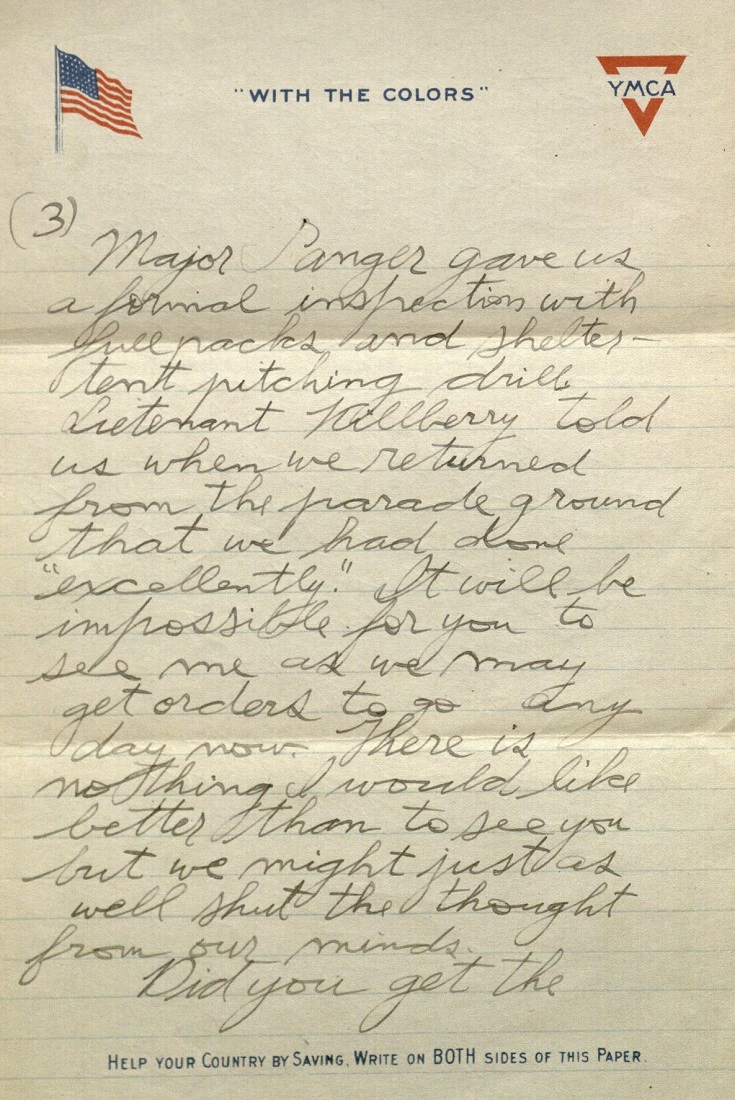
Image of Forrest W. Bassett's letter to Ava Marie Shaw, February 8, 1918 Image of Forrest W. Bassett's letter to Ava Marie Shaw, February 8, 1918

Image of Forrest W. Bassett's letter to Ava Marie Shaw, February 8, 1918 Image of Forrest W. Bassett's letter to Ava Marie Shaw, February 8, 1918

Click images to enlarge.

Friday, Feb. 8, 1918.

Dear Marie,

George Stock left Monday for Urbania, Ill. A young fellow from the Wisconsin University is in his place. He is a A-1 recruit, drafted, I guess, as he came here in his civilian clothes and knows absolutely nothing about military life.

We shipped all our horses to Ft. Riley a few days ago. “Ten” is in the Cavalry as his tag was marked “Cav.” A few of the horses were tagged “Artillery.” We kept most of our pack mules. One mule executed a perfectly good “Halt,” when we led him to the car door, but a rope from his halter around his hind legs, and ten men pushing, just naturally changed his mind.

Yesterday at 4:30 P.M. we had a formal “retreat” with a review of the whole 5th and 6th Battalions. It sure was some fancy.

Today we had our first battalion maneuvers in the field. We had telegraph and radio stations set up in a number of places between Leavenworth and Kickapoo. Our new radio tractor is showing itself to be some machine. I copied a message from it for the first time yesterday afternoon.

Tuesday I passed the semaphore test without an error. We are going to be tested in radio, wig-wag, and acetylene lantern later in the month. Those that fail these tests are not allowed to leave the Cantonments.

I doubt if you would find it worth while to learn either the radio or semaphore code. It is very interesting though.

Well I have hiked quite a bit today and will have to walk home so I guess I’ll quit.

With love,
Forrest.

Meredith Huff
Public Services

Emma Piazza
Public Services Student Assistant
The Lawrence Ice Jam of 1910

January 30th, 2018

Postcard images in Spencer’s Lawrence Photo Collection document the destruction and disruption caused by large ice jams (or ice gorges) along the Kansas (Kaw) River near Lawrence in January 1910. Articles from area newspapers provide additional details about the situation. For example, the Topeka Daily Capital reported on January 15th that “travel on the Santa Fe [railroad] tracks between Lecompton and Lawrence is practically blocked and all westbound Santa Fe trains are coming into Topeka over the Union Pacific tracks.”

Between Lecompton and Lawrence the tracks are partially submerged with water and ice and from the bridge across the Kaw river at Lawrence three miles this way the Santa Fe tracks are covered with from one to three feet of water and ice. An immense ice jam has formed at the bridge at Lawrence and the checking of the river’s flow has forced the water over the tracks. The jam is about six miles long.

Postcard showing an ice gorge at Lawrence, Kansas, 1910

The ice gorge at Lawrence, 1910. Lawrence Photo Collection.
Call Number: RH PH 18. Click image to enlarge.

Newspapers also described how widespread the problem was elsewhere along the Kaw and other rivers, in Kansas and beyond. A headline on the front page of the Topeka Daily Capital on January 15th stated that an “ice gorge in [the] Mississippi [River] in St. Louis goes out causing damage estimated at $200,000.”

Postcard showing high water caused by an ice jam, Lawrence, Kansas, 1910

High water caused by an ice jam, Lawrence, 1910.
Lawrence Photo Collection. Call Number: RH PH 18. Click image to enlarge.

Postcard showing an ice gorge at Lawrence, Kansas, 1910 Postcard showing an ice gorge at Lawrence, Kansas, 1910

The ice gorge at Lawrence, 1910. Lawrence Photo Collection.
Call Number: RH PH 18. Click images to enlarge.

A letter to the World from Burt Brown, who is at Junction City, says: “The ice has broken in the Republican river today, and at Ft. Riley the Kaw river is full of floating ice. The water is considerable above the normal stage. If all the floating ice I saw in the Kaw east of Ft. Riley reaches the ice jam at Lawrence it will surely do some damage there.”

Lawrence Daily World, January 27, 1910

Lawrence, Kan., Jan 28. — Even being a fish has had its handicaps lately, and the dwellers in the Kaw thought that the world had come to end when the ice began moving. Lou McCann was standing near the water’s edge watching the ice move down the stream, when almost at his feet a forty pound catfish was crowded out on the bank, and started for the timber to [e]scape the ice. McCann, who is fleet of foot, took after it and soon overhauled the monster cat and put it out of harm’s way.

Topeka State Journal, January 28, 1910

Since the ice gorge at Lawrence has been broken and the water has receded to the channel of the river, the Santa Fe has been able to restore its train service to normal condition.

Osage City Free Press, February 10, 1910

The county boards of Jefferson and Douglas counties held a conference at the Lecompton bridge this week for the purpose of taking some action to repair the bridge, which was partially destroyed by an ice jam in January. Nothing definite was accomplished. All three of the wrecked spans are in sight; one is about 100 feet from the wrecked bridge, one about 150 feet and the third about 400 yards distant at the mouth of the Delaware. Their condition could not be ascertained, owing to the mush ice in the river and the fact that they are partly buried in sand which is rapidly forming a bar around them…Cal Walton estimates that it will take $14,000 to repair the damage.

Lawrence Daily World, February 26, 1910

Meredith Huff
Public Services

World War I Letters of Forrest W. Bassett: January 29-February 4, 1918

January 29th, 2018

In honor of the centennial of World War I, we’re going to follow the experiences of one American soldier: nineteen-year-old Forrest W. Bassett, whose letters are held in Spencer’s Kansas Collection. Each Monday we’ll post a new entry, which will feature selected letters from Forrest to thirteen-year-old Ava Marie Shaw from that following week, one hundred years after he wrote them.

Forrest W. Bassett was born in Beloit, Wisconsin, on December 21, 1897 to Daniel F. and Ida V. Bassett. On July 20, 1917 he was sworn into military service at Jefferson Barracks near St. Louis, Missouri. Soon after, he was transferred to Fort Leavenworth, Kansas, for training as a radio operator in Company A of the U. S. Signal Corps’ 6th Field Battalion.

Ava Marie Shaw was born in Chicago, Illinois, on October 12, 1903 to Robert and Esther Shaw. Both of Marie’s parents – and her three older siblings – were born in Wisconsin. By 1910 the family was living in Woodstock, Illinois, northwest of Chicago. By 1917 they were in Beloit.

Frequently mentioned in the letters are Forrest’s older half-sister Blanche Treadway (born 1883), who had married Arthur Poquette in 1904, and Marie’s older sister Ethel (born 1896).

Highlights from this week’s letters include Forrest’s frozen ear (“this morning I froze the top of my left ear on my way to school”) and a dispute during guard duty (“[the Officer of the Day] criticised me for not turning out the guard when he came in sight…I was on duty from 10 to 12 P.M. and believe me I halted everyone strictly according to regulations”).

Jan 30, 1918

Dear Marie,

No letter came Monday nor Tuesday but three came today which made it all “fine” once more. You didn’t tell me exactly what an Earth Trodder is, so I am not justified in condemning the idea, however it doesn’t “listen” very good to me. I would be glad to get a fruit cake from you, so you better get Blanche to show you how to make one. I would eat it all myself, too – you see if the whole First Section were tied up with a “tummy-ache,” Co. “A” would be very seriously crippled.

Marie, don’t ever think for a minute that I will get tired of receiving your letters. I am at least as glad to get letters from you as you are to hear from me. But at the same time I think it would be better to write every other day as lots of times I get two letters on one day and none the preceding day.

Now please, little sweetheart, don’t think that I am tiring of you in the least.

We rode all afternoon yesterday. As soon as we hit the hills we left the main road and hit for the tall timber. You should have heard the hooting and yelling when we got in the woods. There is only about six inches of snow on the ground and the ground underneath is hard and slippery so we could not trot very much. Even at that we had a lot of fun. Our new first sergeant is a fine fellow. The other one was promoted and Sg’t. Ryan took his place. Sg’t. Ryan is the one that got kicked just below the eye by the same horse that tickled me on the jaw. I guess he will wear that scar all his life.

The Co. had a big test in semaphore yesterday. We are supposed to be able to send and receive five to eight words a minute in wig-wag and ten to fifteen words a minute in semaphore. The words are supposed to average five letters each. It is easy to read wig-wag as it is impossible to transmit very fast with a large flag. I didn’t take the test as I was down to the class at the Army Service School. During the wig-wag class period in the afternoon, I sent wig-wag at the rate of eleven words per minute for a few minutes, and when I quit I had a blister on the side of my hand. Sending semaphore is not so much work, but it takes lots of practice and a quick eye to get fifteen (that is 75 letters) a minute. This is about as fast as the average person writes. I can receive about twelve words and send about fifteen words per minute. Sometimes we semaphore French words and one is out of luck if he misses a single letter.

This morning I froze the top of my left ear on my way to school. It was hard and stiff so I kept it in the snow until it got soft then I turned the cold water facet on it. It is swollen up and is pretty blue and tender, but I guess it will be O.K. in a few days.

Tonight, Stock and I hiked to town – an auto delivery took us most of the way.

Tomorrow is muster day, so we will have Battalion inspection, which means that yours truly must scrub his leggins before he hits that little straw bunk.

Stock says “That’s enough Bassett, that’s enough” and I guess he is right, don’t you think so?

With love,
Forrest.

I know this writing is fierce but I had to hurry.

Image of Forrest W. Bassett's letter to Ava Marie Shaw, February 3, 1918 Image of Forrest W. Bassett's letter to Ava Marie Shaw, February 3, 1918

Image of Forrest W. Bassett's letter to Ava Marie Shaw, February 3, 1918 Image of Forrest W. Bassett's letter to Ava Marie Shaw, February 3, 1918

Image of Forrest W. Bassett's letter to Ava Marie Shaw, February 3, 1918 Image of Forrest W. Bassett's letter to Ava Marie Shaw, February 3, 1918

Click images to enlarge.

Feb. 3, 1918

Dear Marie,

Glad to hear you liked the pictures. I guess we say our final “Goodbye” to our horses this week. Yesterday we saw our motor radio set. It is for the main station and is set up on a “White” motor truck. The motor class I was in was discontinued at the end of the month. (Jan.)

Stock leaves for Urbania, Ill. tomorrow or Tuesday. He will attend the “ground school” and then go to some aviation field to learn to fly, later. I wish I were going to Urbana as it is only about 160 miles from Beloit. Stock’s final success in getting his transfer has stirred up quite a spirit of unrest among some of the more ambitious men in the Co. Serg’ts Ryan, Carr, and Ward are going to try for a transfer but I doubt if they can “put it over” in the way that Stock did. Maybe Stock will go to Beloit some time before he leaves Urbana.

Friday night and Sat. we were on guard again. The “Officer of the Day” was a pretty strict one and about fifteen minutes after “retreat” was blown he came around to look us over. I was on duty at the Guard House (Post No 1.) and he criticised me for not turning out the guard when he came in sight. Well it happened that I was right because the thirteenth special order, applying to Post # No 1, starts out “Between Reveille and Retreat, turn out the guard for —- etc.”, but it got my goat anyway. The O.D. came around again on an inspection tour and Cpl. Abrams told me to be very sure to challenge all persons and to advance no one without calling the Corporal of the Guard. I was on duty from 10 to 12 P.M. and believe me I halted everyone strictly according to regulations. At midnight I was relieved and went to bed. Just as I was dozing off I heard Corporal Clayton make a remark about “Bassett waking him up several times by calling the Cpl. of the Guard to advance men coming to the guardhouse. Finally he said, “He’s a d-d good kid, but bullheaded as H—l.” I thought that was about “nuff ced” so I cut loose with a few remarks on the subject that cleared the atmosphere considerably. I knew he was pretty unpopular with almost every man in the Co. so I didn’t leave very much unsaid. It’s a gay life. I have only been to one “movie” since Thanksgiving. I saw one of the “Bab’s Diary” pictures last summer. It was the one where her mother wouldn’t let her have her new party dress made with a low neck. She scared her folks into thinking she was going to run away and marry, and finally got her dress. It sure was a good story, was it the one you saw? Well I must quit for tonight. Would you like to learn the radio telegraph code and the Semaphore method of signaling?

With love,
Forrest.

The radio code is the same one we used to use with the buzzer in my desk.

Meredith Huff
Public Services

Emma Piazza
Public Services Student Assistant