The University of Kansas

Inside Spencer: The KSRL Blog

Books on a shelf

Welcome to the Kenneth Spencer Research Library blog! As the special collections and archives library at the University of Kansas, Spencer is home to remarkable and diverse collections of rare and unique items. Explore the blog to learn about the work we do and the materials we collect.

Separated at Birth: The lives of three copies of the True Account of the Horrid Conspiracy

April 18th, 2016

A true account and declaration of the horrid conspiracy against the late king, His present Majesty, and the government: as it was order’d to be published by His late Majesty – Thomas Sprat’s official account of the failed 1683 Rye House Plot to assassinate King Charles II of England and his brother (and successor) James, Duke of York – is no doubt a fascinating and dramatic tale of intrigue. As a conservator, however, I’m interested in the stories that Spencer Research Library’s three different first-edition copies of this title tell through their physical condition and bindings.

Two of the three copies recently crossed my bench in need of treatment, and when I looked up their catalog record I noticed that there was a third copy at Spencer, so I pulled that one from the stacks in order to examine them one next to the other. It was so much fun to compare the three volumes and to imagine how they’d begun their lives all together in the same place – Thomas Newcomb’s print shop – before being sold and going out into the world on their various journeys, only to arrive back together again in our stacks over three hundred years later, each bearing the distinct marks of its own life of use. I’ll refer to them as Copy 1 (E242), Copy 2 (E242a) and Copy 3 (E3324). Let’s do some wild comparatively tame speculation about the life stories of these books.

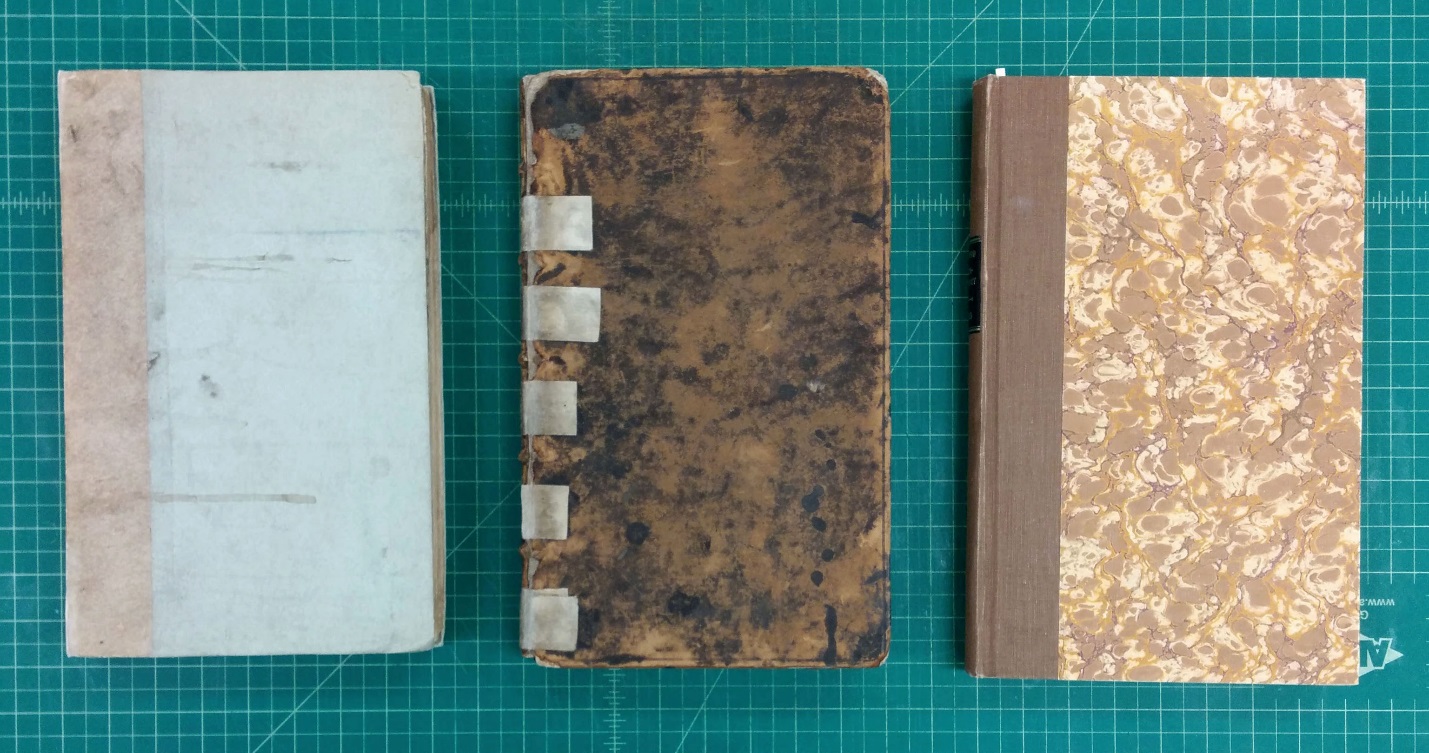
E242, E242a and E3324 pic 1

Spencer Research Library’s three copies of the True account of the horrid conspiracy: E242 (left), E242a (center), and E3324 (right). Click image to enlarge.

E242, E242a and E3324 pic 2

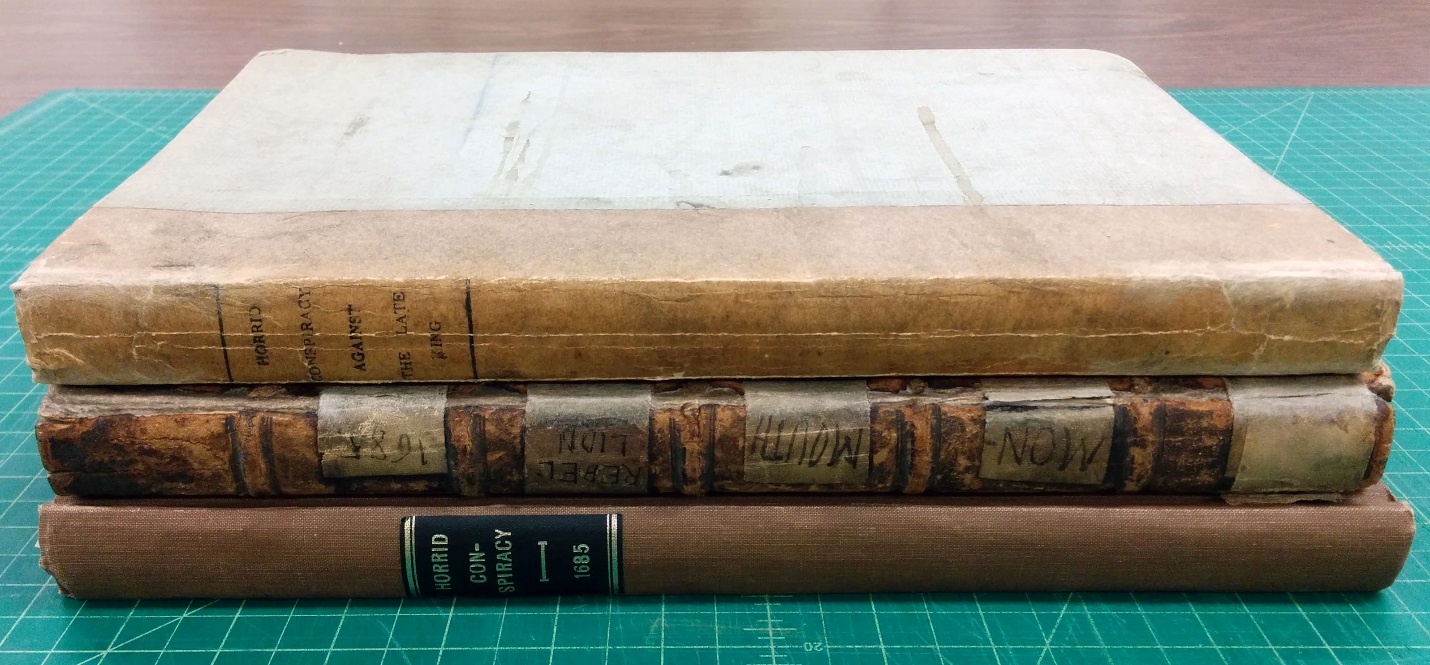
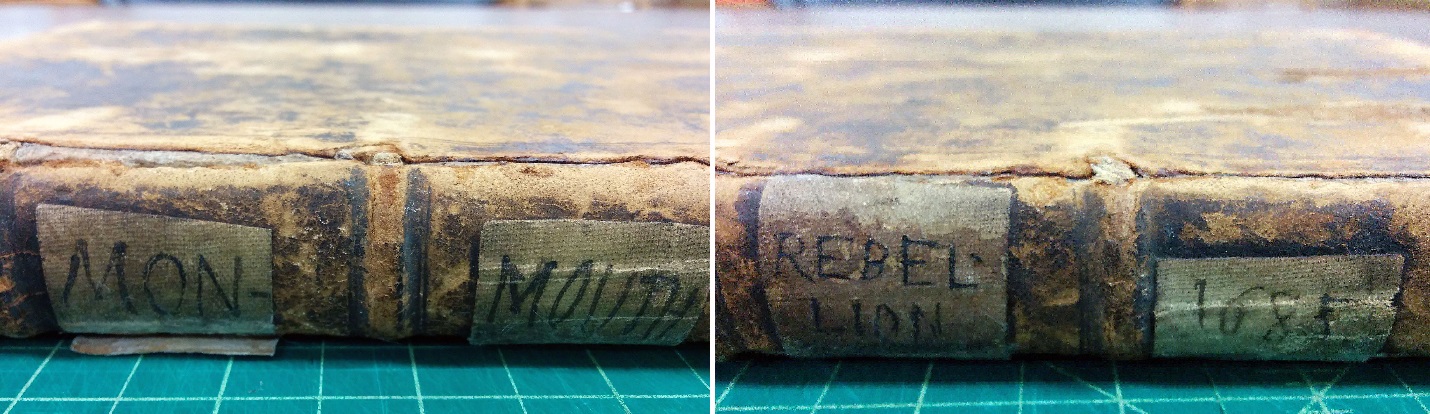
View of the spines of the three volumes: E242 (top), E242a (middle), and E3324 (bottom). Click image to enlarge.

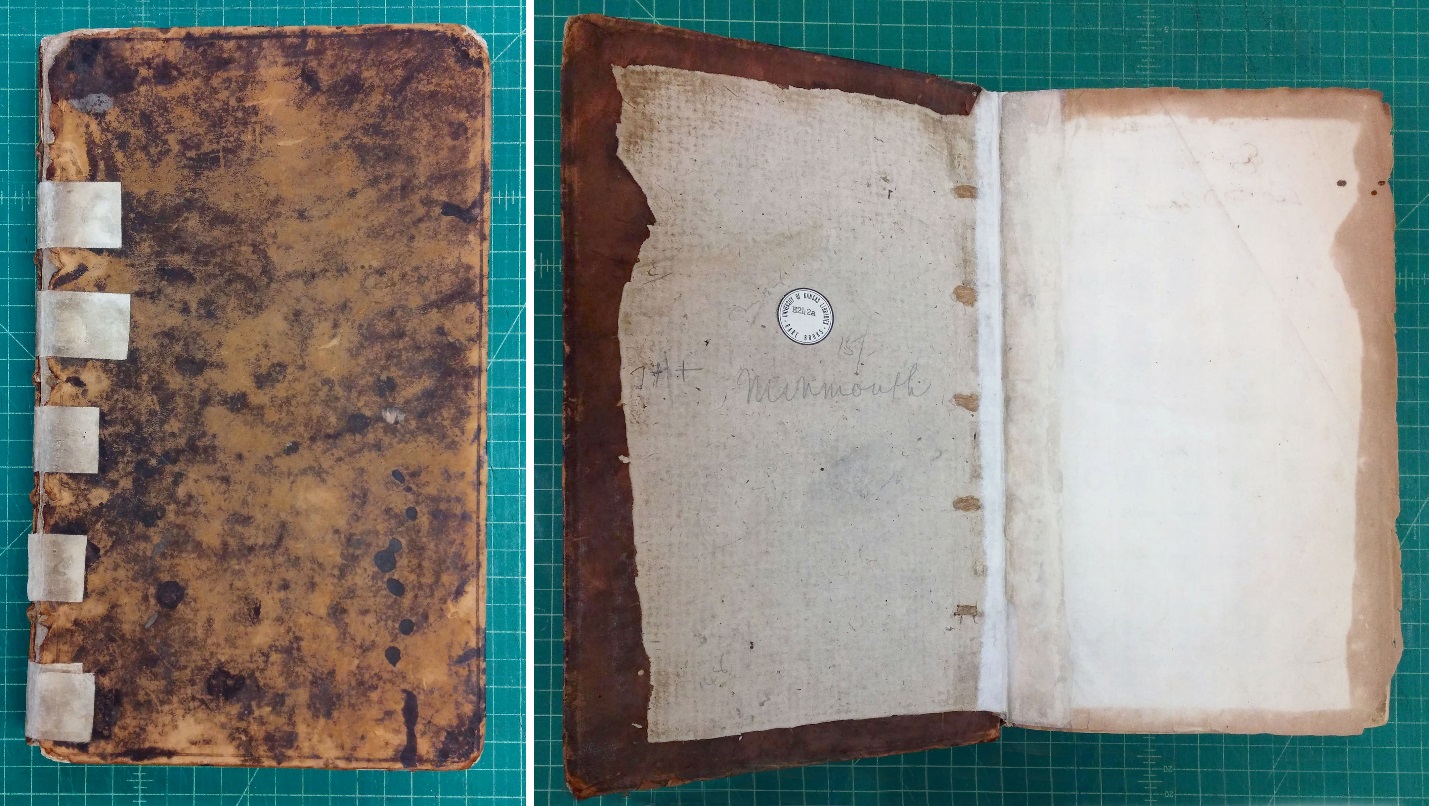
According to the practice common at the time, it is likely that all three of these copies left the printer, and maybe even the bookseller, in an unbound or partially-bound state, or possibly in temporary bindings; the buyer would then take the book to a bindery to be properly bound in his preferred style. Of Spencer’s three copies, only Copy 2 is in a binding roughly contemporary to the time of the book’s printing, though it’s hard to say if it truly is its original binding. It is a full leather binding with minimal decoration – a single tooled line along the edges of the boards – and it has obviously been heavily used; there is a good deal of general wear and tear to the text block and leather, and the front board was detached, held in place with gummed cloth tape. On the inside, the absence of pastedowns allows us to see the irregular turn-ins, the texture of the board, and the laced-in cords that all indicate the binding’s age.

E242a pic 3
Front board and front inside cover of E242a after treatment. Click image to enlarge.

The historic repair on this volume is cringe-inducing, in the way that all tape is offensive to conservators, but I admit to finding it somewhat charming as well, with its hand-scrawled title and date. This volume also had gummed cloth tape along the inner hinge; that tape was removed because it was causing damage to the paper, but the tape across the spine was left in place primarily because of the character that this oddly appealing feature lends to the volume. In addition to removing the tape from the inside of the book, I reattached the front board, reinforced the back board, and surface cleaned the text block where it was needed.

E242a pic 4

Handwritten labels on gummed cloth tape on the spine of E242a. Click image to enlarge.

Copies 1 and 3, having been rebound, may lack some of the old-book charm displayed by their edition-mate, but their bindings still tell (or at least suggest) something about the lives they have lived. We can only guess as to exactly when these volumes were rebound; my guess would be that Copy 1’s current binding is from the late 19th or early 20th century, while Copy 3 was bound somewhere in the first half of the 20th century (and I welcome thoughts and comments to corroborate or refute these estimates!).

When Copy 1 arrived in the lab for treatment, its paper spine was torn in several places and the case, which had been attached to the text block by just the flyleaves along a narrow strip down each shoulder, was nearly detached. The title page was torn and the text block was quite dirty, showing a great deal more wear than its newer case. This binding provides some measure of protection for what was seemingly a much-used volume, but the binder didn’t take extra steps to clean or mend the text block; this is a very utilitarian case binding. As part of its treatment, I mended the case, reinforced the case attachment to the text block, surface cleaned the most soiled parts of the volume (text block edges and the first and last several pages), and mended the tears with Japanese tissue and wheat starch paste.

E242 pic5

Front cover and front inside cover of E242 after treatment. Click image to enlarge.

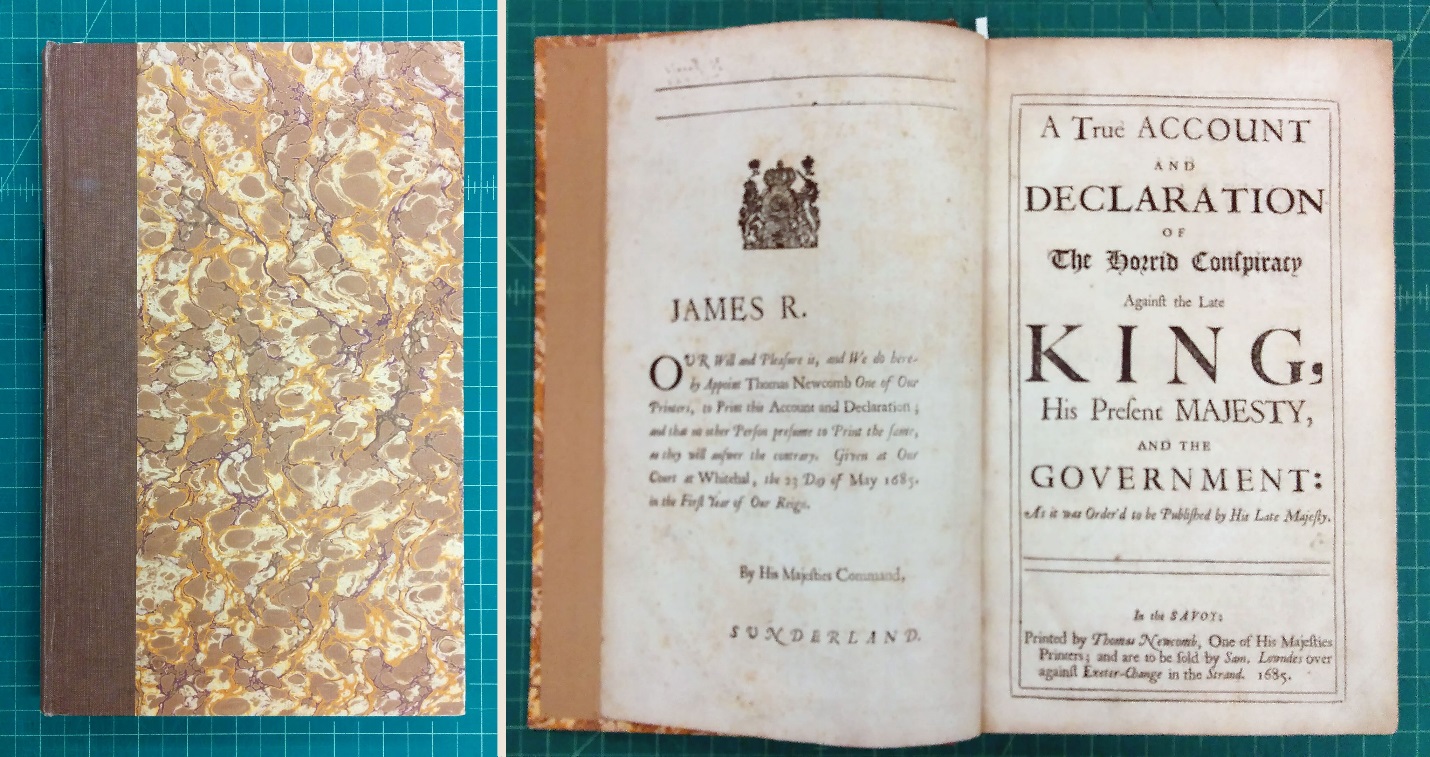
Copy 3, by contrast to the other two, is in very good condition; its text block is significantly cleaner and its binding is sound, probably the work of a commercial bindery or workshop. While any traces of a historic binding are lost, the information contained in the volume has been preserved, which some would argue is ultimately the most important thing. Still others might assert that its current binding can still tell us a lot about what readers, institutions, and book collectors value in the books they use/collect and how those values inform decisions such as how and whether to rebind a volume. Copy 3 does not appear to have been nearly as well-used as its mates, or perhaps it is just that it was not as ill-used – the good condition of its text block may be a sign that its owner(s) simply took very good care of it. Its modern library-style binding is not especially attractive, but it does its job well: it protects the text block and doesn’t cause it any harm.

E3324 pic 6

Front cover, dedication, and title page of E3324. Click image to enlarge.

I have focused so far primarily on the bindings of these volumes, but before I conclude I want to point out an interesting printing detail on the title pages. Here are the three title pages side by side:

E242, E242a and E3324 pic 7

Title pages of True account of the horrid conspiracy: E242 (left), E242a (center), and E3324 (right). Click image to enlarge.

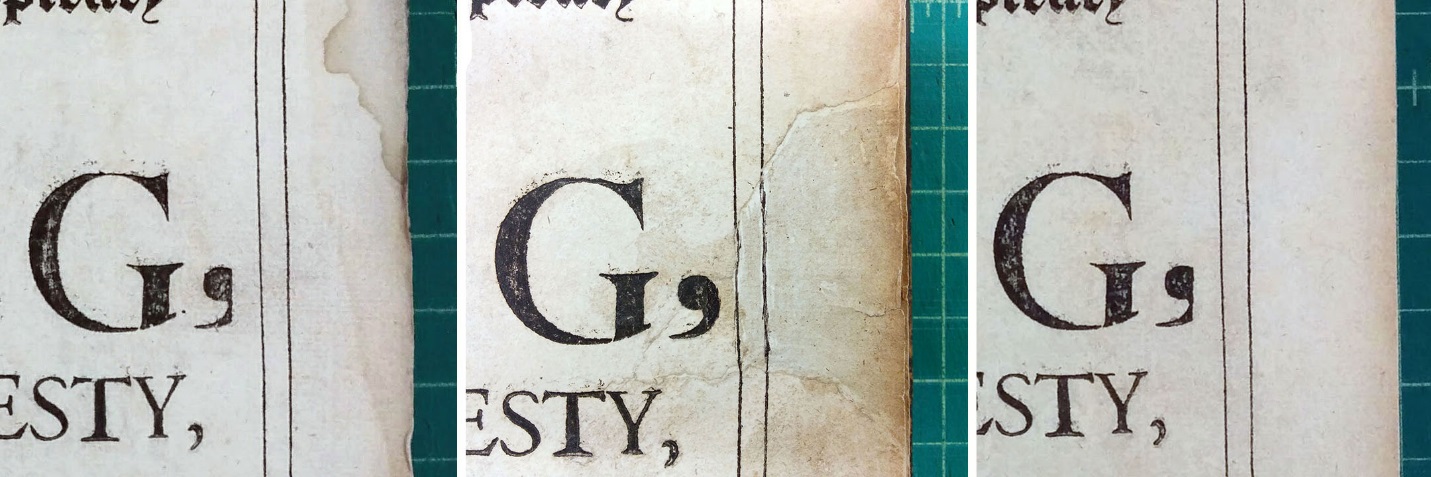
If you look closely, you can see that there’s a printing error on the large comma following the word “KING,” except on the title page of Copy 2, in the middle. Here’s a closer look (click image to enlarge):

E242, E242a and E3324 pic 8

At some time in the past, Copy 2’s title page sustained a small loss at the fore-edge, including part of the comma and the double border lines, and someone had filled the loss by lining the entire page with a piece of plain paper. This person (or perhaps some other, later person?) then drew in the missing lines and filled out the comma with ink. Was this the same person who applied the tape and handwritten labels on the spine of Copy 2? We shall never know, but it certainly is fun to wonder.

Angela Andres
Special Collections Conservator
Conservation Services

Ogilby’s Britannia: Bringing English Cartography into the Scientific Age

April 11th, 2016

John Ogilby, was born in Scotland in 1600, and held many different careers in his life; a dancing-master, theater owner, poet, translator, publisher and cartographer. He is most remembered for bringing English cartography into the scientific age with his 1675 road atlas of England and Wales titled, Britannia. To create the wonderfully detailed strip maps that displayed the topographical features and distances of the roads, Ogilby’s team of surveyors worked with the precise and easy-to-use perambulator or measuring wheel to record the distance of the roads in miles; implementing the standardized measurement of 1,760 yards per mile as defined by a 1592 Act of Parliament. They also used the surveyor’s compass or theodolite to better record the changes in the directions of the roads. Besides the use of scientific instruments, Britannia was also the first published work to use the scale of one inch equaling one mile, which became the prevailing scale for cartography. Through the use of detailed illustrations and precise technology, Ogilby’s Britannia became the first comprehensive and accurate road atlas for England and Wales, making it the prototype for almost all English road books published in the following century. Our Special Collections house several editions and iterations of Britannia and its surveys, including the first edition from 1675.

Title Page for John Ogilby's Britannia (1675).
The title page for the first edition of Ogilby’s Britannia, 1675.
Special Collections, Spencer Research Library. Call Number: H1. Click image to enlarge.

Strip map from Britannia of “The Road From LONDON to ABERSWITH…”.
Strip map of “The Road From LONDON to ABERSWITH…” Note the illustration around the title,
the perambulator/measuring wheel is being used by the man on foot and
the surveyor’s compass/theodolite is being used by the man on horseback.
Special Collections, Spencer Research Library. Call Number: H1. Click image to enlarge.

After Ogilby’s death in 1676, his step-grandson, William Morgan, continued his work. Morgan utilized many of the original maps and descriptions created by Ogilby and his team of surveyors, since Britannia provided such exact and thorough accounts of the British roads. Many travelers and merchants desired to take these accounts with them, so the maps, surveys and descriptions used in Britannia were often scaled down and published in more portable works.

Ogilby editions size comparison
Comparing the size of the works from left to right: Britannia followed by The traveller’s guide or,
a most exact description of the roads of England. Being Mr. Ogilby’s actual survey,
and lastly The traveller’s pocket-book: or, Ogilby and Morgan’s book of the roads improved and amended.
Special Collections, Spencer Research Library. Call Numbers: H1, Bond C69, A297. Click image to enlarge.

Unfolding map for The traveller’s pocket-book: or, Ogilby and Morgan’s book of the roads improved and amended.

Open map for The traveller’s pocket-book: or, Ogilby and Morgan’s book of the roads improved and amended.
The traveller’s pocket-book: or, Ogilby and Morgan’s book of the roads improved and amended

with attached map of England and Wales, 1765. Special Collections, Spencer Research Library.
Call Number: A297. Click images to enlarge.

To learn more about John Ogilby and Britannia, come by Spencer Research Library and take a look at these sources:

  • Hyde, Ralph. “John Ogilby’s Eleventh Hour.” Map Collector No11 (1980): 2-8. Print. Call Number: E1814.
  • Ogilby, John. Britannia: London 1675 with an introduction by Dr. J.B. Harley. Amserdam: Theatrum Orbis Terrarum, 1970. Print. Call Number: G730
  • Worms, Laurence and Baynton-Williams, Ashley. “Ogilby, John (1600-1676)—London.” British Map Engravers: a Dictionary of Engravers, Lithographers and Their Principal Employers to 1850. London: Rare Book Society, 2011. 498-500. Print. Call Number: GA793 .W67 2011.

Mindy Babarskis
Library Assistant
Public Services
The Garden of Health: Gart der Gesundheit, Hortus Sanitatis

April 4th, 2016

The herbal is a medical garden in book form–hence the titles Hortus Sanitatis and Gart der Gesundheit–and as such contains data on the appearance, gathering, preparation, and use of medicinal plants. Remedies from the animal and mineral kingdoms are often included as well. Although the works shown here are from the early part of the Golden Age of the Herbal (roughly 1470-1670), these practical manuals have been popular with scientist and non-scientist alike since antiquity, and a stroll through any bookstore today will attest to a resurgence of that popularity. The Department of Special Collections has a rich and growing garden of herbals spanning six centuries.

Page from herbal book. Call number Summerfield E60 v. 1_1, Kenneth Spencer Research Library, University of Kansas.   Page from herbal book. Call number Summerfield D291, Kenneth Spencer Research Library, University of Kansas.

Left: Otto Brunfels, Herbarum vivae eicones, [1532], call number Summerfield E60 v.1. Right: Pedanius Dioscorides of Anazarbus, De medicinali materia, [1542], call number Summerfield D291 item 1. Click images to enlarge.

Page from herbal book. Call number Summerfield C1125, Kenneth Spencer Research Library, University of Kansas.   Page from herbal book. Call number Summerfield C2114, Kenneth Spencer Research Library, University of Kansas.

Left: Christovam da Costa, Trattato  . . . della historia, natura, et virtu delle droghe medicinali, 1585, call number Summerfield C1125. Right: Incipit Tractatus de virtutibus herbarum, [1509], call number Summerfield C2114. Click images to enlarge.

Adapted entry from the catalog for the exhibition, All that in this delightfull Gardin growes, Department of Special Collections, 1983
Sally Haines, Rare Book Cataloger

Criminal Cases in Medieval Bologna

March 28th, 2016

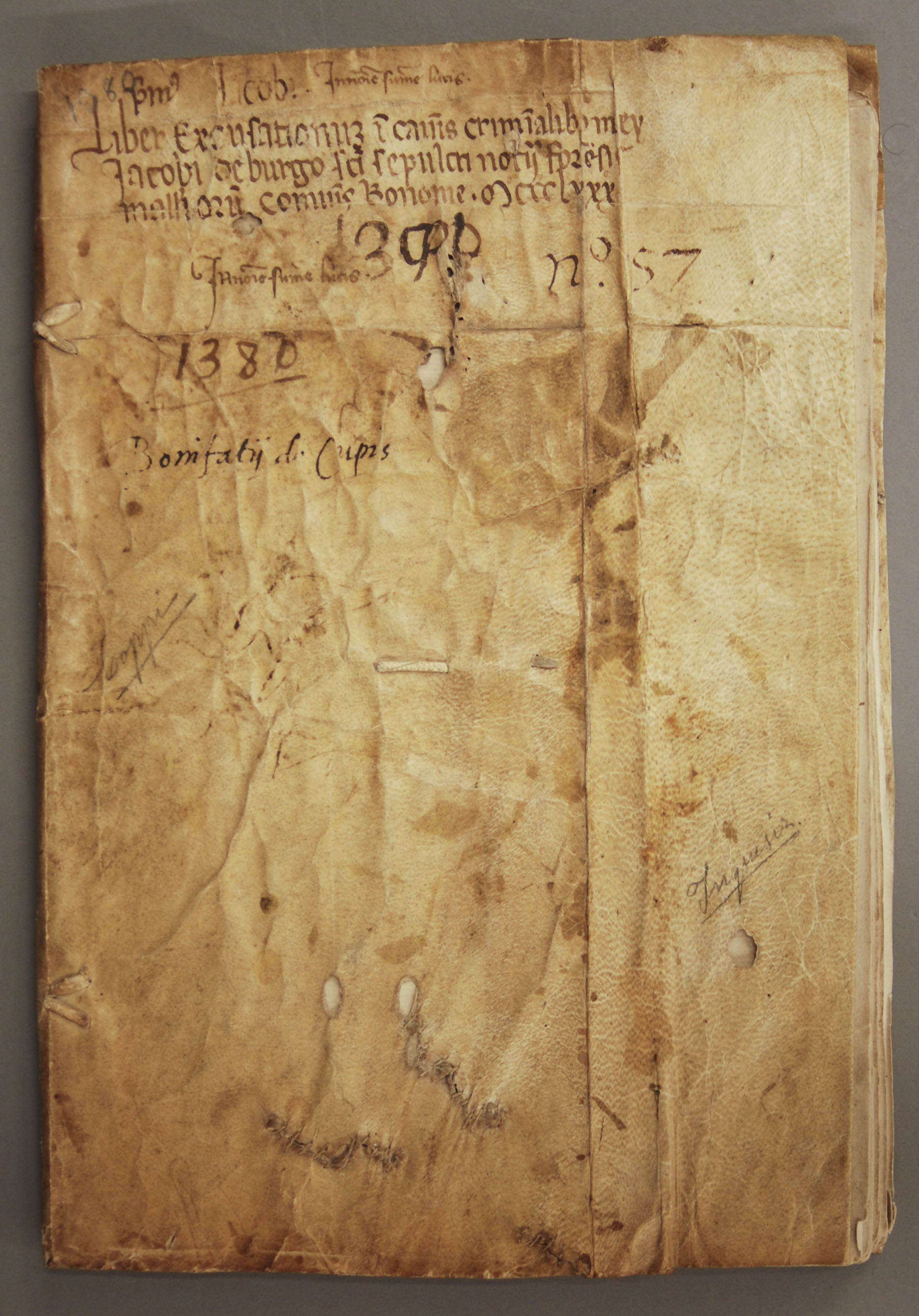
Jacobus de Burgo Sancti Sepulcri (fl. 1380) was a notary and magistrate’s forensic official for misdeeds in Bologna. This is his official record of the charges and pleas he handled in twenty cases involving Bolognese citizens. The cases are mostly minor assaults and theft, although there is one long case of sorcery, seduction, quackery, and con-games.

In one example, German-speaking Ubertus, son of the late Henricus de Norfa, came to the house of Gimignanus Ramainus and stole a woman’s tunic, colored green and worth 10 pounds. Talianarius the notary translated the charge into German for him. He confessed everything.

MS E77 cover MS E77 first page

Liber excusationum in causis criminalibus, Bologna, 31 October 1380 to 24 January 1381. Left: Front cover. Right: First page. Call number MS E77. Click images to enlarge.

MS E77 back cover dragon

Doodle on inside of back cover. Call number MS E77. Click images to enlarge.

Adapted from Civil, Canon, and Common: Aspects of Legal History. An Exhibition of Books and Manuscripts in the Kenneth Spencer Research Library, University of Kansas, 1996.
Alexandra Mason: Catalogue and exhibition; James Helyar: Design

The Long Haul: Treating One of the Neediest Cases

February 15th, 2016

(Part 1 in a series on the treatment of Summerfield D544)

The great majority of the items that we treat here in the conservation lab are in and out of the lab relatively quickly*. (*I use this word in a most qualified and highly subjective way! That usually means anywhere from a few minutes to a few hours to a couple of weeks.) A treatment need not be time-consuming or highly invasive in order to be effective; because there are so very many items in our collections that need treatment, and because we conservators try to take a conservative approach to treatments, we design most treatments to employ our resources – time and materials – as economically as possible while achieving the maximum benefit for the items being treated.

On occasion, however, we encounter items that need extra care and a fuller application of the tools available to us. These treatments are nursed along gradually and in stages, the work carried out alongside and in between shorter-term treatments, and sometimes put away for days or weeks at a time to let more immediate priorities take precedence. I currently have one such treatment on my bench, the Polish printed book, Kazania na niedziele calego roku [i.e., Sermons for Sundays of the Whole Year] by Pawel Kaczyński, published in 1683 (call number: Summerfield D544).

Book before treatment. Call number Summerfield D54, Special Collections, Spencer Research Library.

Summerfield D544 before treatment. Special Collections, Spencer Research Library. Click image to enlarge.

The catalog record notes that Spencer Library’s copy of this title is “imperfect;” indeed, we have only volume 1 of a three-volume set, our volume is missing one page, it has significant losses and edge damage throughout the text block, and not least of all, it is missing its binding. What remains of the volume is dirty and worn, and its sewing is rather carelessly executed, which limits the volume’s opening and has resulted in damage along the spine where sloppily-inserted thread has torn through the paper. In addition, the spine is coated with a thick waxy substance that is causing discoloration and breakage along the spine folds.

Book before treatment. Call number Summerfield D54, Special Collections, Spencer Research Library.

Example of damage caused by poor sewing. Click image to enlarge.

Book before treatment. Call number Summerfield D54, Special Collections, Spencer Research Library.

Damage caused by waxy spine coating. Click image to enlarge.

This poor volume had been housed in a simple envelope, and was at the very least in need of better housing, but one interesting feature drew our attention: a fragment of manuscript binder’s waste still adhered to the frayed cords on the back of the volume. It is not unusual to see repurposed manuscripts in books from this time, and the Summerfield Collection has many other examples of binder’s waste in its books. The fragment on Kazania is a bit different, however, because the language in which it is written appears to be Old Church Slavonic (while most of the manuscript fragments we see tend to be in Latin) and because the material it is written on is paper, rather than parchment.

Book before treatment. Call number Summerfield D54, Special Collections, Spencer Research Library.

Manuscript binder’s waste on the back of the volume. Click image to enlarge.

The fragment was dirty, torn, and completely obscured on one side by the pasted-down cords and layers of delaminated board from the missing binding. Normally we would attempt to preserve binder’s waste on the volume itself, but in this case, absent a binding and with the fragment at risk for further damage, we consulted with the collection curator and opted to release the fragment from the cords, clean it to the extent possible in order to reveal the concealed manuscript, and house it with the volume, including photographs of its original condition, as a teaching tool.

But what about the rest of the volume? In its present condition it is not suitable for use, and its sewing is causing damage to the text block, so we decided that the volume should be disbound, cleaned, mended, sewn up again, and placed into a limp paper conservation case binding. A paper case, similar to the one shown here at left, has many benefits: it will protect the text block and allow for safer and easier handling of the volume; it can be easily removed from the volume if its conservation or binding needs ever change in the future; and it will have an aesthetically appealing appearance that will integrate well on the shelf with other volumes in the collection.

This treatment, then, is one of those exceptions to our generally conservative practice – some items just need more help than others. Now that you’ve been introduced to this volume in its before-treatment condition, stay tuned to this blog for updates as the treatment progresses. The next installment in this series will cover the removal of the manuscript fragment, dismantling of the sewing, and the cleaning and preparation of the text block for re-sewing.

Angela Andres
Special Collections Conservator
Conservation Services