The University of Kansas

Inside Spencer: The KSRL Blog

Books on a shelf

Welcome to the Kenneth Spencer Research Library blog! As the special collections and archives library at the University of Kansas, Spencer is home to remarkable and diverse collections of rare and unique items. Explore the blog to learn about the work we do and the materials we collect.

The Story of “Self-Portrait”: Spencer’s Unpublished Henry Miller Manuscript

February 25th, 2026

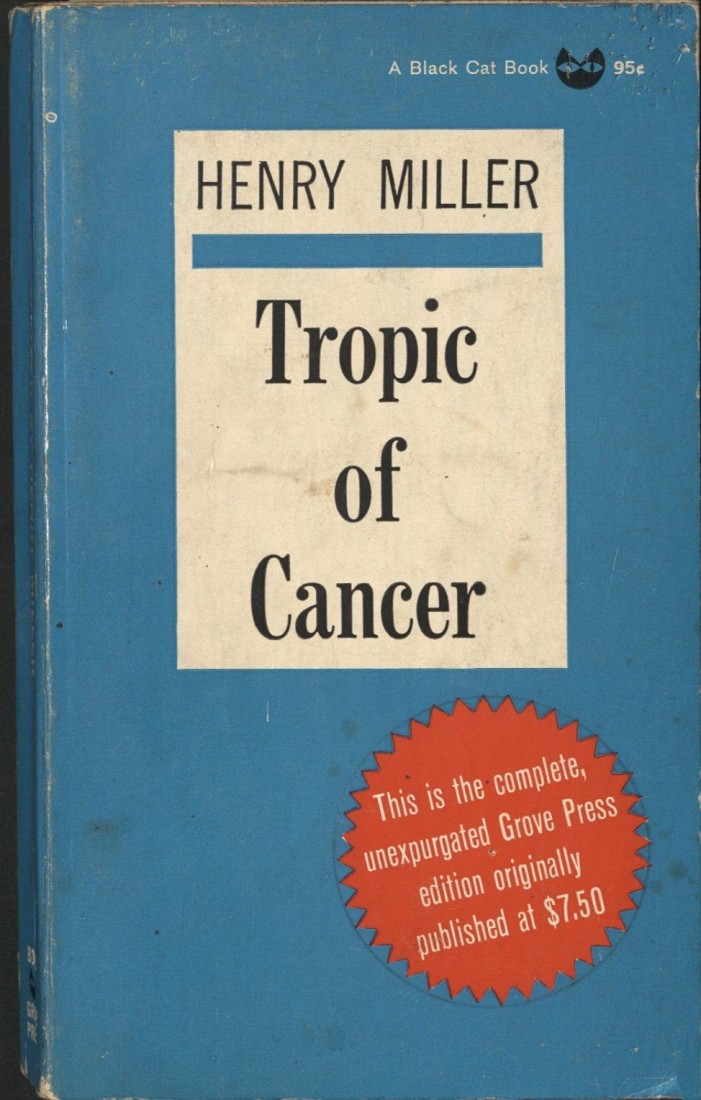
American author Henry V. Miller (1891-1980) is a divisive literary figure, one who has amassed a dedicated cult following, and yet, whose presence in scholarly discourse has traditionally been somewhat limited. Miller is most widely known for his years in Paris, which resulted in the notorious Tropic of Cancer (1934), famously banned for obscenity in the United States for nearly three decades. Despite his popular characterization as a writer who magnified the obscene and grotesque, it’s not uncommon to find Miller falling into extended, heartfelt reveries covering a profound range of subjects, a contrast that contributes to his reputation as an eclectic writer.
This image has text.
The front cover of Tropic of Cancer by Henry Miller, 1961. Call Number: B2849. Click image to enlarge.

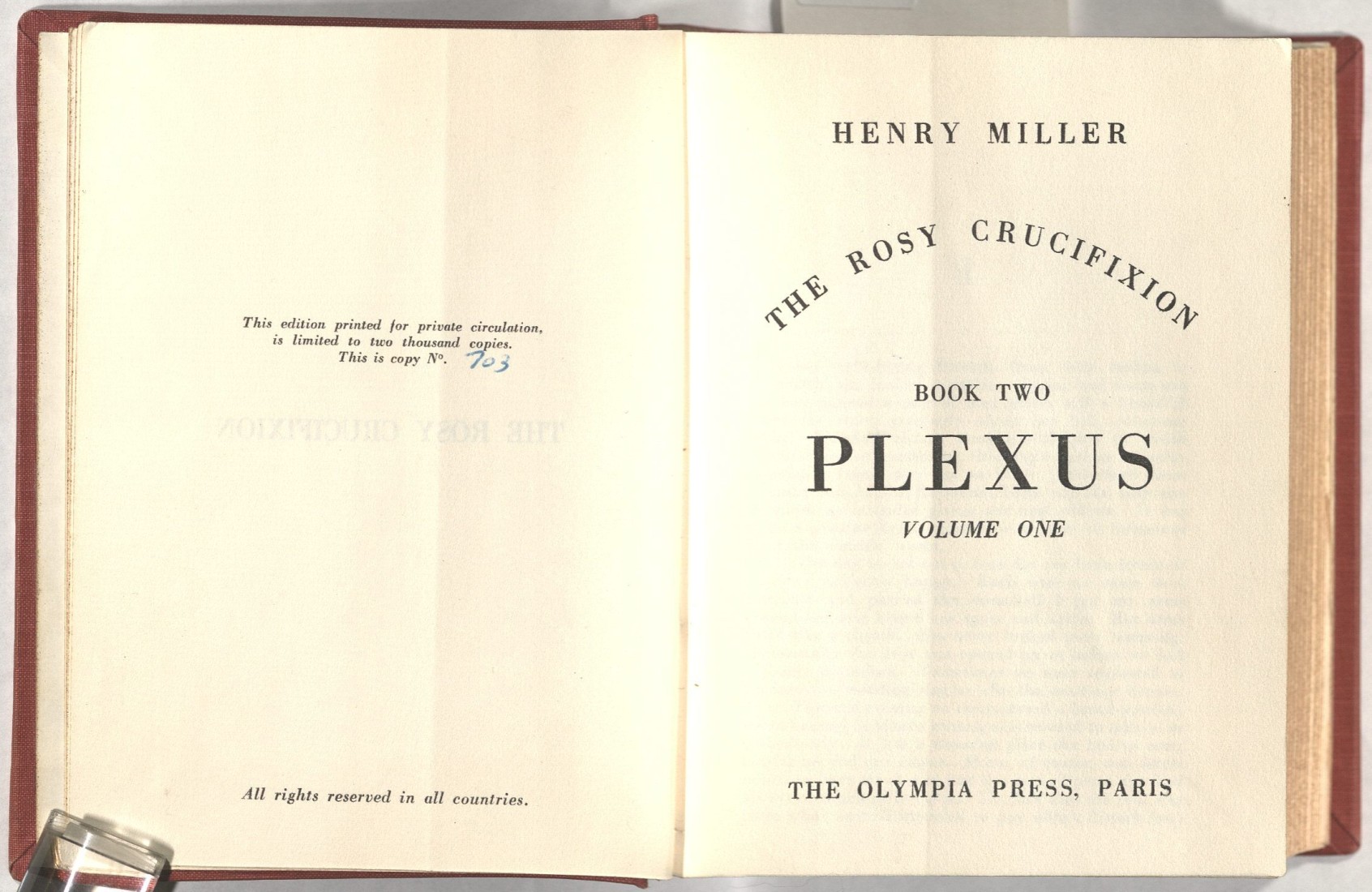
Spencer Library holds a wide range of Henry Miller’s published works, such as an edition of Plexus (1963) limited to two thousand copies. However, the item that might be of most interest to the Miller enthusiast is a small collection of his papers (Call Number: MS P216). This collection primarily consists of typewritten onionskin manuscripts dating from the 1930s, as well as handwritten letters composed during the 1950s. I found the typewritten pieces particularly intriguing; according to the online finding aid, they mostly originate from Miller’s overflowing attempts to write an essay on English novelist D. H. Lawrence.
This image has text.
The title page of Plexus by Henry Miller, 1953. Call Number: B502, book 2, volume 1. Click image to enlarge.

In her biography of Miller, Mary Dearborn details how the D. H. Lawrence project, or “the Brochure” as it was initially called, developed as Miller was attempting to publish Tropic of Cancer in 1932. The only publisher whose attention he managed to get was Jack Kahane of Obelisk Press, who had misgivings about publishing the controversial contents of Tropic. Thus, Miller was asked to compose an essay on Lawrence in order to assert himself as an intellectual and gain more credibility. [1] The project was eventually published as The World of Lawrence: A Passionate Appreciation, much later in 1980.
This image has text.
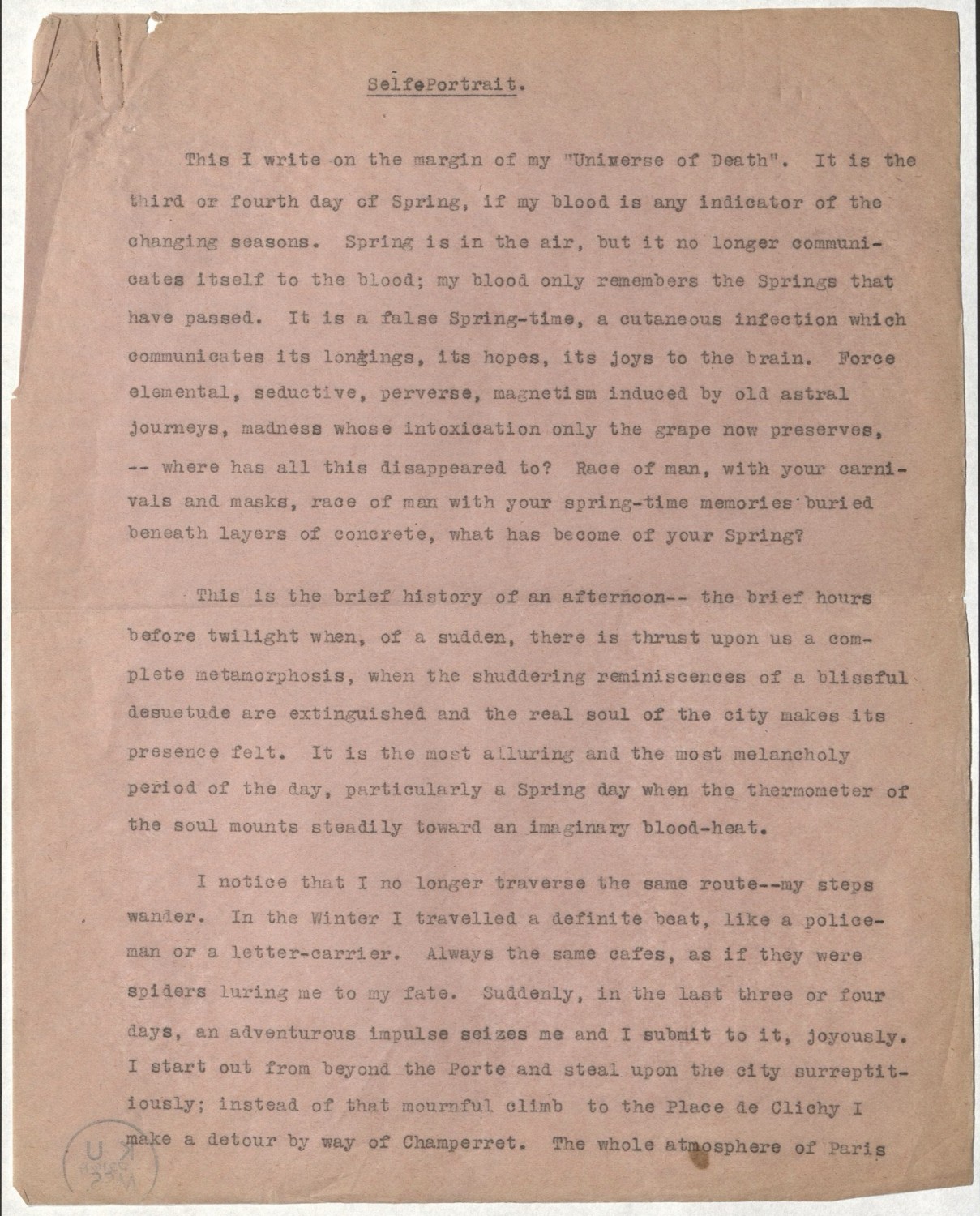
The first page of “Self-Portrait: Installments 1-4” by Henry Miller. Papers of Henry Miller. Call Number: MS P216. Click image to enlarge.

I discovered that very little of the Miller manuscripts at Spencer Library actually appear in any published form. The most perplexing was “Self-Portrait,” a four-part piece that is largely devoid of any connection to the D. H. Lawrence essay, especially in its earlier sections. Within it, Miller mentions the “Universe of Death,” a chapter within The World of Lawrence and The Cosmological Eye (1939). Yet, it bears little resemblance to the section as it appears in the book. Similarly, there is a short description of the 1933 film “Extase,” which was likewise detailed in a chapter of the same name in The Cosmological Eye, yet its appearance within “Self-Portrait” is a different piece altogether. The more I read “Self-Portrait,” the more it appeared as a familiar part of Miller rather than a focused reflection on Lawrence (hence the title). The manuscript, framed around a walk through Paris during springtime, bears many hallmarks of Henry Miller’s original style, such as ornate, unconventional prose, descriptions of sordid and lurid elements lurking underneath the quotidian, a personification of Paris, dubious biographical details and nostalgic reminiscences on his earlier days in Brooklyn, musing on favorite authors (Proust and Dostoevsky), and a meandering, abstract form.
This image has text.
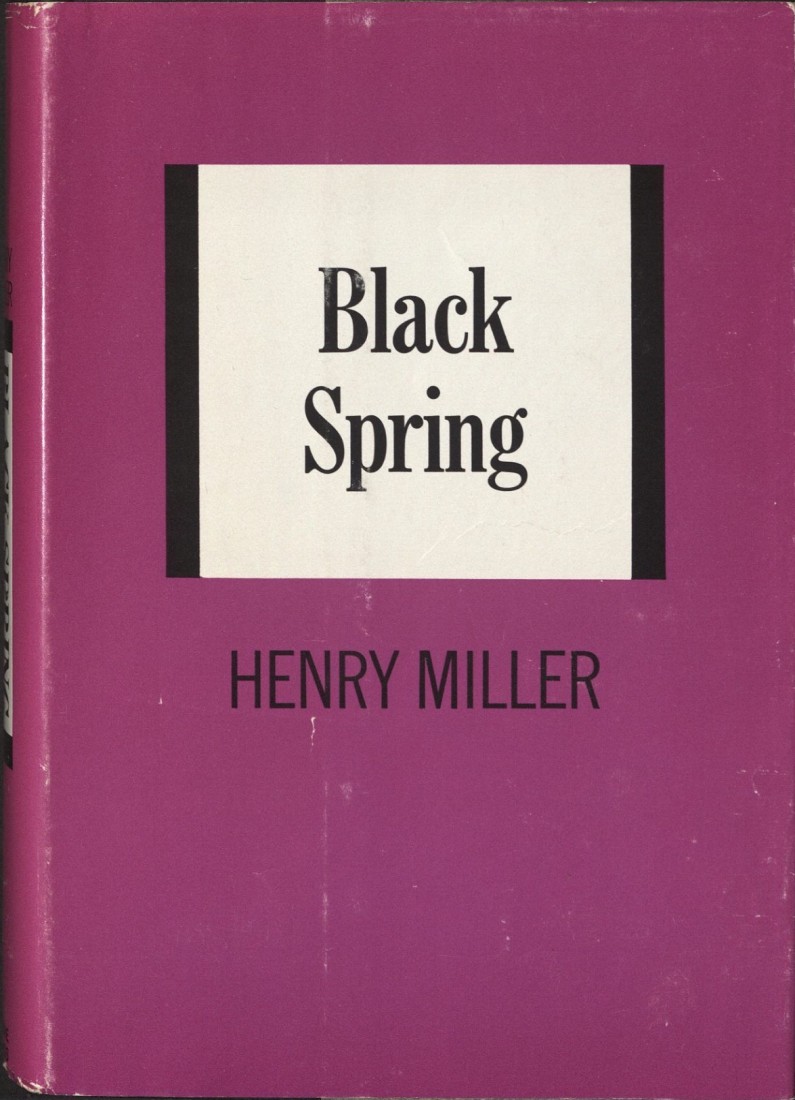
The front cover of Black Spring by Henry Miller, 1938. Call Number: B501. Click image to enlarge.

The fact that “Self-Portrait” presents itself as creative piece, rather than an analytical one, hints towards its eventual fate. Biographer Jay Martin details that, while Miller “originally regarded ‘Self-Portrait’ as a note to the ‘Universe of Death’ or a coda to ‘The World of Lawrence,’ he always planned it as a personal statement … [taking shape] by looking at himself, or portraying his experience, in a variety of ways.” [2] And Dearborn states that “Miller’s new book, tentatively called ‘Self-Portrait,’ … would eventually appear as Black Spring.” [1] This appears to be the definitive answer: “Self-Portrait,” written as a marginal addition to Miller’s project on D. H. Lawrence, became the premise for a new book entirely, and eventually grew into his collection Black Spring (1936). The process of researching Miller’s “Self-Portrait” emphasized one of the most rewarding aspects of my job here at Spencer Library: being able to uncover little-known parts of literary and cultural history.

Nile Russo
Public Services Student Assistant

[1] Dearborn, Mary V. The Happiest Man Alive: A Biography of Henry Miller. New York: Simon & Schuster, [1992]: 156-163. 

[2] Martin, Jay. Always Merry and Bright: The Life of Henry Miller: An Unauthorized Biography. Santa Barbara, Calif, London: Capra Press ; Sheldon Press, [1979]: 293f.

Special thanks to Special Collections Curator Elspeth Healey for directing me towards the Dearborn and Martin biographies of Henry Miller.
The Many Bookplates of William Stirling Maxwell

February 10th, 2026

In my ten years working with Spencer collections, it’s been impossible not to notice the name William Stirling Maxwell printed on a wide variety of bookplates in our Special Collections. Maxwell was a Scottish art historian, scholar, art collector, and bibliophile, a portion of whose considerable book collection found its way to Spencer’s stacks in years past.

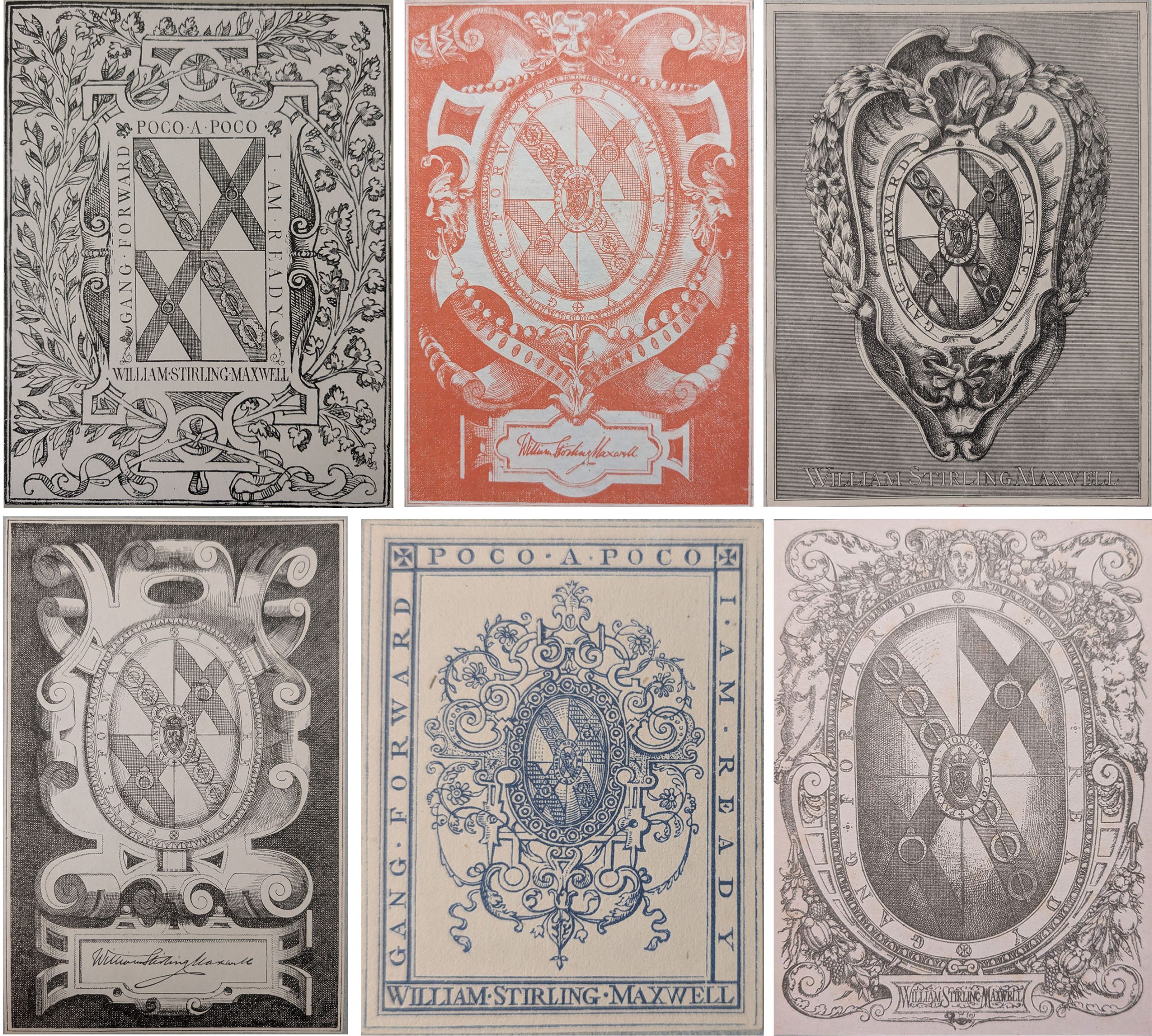
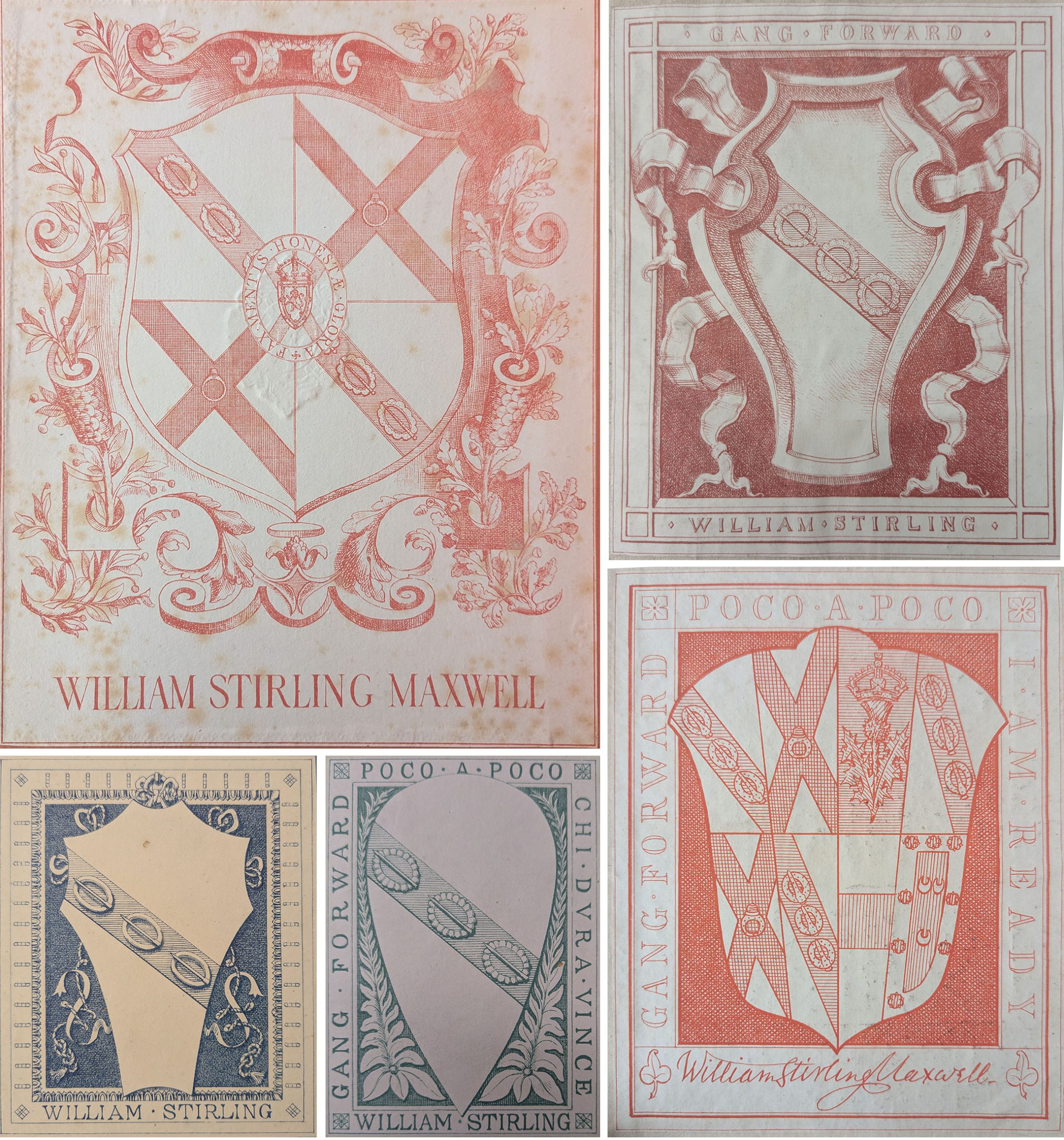
In a flurry of activity one afternoon last fall, I set out to document as many Stirling Maxwell plates as I could find. I located an impressive 35 unique designs in all, and it’s likely there are others out there, in Spencer’s collection and in the many collections around the world across which Stirling Maxwell’s library is dispersed.

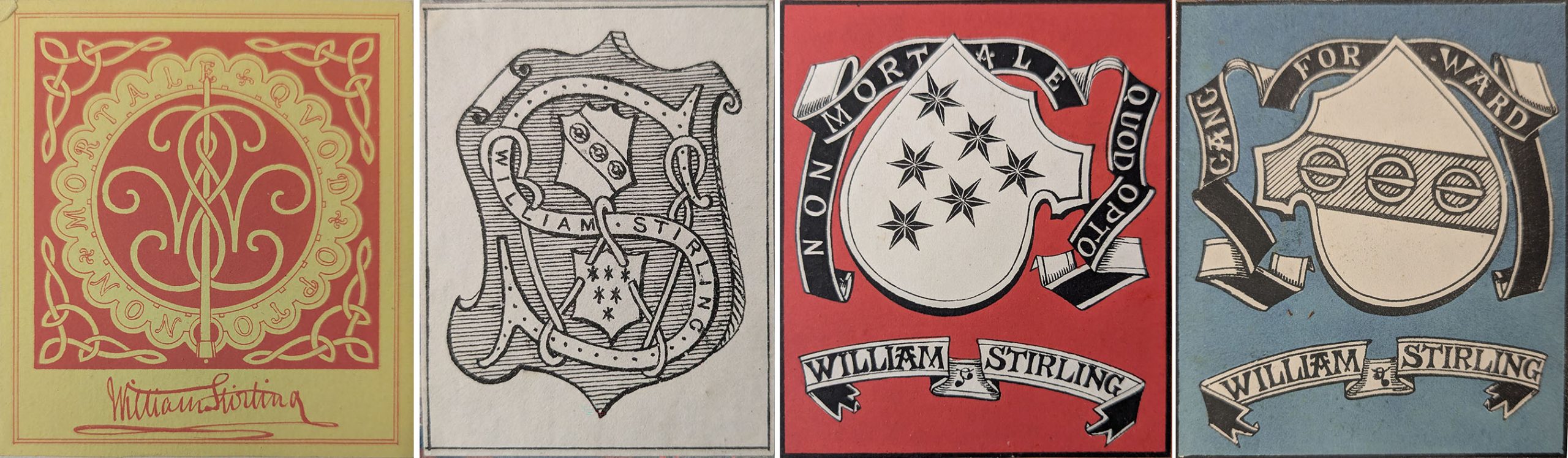
To fit this selection of bookplates into this post, I’ve grouped them together into loose categories and adjusted their sizes. The actual plates range greatly in style and in size, from just a few centimeters long to covering the entire pastedown of a folio volume. I’ve grouped these images based on the more prominently featured design elements, although many of the same motifs are repeated across multiple plates, in particular Stirling Maxwell’s heraldic devices, monograms, and personal or family mottos. Some of the plates bear the name William Stirling, while others include Maxwell, which he added after succeeding the Maxwell Baronetcy in 1865.

It’s clear that Stirling Maxwell took pride in his book collection and derived enjoyment from them; in addition to their personalized bookplates, many of the Stirling Maxwell volumes in Spencer are in fine custom bindings bearing his coat of arms and extensive decoration (another blog post for another day!). I hope you will enjoy perusing this selection (A bevy of bookplates! An excess of ex libris!) as much as I did. Remember that these and all of Spencer’s collections can be viewed in person in our reading room!

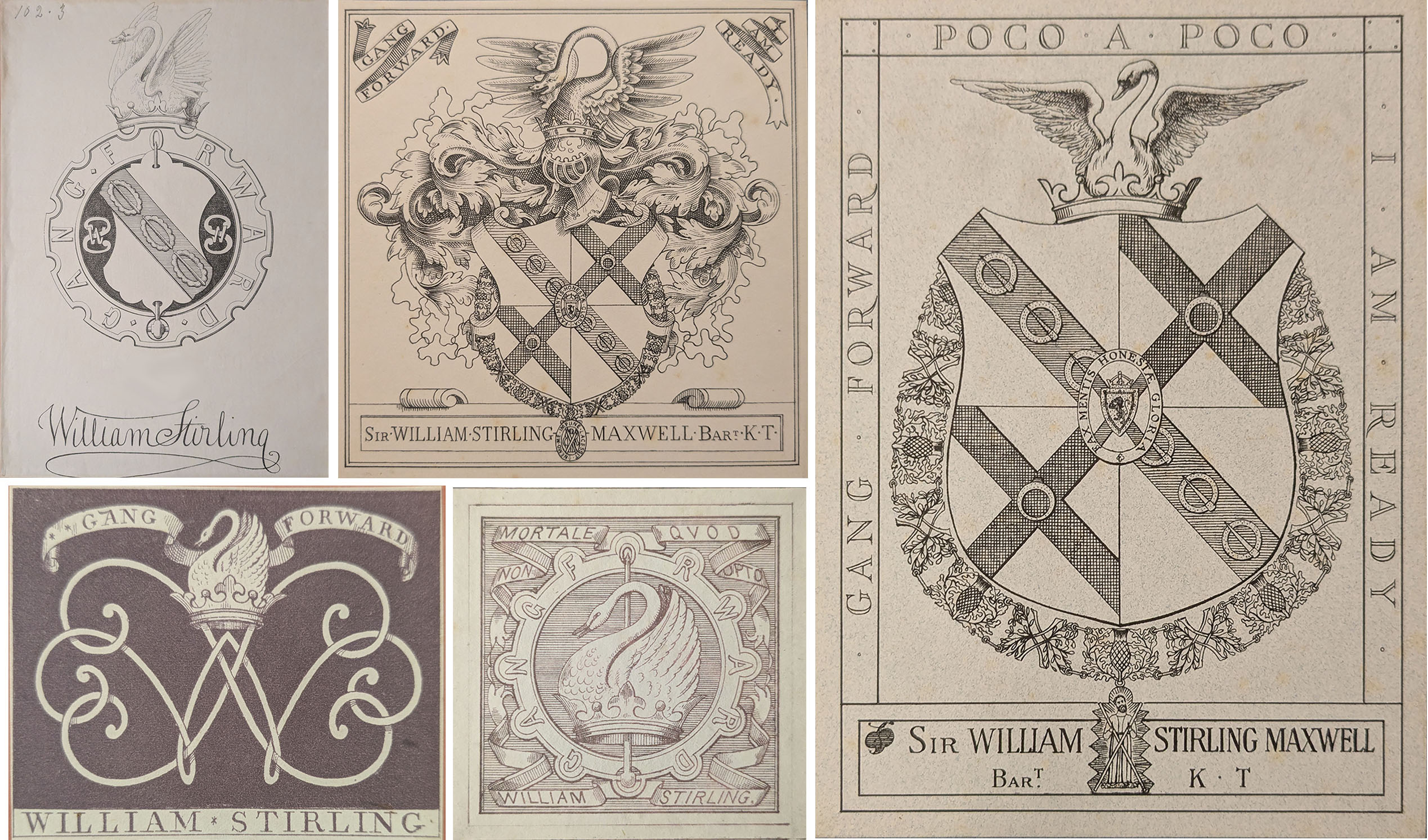
A selection of six of William Stirling Maxwell's bookplates featuring ornate heraldic imagery.
The bookplates in this group feature very ornate heraldic shields. Call numbers clockwise from upper left: Cervantes Z9; Summerfield B1248; Summerfield D261; Summerfield B1243; Summerfield A300; Summerfield E347. Click image to enlarge.
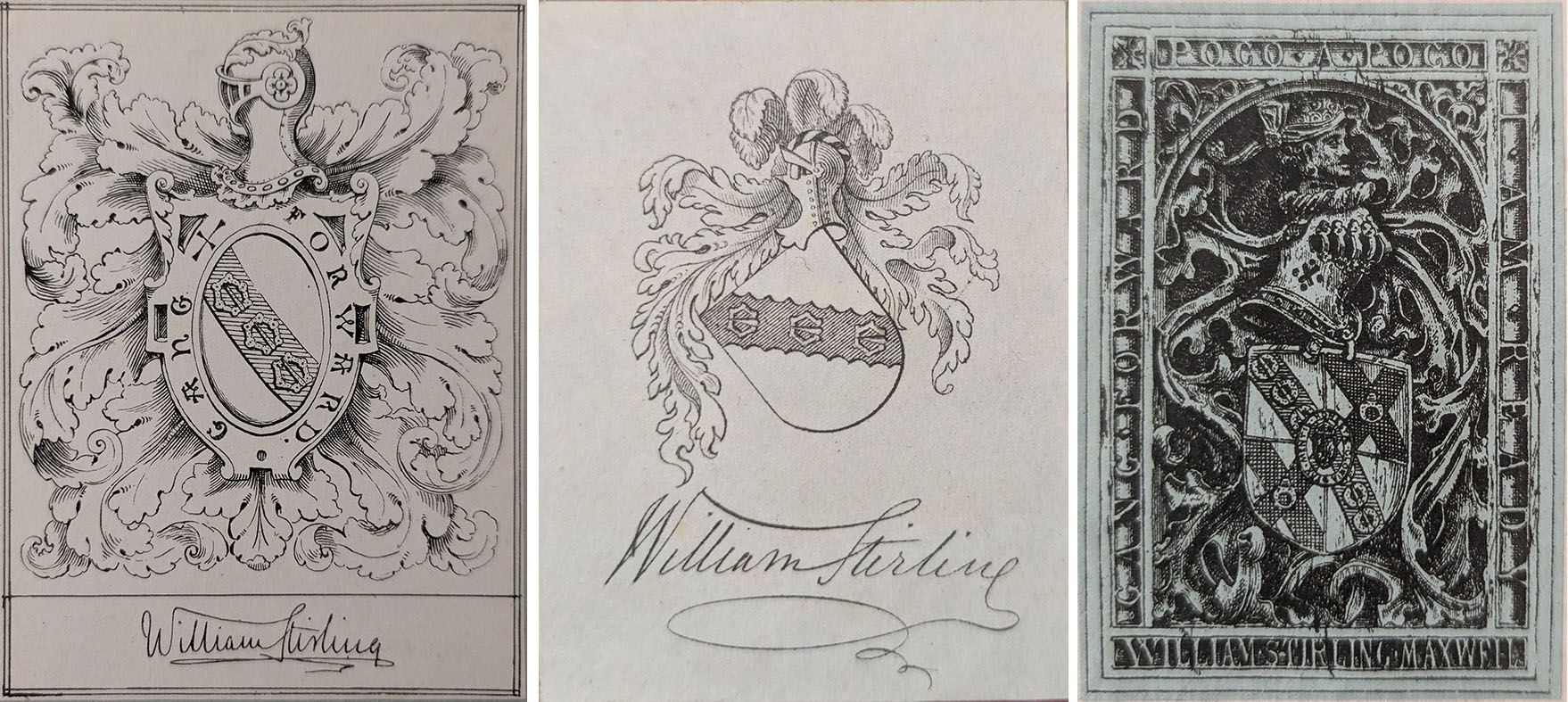
A selection of five of William Stirling Maxwell's bookplates featuring simplified heraldic imagery.
Heraldic shields again, although the designs in this group are somewhat simpler. Call numbers clockwise from upper left: E283; Summerfield E1006; Summerfield C2034; Cervantes Y31; Summerfield C635. Click image to enlarge.
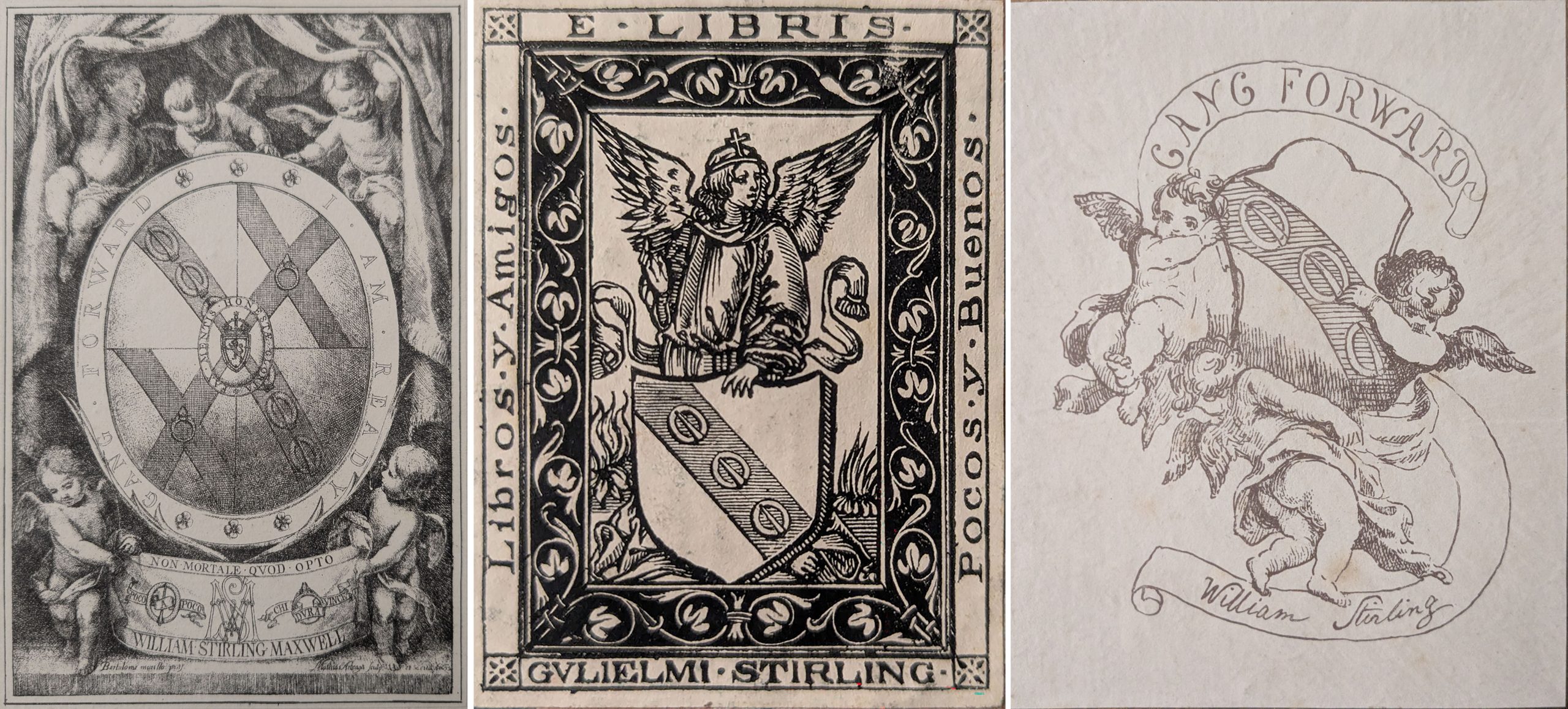
A selection of three of William Stirling Maxwell's bookplates featuring angels or cherubs in the designs.
Angels and cherubs figure in the designs in this grouping. Call numbers clockwise from left to right: Summerfield C850; A1517; Summerfield D254. Click image to enlarge.
A selection of five of William Stirling Maxwell's bookplates featuring swans in the designs.
These bookplates share the swan, a symbol of nobility, as a notable design feature. Call numbers clockwise from upper left: Summerfield D145; Summerfield B1242; D340; Summerfield D210; Cervantes X36. Click image to enlarge.
A selection of three of William Stirling Maxwell's bookplates featuring knight's helmets in their designs.
The barred, sideways-facing knight’s helmet on these bookplates represents the high rank of Stirling Maxwell’s families. Call numbers from left to right: Call numbers from left to right: C1113; Summerfield A668; Summerfield A601. Click image to enlarge.
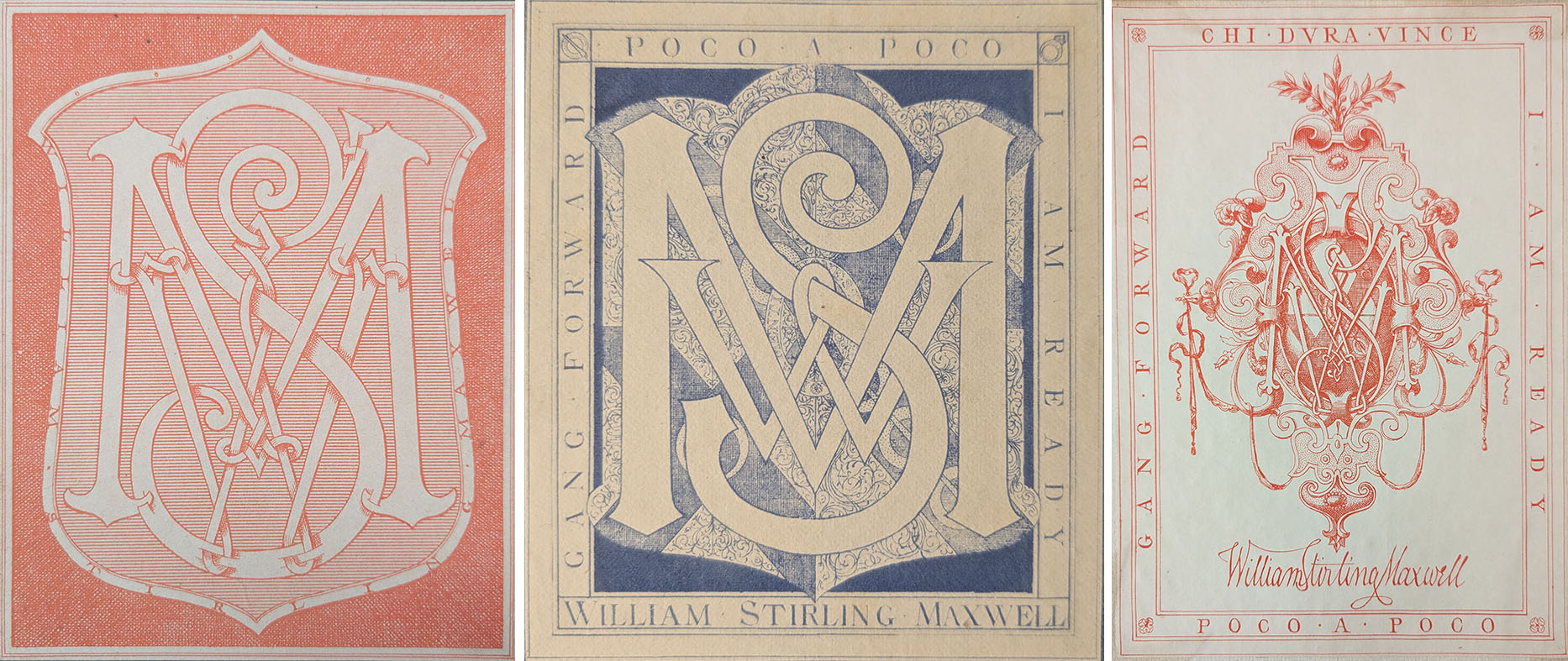
A selection of three of William Stirling Maxwell's bookplates featuring his monogram in the designs.
Monograms, from simple to ornate. Call numbers left to right: Cervantes Y4; Summerfield B882 volume 2; C9478. Click image to enlarge.
A selection of four of William Stirling Maxwell's bookplates featuring bold graphic designs.
These bold, graphic images stand out from the florid, fine-lined designs of many of Stirling Maxwell’s other bookplates. Call numbers left to right: Call numbers left to right: Cervantes Y9; Summerfield A533; C1111; Summerfield B915. Click image to enlarge.
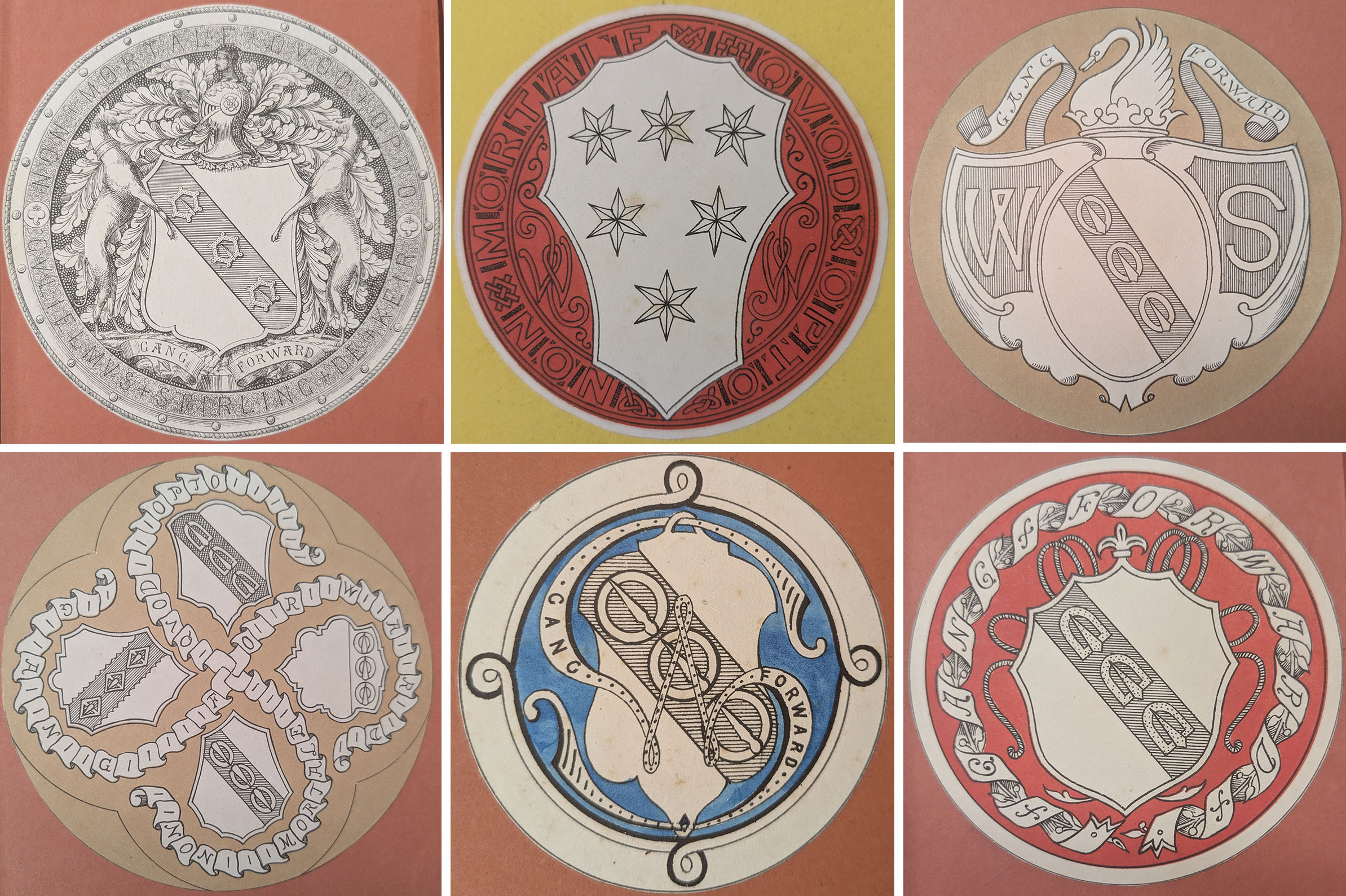
A selection of six of William Stirling Maxwell's bookplates, distinctive for their circular shape.
Many of the same motifs are seen in these bookplates, with one big difference – the plates’ circular shape! Call numbers clockwise from upper left: Summerfield C884; Cervantes Y59; Cervantes Y20; Cervantes Y7; Summerfield B863; Cervantes Y18. Click image to enlarge.

Angela Andres
Special Collections Conservator

Meet the KSRL Staff: Rebekah Ramos

February 4th, 2026

This is the latest installment in a recurring series of posts introducing readers to the staff of Kenneth Spencer Research Library. Today’s profile features Rebekah Ramos, who joined Spencer Research Library in August 2025 as the Curator of Latina/o Collections.

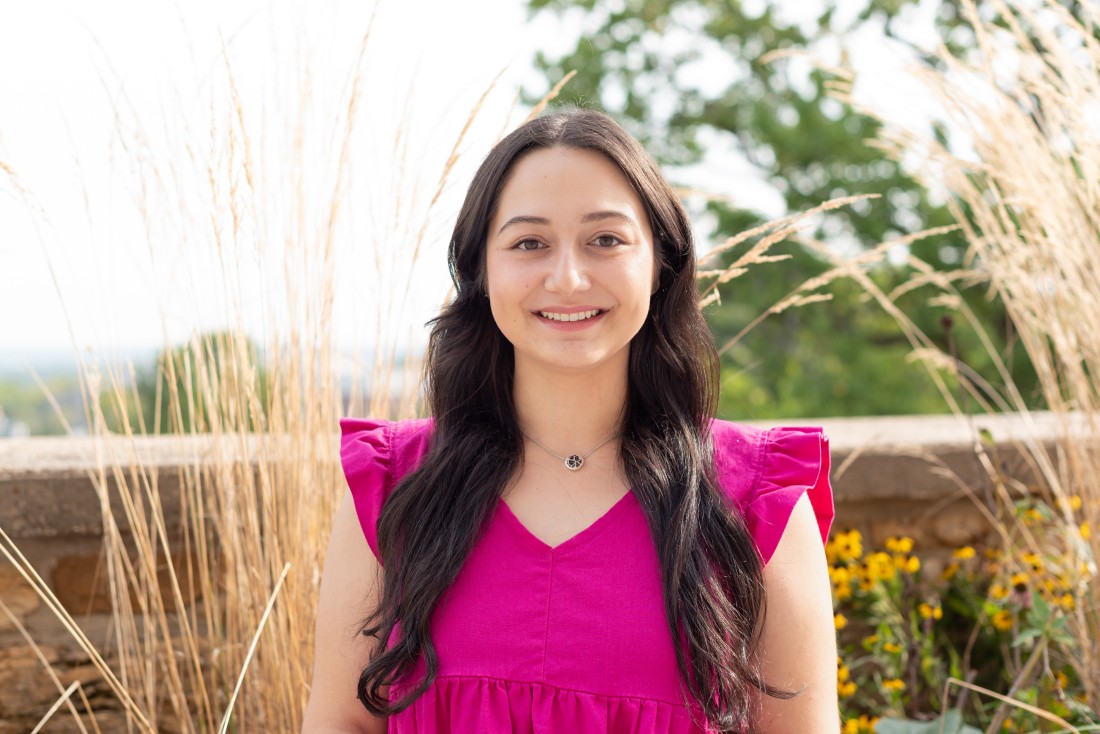
Headshot photograph of a woman in a bright pink top.
Rebekah Ramos, Curator of Latina/o Collections. Click image to enlarge.
Where are you from?

I was born and raised in Puerto Vallarta, Jalisco, Mexico but I moved to Texas when I was sixteen. I jumped around the state quite a bit for school, living in cities like Frisco, Lubbock, Sherman, and most recently Austin.

What does your job at Spencer entail?

As curator of Latina/o Collections I’m in charge of collecting materials that document and preserve the history of Latina/o individuals, families, and organizations in Kansas. Latinos have been part of this state’s history for more than a hundred years, and I’m working to build a collection that reflects the many experiences and stories that exist within this community.

How did you come to work in libraries/archives/special collections?

During undergrad, in the midst of a new semester and trying to stay sane during Zoom classes, I applied for and was hired as a student assistant at the Vietnam Center and Sam Johnson Vietnam Archive’s Oral History Project. During my time there, I reviewed and cleaned up transcriptions of oral history interviews that were conducted with Vietnam War veterans. Then, while I was completing my degree in Information Studies at the University of Texas at Austin, I worked as a graduate student technician at the LLILAS Benson’s Digital Scholarship Lab, where I had the opportunity to work with Latin American and U.S. Latina/o archival materials.  

What part of your job do you like best?

I love getting to meet new people! As someone who is not originally from here, it’s been interesting getting to learn about the variety of nationalities, backgrounds, and stories that make up the Latino community in Kansas.

What do you have on your desk?

I have a bunch of sticky notes with reminders of things I need to look up or do, and a huge pile of books I’m trying to read, like What Kansas Means to Me, Who Owns Native Culture?, and Catching Stories: A Practical Guide to Oral History. There are also a couple of trinkets to remind me of home, like a Mexican rag doll I keep under my monitor.

What is one of the most interesting items you’ve come across in Spencer’s collections?

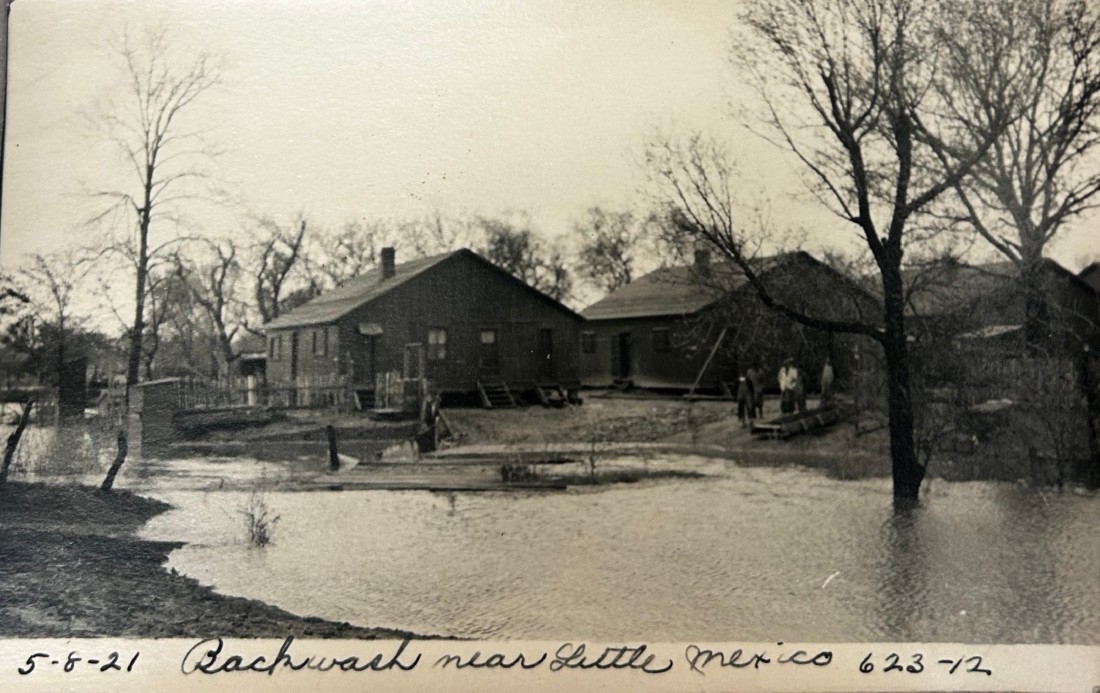
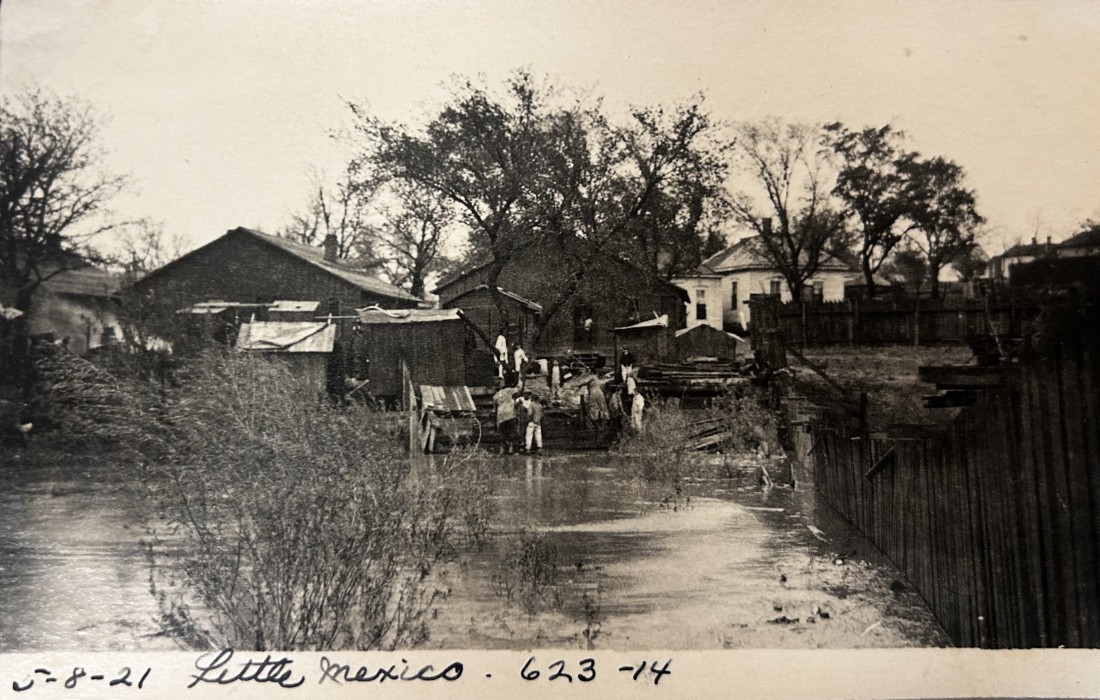
Some of the most interesting items I’ve come across were two photographs I found in the Bourquin Family Collection. Photographs in this collection were taken by a Swiss family that moved to Horton, Kansas, in the late 1800s. The collection’s finding aid showed that there are a couple of photographs that include the name “Little Mexico” in their title.

I was really surprised to find these photographs, since I hadn’t seen any record or evidence of Mexican immigrants in Horton in any of our other collections or online sources. Digitized newspaper clippings confirmed that during the 1920s there was an area of the town that housed many of the Mexican immigrants that had come to work at the local railroad center.

“High water at railroad dam and Little Mexico, May 8, 1921.” Bourquin Family Collection. Call Number: RH PH 30, Box 14, Folder 623. Click images to enlarge.

What are some of your favorite pastimes outside of work?

I am an avid reader and proud bookworm! But I also love going to the movie theater, getting food or coffee with friends, baking, and watching TV.

Rebekah Ramos
Curator of Latina/o Collections