The University of Kansas

Inside Spencer: The KSRL Blog

Books on a shelf

Welcome to the Kenneth Spencer Research Library blog! As the special collections and archives library at the University of Kansas, Spencer is home to remarkable and diverse collections of rare and unique items. Explore the blog to learn about the work we do and the materials we collect.

This blog may contain archived web content. This blog may link to catalog records which no longer exist as of a software change in 2026.

World War I Letters of Forrest W. Bassett: October 23-29, 1917

October 23rd, 2017

In honor of the centennial of World War I, we’re going to follow the experiences of one American soldier: nineteen-year-old Forrest W. Bassett, whose letters are held in Spencer’s Kansas Collection. Each Monday we’ll post a new entry, which will feature selected letters from Forrest to thirteen-year-old Ava Marie Shaw from that following week, one hundred years after he wrote them.

Forrest W. Bassett was born in Beloit, Wisconsin, on December 21, 1897 to Daniel F. and Ida V. Bassett. On July 20, 1917 he was sworn into military service at Jefferson Barracks near St. Louis, Missouri. Soon after, he was transferred to Fort Leavenworth, Kansas, for training as a radio operator in Company A of the U. S. Signal Corps’ 6th Field Battalion.

Ava Marie Shaw was born in Chicago, Illinois, on October 12, 1903 to Robert and Esther Shaw. Both of Marie’s parents – and her three older siblings – were born in Wisconsin. By 1910 the family was living in Woodstock, Illinois, northwest of Chicago. By 1917 they were in Beloit.

Frequently mentioned in the letters are Forrest’s older half-sister Blanche Treadway (born 1883), who had married Arthur Poquette in 1904, and Marie’s older sister Ethel (born 1896).

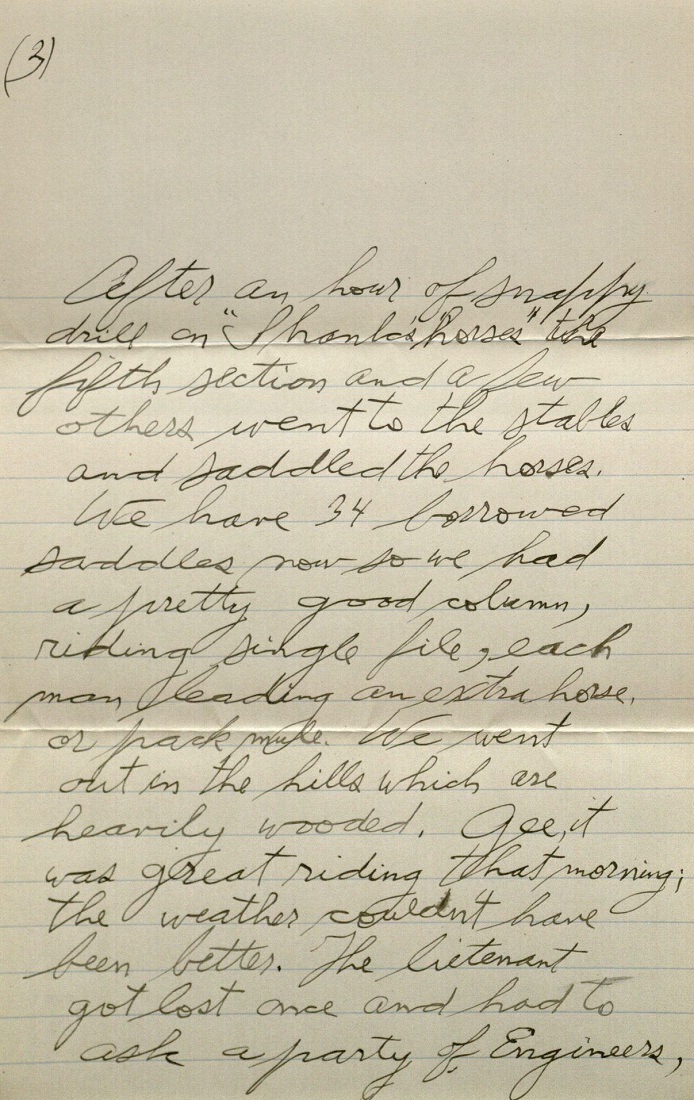
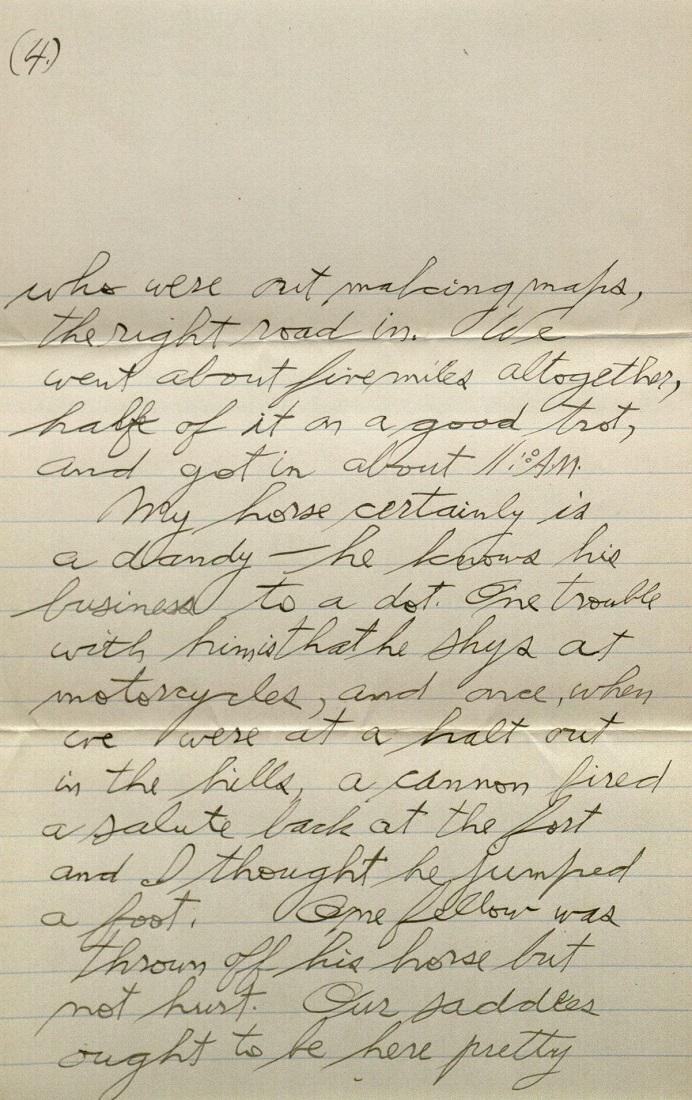
Both of this week’s letters focus on Forrest’s “first taste of riding” a horse. “My horse certainly is a dandy,” Forrest tells Marie, “he knows his business to a dot. One trouble with him is that he shys [shies] at motorcycles, and once, when we were at a halt out in the hills, a cannon fired a salute back at the fort and I thought he jumped a foot.”
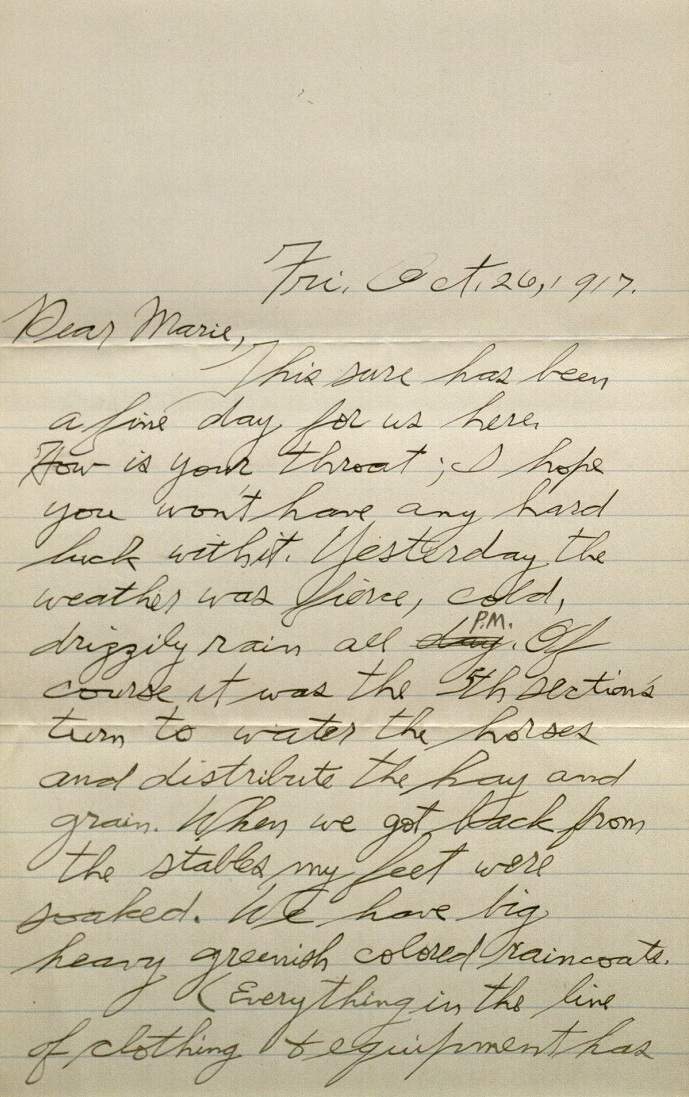
Image of Forrest W. Bassett's letter to Ava Marie Shaw, October 26, 1917 Image of Forrest W. Bassett's letter to Ava Marie Shaw, October 26, 1917

Image of Forrest W. Bassett's letter to Ava Marie Shaw, October 26, 1917 Image of Forrest W. Bassett's letter to Ava Marie Shaw, October 26, 1917

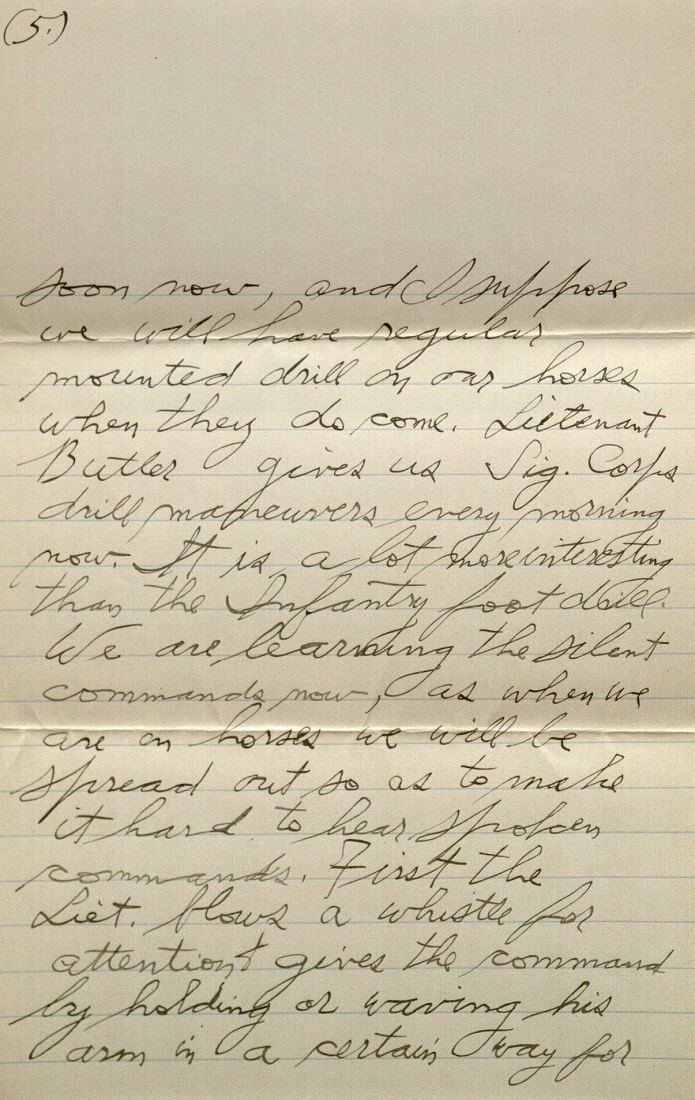
Image of Forrest W. Bassett's letter to Ava Marie Shaw, October 26, 1917 Image of Forrest W. Bassett's letter to Ava Marie Shaw, October 26, 1917

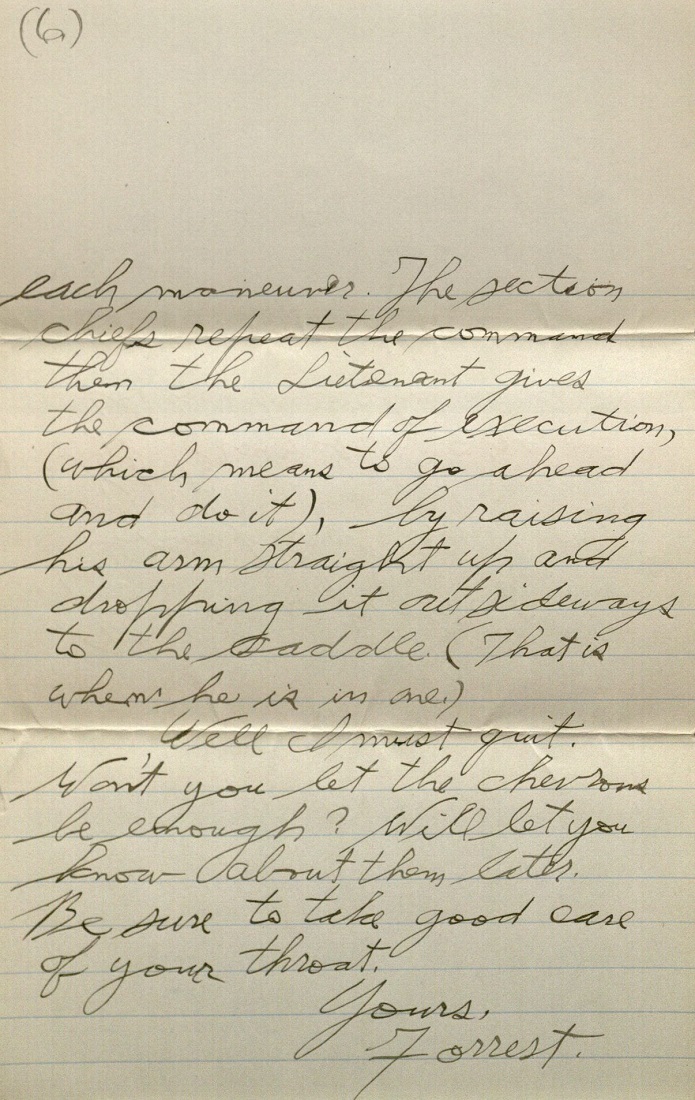
Image of Forrest W. Bassett's letter to Ava Marie Shaw, October 26, 1917

Click images to enlarge.

Fri. Oct. 26, 1917

Dear Marie,

This sure has been a fine day for us here. How is your throat; I hope you won’t have any hard luck with it. Yesterday the weather was fierce, cold, drizzly rain all P.M. Of course it was the 5th section’s turn to water the horses and distribute the hay and grain. When we got back from the stables my feet were soaked. We have big heavy greenish colored raincoats. (Everything in the line of clothing and equipment has that olive drab color and just matches the dead grass. A motorcycle sidecar in the field seems to blend into the background so you can hardly distinguish it.) Well – these raincoats have a very queer cut as they are intended for mounted service men. They are so long that they just miss touching the ground, and when buttoned single breasted they are a regular tent. The back is split clear to the waist.

Yesterday I had my first taste of riding. After an hour of snappy drill on “Shank’s horses” the fifth section and a few others went to the stables and saddled the horses. We have 34 borrowed saddles now so we had a pretty good column, riding single file, each man leading an extra horse or pack mule. We went out in the hills which are heavily wooded. Gee, it was great riding that morning; the weather couldn’t have been better. The lietenant got lost once and had to ask a party of Engineers, who were out making maps, the right road in. We went about five miles altogether, half of it on a good trot, and got in about 11:00 A.M.

My horse certainly is a dandy – he knows his business to a dot. One trouble with him is that he shys at motorcycles, and once, when we were at a halt out in the hills, a cannon fired a salute back at the fort and I thought he jumped a foot. One fellow was thrown off his horse but not hurt. Our saddles ought to be here pretty soon now, and I suppose we will have regular mounted drill on our horses when they do come. Lietenant Butler gives us Sig. Corps drill maneuvers every morning now. It is a lot more interesting than the Infantry foot drill. We are learning the silent commands now, as when we are on horses we will be spread out so as to make it hard to hear spoken commands. First the Liet. blows a whistle for attention and gives the command by holding or waving his arm in a certain way for each maneuver. The section chiefs repeat the command then the Lietenant gives the command of execution, (which means to go ahead and do it), by raising his arm straight up and dropping it out sideways to the saddle. (That is when he is in one.)

Well I must quit. Won’t you let the chevrons be enough? Will let you know about them later. Be sure to take good care of your throat.

Yours,
Forrest.

Here is a picture of a couple of the fellows. Sgt. Brown is the chief of the fourth section.

Sunday, Oct. 28, 1917.

Dear Marie,

Just finished the hardest days work I seen for a month. My turn at stable police came today after I had planned to do a lot of picture work. Jerry Berry and I worked steady from breakfast till 11:00 then I saddled my horse and went to the barracks (a short mile) for an early dinner. This was only the second time I had been on a horse, and the first time alone, so had to watch my step. The most trouble I had was when we passed motorcycles and autos. He’s no city bred horse by a long shot and sure does hate those little three wheeled buzz wagons. When we came near an auto he slowed down from a trot to a walk and as the auto passed he laid back his ears and stopped short. We sure had some dinner. Pork-chops, sweet potatoes, mashed potatoes, cabbage, bread pudding, and cocoa. I guess Tom was hungry too, for, on the way back, when he caught sight of the stables, he lit out on a gallop. This is easier riding than a trot so I let him go to it. I am mighty glad we have horses, for the riding is sure great stuff. We are allowed mounted passes from 1:00 P.M. to 4:00 on Sunday. When I got back the other fellows went to dinner. At 1:30 we bedded the stalls and put out the hay and grain. I took a few pictures and then it was time for me to go to supper, so as to get back before regular mess.

Say, would your Mother let you use my .25 cal. automatic? If you want to shoot, and your folks don’t object, you’re welcome to it. Of course the gun has to be thoroughly cleaned right after using, and I will have to show you how to take it apart and remove the barrel.

Don’t you think it would be better if you did go to these parties even if you don’t care very much about them? I wish you would – I don’t like to hear of people noticing that you only go with me. Please don’t misunderstand me – I simply think you out to go just for that one reason, don’t you?

I can’t get the goods nor the fine olive drab silk floss for the chevrons so will have to give it up. Here are some cards.

Yours,
Forrest.

Meredith Huff
Public Services

Emma Piazza
Public Services Student Assistant
World War I Letters of Forrest W. Bassett: October 16-22, 1917

October 16th, 2017

In honor of the centennial of World War I, we’re going to follow the experiences of one American soldier: nineteen-year-old Forrest W. Bassett, whose letters are held in Spencer’s Kansas Collection. Each Monday we’ll post a new entry, which will feature selected letters from Forrest to thirteen-year-old Ava Marie Shaw from that following week, one hundred years after he wrote them.

Forrest W. Bassett was born in Beloit, Wisconsin, on December 21, 1897 to Daniel F. and Ida V. Bassett. On July 20, 1917 he was sworn into military service at Jefferson Barracks near St. Louis, Missouri. Soon after, he was transferred to Fort Leavenworth, Kansas, for training as a radio operator in Company A of the U. S. Signal Corps’ 6th Field Battalion.

Ava Marie Shaw was born in Chicago, Illinois, on October 12, 1903 to Robert and Esther Shaw. Both of Marie’s parents – and her three older siblings – were born in Wisconsin. By 1910 the family was living in Woodstock, Illinois, northwest of Chicago. By 1917 they were in Beloit.

Frequently mentioned in the letters are Forrest’s older half-sister Blanche Treadway (born 1883), who had married Arthur Poquette in 1904, and Marie’s older sister Ethel (born 1896).

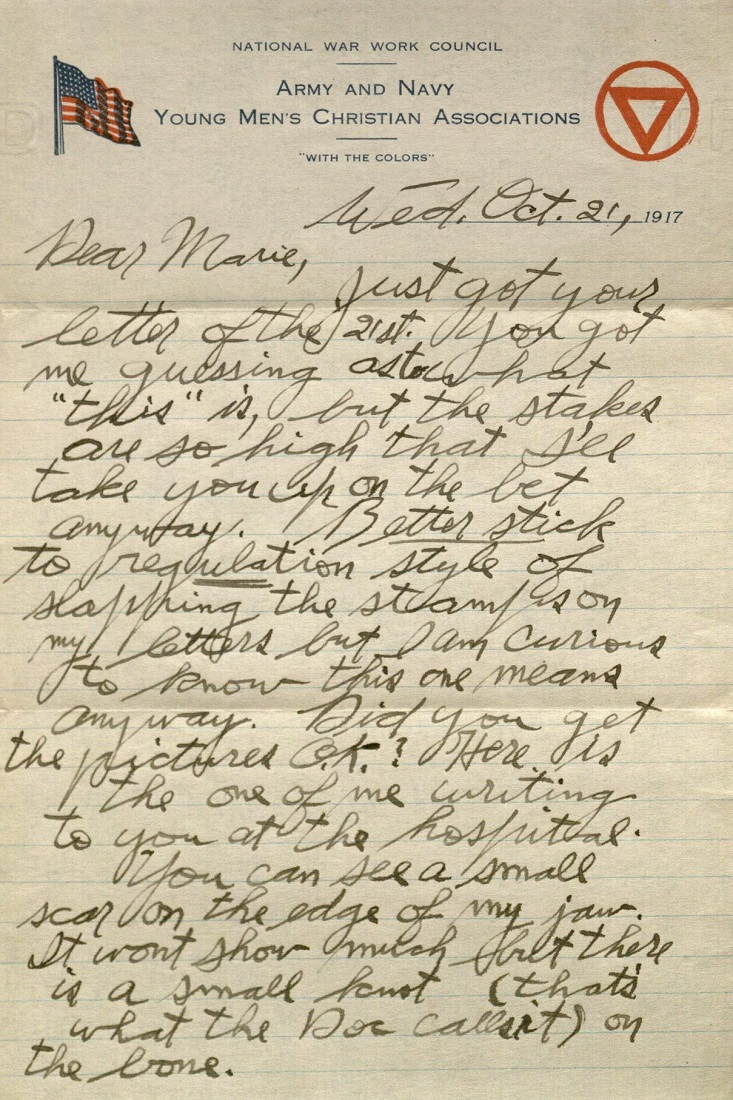
Forrest’s recent illness features prominently in this letter. “Here is the one [photo] of me writing to you at the hospital,” he tells Marie. “You can see a small scar on the edge of my jaw.”

Image of Forrest W. Bassett's letter to Ava Marie Shaw, October 21, 1917 Image of Forrest W. Bassett's letter to Ava Marie Shaw, October 21, 1917

Click images to enlarge.

Wed. Oct. 21, 1917*

Dear Marie,

Just got your letter of the 21st. You got me guessing as to what “this” is, but the stakes are so high that I’ll take you up on the bet anyway. Better stick to regulation style of slapping the stamps on my letters but I am curious to know this one means anyway. Did you get the pictures O.K.? Here is the one of me writing to you at the hospital. You can see a small scar on the edge of my jaw. It won’t show much but there is a small knot (that’s what the Doc calls it) on the bone. I left the hospital Monday morning. It was cold and rainy all day. I got pretty rusty on my telegraph receiving but my transmitting is a lot better.

My best luck was in getting my horse. I can hardly wait to strap a saddle on him. It will be my first time on a horse.

Please invest the 15 cents in stamps. Co A-6 bought over $7,000 in Liberty bonds. I signed up for $100 to be paid at the rate of $20 per month – 5 months. Well I must quit & scrub some clothes.

Yours, Forrest.

*Forrest meant either Wednesday, October 17th, or Saturday, October 21st.

Meredith Huff
Public Services

Emma Piazza
Public Services Student Assistant

World War I Letters of Forrest W. Bassett: October 9-15, 1917

October 9th, 2017

In honor of the centennial of World War I, we’re going to follow the experiences of one American soldier: nineteen-year-old Forrest W. Bassett, whose letters are held in Spencer’s Kansas Collection. Each Monday we’ll post a new entry, which will feature selected letters from Forrest to thirteen-year-old Ava Marie Shaw from that following week, one hundred years after he wrote them.

Forrest W. Bassett was born in Beloit, Wisconsin, on December 21, 1897 to Daniel F. and Ida V. Bassett. On July 20, 1917 he was sworn into military service at Jefferson Barracks near St. Louis, Missouri. Soon after, he was transferred to Fort Leavenworth, Kansas, for training as a radio operator in Company A of the U. S. Signal Corps’ 6th Field Battalion.

Ava Marie Shaw was born in Chicago, Illinois, on October 12, 1903 to Robert and Esther Shaw. Both of Marie’s parents – and her three older siblings – were born in Wisconsin. By 1910 the family was living in Woodstock, Illinois, northwest of Chicago. By 1917 they were in Beloit.

Frequently mentioned in the letters are Forrest’s older half-sister Blanche Treadway (born 1883), who had married Arthur Poquette in 1904, and Marie’s older sister Ethel (born 1896).

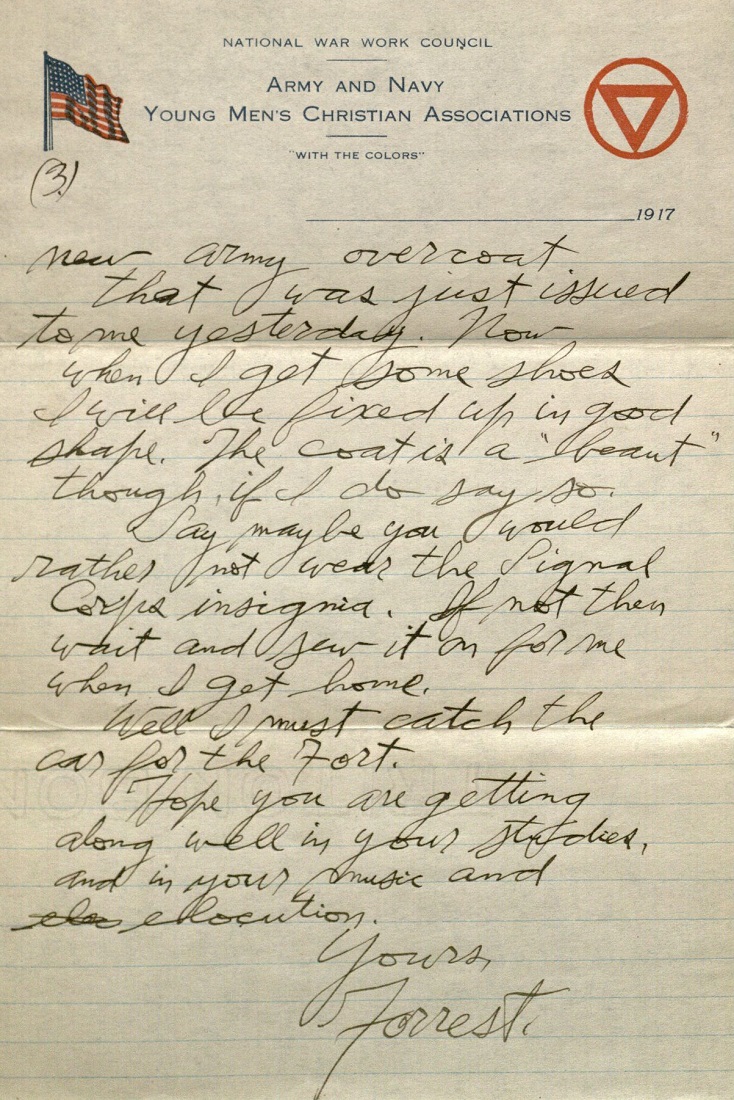
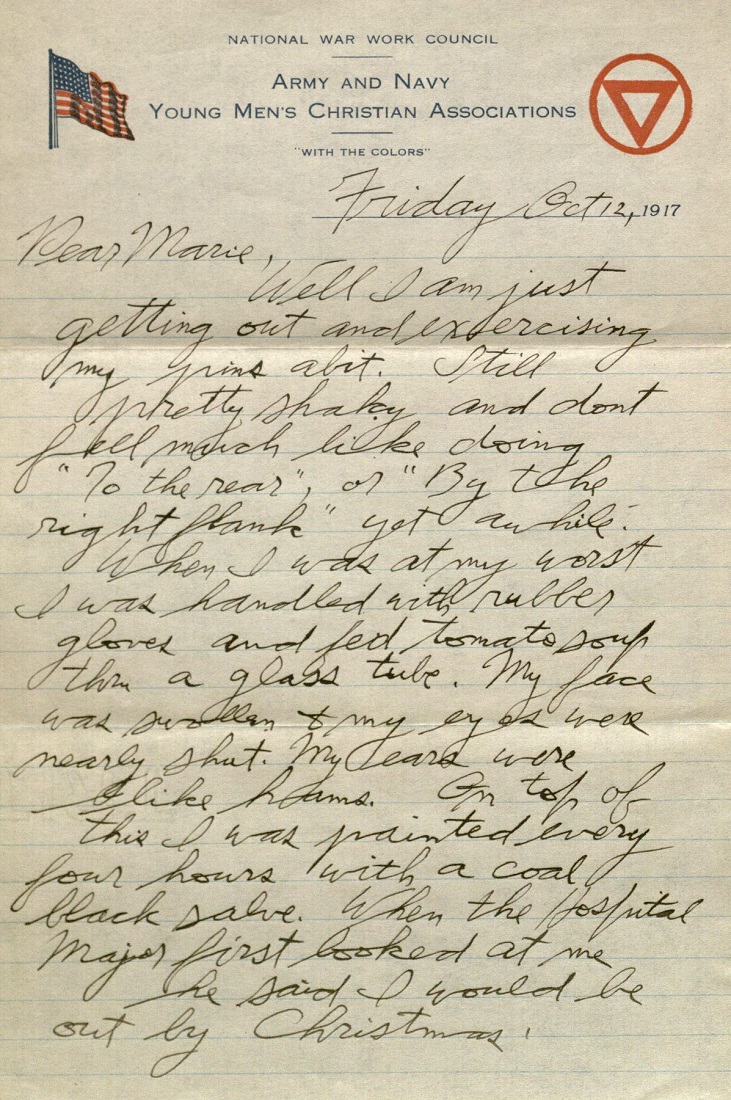
Forrest only wrote one letter to Marie this week, and in it he describes suffering and recovering from a serious illness. “When I was at my worst,” he told Marie, “I was handled with rubber gloves and fed tomato soup thru a glass tube. My face was swollen and my eyes were nearly shut. My ears were like hams.” This illness probably explains the lack of letters over the last two weeks; according to Spencer’s holdings, Forrest’s previous letter to Marie was dated September 25th.

Image of Forrest W. Bassett's letter to Ava Marie Shaw, October 12, 1917 Image of Forrest W. Bassett's letter to Ava Marie Shaw, October 12, 1917

Image of Forrest W. Bassett's letter to Ava Marie Shaw, October 12, 1917

Click images to enlarge.

Friday Oct. 12, 1917

Dear Marie,

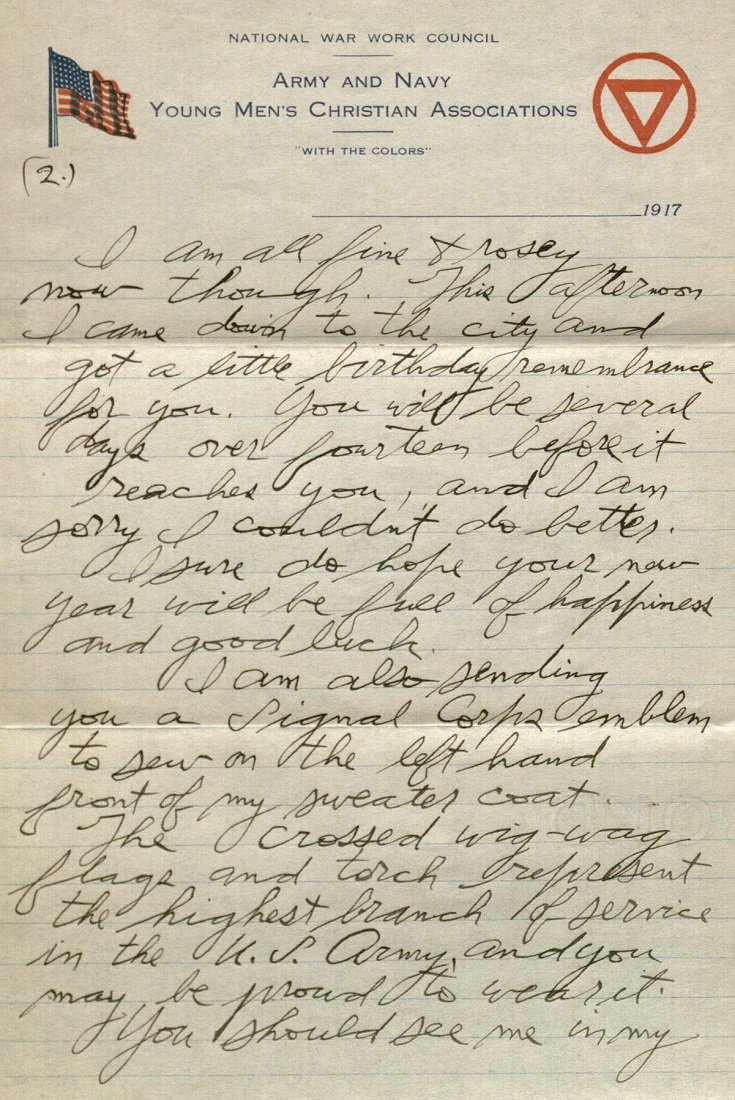
Well I am just getting out and exercising my pins abit. Still pretty shaky and don’t feel much like doing “To the rear,” or “By the right flank” yet awhile. When I was at my worst I was handled with rubber gloves and fed tomato soup thru a glass tube. My face was swollen and my eyes were nearly shut. My ears were like hams. On top of this I was painted every four hours with a coal black salve. When the Hospital Major first looked at me he said I would be out by Christmas. I am all fine & rosey now though. This afternoon I came down to the city and got a little birthday remembrance for you. You will be several days over fourteen before it reaches you, and I am sorry I couldn’t do better. I sure do hope your new year will be full of happiness and good luck.

I am also sending you a Signal Corps emblem to sew on the left hand front of my sweater coat. The crossed wig-wag flags and torch represent the highest branch of service in the U.S. Army, and you may be proud to wear it. You should see me in my new army overcoat that was just issued to me yesterday. Now when I get some shoes I will be fixed up in good shape. The coat is a “beaut” though, if I do say so.

Say maybe you would rather not wear the Signal Corps insignia. If not then wait and sew it on for me when I get home. Well I must catch the car for the Fort.

Hope you are getting along well in your studies, and in your music and elocution.

Yours,
Forrest.

Meredith Huff
Public Services

Emma Piazza
Public Services Student Assistant
World War I Letters of Forrest W. Bassett: September 25-October 1, 1917

September 25th, 2017

In honor of the centennial of World War I, we’re going to follow the experiences of one American soldier: nineteen-year-old Forrest W. Bassett, whose letters are held in Spencer’s Kansas Collection. Each Monday we’ll post a new entry, which will feature selected letters from Forrest to thirteen-year-old Ava Marie Shaw from that following week, one hundred years after he wrote them.

Forrest W. Bassett was born in Beloit, Wisconsin, on December 21, 1897 to Daniel F. and Ida V. Bassett. On July 20, 1917 he was sworn into military service at Jefferson Barracks near St. Louis, Missouri. Soon after, he was transferred to Fort Leavenworth, Kansas, for training as a radio operator in Company A of the U. S. Signal Corps’ 6th Field Battalion.

Ava Marie Shaw was born in Chicago, Illinois, on October 12, 1903 to Robert and Esther Shaw. Both of Marie’s parents – and her three older siblings – were born in Wisconsin. By 1910 the family was living in Woodstock, Illinois, northwest of Chicago. By 1917 they were in Beloit.

Frequently mentioned in the letters are Forrest’s older half-sister Blanche Treadway (born 1883), who had married Arthur Poquette in 1904, and Marie’s older sister Ethel (born 1896).

Image of Forrest W. Bassett's letter to Ava Marie Shaw, September 25, 1917 Image of Forrest W. Bassett's letter to Ava Marie Shaw, September 25, 1917

Image of Forrest W. Bassett's letter to Ava Marie Shaw, September 25, 1917 Image of Forrest W. Bassett's letter to Ava Marie Shaw, September 25, 1917

Click images to enlarge.

Tues. Sept. 25, 1917

Dear Marie,

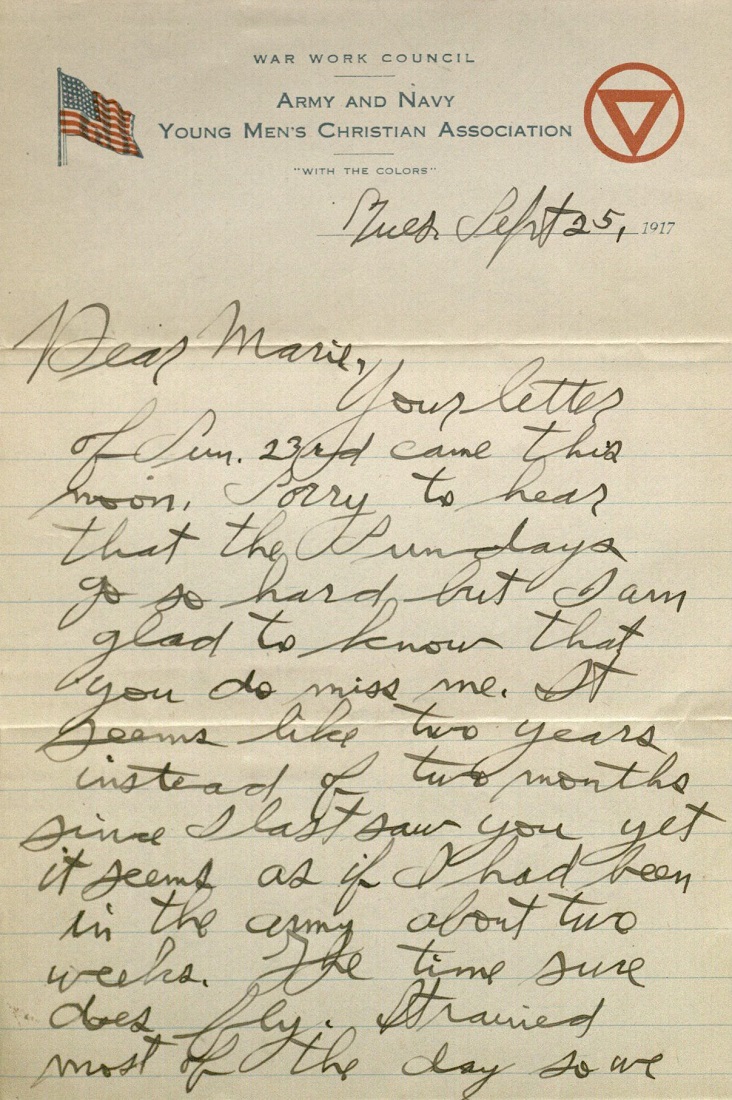
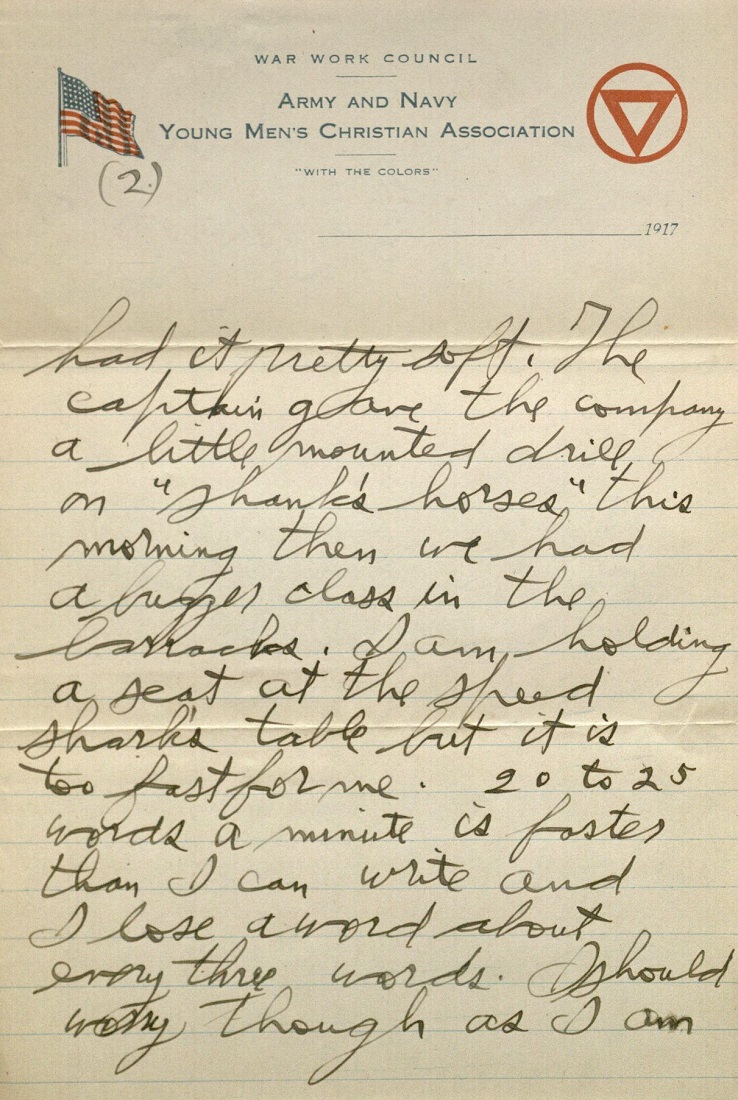
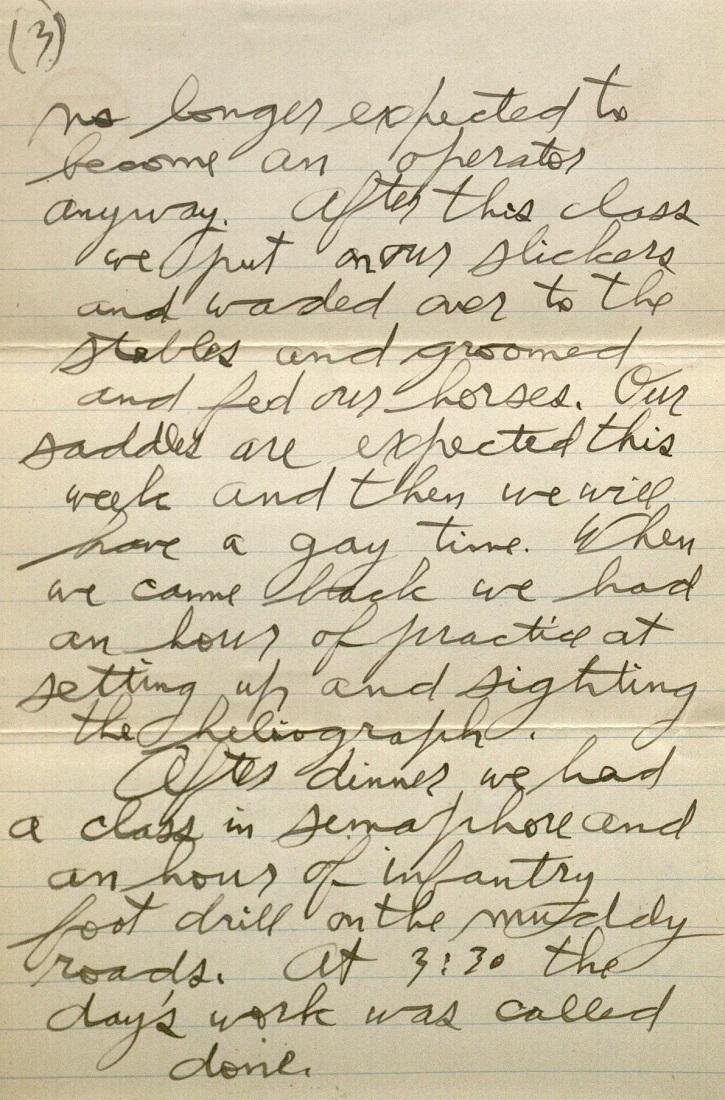
Your letter of Sun. 23rd came this noon. Sorry to hear that the Sundays go so hard but I am glad to know that you do miss me. It seems like two years instead of two months since I last saw you yet it seems as if I had been in the army about two weeks. The time sure does fly. Strained most of the day so we had it pretty soft. The captain gave the company a little mounted drill on “shank’s horses” this morning then we had a buzzer class in the barracks. I am holding a seat at the speed shark’s table but it is too fast for me. 20 to 25 words a minute is faster than I can write and I lose a word about every three words. I should worry though as I am no longer expected to become an operator anyway. After this class we put on our slickers and waded over to the stables and groomed and fed our horses. Our saddles are expected this week and then we will have a gay time. When we came back we had an hour of practice at setting up and sighting the heliograph.

After dinner we had a class of semaphore and an hour of infantry foot drill on the muddy roads. At 3:30 the day’s work was called done. I am down to Leavenworth “Y” now and want to get an early car home so will have to quit.

Marie don’t feel that you are making me homesick by writing letters like the one of Sunday. That’s the kind that help me the most and make me want to get someplace. It’s the very most you can do for me and you don’t realize how much that is.

Forrest.

Meredith Huff
Public Services

Emma Piazza
Public Services Student Assistant
World War I Letters of Forrest W. Bassett: September 18-24, 1917

September 18th, 2017

In honor of the centennial of World War I, we’re going to follow the experiences of one American soldier: nineteen-year-old Forrest W. Bassett, whose letters are held in Spencer’s Kansas Collection. Each Monday we’ll post a new entry, which will feature selected letters from Forrest to thirteen-year-old Ava Marie Shaw from that following week, one hundred years after he wrote them.

Forrest W. Bassett was born in Beloit, Wisconsin, on December 21, 1897 to Daniel F. and Ida V. Bassett. On July 20, 1917 he was sworn into military service at Jefferson Barracks near St. Louis, Missouri. Soon after, he was transferred to Fort Leavenworth, Kansas, for training as a radio operator in Company A of the U. S. Signal Corps’ 6th Field Battalion.

Ava Marie Shaw was born in Chicago, Illinois, on October 12, 1903 to Robert and Esther Shaw. Both of Marie’s parents – and her three older siblings – were born in Wisconsin. By 1910 the family was living in Woodstock, Illinois, northwest of Chicago. By 1917 they were in Beloit.

Frequently mentioned in the letters are Forrest’s older half-sister Blanche Treadway (born 1883), who had married Arthur Poquette in 1904, and Marie’s older sister Ethel (born 1896).

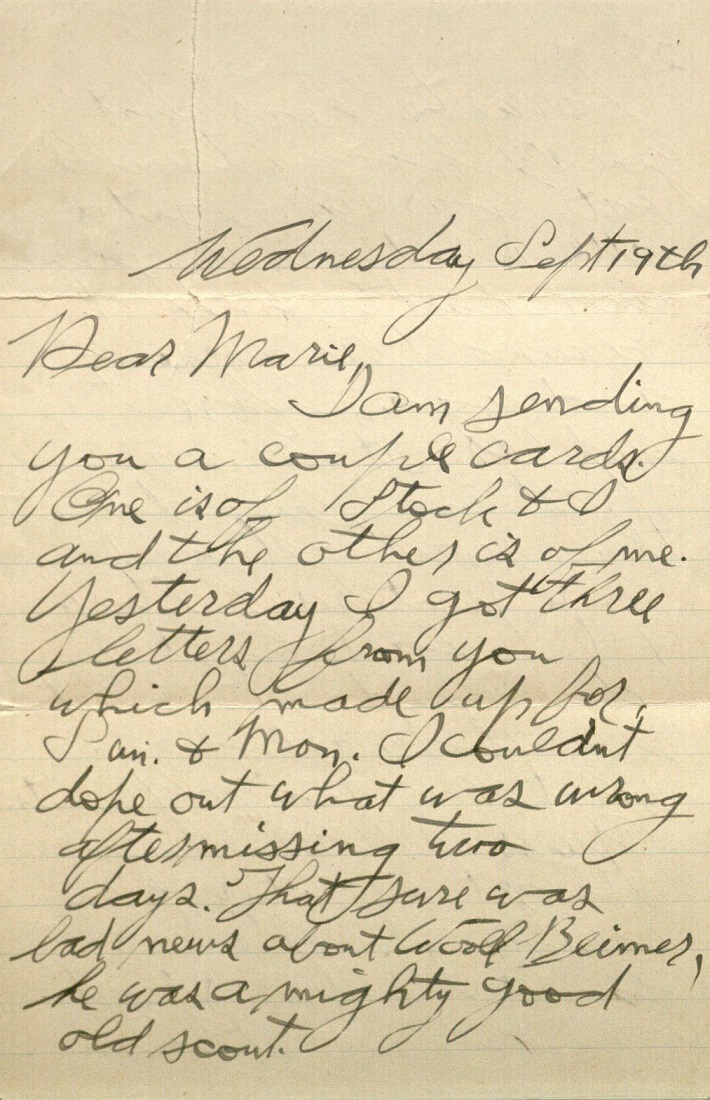
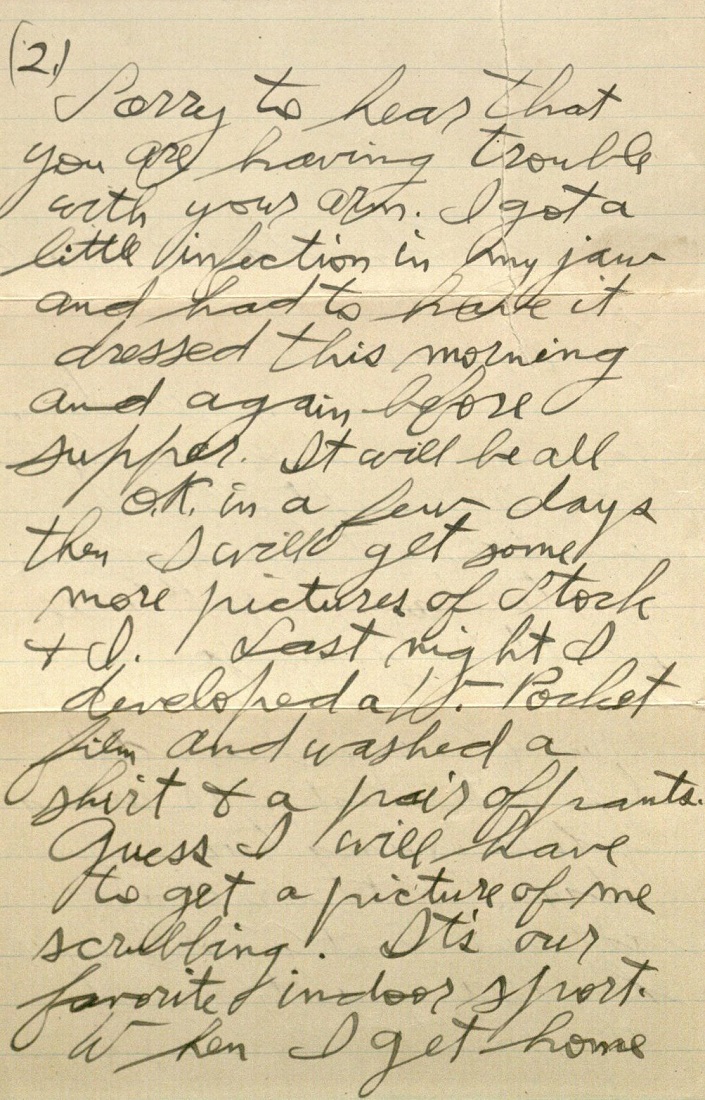
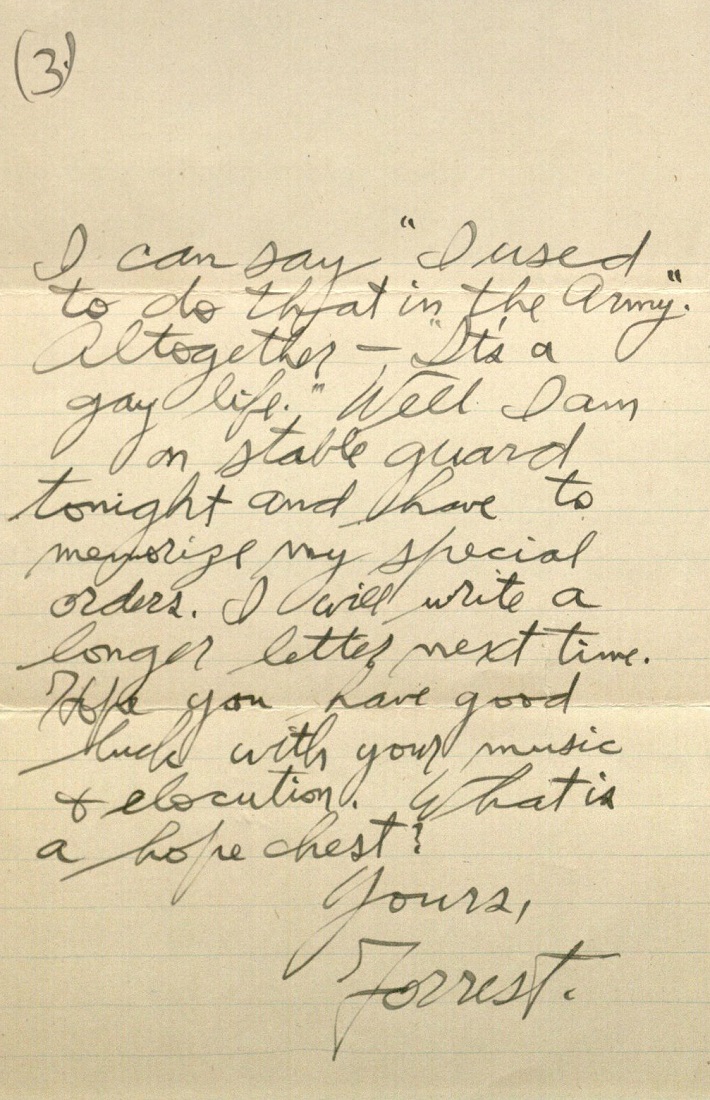
Highlights from this week’s letters include the sad news of a friend’s death and happier news of Forrest’s promotion to first class private (“this simply means that I have qualified in examinations and that I will get $33 a month instead of $30”).

Image of Forrest W. Bassett's letter to Ava Marie Shaw, September 19, 1917 Image of Forrest W. Bassett's letter to Ava Marie Shaw, September 19, 1917

Image of Forrest W. Bassett's letter to Ava Marie Shaw, September 19, 1917

Click images to enlarge.

Wednesday Sept. 19th

Dear Marie,

I am sending you a couple cards. One is of Stock and I and the other is of me. Yesterday I got three letters from you which made up for Sun. and Mon. I couldn’t dope out what was wrong after missing two days. That sure was bad news about Wooll Beimer,* he was a mighty good old scout. Sorry to hear that you are having trouble with your arm. I got a little infection in my jaw and had to have it dressed this morning and again before supper. It will be all O.K. in a few days then I will get some more pictures of Stock and I. Last night I developed a W. Pocket film and washed a shirt and a pair of pants. Guess I will have to get a picture of me scrubbing. It’s our favorite indoor sport. When I get home I can say “I used to do that in the Army.” Altogether – “It’s a gay life.” Well I am on stable guard tonight and have to memorize my special orders, I will write a longer letter next time. Hope you have good luck with your music and elocution. What is a hope chest?

Yours,
Forrest.

Sat. Sept. 22, 1917

Dear Marie,

Your candy came in fine shape and tasted great. I am going to stand pat on my resolution not to eat sweets. Don’t worry about not doing anything to help me; you are doing more than anyone else could do. Thanks for the candy. Don’t let Blanche kid you about your letters. I didn’t think Snyder would stoop to girls of M.W’s type but I shall not lose any sleep over him. He was not much of a friend of mine anyway. I guess I never had any real friends until I came here among these fellows. Your two pictures came fine. Marie, you can’t imagine how they made me feel. You don’t look like the same laughing little girl that sat in the canoe holding the duck. (Have you got that picture?) No one could see your two pictures without seeing what a big, warm-hearted lovable girl you are. I showed them to Stock and he said, “No wonder you are so loyal to her.” This is true Marie, and he said a whole lot in a few words. Marie, I will always be loyal to you and I will try to make myself as nearly worthy of you as I can.

I am glad you are doing so well with your music and hope you will have good luck in the work, and in the recital. I don’t play any here and doubt if I ever will again. There is always something to do. Wednesday my name was on the list of promotions and I am now a first class private. This simply means that I have qualified in examinations and that I will get $33 a month instead of $30. I am mighty glad that I have made good in a radio company before going into the photographic section.

From now on I am going to take a little more time and write to you oftener. There isn’t much to write about but will write what little I can. Last Thursday “Old Specks,” the horse that got me, claimed his seventh and last victim, Corporal Ryan. Ever since my hard luck this horse has been tied all alone and groomed by the non-com officers. He got Ryan the same way he got me. When they took him over to the hospital he had a deep gash on the cheek-bone just below the left eye. He had to have several stitches taken in it and it is all blue and swollen around the eye. I am getting along O.K. but had to have my jaw dressed twice daily the last three days. One day they had a bandage going around my neck, over my head and around the right side of my jaw all for a little cut about an inch long. They were going to keep me in the hospital once but I begged off.

The captain gave orders that no one should go near “Old Specks” now so he is left in the corral. Well I am down to the City and will have to catch the next car home. An order has just been posted that no soldiers will be allowed to board cars thru the windows so we will have to learn a new way of getting seats.

Gee, I wish I could here you give that recital. Don’t send any more fudges because I will not eat any more – unless I can eat them with you.

Yours,
Forrest.

*The Janesville (Wisconsin) Daily Gazette reported the following story on Wednesday, September 12, 1917: “Willard Beimer, of the three brothers of this city whose athletic ability on high school and college teams have gained them considerable repute hereabouts, lies today at the point of death. A four weeks’ fight against typhoid at his home here [Beloit] has been a losing one, and at a consultation of physicians this noon, his chances for recovery were stated to be slim. The young man was taken ill while at work in Gary, Ind., last month. He completed his first year at Beloit college last spring. He was a member of the Delta Phi Upsilon.”

A follow-up article on Monday, September 17, 1917 reported that Beimer “died at his home at five o’clock Sunday afternoon…The funeral will be held Tuesday.”

Meredith Huff
Public Services

Emma Piazza
Public Services Student Assistant