The University of Kansas

Inside Spencer: The KSRL Blog

Books on a shelf

Welcome to the Kenneth Spencer Research Library blog! As the special collections and archives library at the University of Kansas, Spencer is home to remarkable and diverse collections of rare and unique items. Explore the blog to learn about the work we do and the materials we collect.

The Many Bookplates of William Stirling Maxwell

February 10th, 2026

In my ten years working with Spencer collections, it’s been impossible not to notice the name William Stirling Maxwell printed on a wide variety of bookplates in our Special Collections. Maxwell was a Scottish art historian, scholar, art collector, and bibliophile, a portion of whose considerable book collection found its way to Spencer’s stacks in years past.

In a flurry of activity one afternoon last fall, I set out to document as many Stirling Maxwell plates as I could find. I located an impressive 35 unique designs in all, and it’s likely there are others out there, in Spencer’s collection and in the many collections around the world across which Stirling Maxwell’s library is dispersed.

To fit this selection of bookplates into this post, I’ve grouped them together into loose categories and adjusted their sizes. The actual plates range greatly in style and in size, from just a few centimeters long to covering the entire pastedown of a folio volume. I’ve grouped these images based on the more prominently featured design elements, although many of the same motifs are repeated across multiple plates, in particular Stirling Maxwell’s heraldic devices, monograms, and personal or family mottos. Some of the plates bear the name William Stirling, while others include Maxwell, which he added after succeeding the Maxwell Baronetcy in 1865.

It’s clear that Stirling Maxwell took pride in his book collection and derived enjoyment from them; in addition to their personalized bookplates, many of the Stirling Maxwell volumes in Spencer are in fine custom bindings bearing his coat of arms and extensive decoration (another blog post for another day!). I hope you will enjoy perusing this selection (A bevy of bookplates! An excess of ex libris!) as much as I did. Remember that these and all of Spencer’s collections can be viewed in person in our reading room!
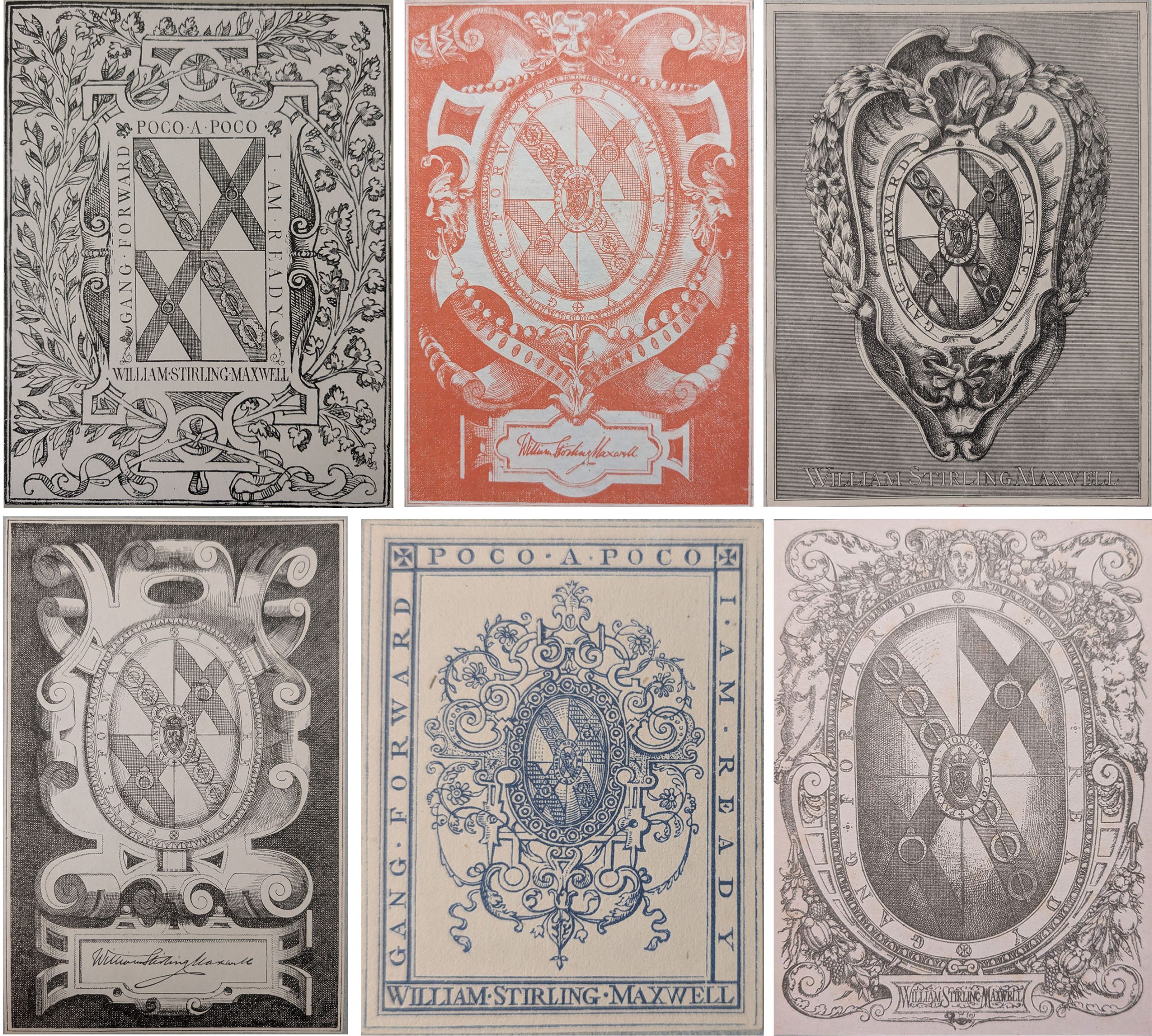
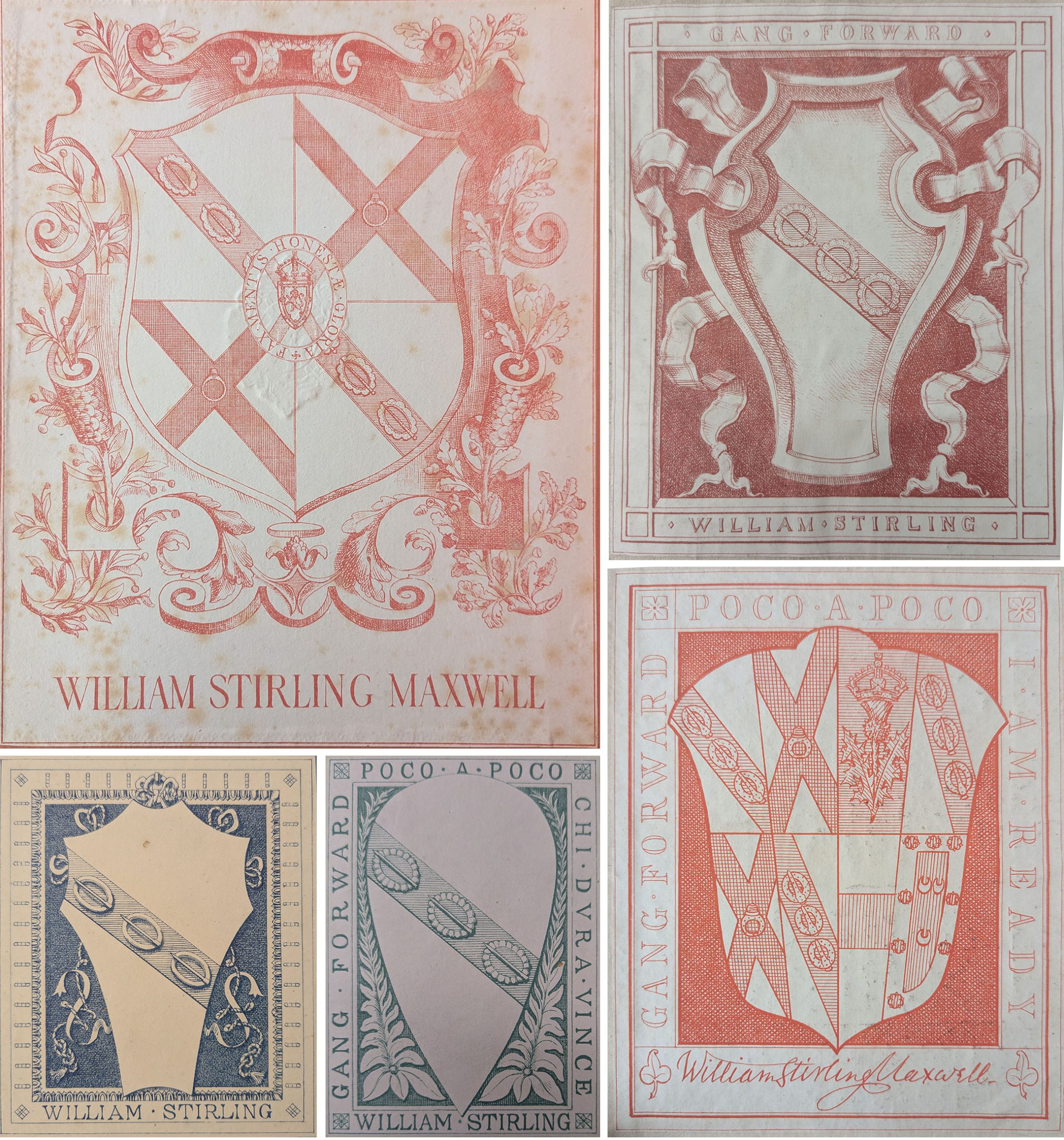
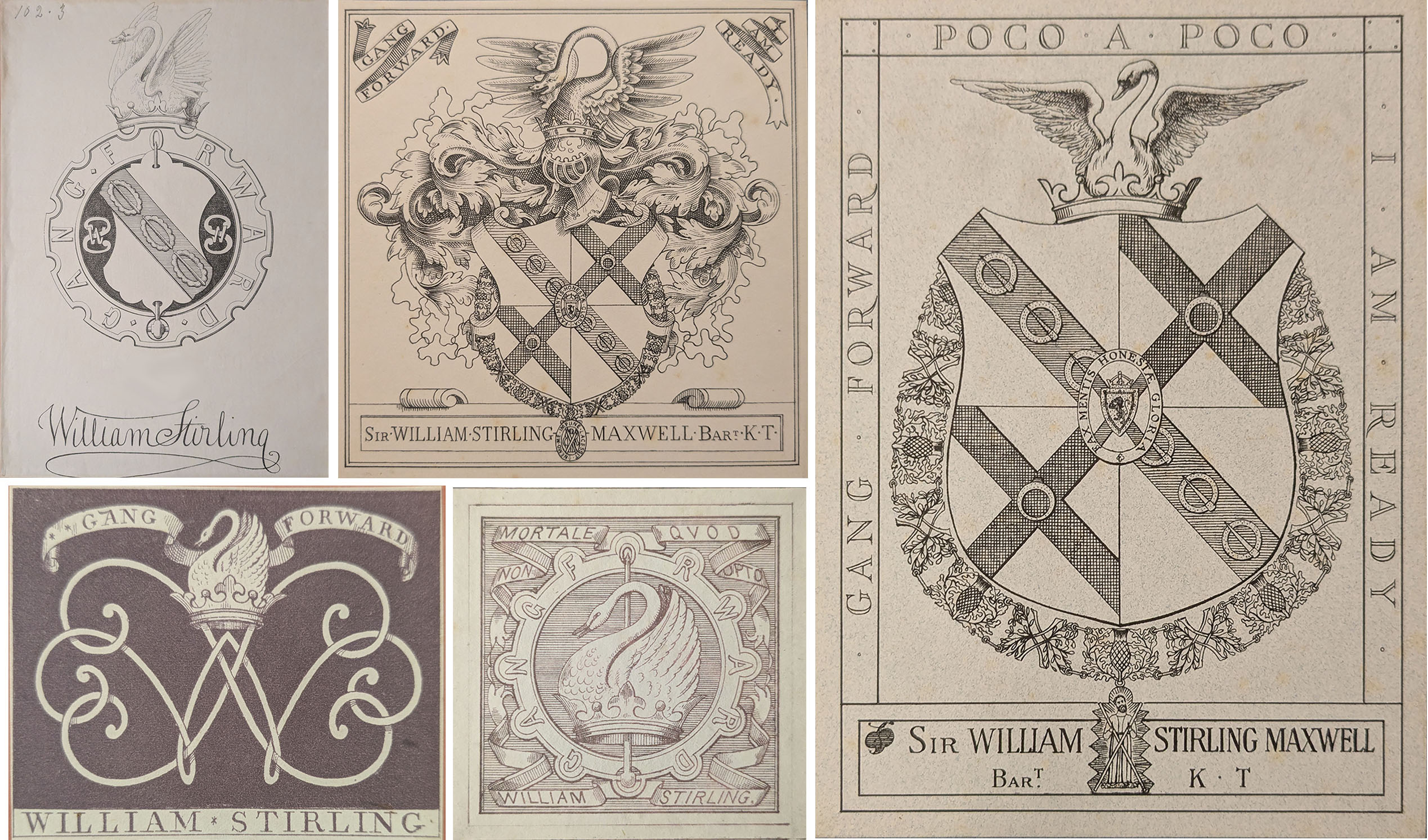
A selection of six of William Stirling Maxwell's bookplates featuring ornate heraldic imagery.
The bookplates in this group feature very ornate heraldic shields. Call numbers clockwise from upper left: Cervantes Z9; Summerfield B1248; Summerfield D261; Summerfield B1243; Summerfield A300; Summerfield E347. Click image to enlarge.
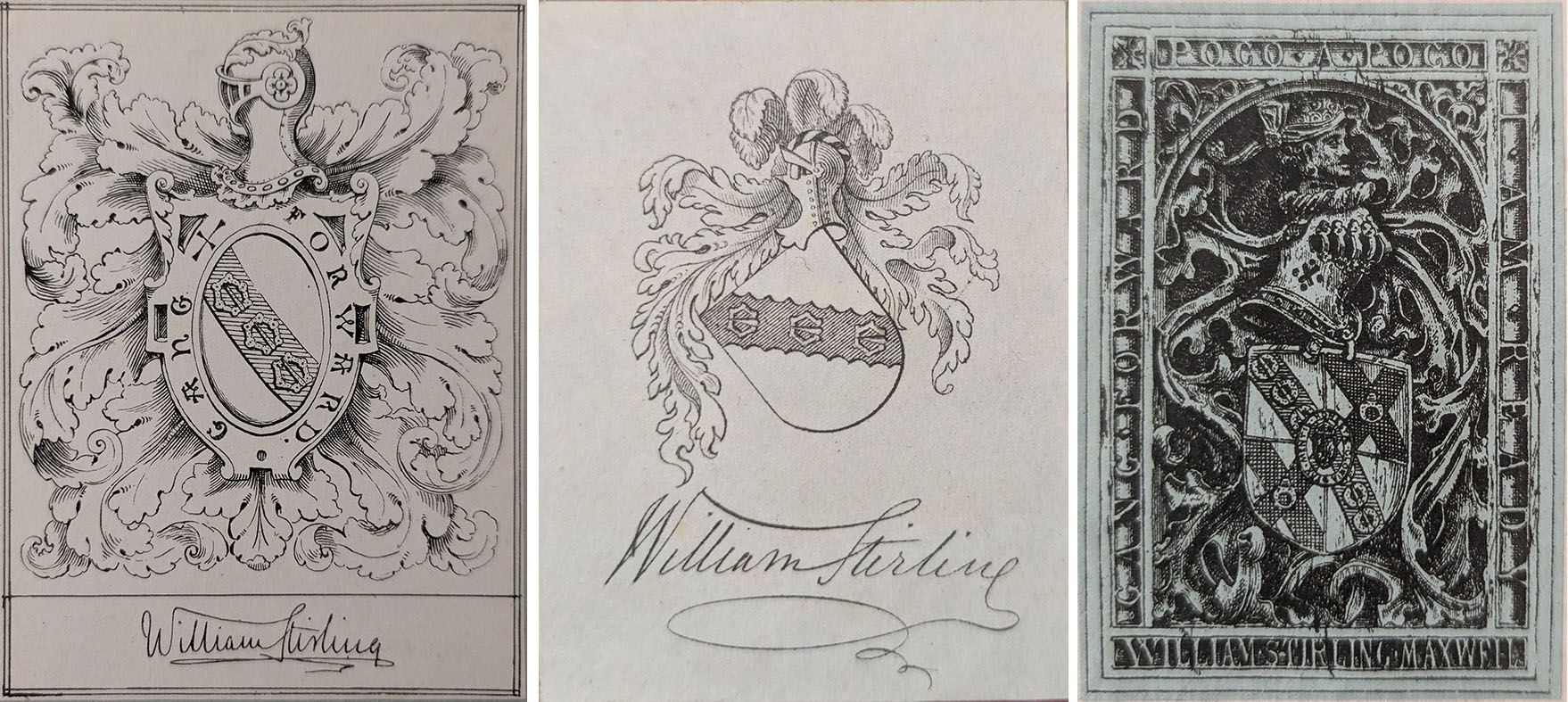
A selection of five of William Stirling Maxwell's bookplates featuring simplified heraldic imagery.
Heraldic shields again, although the designs in this group are somewhat simpler. Call numbers clockwise from upper left: E283; Summerfield E1006; Summerfield C2034; Cervantes Y31; Summerfield C635. Click image to enlarge.
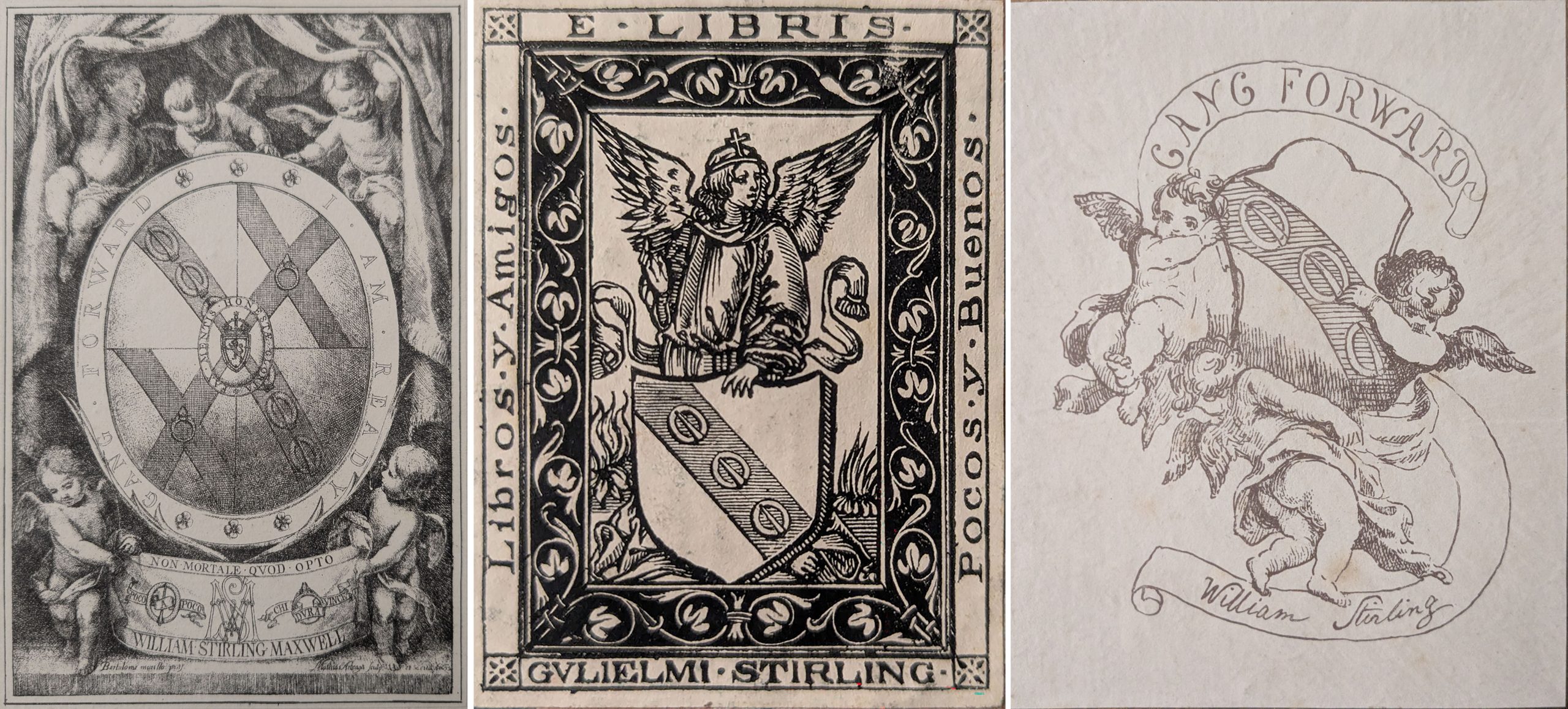
A selection of three of William Stirling Maxwell's bookplates featuring angels or cherubs in the designs.
Angels and cherubs figure in the designs in this grouping. Call numbers clockwise from left to right: Summerfield C850; A1517; Summerfield D254. Click image to enlarge.
A selection of five of William Stirling Maxwell's bookplates featuring swans in the designs.
These bookplates share the swan, a symbol of nobility, as a notable design feature. Call numbers clockwise from upper left: Summerfield D145; Summerfield B1242; D340; Summerfield D210; Cervantes X36. Click image to enlarge.
A selection of three of William Stirling Maxwell's bookplates featuring knight's helmets in their designs.
The barred, sideways-facing knight’s helmet on these bookplates represents the high rank of Stirling Maxwell’s families. Call numbers from left to right: Call numbers from left to right: C1113; Summerfield A668; Summerfield A601. Click image to enlarge.
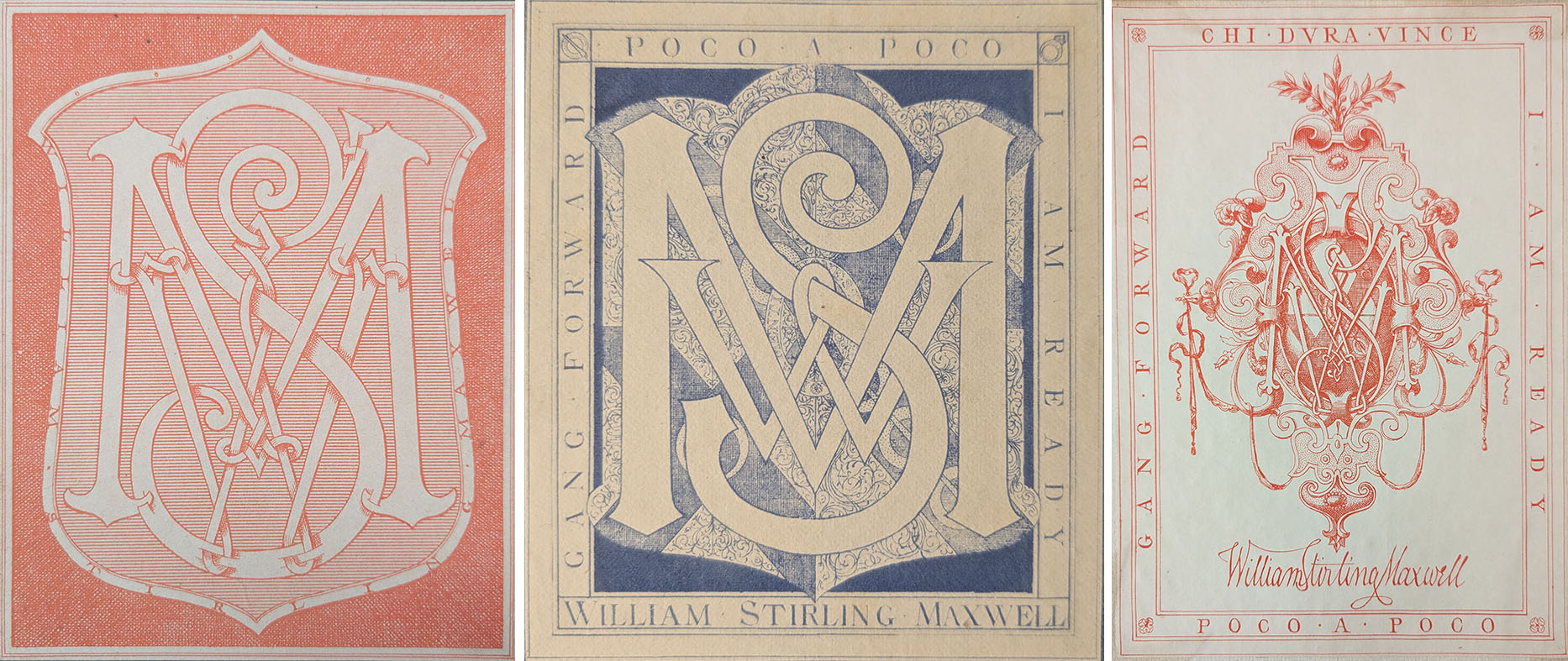
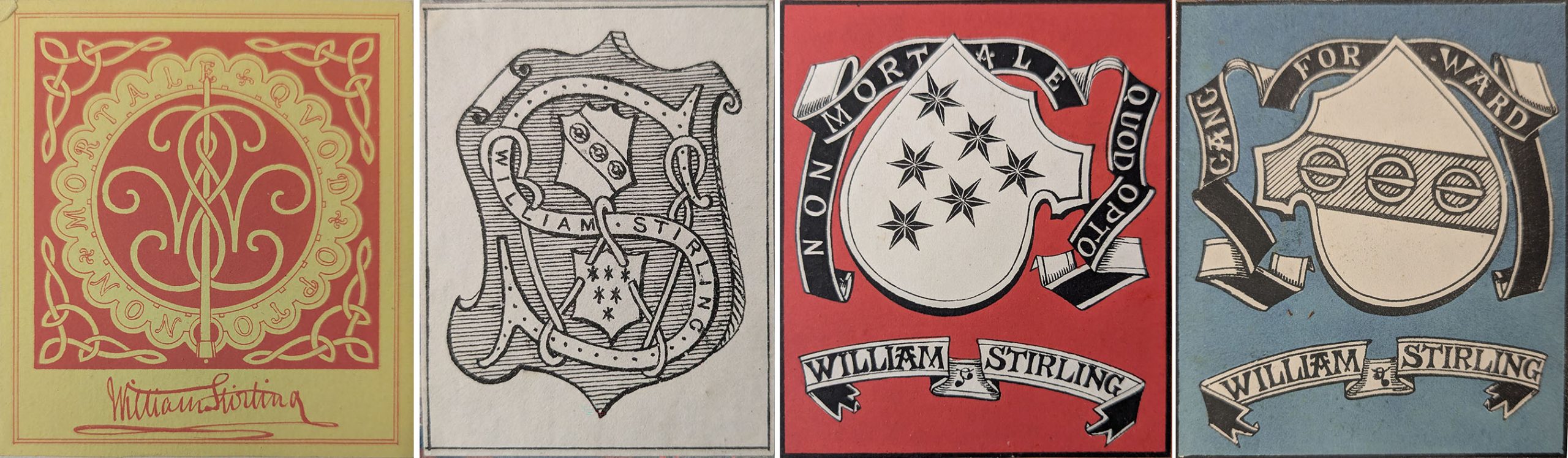
A selection of three of William Stirling Maxwell's bookplates featuring his monogram in the designs.
Monograms, from simple to ornate. Call numbers left to right: Cervantes Y4; Summerfield B882 volume 2; C9478. Click image to enlarge.
A selection of four of William Stirling Maxwell's bookplates featuring bold graphic designs.
These bold, graphic images stand out from the florid, fine-lined designs of many of Stirling Maxwell’s other bookplates. Call numbers left to right: Call numbers left to right: Cervantes Y9; Summerfield A533; C1111; Summerfield B915. Click image to enlarge.
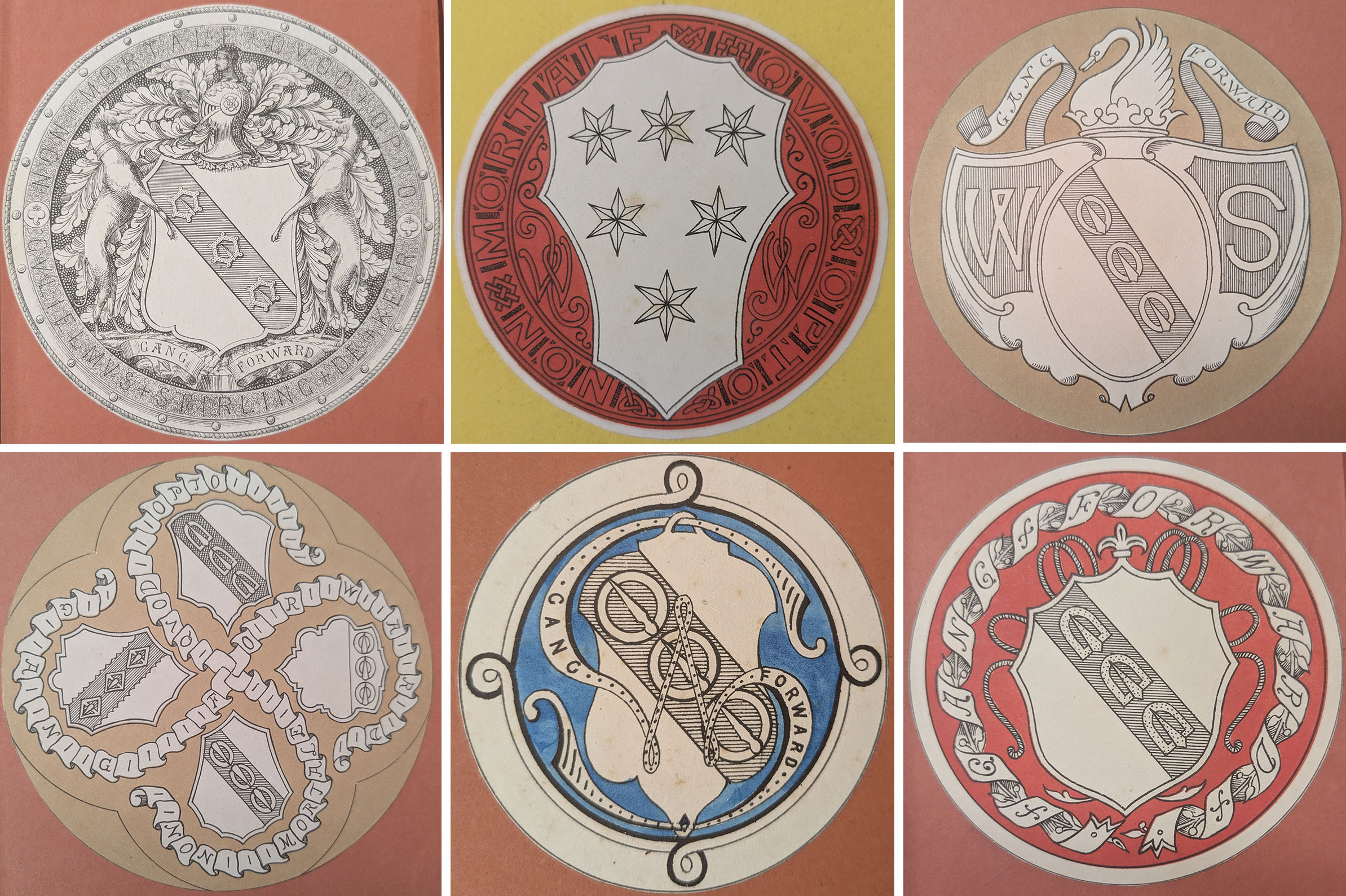
A selection of six of William Stirling Maxwell's bookplates, distinctive for their circular shape.
Many of the same motifs are seen in these bookplates, with one big difference – the plates’ circular shape! Call numbers clockwise from upper left: Summerfield C884; Cervantes Y59; Cervantes Y20; Cervantes Y7; Summerfield B863; Cervantes Y18. Click image to enlarge.

Angela Andres
Special Collections Conservator

Researchers Wanted!

June 6th, 2014

Ask any special collections librarian or archivist about her favorite collection item, and she may hem and haw (how can you pick just one favorite?!?). However, ask that same librarian about interesting items or collections that she wishes more researchers would use, and invariably she will rattle off a frighteningly long list.

This week, in the spirit of summer discovery, we present two intriguing selections that scream “researchers wanted!”

1.  Papers of William Poel, ca. 1895-1934 (MS 31)

As admirers of William Shakespeare know, this April marked the 450th anniversary of the playwright’s birth.  And while Spencer doesn’t have a manuscript by the Bard gathering dust on a shelf (no manuscripts in his hand are known to survive), the library does hold papers for William Poel (1852-1934), an actor, writer, and theater director known for his attempts to revive the conventions of the Elizabethan stage at the dawn of the twentieth century. The collection includes correspondence with figures from the theater world (actors, writers, critics, and others), a small number of scripts, prompt books, and journals, and ephemera such as playbills and review clippings.  Pictured below is Poel’s heavily annotated prompt copy for Fratricide Punished, a German version of Hamlet of ambiguous relation to Shakespeare’s play.  Also pictured are a theater program and a lecture announcement, examples of Poel ephemera.

Picture of Poel's Fratricide Punished Prompt book, open to the list of characters and a pasted in print announcement. Plan of playscene in Poel's Fratricide Punished prompt book.
Lecture announcement for a lecture series on Shakespeare. Image of exterior of program for Poel's production of Marlowe's Faustus
Top: Poel’s prompt book for Fratricide Punished , ca. 1924. MS 31:D4; Bottom: an announcement for a series of lectures by Poel on Shakespeare, 1900, and the program for a production of Marlowe’s Faustus directed by Poel, 1904. MS 31, F6. Click images to enlarge.

2. Don Quixote, el Castellano viejo, undated (before 1860).

This mysterious bound manuscript came to Spencer from the library of the well-known nineteenth-century art historian, bibliophile, and Hispanist, Sir William Stirling Maxwell (1818-1878).  A portion of Stirling Maxwell’s vast library was sold at auction and 1958, enabling KU to acquire a significant number of early printed Spanish volumes, including important editions that now form the basis of Spencer’s Cervantes Collection, and this manuscript.  As far as we know, the author of this manuscript has not been identified, though the text concerns Cervantes’s famed character Don Quixote.   A note pasted toward the front gives further provenance, describing it as a “curious manuscript” sold as part of the auction of the library of “the late Don Justo de Sancha” by Sotheby’s in December of 1860.  Though the hand is later than Cervantes’s time, scholars of Spanish literature might find much to pique their interest in this 205-page manuscript.  The pictures below include the table of contents, which offers readers an idea of the matter covered.

Image of the title page (in a different hand?) giving the title, Don Quixote, el Castellano viejo Image of prologue with pasted in provenance note for Don Quixote, el Castellano viejo. Image of the first page of the table of contents of Don Quixote, el Castellano viejo Image of the final page of Don Quixote, el Castellano viejo.

Bookplate of William Stirling-Maxwell Image of the beginning of Chapter 2 in Don Quixote, el Castellano viejo.

Don Quixote, el Castellano viejo, undated (before 1860). MS C73. Click images to enlarge.

For more information on these and any of our other manuscript holdings, please don’t hesitate to contact us.  After all, the summer is an ideal time to start a new research project.

Elspeth Healey
Special Collections Librarian