The University of Kansas

Inside Spencer: The KSRL Blog

Books on a shelf

Welcome to the Kenneth Spencer Research Library blog! As the special collections and archives library at the University of Kansas, Spencer is home to remarkable and diverse collections of rare and unique items. Explore the blog to learn about the work we do and the materials we collect.

Entre los Estantes: Latina/o Collection Items

April 6th, 2026

As I work to develop the Spencer’s new Latina/o Collections*, I wanted to take a moment and look back at the interesting materials that are already sitting within our library stacks and viewable in our Reading Room today! All the materials presented allow us to briefly see how Latina/os have gathered and built community within different places across Kansas.

Take a look at some of those materials below.

Aztlán de Leavenworth, volume 1

First published May 5, 1970, Aztlán de Leavenworth was a bilingual Chicano prisoner newspaper edited and published at Leavenworth Federal Penitentiary in Kansas. It features poet and activist raúlrsalinas’ famous poem “A Trip Through the Mind Jail.” Other members of the publication team included Albert Mares, Ruben Estrella, Alfredo Arellanes, Ricardo Mena, and Beto Palomino. Inspired by Aztec history and iconography, the newspaper is named after Aztlán, the ancestral home of the Aztecs, and features images of Tizoc and designs inspired by Aztec art.
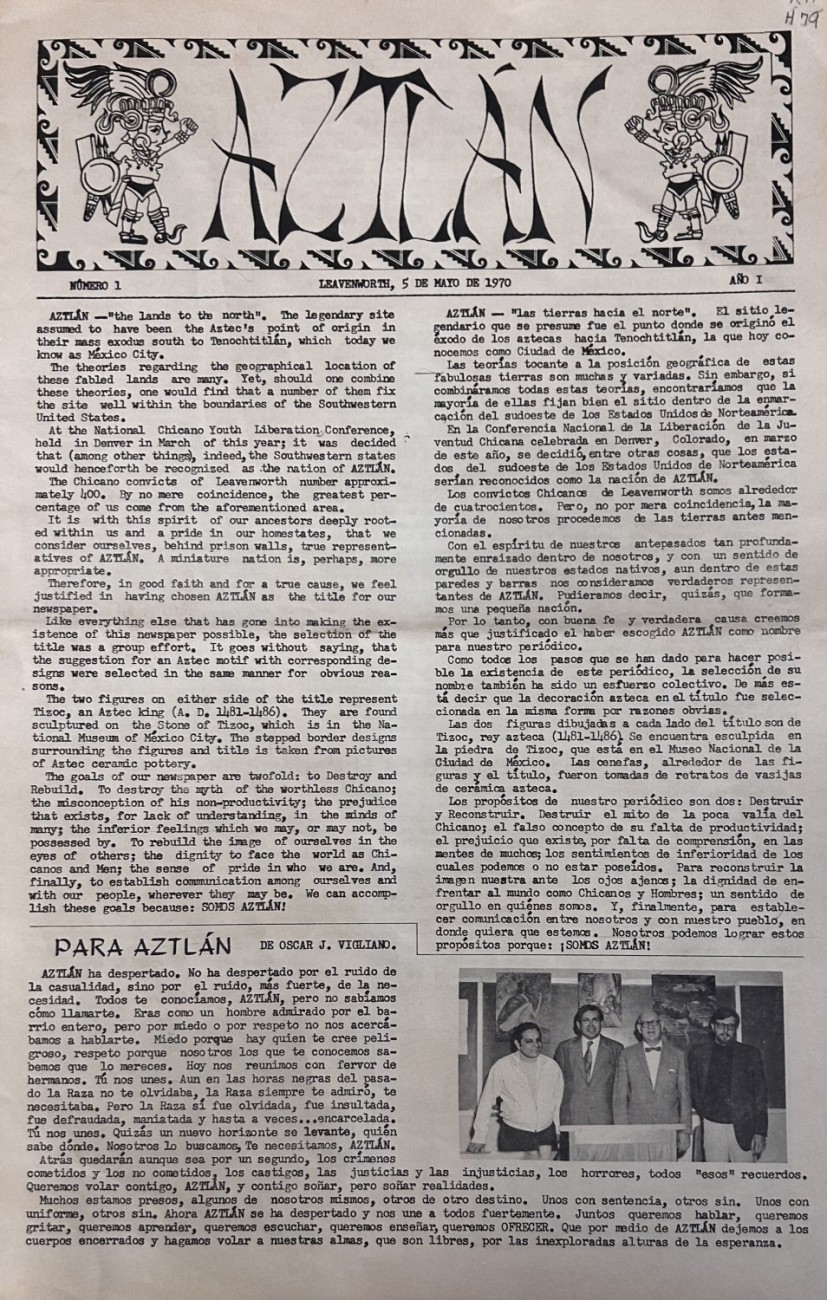
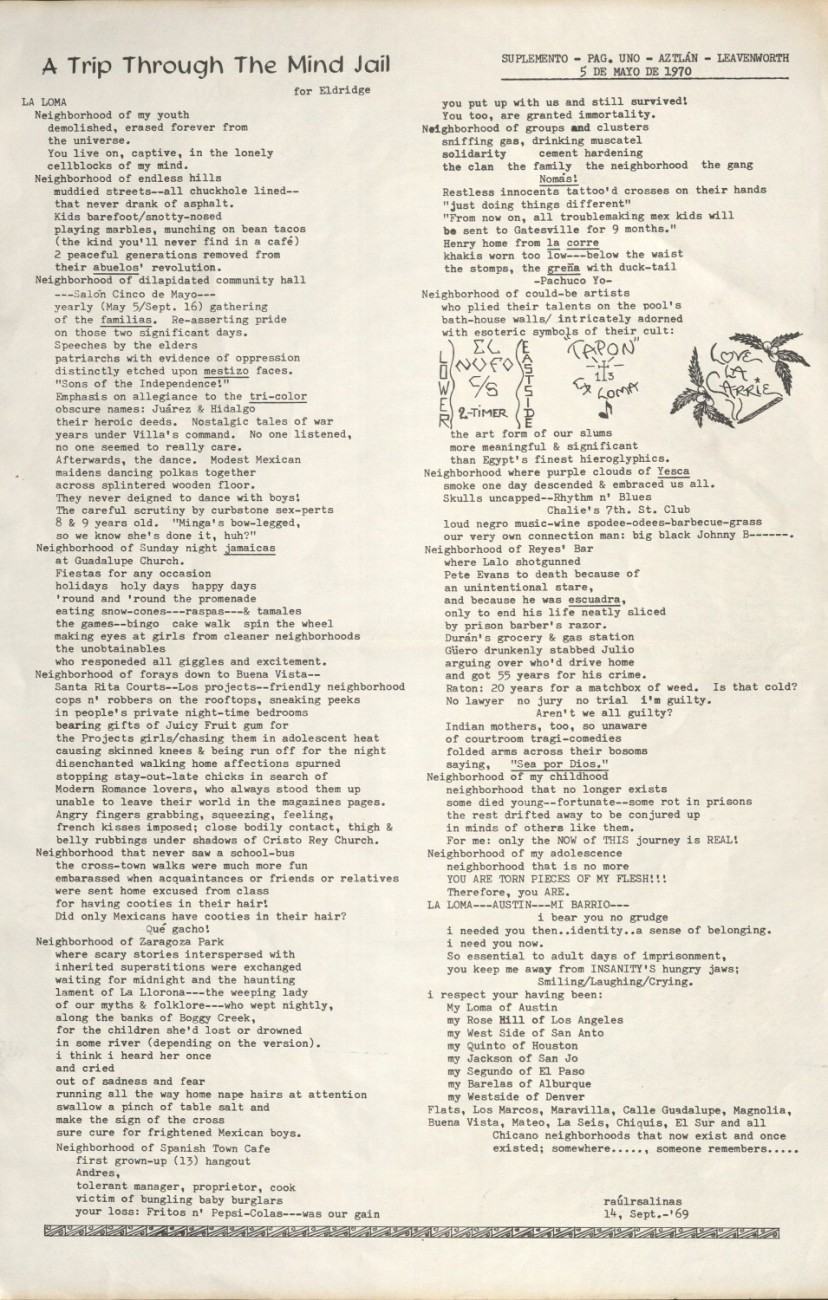
Left: The front cover of Aztlán de Leavenworth, 1970. Right: The page of Aztlán de Leavenworth featuring “A Trip Through the Mind Jail,” 1970. Call Number: RH H79, volume 1. Click images to enlarge.

KACMAA Special Report, 1981

This 1981 special report was created by Kansas’ Advisory Committee in Mexican American Affairs (KACMAA). As explained in the report’s introduction, it “optimistically highlights important accomplishments and measurable in Hispanic’s social, economic, and political life” but also “clarifies the work that remains to be done.” While the KACMAA originally concentrated on projects to promote people of Mexican heritage, the organization evolved to include all Hispanics and Latinos across the state and is now known as the Kansas Hispanic and Latino American Affairs Commission.
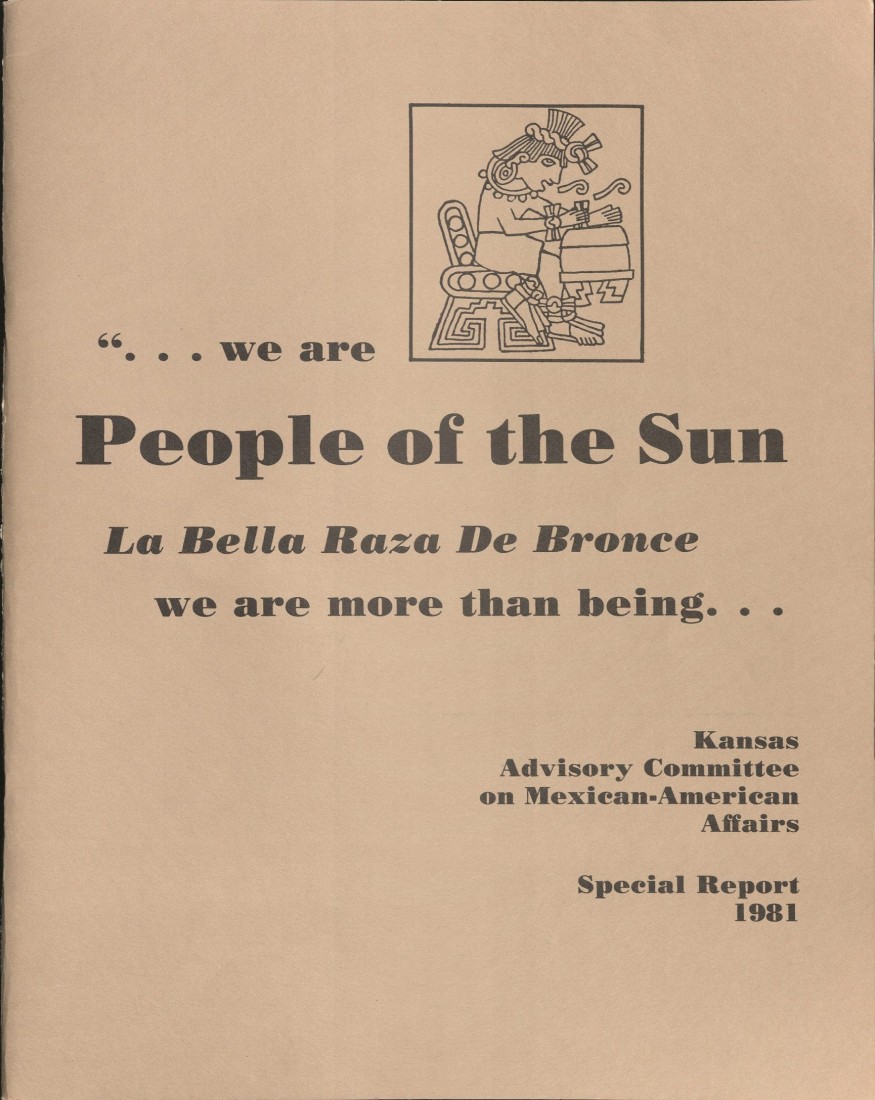
Line drawing of an Aztec symbol with the text "...we are People of the Sun / La Bella Raza De Bronce / we are more than being..."
The front cover of the KCMAA’s 1981 Special Report. Call Number: RH D6100. Click image to enlarge.
Music groups in Emporia

Taken some time in 1932, these photographic prints from the Oral History Project Regarding the Hispanic Community of Emporia, Kansas (Call Number: RH PH 182) allow us to see some of Emporia’s early musical groups. The first photo shows members of the Mexican band Orquesta de Leora posing with their instruments, while the second features the women who made up the Coro de Santa Catalina, or St. Catherine’s Choir. St. Catherine’s Catholic Church still exists to this day and continues to offer Catholic services to Spanish speakers in Emporia.
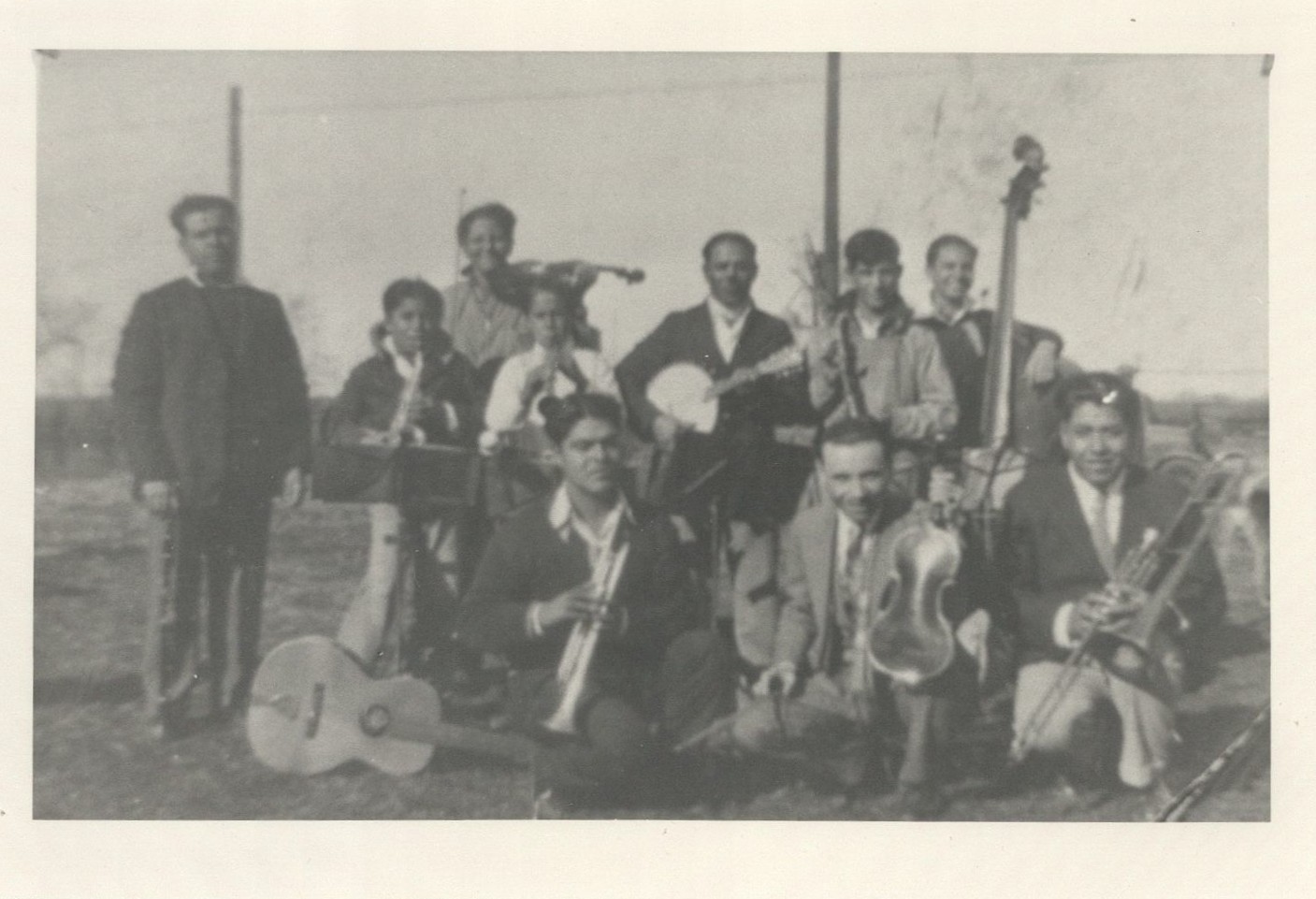
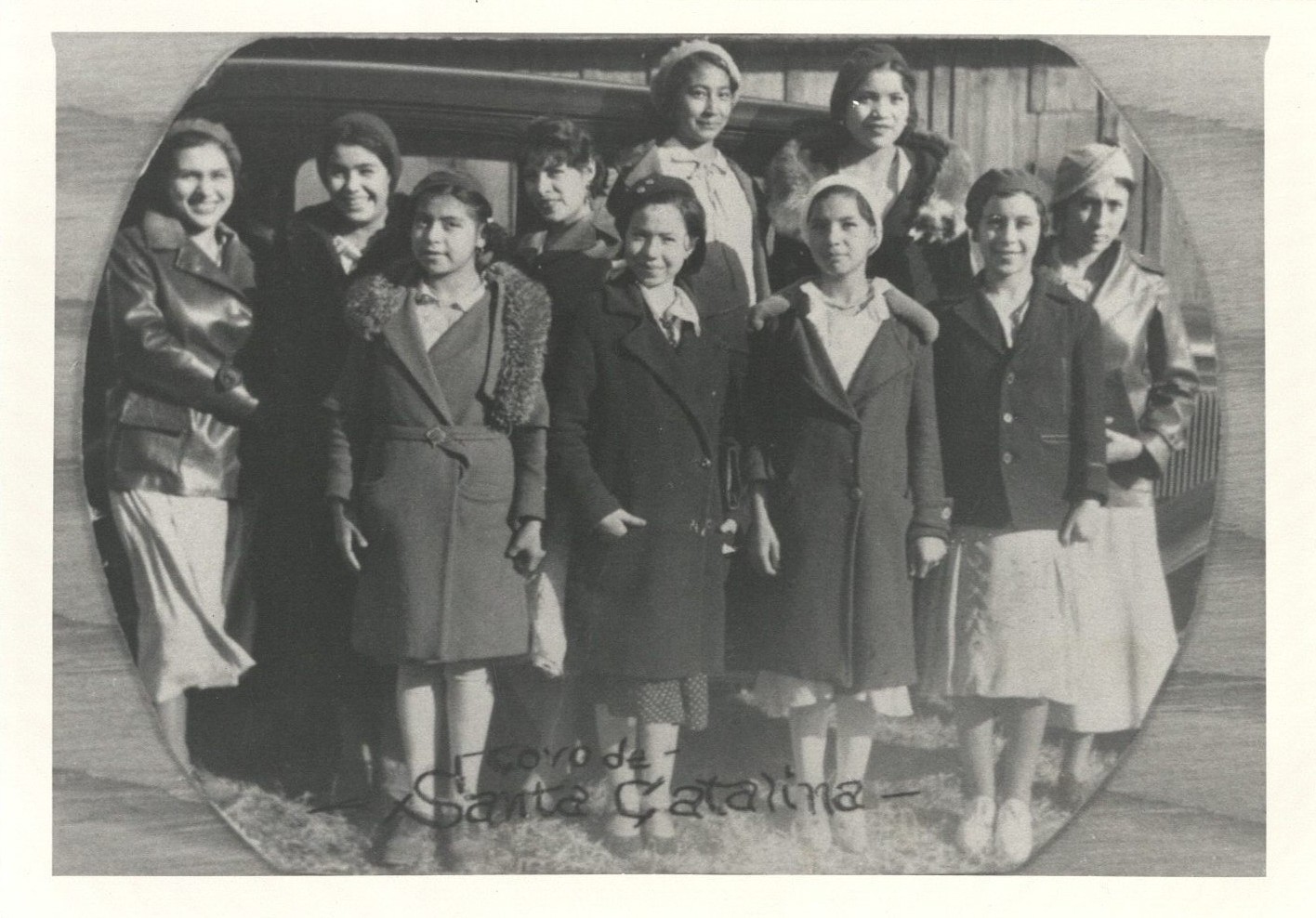
Left: Photograph of Orquesta de Leora, 1932. Right: Photograph of St. Catherine’s Choir, 1932. Oral History Project Regarding the Hispanic Community of Emporia, Kansas. Call Number: RH PH 182, Box 1, Folders 11 and 19. Click images to enlarge.

MEChA & HALO Pamphlets

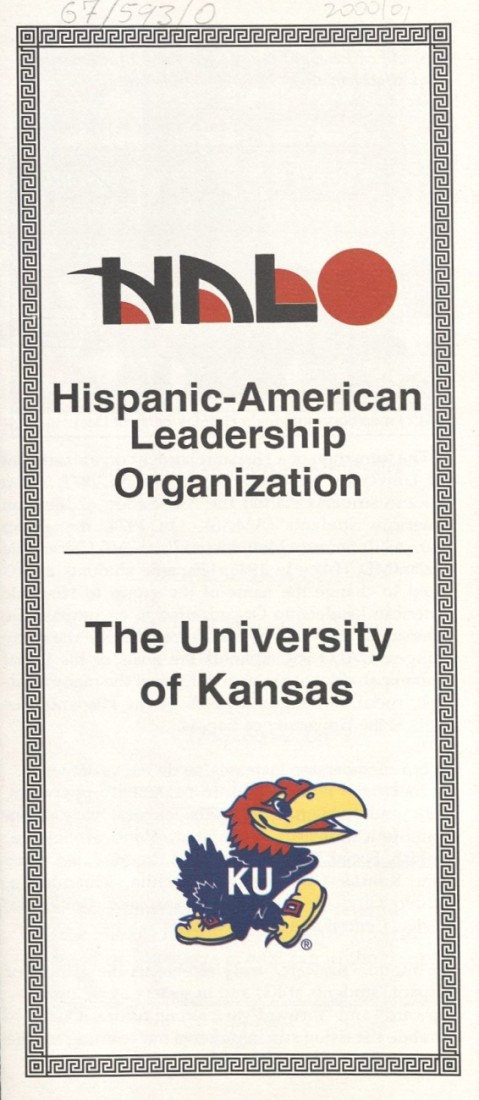
Records of a Latina/o focused group at the University of Kansas have existed since the 1970s. However, before it was LASU (Latin American Student Union), KU’s Latino student group went by many names. It first went by the name AMAS (Association of Mexican American Students), and then it was MEChA (Movimiento Estudiantil Chicano de Aztlán). The group took the name HALO (Hispanic American Leadership Organization) when it was re-established in the 1980s, and it finally became LASU to further expand its inclusion of all students of Latin American heritage or background.  
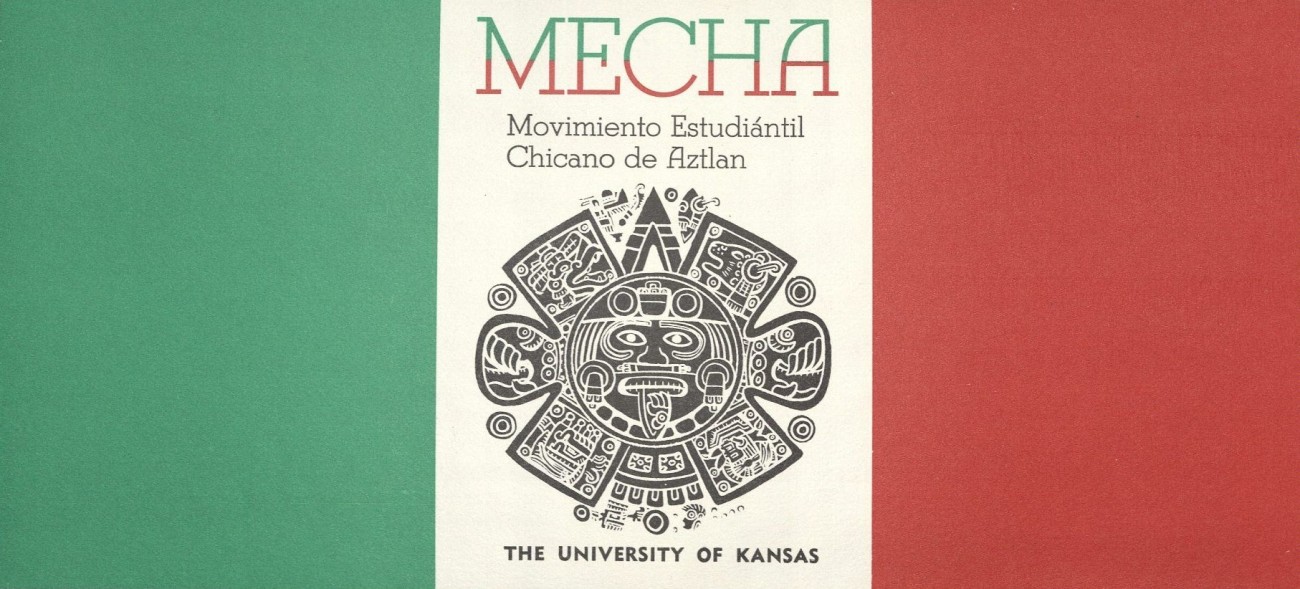
The name of the organization with a black-and-white sketch of an Aztec symbol, all against the Mexican tri-color flag as a background.
|
The name of the organization with a Jayhawk, all against a white background.
Top: MEChA pamphlet, circa 1970. Bottom: HALO pamphlet, circa 1997. KU Student Organization Records: Hispanic American Leadership Organization. Call Number: RG 67/593, Box 1, Folders 1970s and 1997. Click images to enlarge.

Rebekah Ramos
Curator of Latina/o Collections

Sources

“A Trip Through the Mind Jail: A Textual History of raúlrsalinas’ Magnum Opus” by Santiago Vidales Martínez in Textual Cultures 14.1 (2021): 208–229. DOI: https://doi.org/10.14434/tc.v14i1.32858

Kansas Hispanic & Latino American Affairs Commission website, “Our Mission and Our Origins from KACMAA to KHLAAC.”

KU Latin American Student Union website, “LASU History.”

*While many terms exist to identify people in the United States of Latin American origin and/or ancestry (i.e. Hispanic, Chicano, Latino, Latina/o, Latinx, Latine) at Spencer Research Library we chose to use “Latina/o” for the collection’s title. As the collection grows and evolves, the term used might change.

George Allen Collection of Stereoviews, 1867-1915

May 13th, 2015

Photograph of George Allen, 1989

George Allen with his collection, December 1989.
Lawrence Journal-World Photo. George Allen Photograph Collection
accession file. Click image to enlarge.

George Allen (1913-2007) was born in Wichita, Kansas. His family moved to Lawrence in 1927. He graduated from Liberty Memorial High School, and then earned a law degree from Kansas University. He practiced law in Lawrence for forty years. Mr. Allen also collected stereoviews, a hobby fueled by his love of history and an interest in photography. He bought his first stereoview in the 1950s from a woman who operated an antique shop behind her house. He would go on to spend thirty-five years collecting thousands more, with his collection peaking somewhere between 20,000 and 25,000. In 1990 he sold 722 stereoviews to the University of Kansas Libraries. Among the collection are views of Kansas, Arizona, Illinois, Nebraska, New Mexico, North Dakota, Ohio, Pennsylvania, Texas, Missouri, Dakota Territory, as well as images of cowboys, sod homes, coal mining, floods, cattle raising, the Chicago Exposition of 1874, and railroads.

Photograph of theEmporia News building, Emporia, Kansas, undated

Emporia News building on Commercial Street, Emporia, Kansas, undated.
George Allen Photograph Collection. Call Number: RH PH 137.
Click image to enlarge.

Photograph of a flood in Abilene, Kansas, 1903

Flood in Abilene, Kansas, 1903. George Allen Photograph Collection.
Call Number: RH PH 137. Click image to enlarge.

Photograph of boys bathing in Mud Creek, Dickinson County, Kansas, undated

Boys bathing in Mud Creek, Dickinson County, Kansas, undated.
George Allen Photograph Collection. Call Number: RH PH 137.
Click image to enlarge.

The most popular stereoviews from Mr. Allen’s collection are fifty-five from Alexander Gardner’s “Across the Continent on the Union Pacific Railway, Eastern Division” series, which include several images of post-Civil War Lawrence, Kansas. Gardner, working for the Union Pacific Railway, took his photography wagon, loaded with chemicals and glass plates, across the west in 1867. He first followed the existing railroad line, which passed through Kansas, and then he continued along the proposed railroad route to the Pacific Ocean. He documented the towns, landscapes, and people he encountered on the way, using stereoviews to do so.

Photograph of Massachusetts Street, Lawrence, Kansas, 1867

Image of Massachusetts Street, Lawrence, Kansas, 1867 (back)

Massachusetts Street, Lawrence, Kansas, 1867 (front and back of card).
The image shows the rebirth of the town within five years of Quantrill’s Raid.
Alexander Gardner, Across the Continent on the Union Pacific Railway, Eastern Division.
George Allen Photograph Collection. Call Number: RH PH 137.
Click images to enlarge.

Stereoscopic photography consists of two nearly identical images pasted on a board, side by side. To get the two images, the photographer would make an exposure, then move the camera 2 1/2 inches, the average distance between human eyes, and make a second exposure. The photographer would then develop each of the images and paste the prints onto the board. When the two images are viewed through an apparatus called a stereoscope, or stereoviewer, the eyes force the two images into one image, creating the appearance of depth perception, or 3D. Another method was to use a twin-lens camera, which allowed the photographer to make the two exposures simultaneously, saving time and eliminating the need to reload the camera.

Image of a stereoviewer

An example of a stereoviewer, also known as a stereoscope.
Image courtesy of Gilai Collectibles. Click image to enlarge.

Collecting and trading stereoviews of plays, famous sites, people, or events was quite popular in the mid nineteenth and early twentieth centuries. Most homes had a stereoviewer in the parlor, which allowed viewers to see, for example, views of Paris without actually traveling. Mr. Allen enjoyed stereoviews for the way they portrayed history and told the story of our shared past.

Photograph of a round-up on the Sherman Ranch, Genesee, Kansas, undated

Image of a round-up on the Sherman Ranch, Genesee, Kansas, undated

Round-up on the Sherman Ranch, Genesee, Kansas, undated (front and back of card).
George Allen Photograph Collection. Call Number: RH PH 137. Click images to enlarge.

Photograph of a dugout sod home, Kansas, undated

Dugout sod home, Kansas, undated. George Allen Photograph Collection.
Call Number: RH PH 137. Click image to enlarge.

Kathy Lafferty
Public Services