A History of Día de Muertos
October 30th, 2026While sometimes incorrectly touted as the “Mexican Halloween,” Día de Muertos (Day of the Dead) is much more than that. Like many modern-day holidays, Día de Muertos looks very different today than it did at the beginning.
Origins
The origins of Día de Muertos can be traced back thousands of years to traditions of the Aztecs and other Indigenous peoples of Mesoamerica. For the Aztecs, death was not the end, but the beginning of their journey to Mictlan, the underworld governed by Mictlantecuhtli and Mictecacíhuatl. Many of the events honoring the dead included the placing of food on altars and the burning of incense. With the arrival of the Spanish to Latin America, these events were moved to coincide with the Catholic holidays of All Saints’ Day and All Souls’ Day at the beginning of November. However, Indigenous beliefs remained and led to a syncretic tradition that honored the cyclical nature of life and death seen in pre-Hispanic and Catholic traditions.

In the early 1900s, four hundred years after the Spanish conquest of Latin America and about a hundred years after Mexico’s Independence from Spain, the Mexican government began to encourage the celebration of Día de Muertos in an effort to unite the Mexican people during a time of great political turmoil.
The calavera imagery often associated with Día de Muertos is in large part because of Jose Guadalupe Posada’s calaveras. Posada began to make satirical prints using this calavera imagery to poke fun at society and politicians, as was the case with his famous La Catrina. These depictions of calaveras were soon adopted by those participating in Día de Muertos, with it becoming a symbol of the celebration.

Día de Muertos in the United States
As Mexican immigrants made their way to the United States, so did their customs and traditions. Traced back to the 1980s, Mexican Americans in the Southwest maintained the religious tradition of visiting their past one’s gravesites. However, this did not include the Indigenous practices of setting up ofrendas or burning copal incense. Instead, many of these communities engaged in “folk Catholic” traditions that tended to be more solemn to honor All Saints’ Day and Souls’ Day, rather than the vibrant and celebratory Día de Muertos of today.
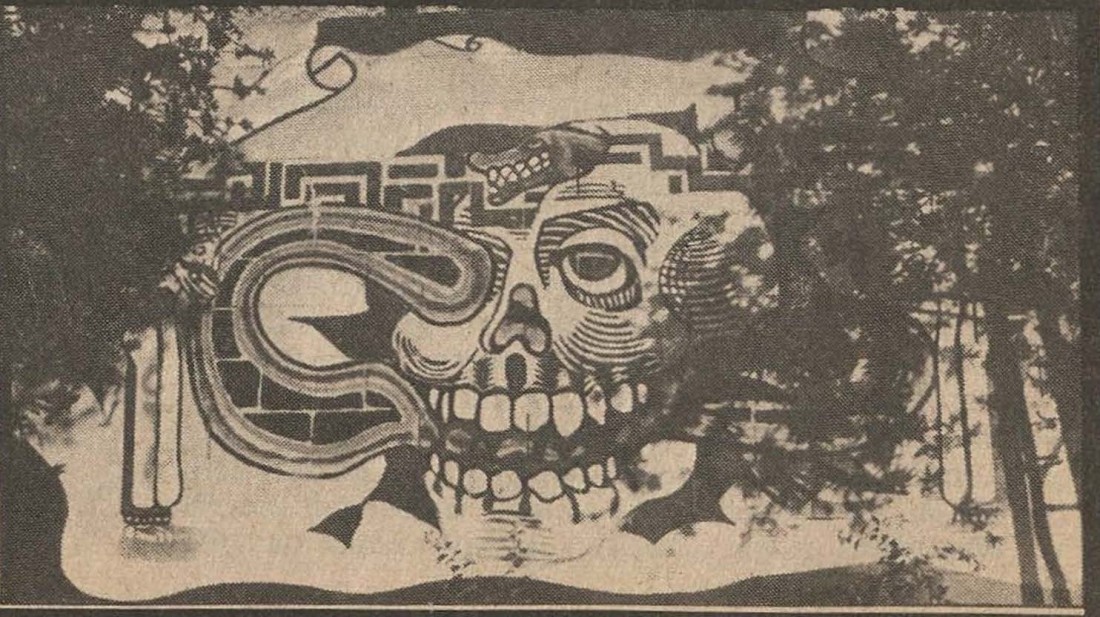
However, during the 1970s the Chicano Movement embraced the traditions of Día de Muertos celebrations as a way to connect to their Mexican identity and Indigenous roots. Starting in California, these early Día de Muertos events were seen as a way for Chicano artists to publicize their art and celebrate Latino culture. In 1972, a Chicano activist group from East Los Angeles called Self Help Graphics & Arts organized what is considered the first Día de Muertos event in the country. This included a small procession to a nearby cemetery, calaveras, and ofrendas. Since then, Día de Muertos events in the United States have transformed the holiday and differed from traditional Mexican and Indigenous traditions, with politically themed altars, posters, danzas, lowriders, calavera face painting, and fashion shows. This evolution of the holiday was so impactful that it’s also influenced Mexico’s Día de Muertos celebrations.
Día de Muertos in the Midwest and Kansas
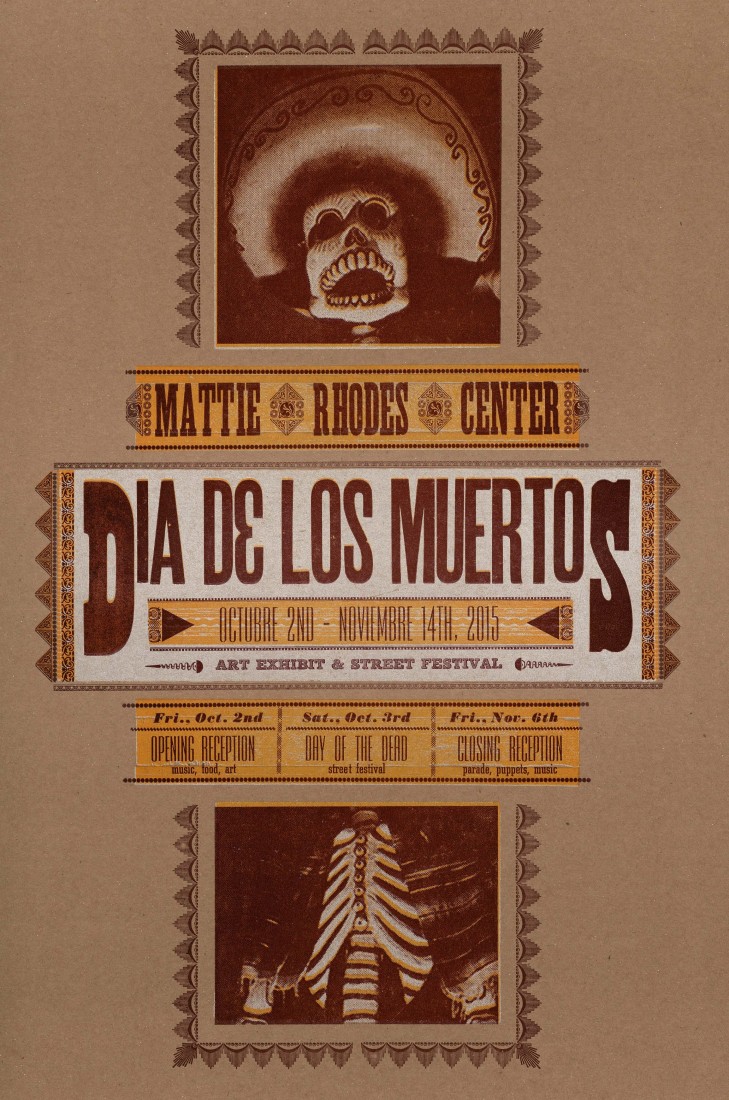
As Día de Muertos gained more popularity, Mexican American communities across the country also began to adopt the holiday, including the Midwest. For example, Chicago’s National Museum of Mexican Art began celebrating Día de Muertos in 1986. In Kansas City, several Latino service organizations have celebrated the holiday by hosting events for the community, including the Guadalupe Centers and Mattie Rhodes Center, which has hosted a Día de Muertos celebration since 1998.
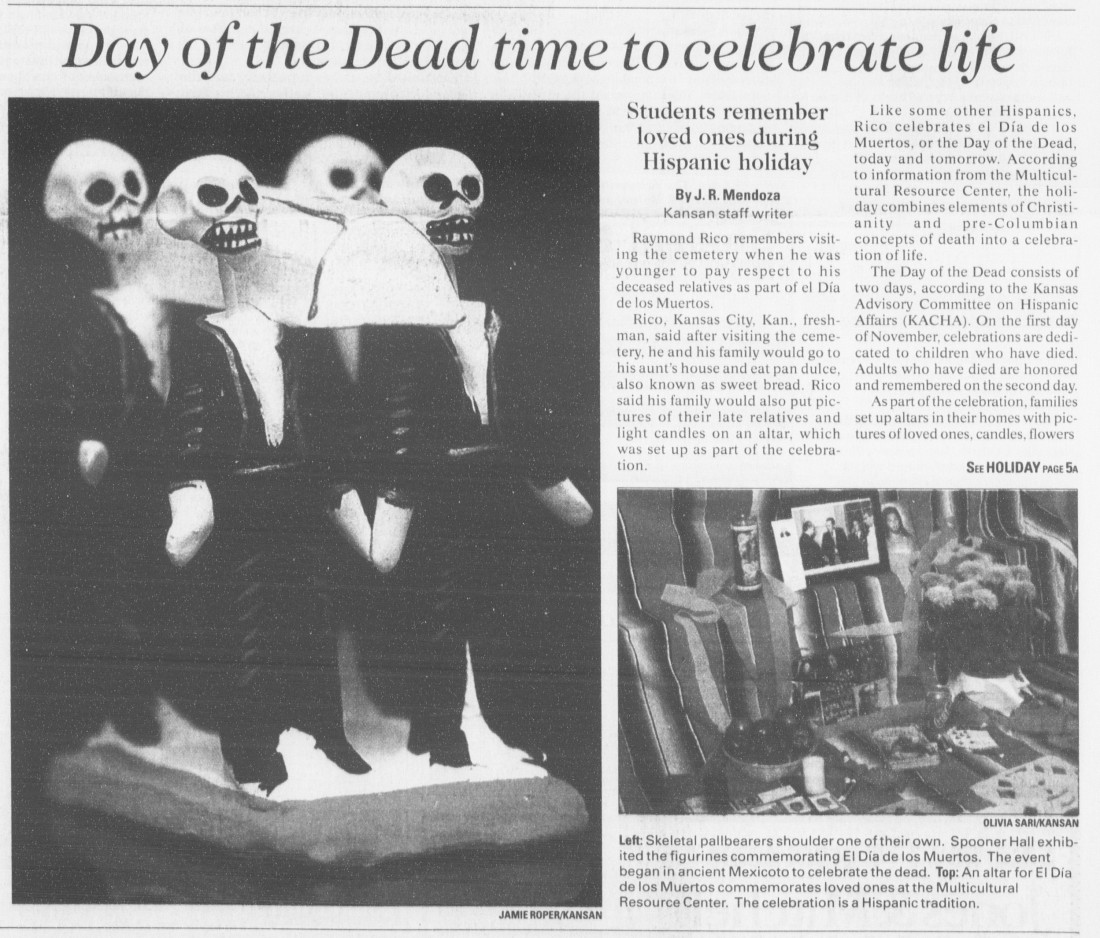
In Lawrence, the University of Kansas’s Museum of Anthropology, now part of the university’s Biodiversity Institute, hosted a Día de Muertos exhibit in 1994 and several events while it remained open. Similarly, KU’s Latin American Student Union has also hosted many Día de Muertos celebrations throughout the years and continues to do so to this day.

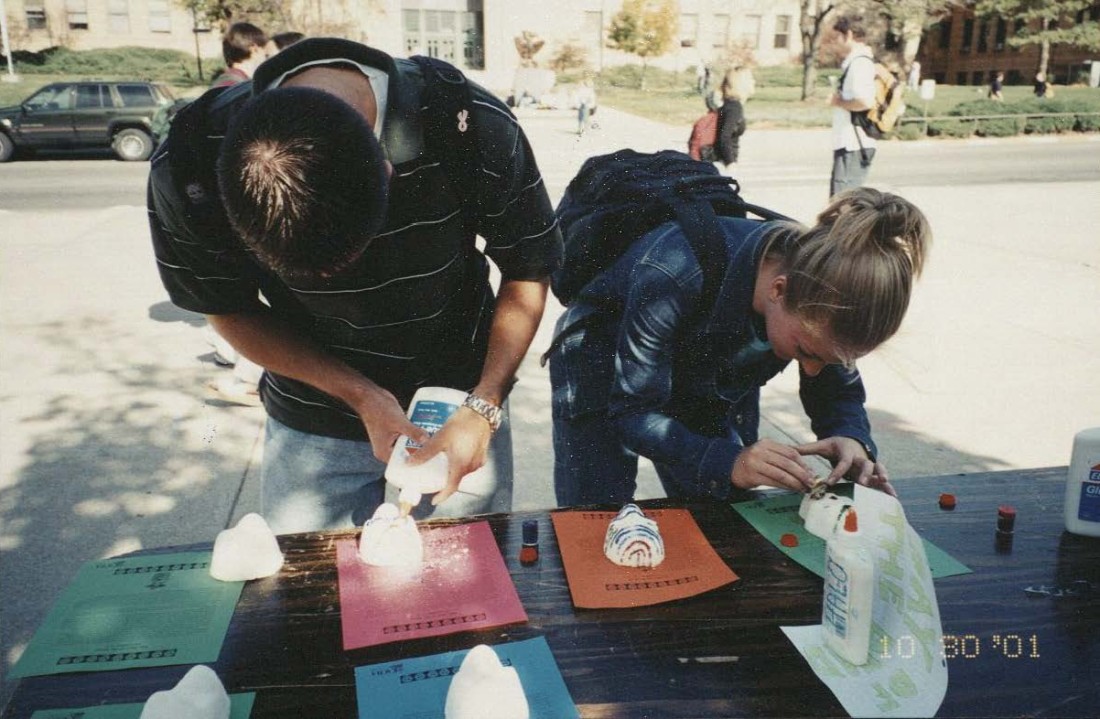
Outside of campus, Somos Lawrence, a nonprofit organization focused on serving the non-English speakers of Lawrence, has hosted a Día de Muertos event the last couple of years, and will be doing so again this November 1st.
Just as Latino communities in the United States continue to grow and diversify, Día de Muertos celebrations will continue to evolve. In recent years, one might’ve noticed an increased commodification of Día de Muertos decorations and events, something that many in Mexican American and Latino communities fear could lead to gentrification of the holiday. However, with changes to the holiday, there has also been an effort to incorporate elements from similar celebrations in Central America to Día de Muertos celebrations, especially as a way to be inclusive of more recent immigrants from countries in that region.
So, if you go to a Día de Muertos celebration this November 1st, I invite you to think about the history and traditions this holiday holds as you eat some pan the muerto and enjoy the community ofrendas!
Rebekah Ramos
Curator of Latina/o Collections
Sources
Day of the Dead Guide [PDF]. National Museum of Mexican Art, 2020. Accessed 26 October 2026.
“Day of the Dead.” Encyclopaedia Britannica, Encyclopaedia Britannica, Inc. Accessed 28 October 2026.
“Día de los Muertos in the United States.” Smithsonian American Art Museum Blog, Smithsonian American Art Museum, 1 November 2017. Accessed 26 October 2026.
Marchi, Regina M. Day of the Dead in the USA, Second Edition: The Migration and Transformation of a Cultural Phenomenon, Rutgers University Press, 2022. JSTOR, https://doi.org/10.2307/j.ctv2v55jxd.10. Accessed 28 October 2026.