The University of Kansas

Inside Spencer: The KSRL Blog

Books on a shelf

Welcome to the Kenneth Spencer Research Library blog! As the special collections and archives library at the University of Kansas, Spencer is home to remarkable and diverse collections of rare and unique items. Explore the blog to learn about the work we do and the materials we collect.

Manuscript of the Month: From the Library of the Charterhouse of St Barbara in Cologne

June 30th, 2021

N. Kıvılcım Yavuz is conducting research on pre-1600 manuscripts at the Kenneth Spencer Research Library. Each month she will be writing about a manuscript she has worked with and the current KU Library catalog records will be updated in accordance with her findings.

Kenneth Spencer Research Library MS C91 is a fifteenth-century collection of religious texts. It contains a copy of the Homiliae quadraginta in evangelia [Forty homilies on the Gospels] by St Gregory the Great (approximately 540–604), the Exposicio sive postilla passionis Ihesu Christi [An exposition or annotations on the passion of Jesus Christ] compiled by Herman Appeldorn (d. 1473) and a shorter text on the passion of Christ, also attributed to him in the manuscript.

Unlike many manuscripts whose origin and provenance are now lost to us, we have evidence that MS C91 comes from the medieval library of the Charterhouse of St Barbara in Cologne, Germany, a Carthusian monastery. St Bruno (approximately 1030–1101), who was educated in Reims, France, and who later became the Chancellor of the Archdiocese of Reims, founded the Carthusian Order in 1084 in the Chartreuse Mountains, north of Grenoble, France. This original establishment, known as the Grande Chartreuse, is the head monastery of the Carthusian Order, and Carthusian monasteries are known as “charterhouses” after Chartreuse. Despite St Bruno originally being from Cologne, there was no charterhouse in Cologne until December 12, 1334, when the Charterhouse of St Barbara was founded by the Archbishop of Cologne, Walram of Jülich (approximately 1304–1349). Although it had a difficult start due to political tensions in the region, the charterhouse began to prosper especially after it came under the protection in 1354 of Charles IV (1346–1378), King of Bohemia and later Holy Roman Emperor.

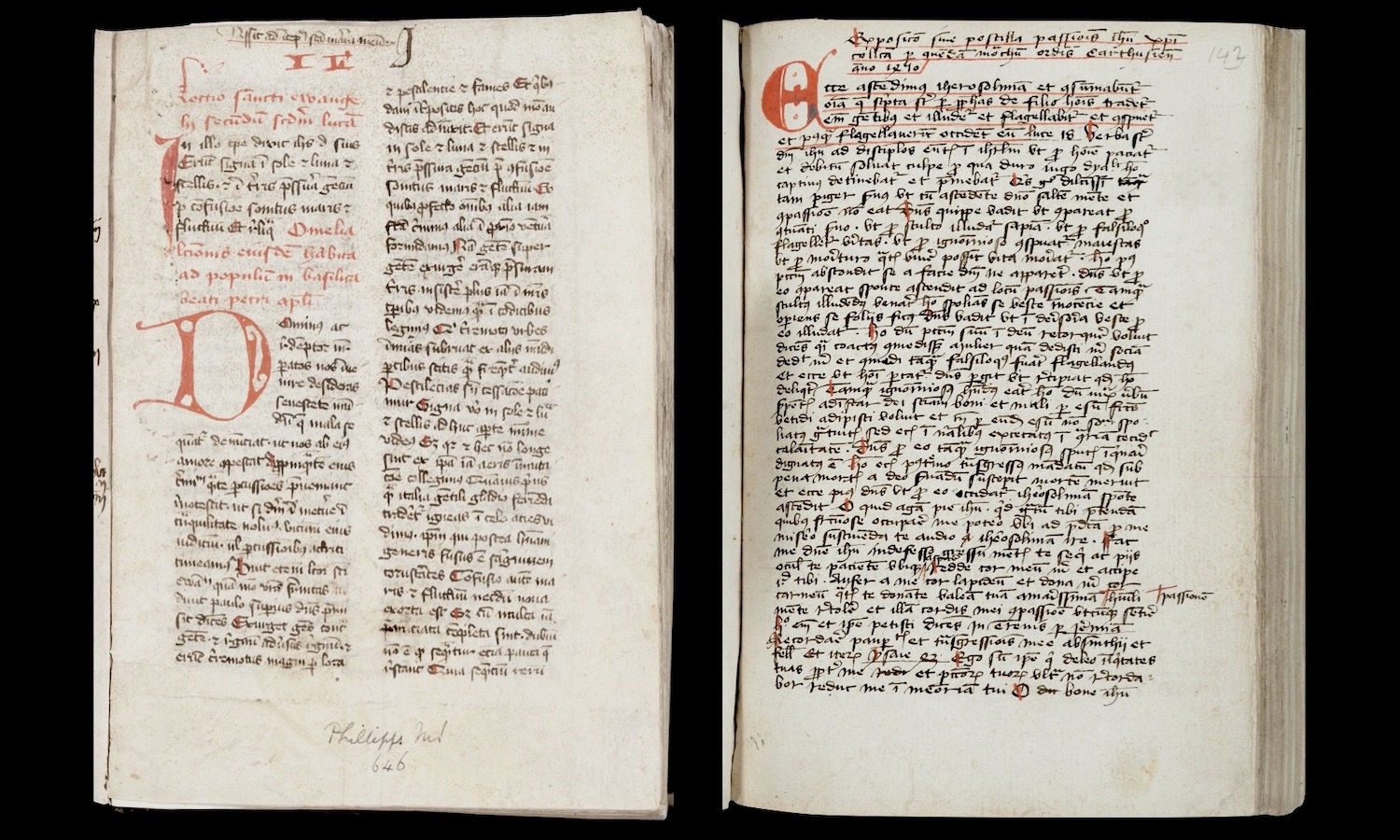
Image of St. Gregory the Great’s Homilies on folio 2r and Herman Appeldorn’s Exposition on folio 144r.
Beginning of St. Gregory the Great’s Homilies on folio 2r and Herman Appeldorn’s Exposition on folio 144r. Trier and/or Cologne, Germany, between 1451–1473. Call # MS C91. Click image to enlarge, and see the Digital Scriptorium for additional images from this manuscript.

By the mid-fifteenth century the manuscript collection of the Charterhouse of St Barbara was the largest in Cologne, at least until the library and the neighboring buildings were completely consumed by a fire in November 1451. Some manuscripts, however, would have survived, for even though the Charterhouse of St Barbara had a separate library space, one did not need to be there to work with books. The Carthusians lived a solitary and contemplative life, and much work with manuscripts, including reading, copying, and writing commentaries was carried out by nuns and monks in the solitude of their cells. Therefore, although many books surely perished during this fire, scholars have argued that some of the manuscripts the monks were consulting at the time would have been spared.

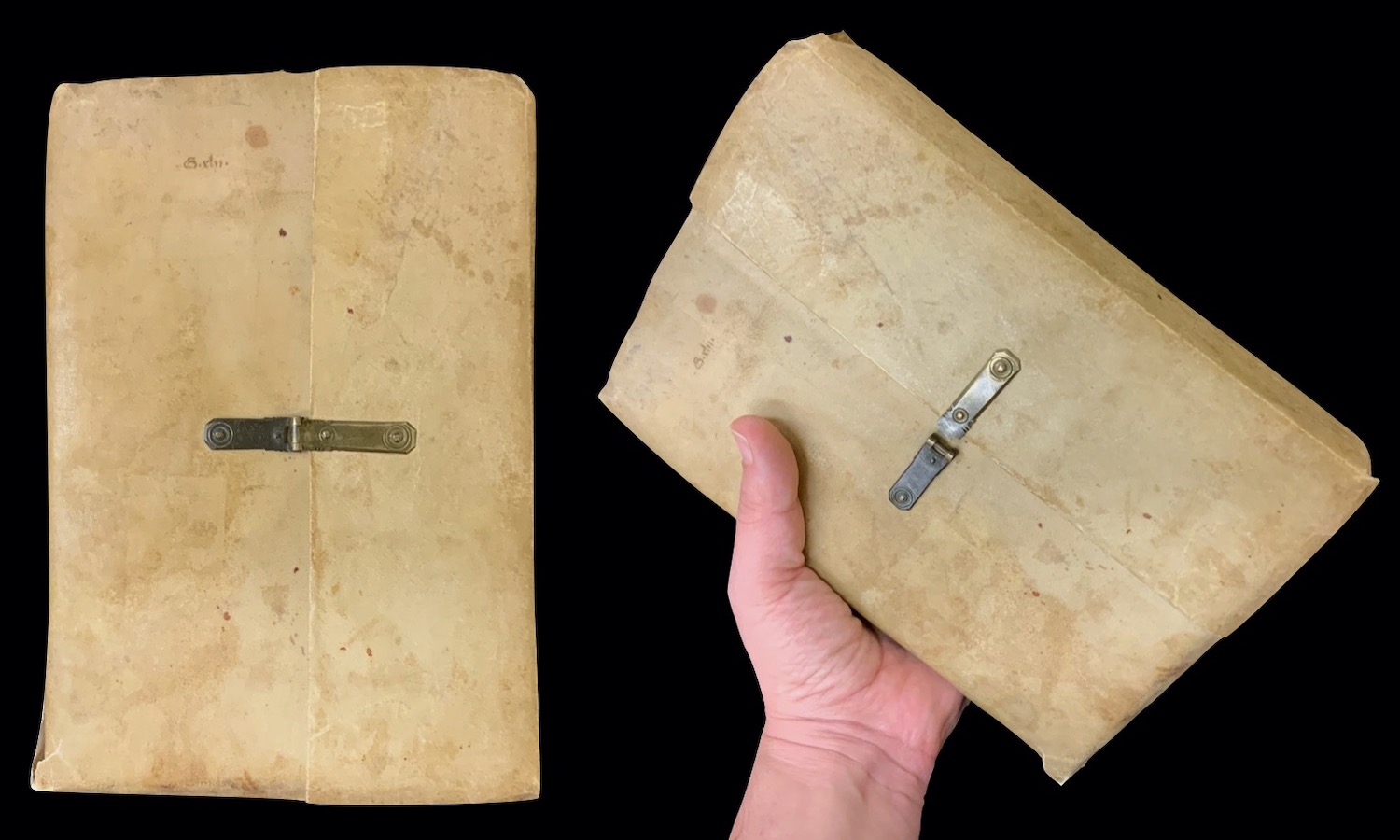
Image of the parchment binding of MS C91, the front cover of which contains an older shelfmark of the library of the Charterhouse of St Barbara in Cologne: “G.xlii.”
Parchment binding of the manuscript, the front cover of which contains an older shelfmark of the library of the Charterhouse of St Barbara in Cologne: “G.xlii.” Call # MS C91.

Following the 1451 fire, the collection of the Charterhouse of St Barbara in Cologne was swiftly rebuilt not only by the copying of new manuscripts by the members of the charterhouse but also through purchases and donations. MS C91 is the product of these efforts, probably put together when Herman Appeldorn was Prior of the Charterhouse of St Barbara between 1457 and 1472. MS C91 is in its original parchment limp binding with a fore-edge envelope flap that extends from the right (back) side of the cover and is secured with a brass clasp. The fifteenth-century shelfmark of the library of the Charterhouse of St Barbara is written on the front cover of the manuscript: “G.xlii.” In this system, the letter is thought to indicate the name of the author or the subject of the manuscript and the number possibly the order of acquisition. So, in the case of MS C91, “G” probably refers to Gregory, whose work is the first text in the manuscript, and “xlii” to no. 42. Another manuscript from the library of the Charterhouse of St Barbara in Cologne with a very similar binding, presumably bound around the same time as MS C91, is now held at the Kislak Center for Special Collections, Rare Books and Manuscripts at the University of Pennsylvania in Philadelphia (Ms. Codex 1164). No shelfmark survives on the front cover of this manuscript, but there is evidence that some writing was scraped off of the parchment and one may presume that the shelfmark was erased by a subsequent owner.

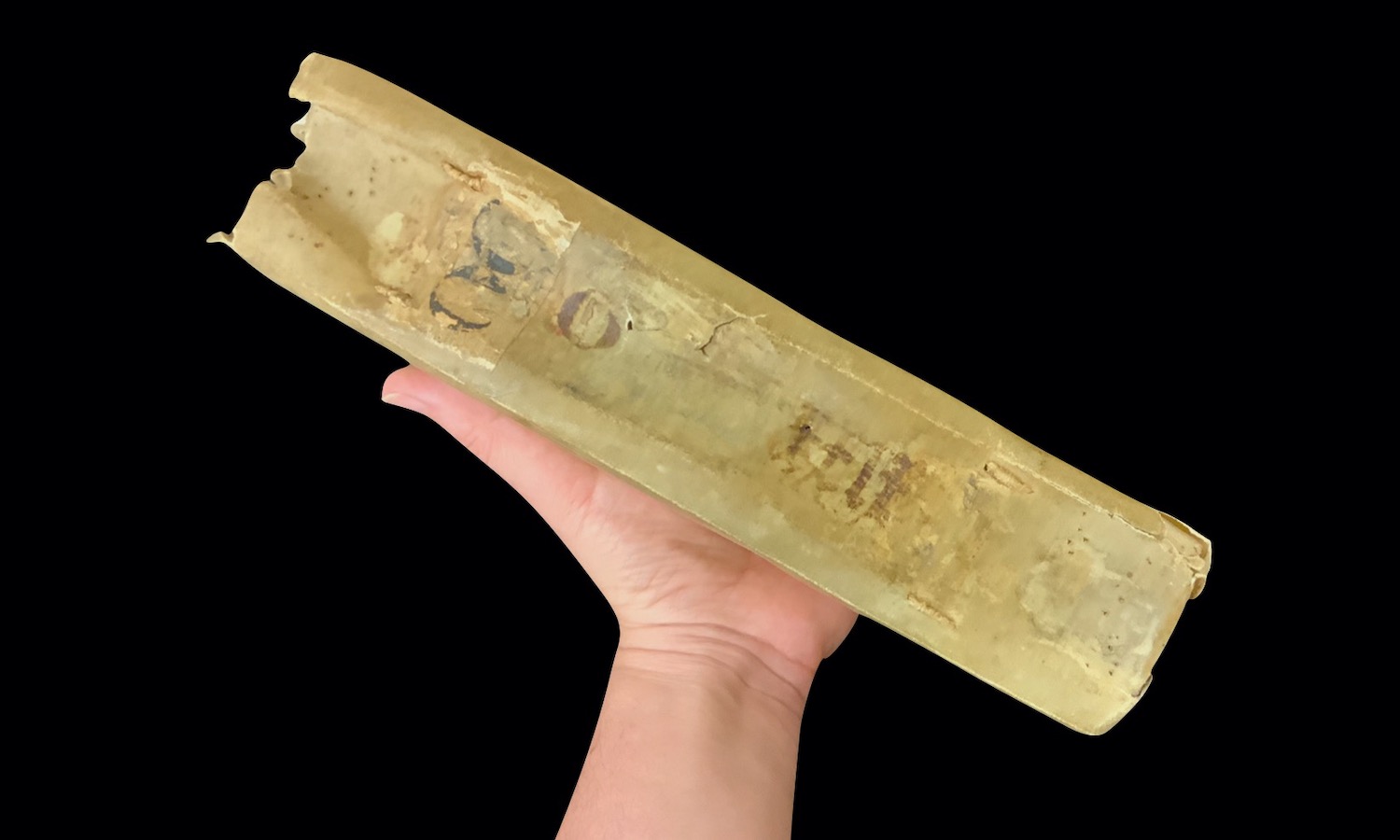
Although no medieval catalogs of the library of the Charterhouse of St Barbara with these shelfmarks survive, there are other manuscripts from the library with them. There are also several documents that detail the contents of the library from the seventeenth and eighteenth centuries, most of which have been preserved in the Historical Archive of the City of Cologne. For example, a shelf list edited by Richard Bruce Marks that was compiled in the second half of the seventeenth century includes over 550 volumes of manuscripts. In this document (Cologne, Historisches Archiv der Stadt Köln, Best. 233 Kartäuser, Repertorien und Handschriften, Nr. 14), MS C91 is assigned the shelfmark “OO 89.” In the shelf list, the print books are organized according to subject matter under the letters of the alphabet (A to H; J to N), with the letter O reserved for all manuscripts. The manuscripts are divided into four groups according to their size: O for folio, OO for quarto, OOO for octavo and OOOO for duodecimo. Measuring approximately 210 x 145 mm, MS C91 has one of these labels with “OO” adhered to its spine.

Image of the label with “OO” of the library of the Charterhouse of St Barbara in Cologne adhered to the spine of the binding of MS C91
The label with “OO” of the library of the Charterhouse of St Barbara in Cologne adhered to the spine of the binding. Call # MS C91. Click image to enlarge.

Furthermore, the short description for MS C91 in the seventeenth-century shelf list comes directly from the list of contents provided in a contemporary hand on the front flyleaf of the manuscript:

Conte[n]ta libri h[uius]
Quadraginta omeli[a]e b[ea]ti Gregorii p[a]p[a]e super evangelia
Collectu[m] q[uo]dda[m] sup[er] passione[m] d[omi]ni ven[erabi]lis p[at]ris H[er]ma[n]ni Appeltorn p[ri]oris tu[n]c dom[us] T[re]veren[sis] et postea dom[us] h[uius] scriptiu[m] man[u] ipsi[us] obiit 1473
Ite[m] textus passio[n]is Chr[ist]i ex [quattuor] eva[n]gelistis eiusdem.

This book contains:
Forty homilies on the gospels of the blessed pope St Gregory,
A certain collection on the passion of our lord by the venerable father Herman Appeldorn, then the prior of the house of Trier, and afterwards of this house, written by his own hand, died 1473,
Also a text on the passion of Christ from the four evangelists, by the same [Herman Appeldorn].

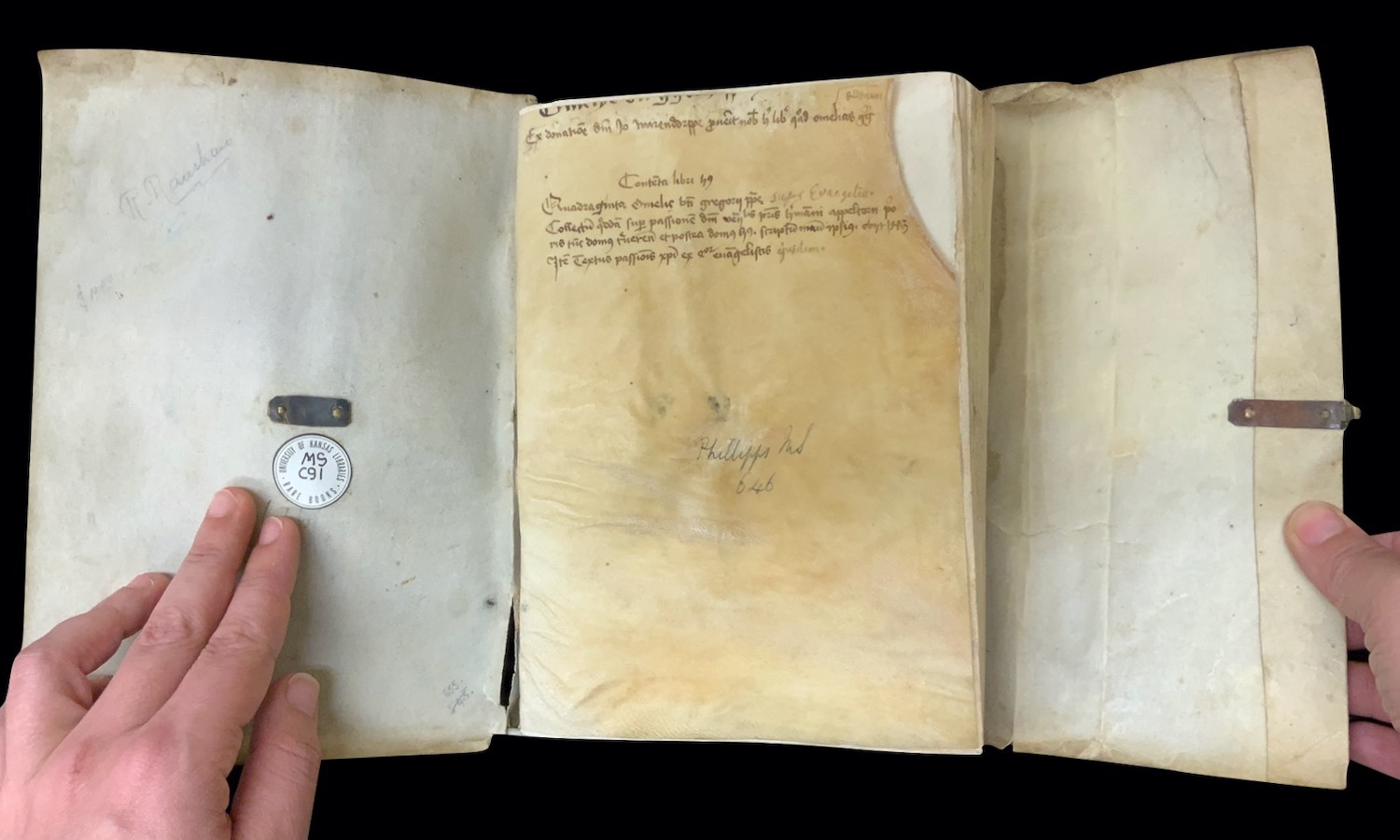
Image of the opening of the manuscript and the table of contents and the ownership inscription on the front flyleaf on MS C91
Opening of the manuscript and the table of contents and the ownership inscription on the front flyleaf. Call # MS C91. Click image to enlarge.

Above this brief table of contents on the first flyleaf of MS C91, there is also a donation inscription:

Ex donation[n]e d[omi]ni Jo[?] Warendorppe p[ro]ve[n]it nobis h[ic] lib[er] quoad Omelias Gregorii
This book, as far as Gregory’s Homilies, comes to us from the donation of Johann? Warendorppe.

Unfortunately, the identity of this donor Warendorppe is unknown; Richard Bruce Marks reports that there are eighteen people with the same name in the list of graduates from the University of Cologne before the year 1500 (p. 16). The donation inscription and the table of contents are written by the same hand, presumably around the same time the contents of the manuscript were copied. Taken together, they tell us that what is now the first part of the manuscript (Gregory’s Homilies) was commissioned by Warendorppe and that the remainder was authored and copied by Herman Appeldorn. These two parts must have been put together shortly after their copying, with the addition of the flyleaf with the donation and contents information when the manuscript was bound. There is very little known about Herman Appeldorn, although his name is recorded in other manuscripts as part of purchases and donations made to the library of the Charterhouse of St Barbara in Cologne during his priorship. He is thought to have composed three works: Sermones dominicales [Sunday Sermons], De passione domini [On the passion of Christ], and De institutione novitiorum [On the education of novices]. None of these works seem to have been published and it is possible that MS C91 contains the only copy of the De passione domini.

The recent provenance of MS C91 is quite well known. After the dissolution of the Charterhouse of St Barbara in Cologne in 1794 during the French Revolution, some of the manuscripts were sent to Paris, others to a new school founded in Cologne and the rest were sold. During these sales, some hundred and thirty-six manuscripts were acquired by the book and art dealer Johann Matthias Heberle (Antiquargeschäft mit Auktionsanstalt Cologne) and then sold in 1821 to Leander van Ess (Johann Heinrich van Ess, 1772–1847), a theologian and book collector from Warburg, Germany. MS C91 was one of these. Only a few years later, in 1824, Sir Thomas Phillipps (1792–1872) purchased the entire collection of Leander Van Ess, including those manuscripts that formerly belonged to the Charterhouse of St Barbara. In 1910, at the beginning of the twentieth century, as part of an auction of Phillipps manuscripts, MS C91 was sold by Sotheby, Wilkinson & Hodge to J. & J. Leighton, booksellers and bookbinders in London. Soon afterward, in 1912, the manuscript was purchased from J. & J. Leighton by Robert Ranshaw (1836–1924), a master draper and an art collector from Louth, Lincolnshire.

In his 1974 study, Richard Bruce Marks aimed at reconstructing the manuscript collections of the Charterhouse of St Barbara in Cologne and identified the current whereabouts of over 250 manuscripts that were included in the seventeenth-century shelf list. MS C91 was among those he was not able to locate. Indeed, Spencer Library holds two former Van Ess and Phillipps manuscripts from the library of the Charterhouse of St Barbara in Cologne, neither of which was identified by Marks: Phillipps MS 642 (now MS C64) and Phillipps MS 646 (now MS C91). Both of these manuscripts can now be added to the list.

The Kenneth Spencer Research Library purchased the manuscript from Internationaal Antiquariaat (Menno Hertzberger & Co.) in September 1960, and it is available for consultation at the Library’s Marilyn Stokstad Reading Room when the library is open.

  • The most comprehensive study in English on the Library of the Charterhouse of St Barbara in Cologne: Richard Bruce Marks. The Medieval Manuscript Library of the Charterhouse of St. Barbara in Cologne. 2 vols. Analecta Cartusiana 21. Salzburg: Institut für Englische Sprache und Literatur, Universität Salzburg, 1974.
  • Other blog posts from the “Manuscript of the Month” series on former Sir Thomas Phillips manuscripts at the Kenneth Spencer Research Library: https://blogs.lib.ku.edu/spencer/tag/sir-thomas-phillipps/

N. Kıvılcım Yavuz
Ann Hyde Postdoctoral Researcher

Follow the account “Manuscripts &c.” on Twitter and Instagram for postings about manuscripts from the Kenneth Spencer Research Library.

Manuscript of the Month: Signs in the Margins and Between the Lines

May 26th, 2021

N. Kıvılcım Yavuz is conducting research on pre-1600 manuscripts at the Kenneth Spencer Research Library. Each month she will be writing about a manuscript she has worked with and the current KU Library catalog records will be updated in accordance with her findings.

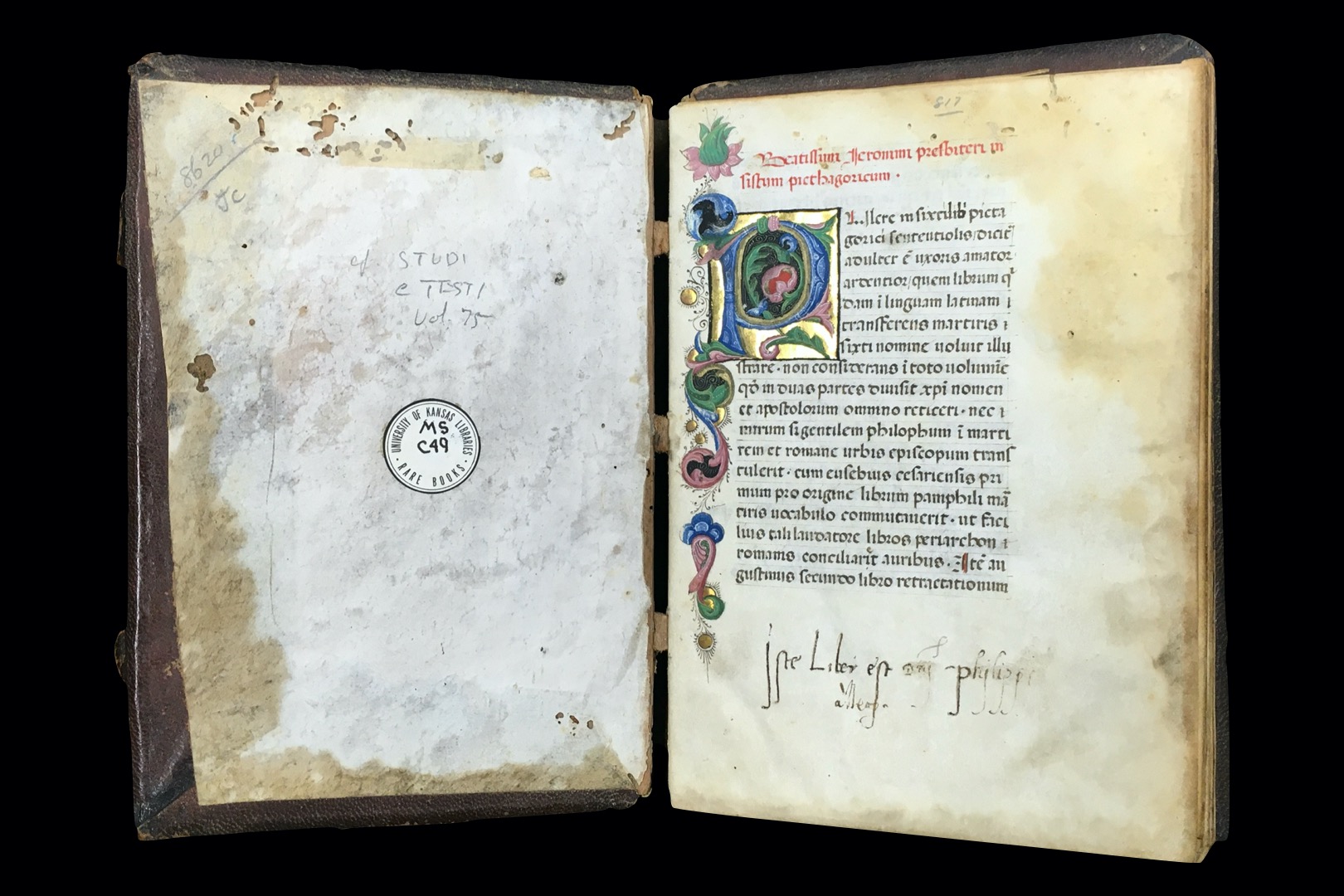
Kenneth Spencer Research Library MS C49 contains copies of two works which were originally composed a millennium apart: the translation of Sextus Pythagoreus’s Sententiae from Greek into Latin by Rufinus of Aquileia (345–410) and the Enchiridion by Laurentius Pisanus (approximately 1391–1465). Both works are collections of sayings, usually of moral nature, and the genre of sententiae (i.e., sentences) goes back to the classical times. Considering its age, MS C49 is in relatively good condition despite heavy water damage that caused discoloration of parchment on the upper part of the manuscript towards the fore-edge. The manuscript was copied by a single scribe, probably in the third quarter of the fifteenth century in Italy, and it probably is still in its original binding. We do not have any information on the exact origin or the history of the manuscript, except for an unidentified ownership inscription in the lower margin on folio 1r, which indicates that the manuscript once belonged to a Philippus (“Iste liber est d[omi]ni Philippi […]”: This book belongs to master Philippus […].)

In addition to this ownership inscription, there is a series of other writings and markings in MS C49, especially in the margins of the first part of the manuscript which contains the Sententiae. Originally written in Greek in the late second or early third century, the Sententiae by Sextus Pythagoreus includes about 500 sayings. The Latin translation by Rufinus of Aquileia in the late fourth or early fifth century, which includes 451 of these sayings, is mostly literal, although there are alterations to the text as with any late antique or medieval translation. In MS C49, the text opens with an extended version of Rufinus’s preface, and even though the sayings are copied as if they were a prose text and not numbered, they can be easily identified as each saying begins with a capital letter highlighted in red.

Image of the opening of the manuscript and the unidentified ownership inscription on folio 1r of Sextus Pythagoreus, Sententiae translated by Rufinus of Aquileia, and Laurentius Pisanus, Enchiridion. Italy (?), third quarter of the fifteenth century (?). Call # MS C49.
Opening of the manuscript and the unidentified ownership inscription on folio 1r. Sextus Pythagoreus, Sententiae, translated by Rufinus of Aquileia, and Laurentius Pisanus, Enchiridion. Italy (?), third quarter of the fifteenth century (?). Call # MS C49. Click image to enlarge, and see the Digital Scriptorium for additional images from this manuscript.

All text and marks in the margins of a manuscript are collectively called marginalia. There can be several reasons for marginalia in a manuscript; some are left by the scribes of the manuscripts and others by the readers or later owners of the manuscripts, such as the ownership inscription on folio 1r. After the copying of a text in a manuscript, for example, often scribes or others working with them would check the copy against the exemplar, the manuscript from which the copy was made. This was to ensure that the copy of the text was correct and complete, similar to modern proofreading and copyediting practices. Sometimes, they would also check the copy they had against another copy of the same text, especially if they thought what was copied was not reliable or there was lacuna in the exemplar. During both of these processes, if they encountered a missing word or a phrase, or a discrepancy, they would note this down, usually in the margins of the manuscript and sometimes in between the lines. Interventions and alterations of any kind to the main text frequently also included the use of different types of signs. Centuries later, similar practices are still in place today in the academic and publishing worlds. See, for example, the Proofreader’s Marks provided by the Chicago Manual of Style. It is possible to discern how this methodology works even when the copyediting or proofreading is done electronically, for example, via Microsoft Word Track Changes or Adobe Acrobat Comments.

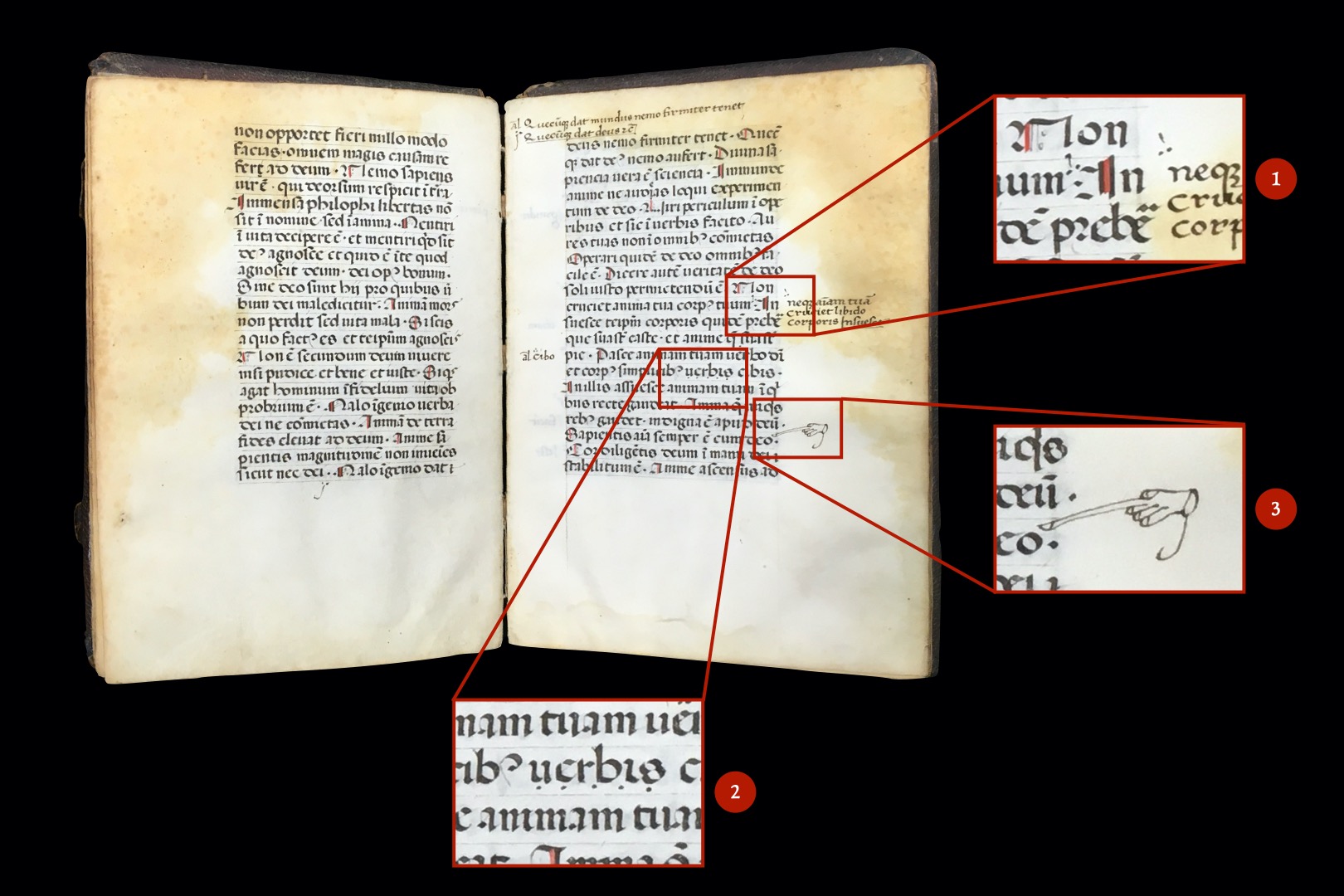
Image with enlarged pop-outs showing three examples of marginal and interlinear interventions on folios 16v-17r of MS C49.
Examples of marginal and interlinear interventions on folios 16v-17r. Call # MS C49. Click image to enlarge.

In the case of MS C49, most of the marginal and interlinear additions and corrections seem to have been made by the same hand, either the scribe who copied the text or a contemporary who could have been another scribe, an editor or a reader. Since this second hand mostly adds corrections to the main text, we can be fairly certain that they were checking the copied text against the exemplar. Here are three examples of interventions from folio 17v:

In the first case, the text is corrected by adding a missing sentence in the outer margin. This usually happens when the scribe originally skips a word, a phrase or a sentence and later notices that they made a mistake. Instead of copying the entire page again, which would be costly and time consuming, they make a note of the missing passage. In order to ensure that the additional text is inserted into the right place, the place where the insertion needs to be made in the main text is first marked with a sign and later a corresponding sign is placed together with the additional text in the margin. In this case, the sign employed in MS C49 looks like an exclamation mark with two dots. These types of signs are called signe-de-renvoi (i.e., “sign of return”) or tie marks. They are used in pairs and link the main text to a marginal annotation.

In the second example, on line 15 of folio 17r, the word “verbis” has a series of dots underneath. In this case, it seems that the scribe made another mistake by copying a word that is not part of the text. In these cases, again, instead of copying the entire page, they signaled a deletion of the extraneous word or phrase. There are differing practices to indicate a deletion in medieval and early modern manuscripts, depending on the scribe and where and when a manuscript is copied. What is used here is an omission technique called subpuncting or underdotting, in which a series of dots are placed under the letter or the word that is to be omitted from reading. Today, one usually crosses out a passage or a word when there is a mistake. Nevertheless, this medieval practice is thought to have given way to the modern ellipsis, which indicates omitted words in a text.

The sign seen in the third example has a slightly different use; it is not a direct intervention to the text. Instead, it is utilized to mark an important passage. The symbol in the shape of a pointing hand is called a manicule (from the Latin word manicula, meaning “little hand”), and it is found in the margins of medieval manuscripts and later on in printed books to draw attention to a section of a text. There are over two dozen manicules in MS C49. If this pointing hand sign seems familiar, it is because it is the same symbol that one sees when one moves their pointer over a hyperlink today!

The Kenneth Spencer Research Library purchased the manuscript from Charles S. Boesen in February 1959, and it is available for consultation at the Library’s Marilyn Stokstad Reading Room when the library is open.

N. Kıvılcım Yavuz
Ann Hyde Postdoctoral Researcher

Follow the account “Manuscripts &c.” on Twitter and Instagram for postings about manuscripts from the Kenneth Spencer Research Library.

Collection Snapshot(s): Marcas de fuego

May 11th, 2021
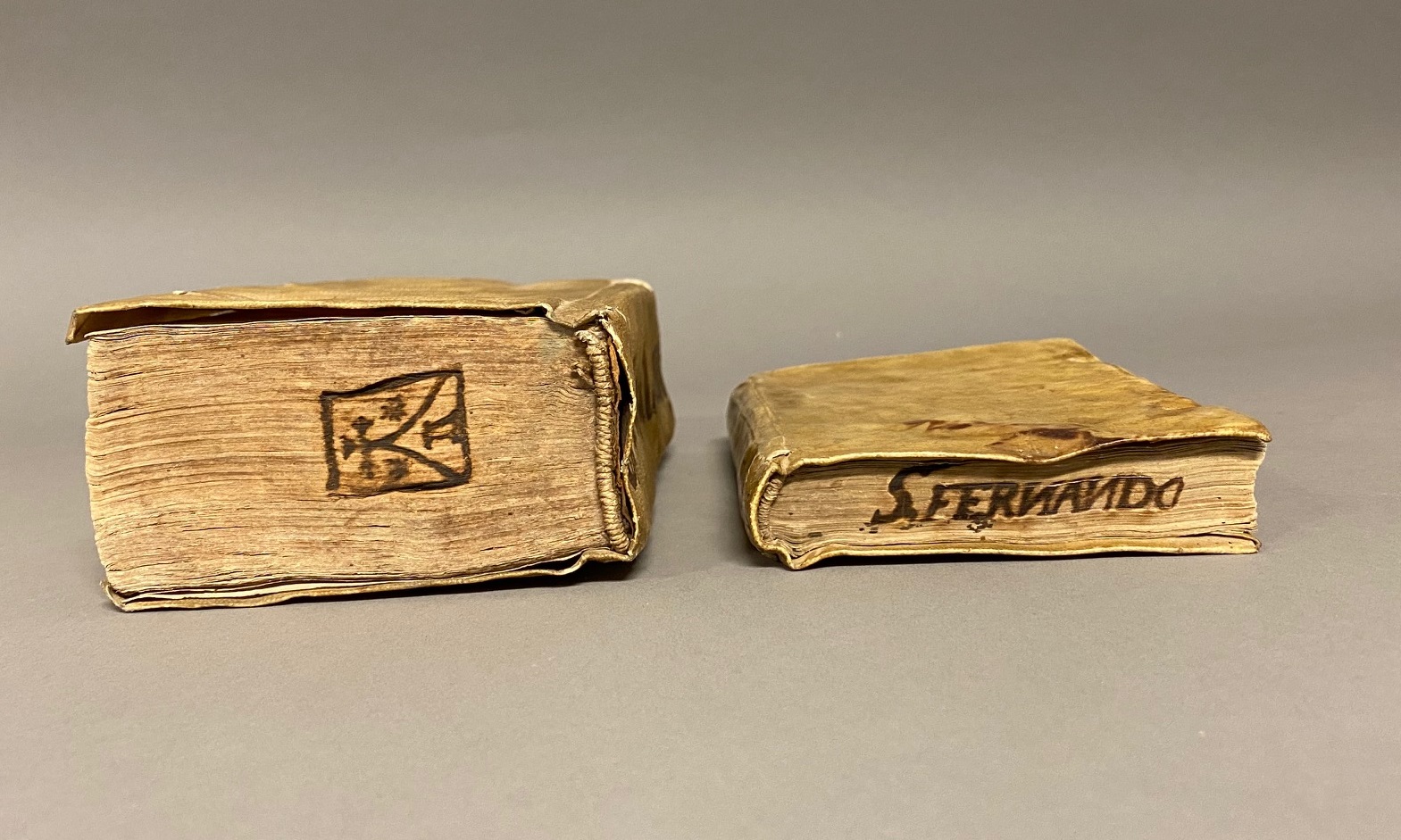
Marcas de Fuego on Part 1 (right) and Part 2 (left) of Spencer Research Library's copies of Fray Juan Bautista'sAdvertencias para los confesores de los naturales (1600-1601)
Marcas de fuego on Part 1 (right) and Part 2 (left) of Spencer Research Library’s copies of Advertencias para los confesores de los naturales by Fray Juan Bautista. Mexico: Por M. Ocharte, año 1600 (Parte 1); Excudebat Ludovicus Ocharte Figueroa, 1601 (Parte 2). Call Number #: B620.

Today we share two examples of “marcas de fuego” from Spencer Research Library’s collections. In colonial Mexico, “marcas de fuego” (that is, “marks of fire” or fire brands) identified a book as belonging to a particular religious order or institution. This identifying emblem (or sometimes a set of stylized initials or a name) would be burned into the edge of the text block of a book using a hot metal instrument.  The scholars and librarians associated with the Catálogo Colectivo de Marcas de Fuego (Collective catalog of fire brands) date this practice from the second half of the 16th century into the first decades of the 19th century.

The marcas de fuego shown above appear on the top edges of the two parts of Spencer Research Library’s copy of Fray Juan Bautista’s Advertencias para los confesores de los naturales. Printed in Mexico City in 1600 (Parte 1) and 1601 (Parte 2), Bautista’s Advertencias was a manual offering guidance for priests taking the confessions of the indigenous peoples of “New Spain.” Printing came to the Americas in 1539 when Juan Pablos established a printing press in Mexico City. Bautista’s text is included in that first group of editions (roughly 220 in Mexico City and 20 in Lima, Peru) printed in the Americas prior to 1601. These are sometimes known in Spanish as “Incunable Americano,” after the practice of calling books printed in Europe prior to 1501—the “cradle stage” of printing—incunabula.

Interestingly, although Spencer Research Library acquired the two parts of Bautista’s Advertencias together from the California-based bookseller Zeitlin & Ver Brugge, their marcas de fuego suggest that the two separate volumes haven’t always resided together.  Using the enormously helpful Catálogo Colectivo de Marcas de Fuego, we’ve been able to identify the fire brand that appears on each of the two volumes. 

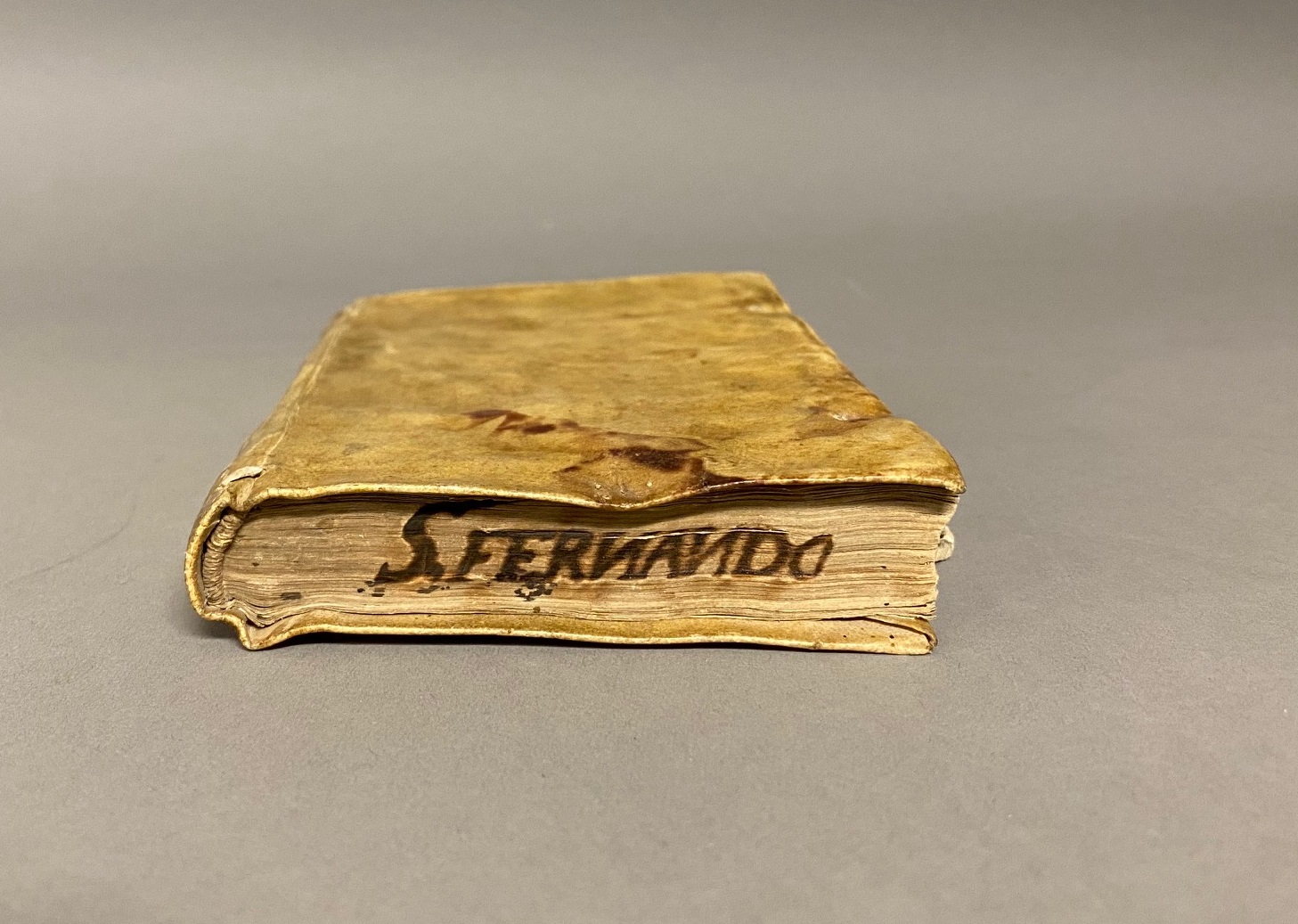
Marca de Fuego of the Colegio de San Fernando on the text block Juan Bautista's Advertencias para los confesores de los naturales, Parte 1 (1600), Kenneth Spencer Research Library Call Number: B620.
Marca de fuego of the Colegio de San Fernando at the top (head) of the text block of Juan Bautista’s Advertencias para los confesores de los naturales, Parte 1 (1600). Call Number #: B620.

The marca de fuego that appears on “Parte 1” is that of the Colegio de San Fernando in Mexico City (see this entry in the Catálogo Colectivo for comparison). We’ll admit that this marca is among the more self-evident! The Colegio de San Fernando was founded in the 1730s as a Franciscan missionary college or seminary.  Since one of its primary purposes was to train priests for conducting missionary work with indigenous peoples, it’s not surprising to see a copy of Bautista’s Advertencias with the marca de fuego of the Colegio de San Fernando.

Marca de Fuego of the Convento del Carmen (Atlixco, Puebla) on the text block Juan Bautista's Advertencias para los confesores de los naturales, Parte 2 (1601), Kenneth Spencer Research Library Call Number: B620
Marca de fuego of the Convento del Carmen (Atlixco, Puebla) at the top (head) of the text block of Juan Bautista’s Advertencias para los confesores de los naturales, Parte 2 (1601). Call Number #: B620.

The marca de fuego on “Parte 2” appears to be that of the Convento del Carmen in Atlixco, Puebla (see this entry for comparison).  The term “Covento” in the Spanish colonial context refers to complex or facility used by a religious order, without the strong connotation of a female order present in the English term “convent.” Founded by the Carmelites, the Convento and the associated church were built the during the first two decades of the 1600s. The marca contains several elements of the Carmelite shield (the cross, the mount, and two of its characteristic three stars), and, as the Catálogo Colectivo entry for the marca notes, the initial “A” at the bottom of the marca might be an abbreviation for Atlixco. The “Convento” was dissolved in the mid 19th century and its belongings sold, but the much of the building structure still stands (with a more modern façade), though it did sustain damage in the 2017 earthquake that hit the region.

The Catálogo Colectivo de Marcas de Fuego is a fascinating resource for researching provenance and the movement of books in colonial Mexico and beyond.  In order to encourage you to explore it (and marcas de fuego more generally) we share one final “snapshot” from Spencer’s collections — a photograph that we use on the page of our website that discusses Spencer’s Renaissance and  Early Modern Imprints.  Unlike the Advertenicas which was printed in Mexico City, the six volume Complutensian Polyglot Bible was printed in Spain under the patronage of Cardinal Francisco Ximenes de Cisneros in 1514-17, as noted in the volume (though actually, 1520/1521). However, at some point in the decades and centuries following its publication, Spencer’s copy travelled to “New Spain” and received its marcas de fuego.  Can you identify whose heart-shaped brand this is?  Take a look through the Catálogo Colectivo de Marcas de Fuego and then highlight the text in the square brackets to confirm your identification: [Convento de san Agustín (Puebla, Puebla), see for example the variations on the brand BJML-1005.]

Marcas de fuego from the Convento de san Agustín (Puebla, Puebla) on Spencer Research Library's copy of Biblia polyglotta.  Alcala de Henares: in Complutensi universitate, industria Arnaldi Gulielmi de Brocario, 1514-1517 [i.e. 1520 or 1521]. Call # Summerfield G41.
Marcas de fuego of [Convento de san Agustín (Puebla, Puebla)] on Spencer Research Library’s copy of Biblia polyglotta. Alcala de Henares: in Complutensi universitate, industria Arnaldi Gulielmi de Brocario, 1514-1517 [i.e., 1520 or 1521]. Call #: Summerfield G41. (Highlight the text in brackets to reveal the source of the brand).

Both parts of Spencer’s copy of Advertencias para los confesores de los naturales by Fray Juan Bautista have been digitized and are available online (Images 1-370 are “Parte 1” and the binding of “Parte 2” begins at Image 371). You’ll also find a digitized copy of Spencer’s other “Mexican Incunable”– the 1571 edition of Alonso de Monlina Vocabulario en lengua Castellana y Mexicana (Call #: D214), a Nahuatl-Spanish dictionary–in our digital collections. To read more about both of these volumes, visit the online version of Spencer’s 2016 exhibition In the Shadow of Cortés: From Veracruz to Mexico City, where Caitlin Klepper discusses them in the section headed “The Colonization of This Land.”

  • This blog post was originally intended to post in November 2020, but was postponed due to a time-sensitive post. Since then, a colleague at another university, Michael Taylor, has written a fascinating and more detailed post on marcas de fuego for the blog of the Book Club of Washington. Take a read to dive even further into the history and nature of these bibliographic firebrands.

Elspeth Healey
Special Collections Librarian

Manuscript of the Month: Tracking the Two-Hundred-Year Ownership Trail of a Fifteenth-Century Manuscript

April 28th, 2021

N. Kıvılcım Yavuz is conducting research on pre-1600 manuscripts at the Kenneth Spencer Research Library. Each month she will be writing about a manuscript she has worked with and the current KU Library catalog records will be updated in accordance with her findings.

Kenneth Spencer Research Library MS D2 is a fifteenth-century paper manuscript that contains the Epigrams of Martial (Marcus Valerius Martialis, approximately 40 CE–approximately 104 CE). Originally written to celebrate the opening of the Colosseum in the year 80 CE, the Epigrams are a series of short, satirical poems reflecting different aspects of Roman life. In this manuscript the Epigrams are prefaced by a letter written by Martial’s contemporary and friend, Pliny the Younger (61/62 CE–114 CE), to another friend, Cornelius Priscus, on the occasion of Pliny hearing of Martial’s death. According to a colophon found at the end of the text, MS D2 was copied by Jacopo Tiraboschi of Bergamo and was completed on October 19, 1470, probably somewhere in Italy.

Image showing the colophon in MS D2 on folio 184v, in which the scribe mentions their name (“Iacobus Tirabuschus B[er]gomensis”) and the date of the completion of the copying of the manuscript (“MoccccoLxxo die decimo nono Octobris”) in Martial, Epigrams, Italy (?), October 19, 1470. Call # MS D2.
The colophon in MS D2 on folio 184v, in which the scribe mentions their name (“Iacobus Tirabuschus B[er]gomensis”) and the date of the completion of the copying of the manuscript (“MoccccoLxxo die decimo nono Octobris”). Martial, Epigrams, Italy (?), October 19, 1470. Call # MS D2. Click image to enlarge. See the Digital Scriptorium record for MS D2 for additional metadata and images.

We do not know any other details about the circumstances in which MS D2 was copied nor do we have any information on the whereabouts of the manuscript during the three or so centuries after its completion. The history of MS D2 in the past two centuries, however, is rather exciting and can be reconstructed, especially by consulting modern sale and auction catalogs of manuscripts. Provenance (previous ownership) of manuscripts is an important branch of historical bibliography that has gained more and more prominence in the past few decades. The bedside book for provenance researchers, beginners and experts alike, is David Pearson’s Provenance Research in Book History: A Handbook, which was recently published in a revised edition. The most important resource for those interested in the history of any pre-1600 manuscript, moreover, is the Schoenberg Database of Manuscripts, an ongoing, community-driven project to track the historic and current locations of manuscript books across time and place. Initiated by Lawrence J. Schoenberg in 1997, the database is currently managed by the Schoenberg Institute of Manuscripts at the University of Pennsylvania Libraries under the direction of Lynn Ransom.

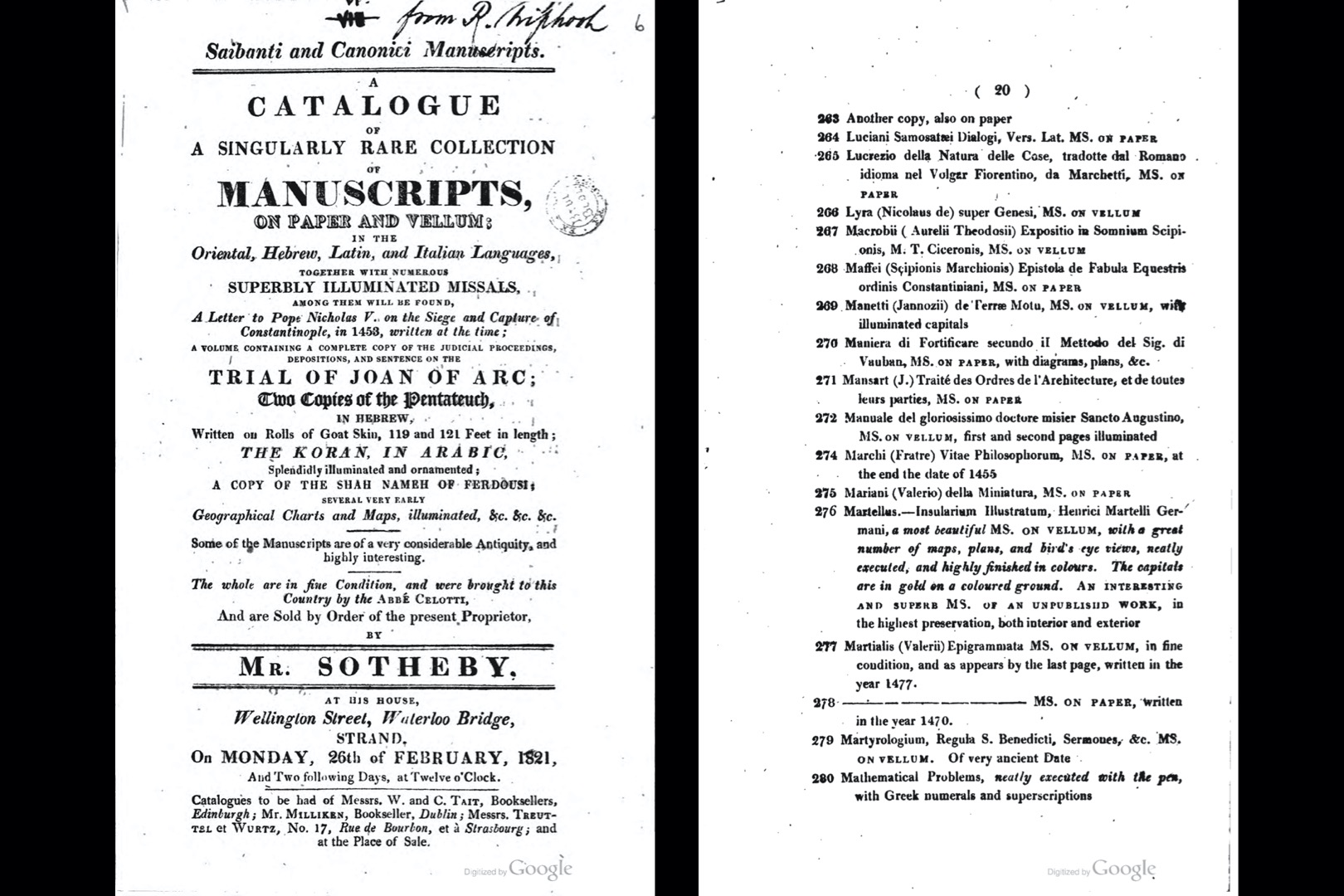
The first trackable mention of MS D2 comes from a Sotheby’s auction catalog dated to February 26, 1821. The long title of the auction catalog indicates that this “singularly rare collection of manuscripts” previously belonged to “Saibanti and Canonici” and that the manuscripts were “brought to this country [the United Kingdom] by the Abbe Celotti.” Abbé Luigi Celotti (1759–1843) was a Venetian abbot who later became a book dealer and this three-day 1821 auction, which included 542 items, was one of his earliest and most important sales. There is no indication in the catalog as to which manuscripts originate from the collection of Matteo Luigi Canonici (1727-1805) or from that of Giovanni Saibante of Verona (flourished first half of the eighteenth century). Both Canonici and Saibante were Italian book collectors and several of their manuscripts were either auctioned off in Britain or purchased by British collectors in the nineteenth century. Based on the name of its scribe and its Humanistic script, it is very likely that MS D2 was originally produced somewhere in Italy and it almost certainly did not leave Italy until it was put to sale by Celotti through Sotheby’s in this 1821 auction.

Image from Google Books showing the title page of the 1821 Sotheby’s auction catalog (left) and the catalog entry no. 278 that corresponds to MS D2 (right).
The title page of the 1821 Sotheby’s auction catalog (left) and the catalog entry no. 278 that corresponds to MS D2 (right). Source: Google Books.

Following the 1821 auction in London, the manuscript is listed in the inventories of a number of booksellers and appears to have entered into the collections of a series of prominent British book collectors. The next mention of MS D2 is found in the 1836 auction catalogue of the manuscripts that previously belonged to Richard Heber (1773–1833), an English book collector. Heber presumably purchased the manuscript from Celotti at the 1821 Sotheby’s auction. In the 1836 auction of Heber’s manuscripts, MS D2 was purchased by Thomas Thorpe (1791–1851), a well-known bookseller in London from the 1820s until his death. In fact, MS D2 bears an inscription on folio 186v that reads “Thomas Thorpe.” Immediately after, however, during the same year, the manuscript was purchased from Thomas Thorpe by Sir Thomas Phillipps (1792–1872), who had Payne & Foss, another London-based bookseller, purchase several other manuscripts from the 1836 auction of Heber’s collection. I have previously written about one of those manuscripts, now with the shelfmark MS C247, which is also part of the collections of the Kenneth Spencer Research Library. Indeed, there are over a hundred manuscripts from the former Phillipps collection currently housed at Spencer Research Library.

Image of the Spine of MS D2 with remnants of a rectangular Phillipps label
Spine of MS D2 with remnants of a rectangular Phillipps label. Click image to enlarge.

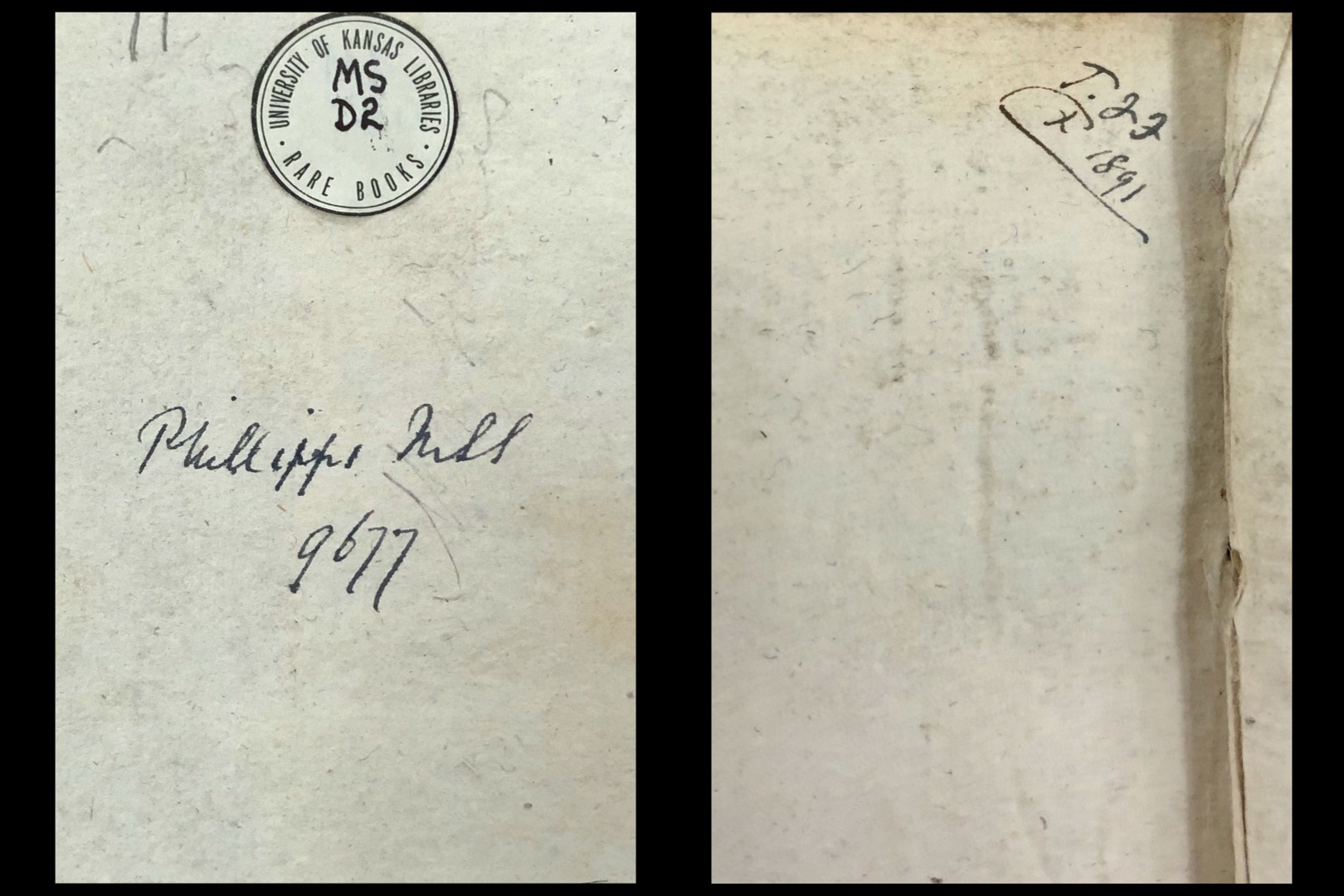
With an estimated forty thousand printed books and sixty thousand manuscripts, Sir Thomas Phillipps had the largest private manuscript collection in the world at the time. MS D2 is inscribed “Phillipps MSS 9677” in ink on the front pastedown and there are remnants of a rectangular Phillipps label with a typeset number, with only “96” remaining, adhered to the tail of the spine. The Phillipps numbers, both in the form of a paper label adhered to the spine of the bindings and as handwritten notes, usually on the first couple of leaves of manuscripts, are one of the identifying features of manuscripts that once belonged to Sir Thomas Phillipps. MS D2 has a modern binding but the fact that there is a Phillipps label on the spine suggests that the medieval manuscript was already rebound with its current, modern binding when this manuscript was being accessioned into the Phillipps collection. There is a binder’s ink stamp belonging to John P. Gray & Son Ltd., a bookbinder based in Cambridge, in the lower left corner of the back pastedown. However, there is no date associated with this stamp and it is likely that this was the result of a repair undertaken rather than a full rebinding of the manuscript.

Image showing the Number given by Sir Thomas Phillipps on the front pastedown (left) and initials of Thomas FitzRoy Fenwick on the verso of the end flyleaf (right) of MS D2.
Number given by Sir Thomas Phillipps on the front pastedown (left) and initials of Thomas FitzRoy Fenwick on the verso of the back flyleaf (right) of MS D2. Click image to enlarge.

After his death, Phillipps’s library was inherited by Katharine Fenwick, his daughter, and was later passed on to Thomas FitzRoy Fenwick (1856–1938), his grandson, who oversaw the sales of the Phillipps collection over several decades. We know that Fenwick examined MS D2 in 1891 as his initials are found in the upper left corner of the verso of the back flyleaf: “T.FF 1891.” Within a few years of this inscription, the manuscript was sold by Fenwick at a Sotheby, Wilkinson & Hodge sale in 1895, during which it seems to have been purchased by Harold Baillie-Weaver (1860–1926), a British barrister and a book collector. Only three years later, in March 1898, the manuscript was purchased by Bernard Quaritch (1819–1899) during the sale of the collection of Baillie-Weaver by Christie, Manson & Woods. Bernard Quaritch was both a book collector and a bookseller, also based in London. In the late nineteenth-century, Quaritch had become one of the biggest traders in antiquarian books and manuscripts in the world. After his death, his bookselling business was continued by his son, Bernard Alfred Quaritch (1871–1913), and the company he founded still survives today as Bernard Quaritch Ltd, owned by John Koh.

MS D2 later appears in two of Quaritch’s sale catalogs, first immediately after its purchase in 1898 (Catalog no. 180, item no. 40) and then in 1902 (Catalog no. 211, item no. 153). The manuscript seems to have been purchased in 1902 by Sir Thomas Gibson-Carmichael (1859–1926), only to be sold a year later in a Sotheby, Wilkinson & Hodge sale of his collection. Gibson-Carmichael was a Scottish politician who held governorships in the British Empire. Since the manuscript reappears in a sale catalog of Quaritch in 1905, we can only assume that the younger Quaritch purchased the manuscript back during the 1903 Sotheby, Wilkinson & Hodge sale. However, only two years later, in 1907, MS D2 is again listed by Sotheby, Wilkinson & Hodge and this time it is sold to another bookseller, Francis Edwards Ltd, who listed the manuscript in their catalog in 1909. Established in 1855, also in London, Francis Edwards is another bookseller who continues to operate today.

The history of this fifteenth-century manuscript is a testament to the lively book trade business centered around London in the nineteenth century. After changing several hands, appearing in at least ten sale catalogs and briefly entering collections of famous British collectors in less than a century, the ownership trail of MS D2 goes cold for some twenty years following its appearance in the 1909 Francis Edwards catalog. We do not know whether the manuscript was sold at that time, and if it was to whom. The ongoing “Cultural Values and the International Trade in Medieval European Manuscripts, c. 1900-1945” project led by Laura Cleaver might provide us further clues in the future as to the whereabouts of the manuscript in the early decades of the twentieth century. About two decades later, in 1930, MS D2 is listed for sale by E. P. Goldschmidt & Co., which was founded by E. P. Goldschmidt (1887–1954), a scholar and a bookseller, also based in London. Whether the manuscript was sold in 1930 is also unclear. It is listed again by E. P. Goldschmidt & Co. in 1955, just after Goldschmidt’s death and it is possible that it remained in the inventory of the bookseller for twenty-five years when it was purchased in 1956 by the University of Kansas. Since then, for the past 65 years MS D2 has had its longest stay in its recent history in the same collection. You can track the history of MS D2 yourselves, examine the open access records of different sales and catalogs, and contribute to the history of the manuscript through the Schoenberg Database of Manuscripts.

The Kenneth Spencer Research Library purchased the manuscript from E. P. Goldschmidt & Co. in May 1956 and it is available for consultation at the Library’s Marilyn Stokstad Reading Room when the library is open.

For the texts in this manuscript, see:

    • Martial. Epigrams. Edited and translated by D. R. Shackleton Bailey. 3 vols. Loeb Classical Library 94, 95, 480. Cambridge, MA: Harvard University Press, 1993. [KU Libraries]
    • Pliny the Younger. Letters. Translated by Betty Radice. 2 vols. Loeb Classical Library 55, 59. Cambridge, MA: Harvard University Press, 1969. [KU Libraries]

For introduction to provenance research, see:

N. Kıvılcım Yavuz
Ann Hyde Postdoctoral Researcher
Follow the account “Manuscripts &c.” on Twitter and Instagram for postings about manuscripts from the Kenneth Spencer Research Library.

Manuscript of the Month: An Early Fragment of the Old French Bible?

March 31st, 2021

N. Kıvılcım Yavuz is conducting research on pre-1600 manuscripts at the Kenneth Spencer Research Library. Each month she will be writing about a manuscript she has worked with and the current KU Library catalog records will be updated in accordance with her findings. 

Kenneth Spencer Research Library MS D40 consists of two gatherings that contain parts of the Gospel of Matthew in French. The first gathering is made up of a bifolium, possibly missing six leaves, whereas the second gathering seems to be more or less intact, with all eight leaves still surviving. We have no information on the history of MS D40, but it is clear from its current state that these leaves were once used as part of a binding of another book. The outer edges and corners of several of the leaves are cut off in different shapes and a number of the leaves, which are also very worn, are soiled.

When MS D40 was purchased by the University of Kansas in 1964, the fragmentary manuscript was dated by the bookseller to “ca. 1425.” Over the years, the librarians at Spencer revised this dating first to sometime in the 1300s, then to around 1400, then to around 1400 or earlier, and finally to 1385-1399. Still, Ann Hyde, the former manuscripts librarian at Spencer, noted in her unpublished in-house description of the manuscript, “Why not earlier?” Since its purchase, MS D40 has been examined by a series of researchers at the University of Kansas and has been used for different classes; however, as far as I am aware, no one has published any study of it. I should also mention, there are over 240 known translations of the Bible into French from the tenth century to 1450 (Sneddon, p. 251).

At the time of its purchase, MS D40 was accompanied by photostats of Paris, Bibliothèque nationale de France, Français 899. These belonged to the previous owner of the manuscript, who remains unknown to us. Dated to around 1260, Paris, Bibliothèque nationale de France, Français 899 is considered to be the earliest surviving copy of the Old French Bible. Known as the Bible française du XIIIe siècle, the Old French Bible is the first (full) prose translation of the Bible from Latin into French and is thought to have been undertaken sometime after 1220 and before the Paris manuscript was produced in around 1260. It is also the first complete vernacular Bible translation in Western Europe.

As it stands, MS D40 contains the Gospel of Matthew, chapters 2:16-4:25, 9:22-10:28 and 12:1-21:35. There is no indication in our records at Spencer Library as to whether Ann Hyde or any of the researchers who studied the manuscript ever compared it to the version of the text in the Paris manuscript. After careful examination, I found that the passages in MS D40 correspond very closely to the copy of the Old French Bible found in Paris, Bibliothèque nationale de France, français 899, folios 271vb-272vb; 276ra-276vb and 277vb-288va. Thus, this manuscript could be not any French vernacular Bible but a hitherto unknown fragment of the Old French Bible. Not only that, there are reasons to suspect that it might be dated earlier, to the thirteenth century.

Image in which of the ghost of another book is almost visible in MS D40, folios 1v-2r. Bible Fragment, northern France (?), second half of thirteenth century (?). Call # MS D40.
The ghost of another book is almost visible in MS D40, folios 1v-2r. Bible. French (Gospels), incomplete, northern France (?), second half of thirteenth century (?). Call # MS D40. Click image to enlarge.
Image showing Chapters 17 and 18 of the Gospel of Matthew in MS D40, folios 7v-8r.
Chapters 17 and 18 of the Gospel of Matthew in MS D40, folios 7v-8r. Click image to enlarge.
Image of Chapters 17 and 18 of the Gospel of Matthew in Paris, Bibliothèque nationale de France, Français 899, folios 282v-282r.
Chapters 17 and 18 of the Gospel of Matthew in Paris, Bibliothèque nationale de France, Français 899, folios 282v-282r. Source: Gallica. Click image to enlarge.

Indeed, not only is the text in MS D40 very close to that of Paris, Bibliothèque nationale de France, Français 899, but also the illumination program in both manuscripts is very similar. The beginnings of chapters 2, 3, 10, 12-21 of the Gospel of Matthew are present in MS D40. All chapters open with two- to three-line alternately red and blue initials with penwork in the opposite color as well as chapter numbers in Roman numerals preceded with a pilcrow (paragraph mark), also in red and blue. The manuscript also has running titles in red and blue (MA | TE to indicate Matthew) in upper margins. What I identify as the blue color in MS D40 is almost completely faded in all of the leaves, now visible to the naked eye as pale gray. Similar initials with penwork, chapter numbers in Roman numerals and running titles, all of which are also in two alternating colors, are present in Paris, Bibliothèque nationale de France, Français 899.

According to Clive R. Sneddon, the Old French Bible survives in some 20 witnesses. The oldest Paris manuscript is incomplete and mutilated, with almost all of its illuminations, which were at the beginnings of books, having been excised and removed. More complete copies include New York, The Morgan Library and Museum, MS M.494; Chantilly, Bibliothèque et archives du musée Condé, 4 and Chantilly, Bibliothèque et archives du musée Condé, 5 (two volumes); London, British Library, Harley 616 and London, British Library, Yates Thompson 9 (two volumes). All dated to the last quarter of the thirteenth century, these three copies of the Bible seem more similar to each other than they are to Paris, Bibliothèque nationale de France, Français 899, especially in terms of their decoration programs. There are also several fragmentary manuscripts, some of which are seemingly related to the Paris manuscript. Some of these fragments are repurposed manuscripts as well, and they are still in situ, such as leaves from a fourteenth-century manuscript that now form the front flyleaves of Oxford, Bodleian Library, 4o I 1 Th. Seld.

Image of Detail from MS D40, folio 10v., showing Gothica textualis libraria script in MS D40, Bible fragment (Gospels), incomplete, northern France (?), second half of thirteenth century (?).
Detail from MS D40, folio 10v. Click image to enlarge.

MS D40 is written in Gothic script. Although the Gothic script has been surveyed extensively, the focus has been mostly on manuscripts written in Latin. As Marie-Hélène Tesnière points out “the [thirteenth-century] script in [French] vernacular manuscripts has to date not been the object of a palaeographical study” (p. 334). My understanding is that the vernacular script was less formal, smaller and closer to Praegothica, a blanket term used to describe transitional scripts between Carolingian script and Gothic script during the twelfth century. Nevertheless, the general features still apply. Albert Derolez outlines the most common features of the most common form of Gothic script known as textualis as follows: a in two compartments; f and tall s not going beneath the baseline; b, h, k, and l without loops on their ascenders. All of these features fit with the script used in MS D40 as is seen in the detail from folio 10v above. Since the script (and the layout) in our manuscript is less formal and less rigid than what would be called formata, it may be classified as Gothica textualis libraria.

Detail showing the form of the “falling d” (no. 49) as identified by Albert Derolez in The Palaeography of Gothic Manuscript Books: From the Twelfth to the Early Sixteenth Century (Cambridge: Cambridge University Press, 2003), p. 87.
The “falling d” (no. 49) as identified by Derolez. Source: Albert Derolez, The Palaeography of Gothic Manuscript Books: From the Twelfth to the Early Sixteenth Century (Cambridge: Cambridge University Press, 2003), p. 87.

It is possible to find manuscripts written in Gothica textualis libraria from the thirteenth to the fifteenth centuries. Certain characteristics of the writing, however, allow us to speculate on the date of a manuscript. I will give two such examples as to why I think MS D40 might be dated earlier, to the thirteenth century: these concern the letter a and the letter d. In her discussion of manuscripts produced in France, Tesnière states that “toward 1300, the a is made with a double bow. It will close truly into the form of a box in the fourteenth century” (p. 326). Derolez similarly maintains that “the top of the shaft of a turns over to the left in the thirteenth century, and […] the bow thus formed tends to be closed from the fourteenth century” (p. 84). In MS D40, there is only one shape of a: it is the “double-bow a,” which is in two compartments (as in the words “ma,” “sera,” “apelee” on line 2, folio 10v). As for the letter d, here is what Derolez observes: “When writing Textualis at the Currens and Libraria levels, scribes trained with the documentary tradition sometimes took advantage of the space offered by the left-hand margin to extend the shaft of the Uncial d at the beginning of the line to the left and might even start with an upward movement of the pen” (p. 87). He calls this type of d, a “falling d.” The letter d is found in two shapes in MS D40: Uncial d and this very “falling d.” Both are displayed in the first line of folio 10v, in the first word “de” and the fourth word “doient.” What is interesting, moreover, Derolez states that “this phenomenon of ‘falling’ d (sometimes also observed in the middle of lines […]) seems to be limited to manuscripts of the thirteenth century and early fourteenth century” (p. 97). These observations lead me to hypothesize that MS D40 might be dated to much earlier than it was previously suggested. I therefore look forward to further investigations on MS D40 by specialists of thirteenth-century French vernacular manuscripts and those working on French Bibles.

The Kenneth Spencer Research Library purchased the manuscript from Martin Breslauer, Inc. in November 1964, and it is available for consultation at the Library’s Marilyn Stokstad Reading Room when the library is open.

Further reading:

  • Pierre-Maurice Bogaert et al., Les bibles en français: histoire illustrée du Moyen Age à nos jours. Turnhout: Brepols, 1991. [KU Libraries]
  • Clive R. Sneddon. “The Bible in French.” In The New Cambridge History of the Bible. Volume 2: From 600 to 1450. Edited by Richard Marsden and E. Ann Matter. Cambridge: Cambridge University Press, 2012. 251–67. [KU Libraries]
  • Albert Derolez. The Palaeography of Gothic Manuscript Books: From the Twelfth to the Early Sixteenth Century. Cambridge: Cambridge University Press, 2003. [KU Libraries]
  • Marie-Hélène Tesnière. “Gothic Script in France in the Later Middle Ages (XIIIth-XVth Centuries).” Translated by Frank T. Coulson. In The Oxford Handbook of Latin Palaeography. Edited by Frank Coulson and Robert Babcock. Oxford: Oxford University Press, 2020. 321–90. [KU Libraries]

N. Kıvılcım Yavuz
Ann Hyde Postdoctoral Researcher
Follow the account “Manuscripts &c.” on Twitter and Instagram for postings about manuscripts from the Kenneth Spencer Research Library.