Rewritten and Retold: “Robyn Hode” at Spencer
July 24th, 2025Robin Hood has long been a favorite research topic of mine, and upon arriving at Spencer I was interested to see what we have available. Within Special Collections, the offerings include 19th- and 20th-century printings of the iconic Howard Pyle The Merry Adventures of Robin Hood (Call Number: Children C821), collections of extant ballads (Call Number: O’Hegarty A224), and even a time travel adventure by William Wu (Call Number: ASF B2119). While most of the library’s holdings are within the Children’s Collection, I was interested in looking at some of the oldest items.
The quest for the “real” Robin Hood is as never-ending as it is ambiguous; there are very few (if any) written records that would provide evidence for Robin Hood as a historical person. The legendary outlaw is, primarily, a legendary and even mythic figure, preserved in song and popular imagination throughout the centuries.
You may be familiar with A Lytell Geste of Robyn Hode as being one of the oldest ballads relating to the titular outlaw. Several of the items here at Spencer feature Lytell Geste, which comprises either the entirety of the volume (Call Number: B2069) or includes it amongst a broader collection of ballads (Call Number: O’Hegarty A224). As I was looking through them, a few things stood out to me.
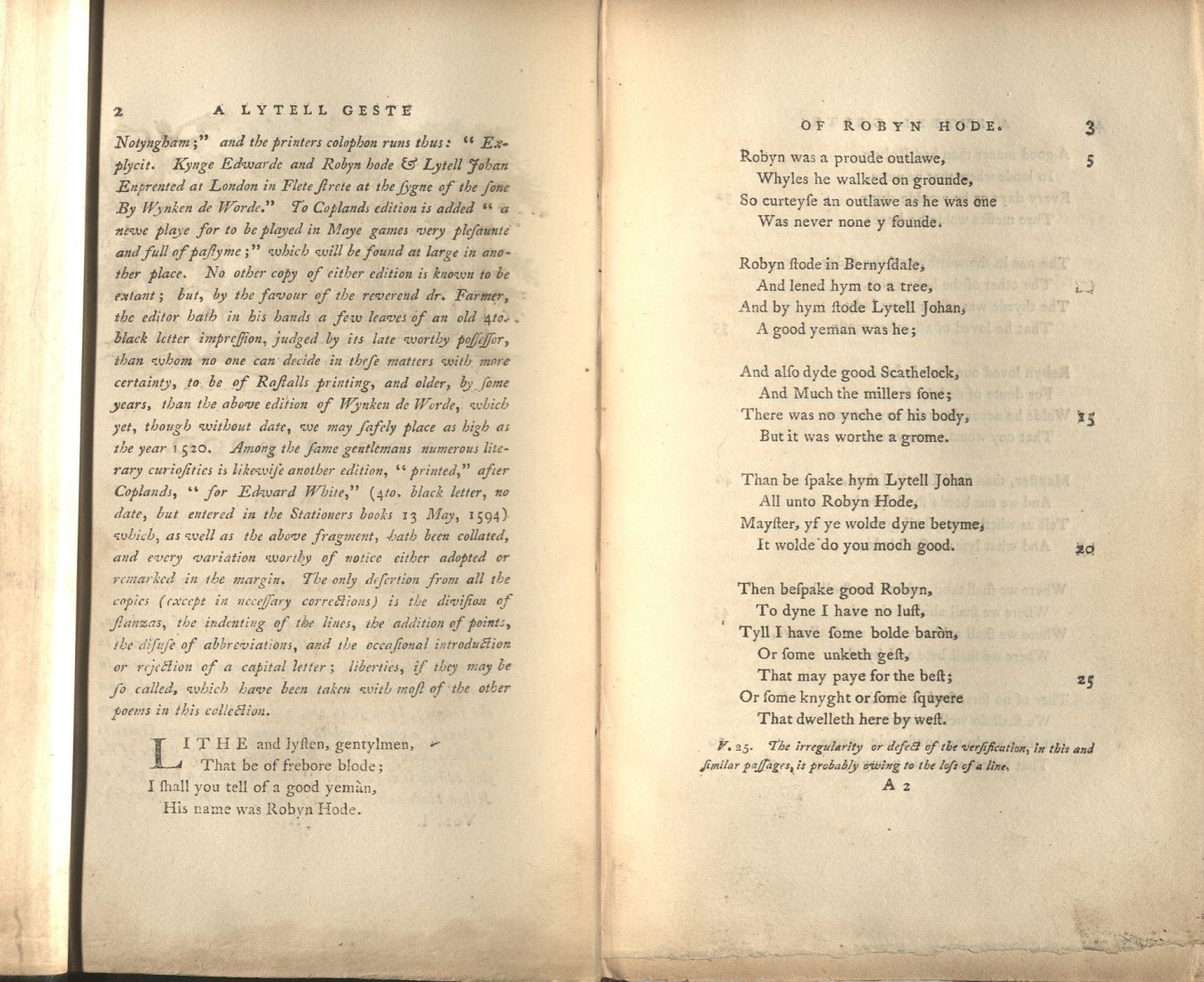
The oldest volume I looked at is a 1795 edition of Joseph Ritson’s volume Robin Hood: A Collection of All the Ancient Poems, Songs, and Ballads, Now Extant, Relative to that Celebrated English Outlaw (Call Number: C4323). The legend is largely credited to items recorded by either Wynken de Wode or William Copland, as you can see here in the introduction to Ritson’s recorded version of Lytell Geste.
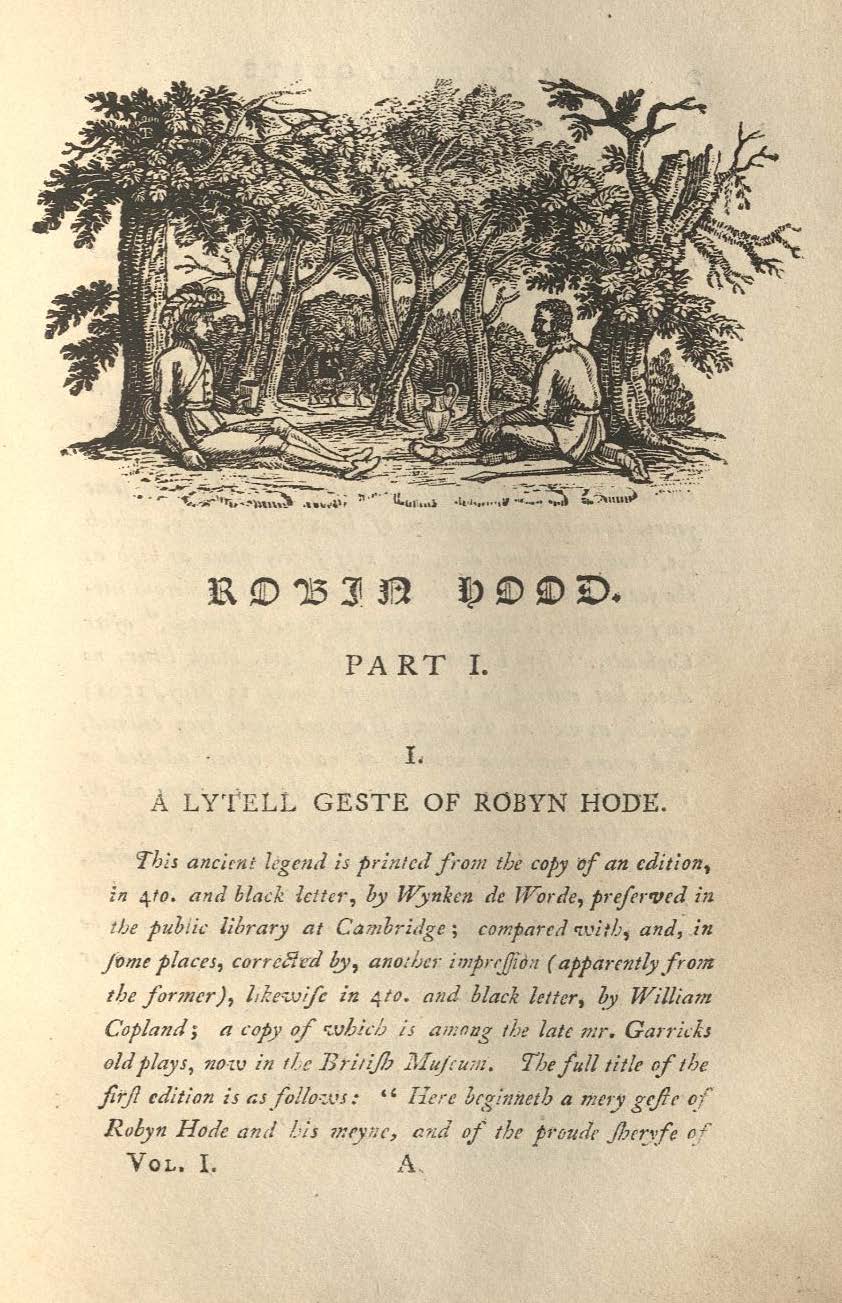
While I had initially limited myself to looking at Lyttel Geste, and thought I might write primarily on the poem itself, I was immediately struck by the variance in prefatory materials between editions. Most notably, Ritson includes a detailed history of Robin Hood’s early life, as well as a family tree.
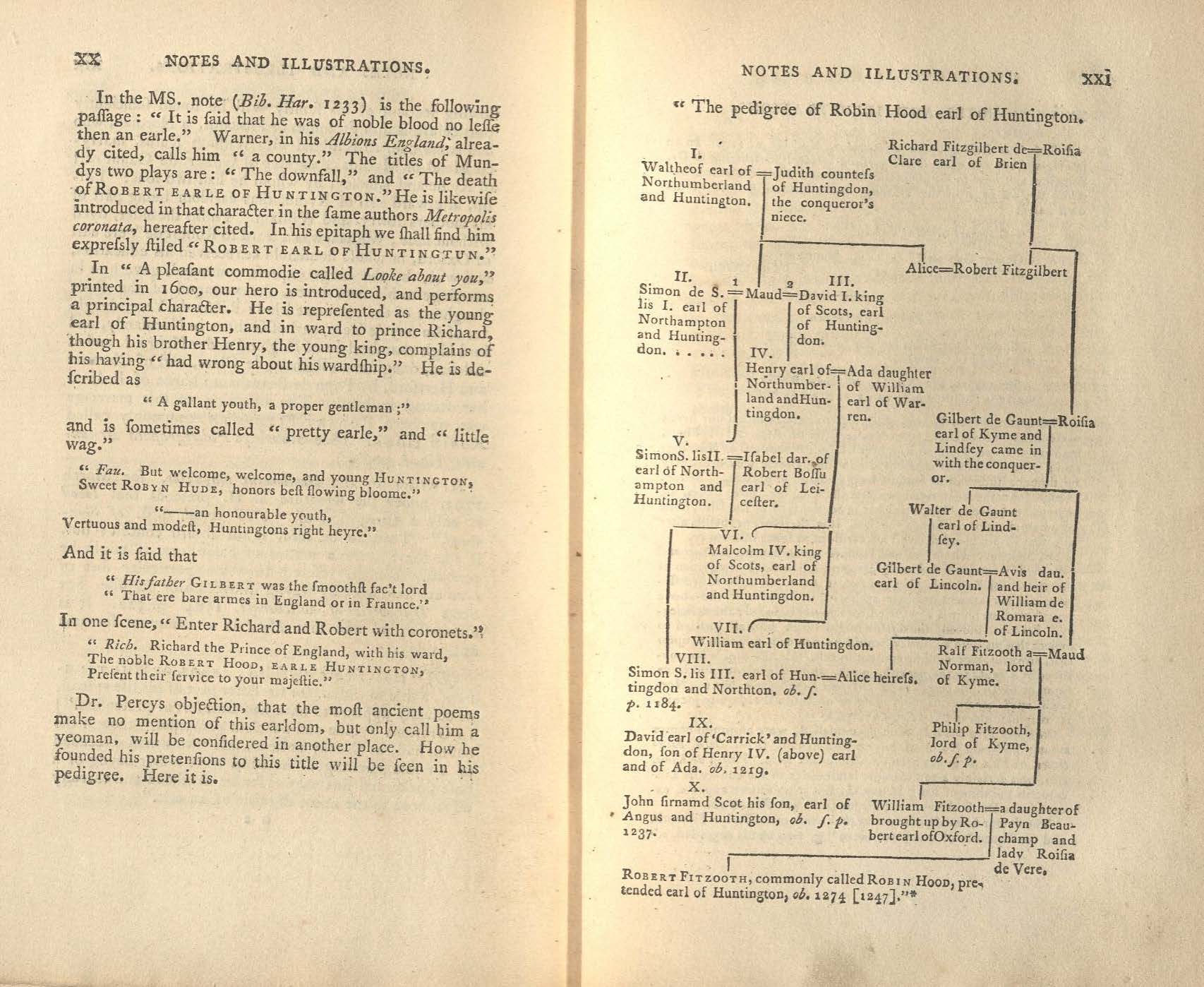
As you can see, Ritson’s accounting of the life of Robin Hood situates Robin as a member of the nobility, namely the Earl of Huntingdon. One might speculate on this rhetorical choice in light of contemporary events: Was there a need to firmly situate the image of the noble class as a champion of the common person in the wake of the American Revolution? We will likely never know, but Ritson’s scholarship on the subject gives us an interesting and valuable insight into ways in which the Robin Hood mythos has shifted over the years.
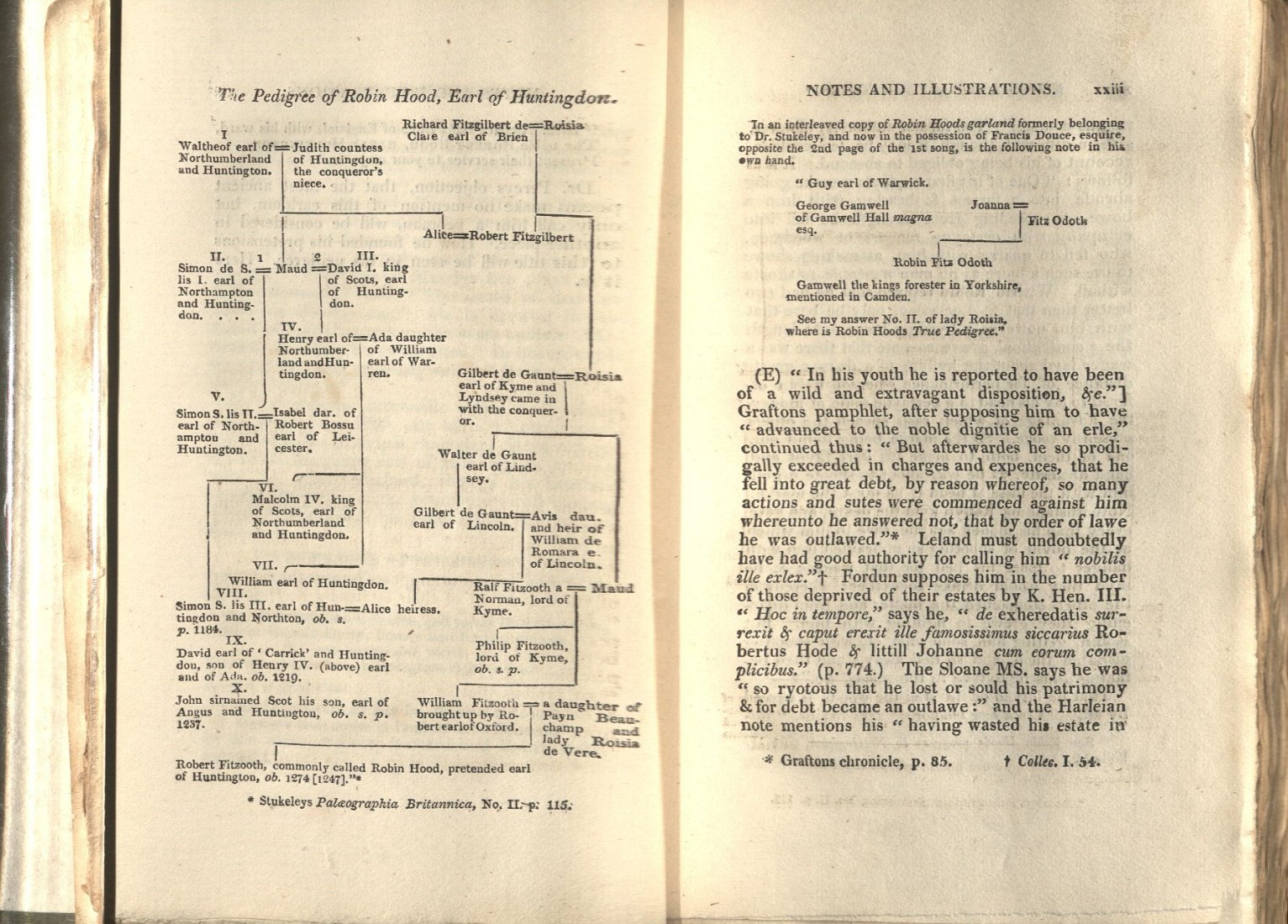
Indeed, every printing of Lyttel Geste that I looked at credits Ritson in some way. The volume at call number EPM X293 is an 1820 reprinting of Ritson’s seminal work, edited for younger readers and significantly shorter in length, and which also features a “family tree” of the Earl of Huntingdon.
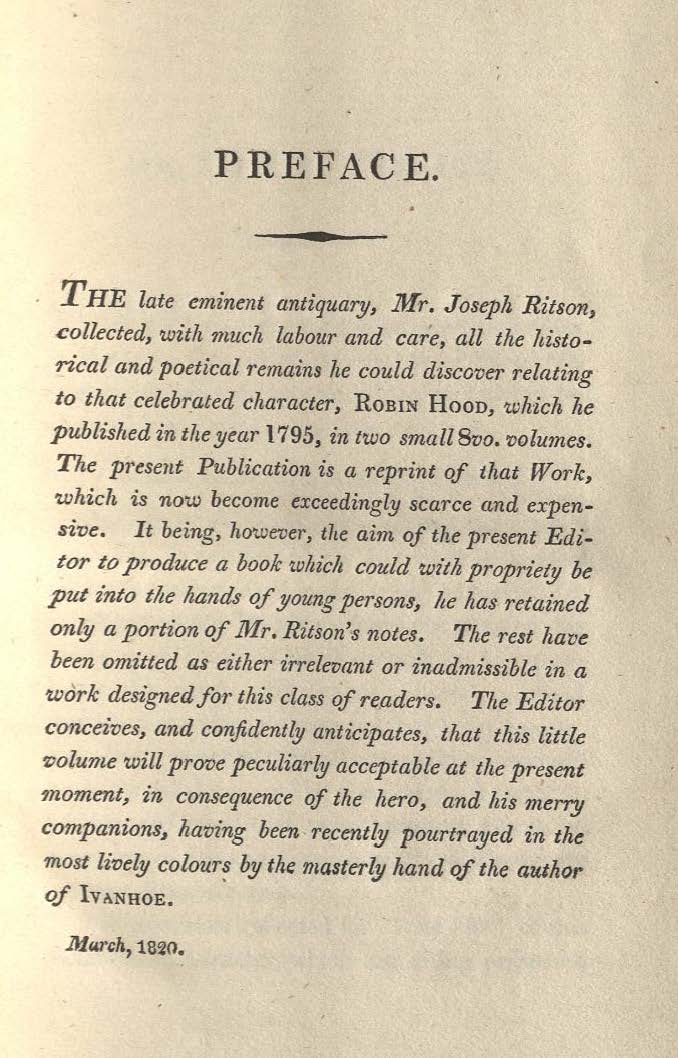
The other major player in the printings I looked at is a scholar by the name of John Mathew Gutch, who reprinted Ritson’s Lyttel Geste text with some heavy revisions (Call Number: O’Hegarty A213). Gutch includes a version of Lyttel Geste that had been completely rewritten by the Rev. John Eagles, not only standardizing the spelling, but changing the language entirely.
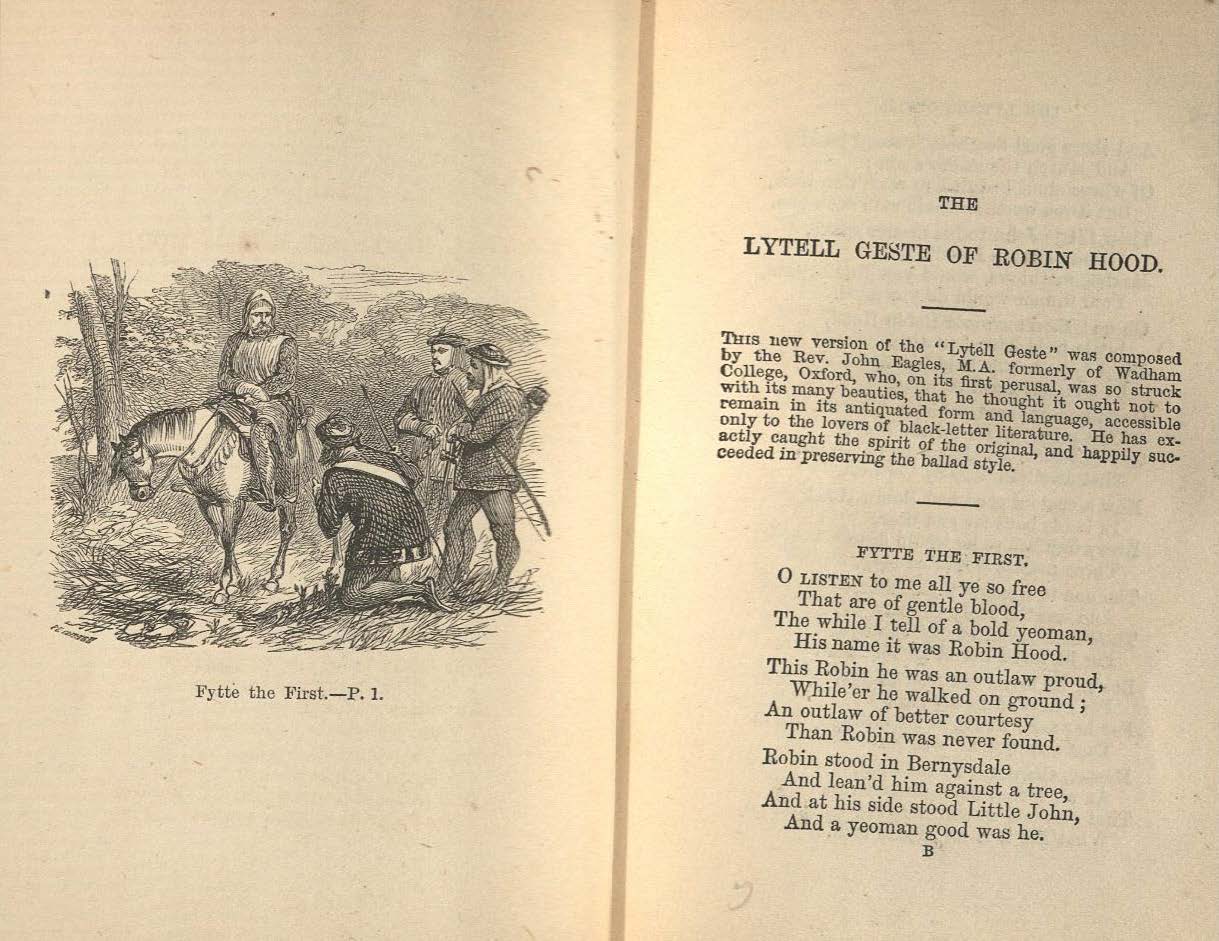
Gutch casts some aspersions on Ritson’s scholarship and provides an overview of the scholarship to date. While Gutch does not broadly contest Ritson’s claim to Robin Hood’s nobility, he takes issue with a few key points of Ritson’s argument. Namely, Gutch stipulates that Robin Hood must have been of Saxon descent rather than Norman. Gutch draws out the distinction between Norman King Richard and Saxon Robin Hood, quoting from antiquarian and fellow scholar M. Thierry as well as delving etymologically into the origins of Robin’s surname.
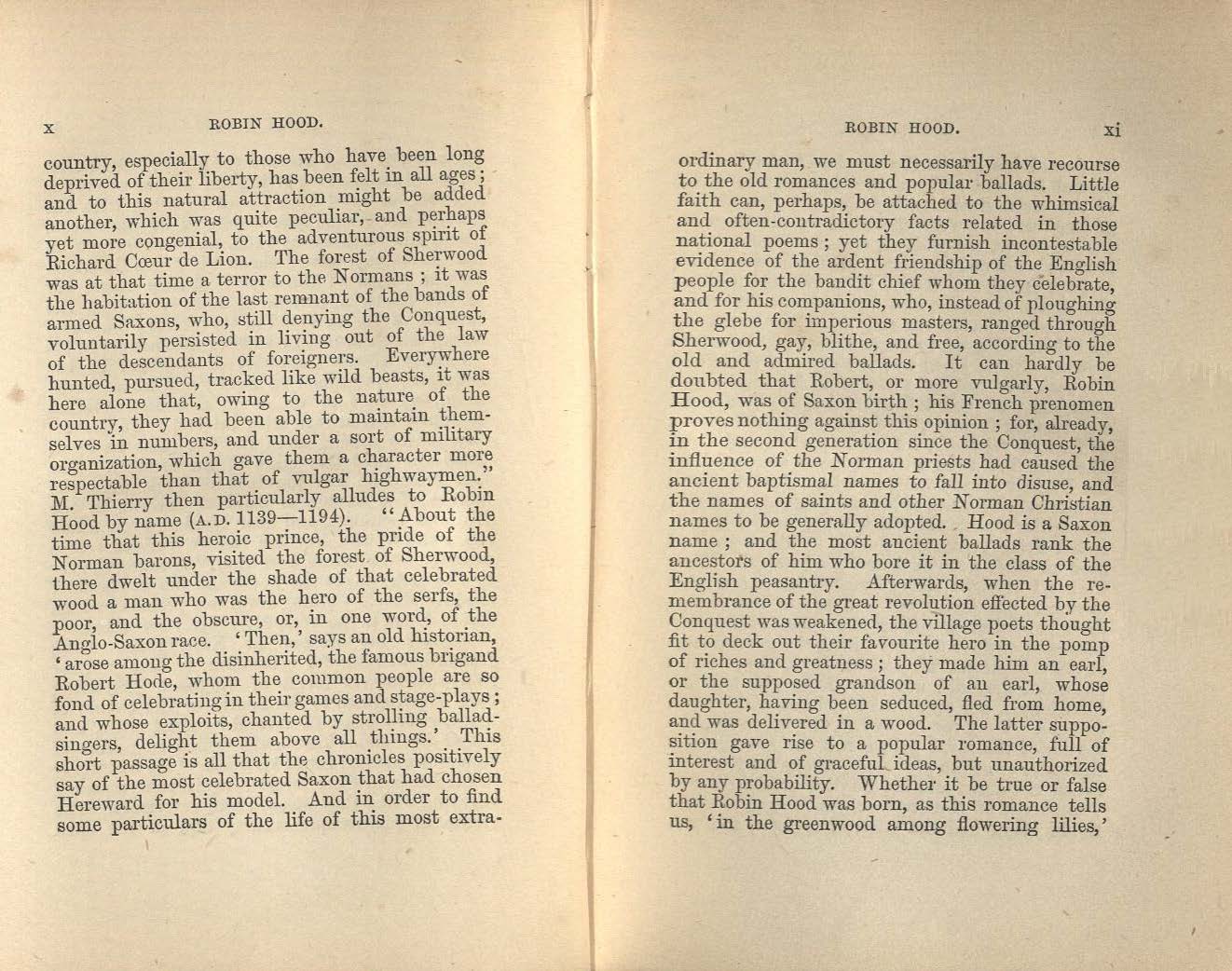
While I can’t speculate on the utility of Gutch drawing out this particular narrative thread during his contemporary setting, I can say that it is a rich insight into possible interpretations of the story. There is general agreement that Robin Hood’s narrative fits best into the latter half of the 12th century, during the Princes’ Crusade, during which there is a noted divide between the French-speaking Norman aristocracy and the English-speaking common people.
The story of Robin Hood has long been mutable, with its various written forms being complemented or augmented by a rich oral history that is, for obvious reasons, unavailable to us here at Spencer. As Gutch says, “the surprising adventures of this chief of bandits of the twelfth century, his victories over the men of foreign race, his stratagems and escapes, were long the only stock of national history that a plain Englishman of those ages transmitted to his sons, after receiving it from his forefathers.” Robin Hood continues to fascinate and charm even outside of the era of his origin.
I had initially thought that limiting myself to comparing variations between versions of a singular poem would be a small enough scope for a blog post. As so often happens, I was mistaken. Even looking at just four items, I uncovered a wealth of information to dive into and a thousand threads of inquiry to follow. If you, too, are an aspiring outlaw hobbyist, I encourage you to peruse the following items, both at Spencer and in the broader KU Libraries collection.
Grace Brazell
Administrative Associate
Selected Further Reading at KU Libraries:
- John Mathew Gutch’s scholarship on Robin Hood, 1847 (Call Number: PR2125 .G8)
- Reading Robin Hood: Content, Form and Reception in the Outlaw Myth by Stephen Knight, 2015 (Call Number: PR2129 .K57 2015)
- Images of Robin Hood: Medieval to Modern by Lois Potter, 2008 (Call Number: PR2129 .I63 2008)
Selected Further Reading at Spencer:
- Headlong Hall. : Nightmare Abbey. ; Maid Marian. ; Crotchet Castle by Thomas Love Peacock, 1837 (Call Number: O’Hegarty B4480)
- The English Archer; Or, Robert Earl of Huntingdon, Vulgarly Called Robin Hood, 1821, 1823 (Call Number: B1177)
- The Merry Adventures of Robin Hood of Great Renown, in Nottinghamshire by Howard Pyle, 1940 (Call Number: Children C101)
- Robin Hood and Little John or the Merry Men of Sherwood Forest by Pierce Egan, 1850 (Call Number: O’Hegarty D168)
- Robin Hood and the Archers of Merrie Sherwood by George Emmett, approximately 1875 (Call Number: O’Hegarty D275)
- Robin Hood and His Merry Foresters by Joseph Cundall, 1850 (Call Number: Children 1258A)