The University of Kansas

Inside Spencer: The KSRL Blog

Books on a shelf

Welcome to the Kenneth Spencer Research Library blog! As the special collections and archives library at the University of Kansas, Spencer is home to remarkable and diverse collections of rare and unique items. Explore the blog to learn about the work we do and the materials we collect.

World War I Letters of Forrest W. Bassett: April 30-May 6, 1918

April 30th, 2018

In honor of the centennial of World War I, we’re going to follow the experiences of one American soldier: nineteen-year-old Forrest W. Bassett, whose letters are held in Spencer’s Kansas Collection. Each Monday we’ll post a new entry, which will feature selected letters from Forrest to thirteen-year-old Ava Marie Shaw from that following week, one hundred years after he wrote them.

Forrest W. Bassett was born in Beloit, Wisconsin, on December 21, 1897 to Daniel F. and Ida V. Bassett. On July 20, 1917 he was sworn into military service at Jefferson Barracks near St. Louis, Missouri. Soon after, he was transferred to Fort Leavenworth, Kansas, for training as a radio operator in Company A of the U. S. Signal Corps’ 6th Field Battalion.

Ava Marie Shaw was born in Chicago, Illinois, on October 12, 1903 to Robert and Esther Shaw. Both of Marie’s parents – and her three older siblings – were born in Wisconsin. By 1910 the family was living in Woodstock, Illinois, northwest of Chicago. By 1917 they were in Beloit.

Frequently mentioned in the letters are Forrest’s older half-sister Blanche Treadway (born 1883), who had married Arthur Poquette in 1904, and Marie’s older sister Ethel (born 1896).

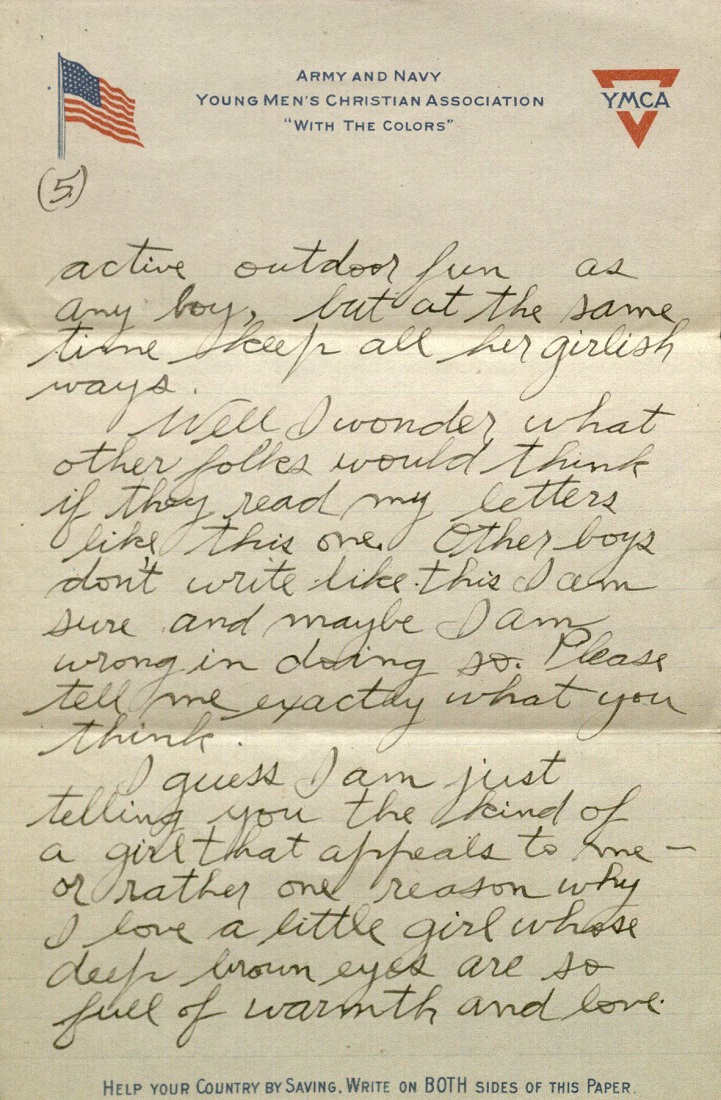
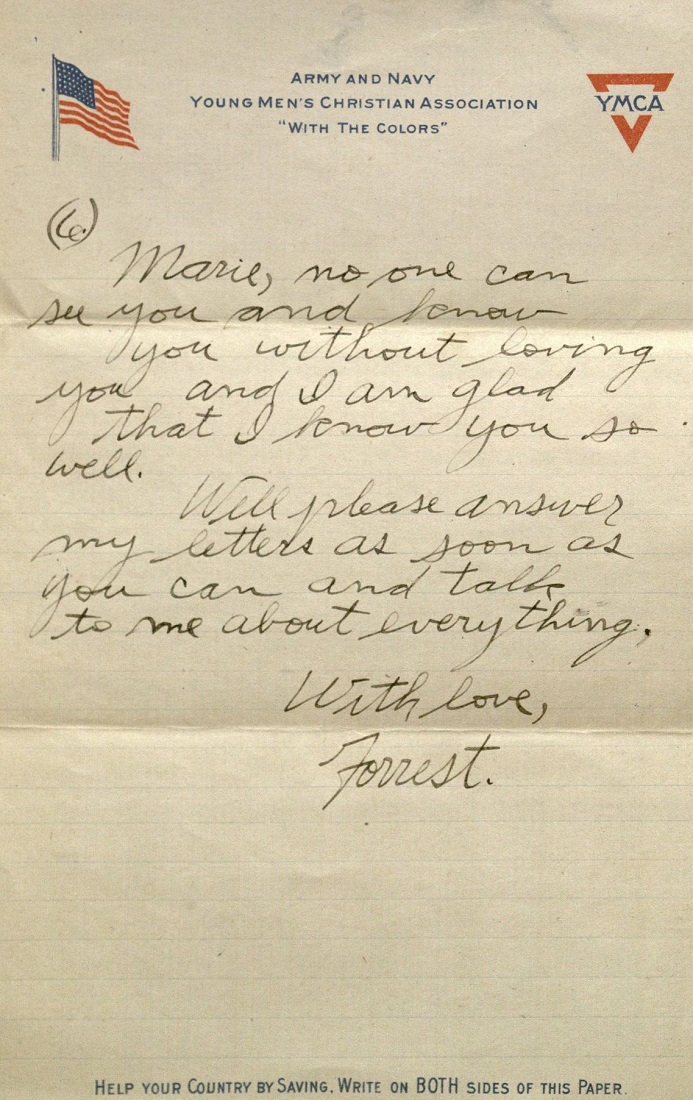
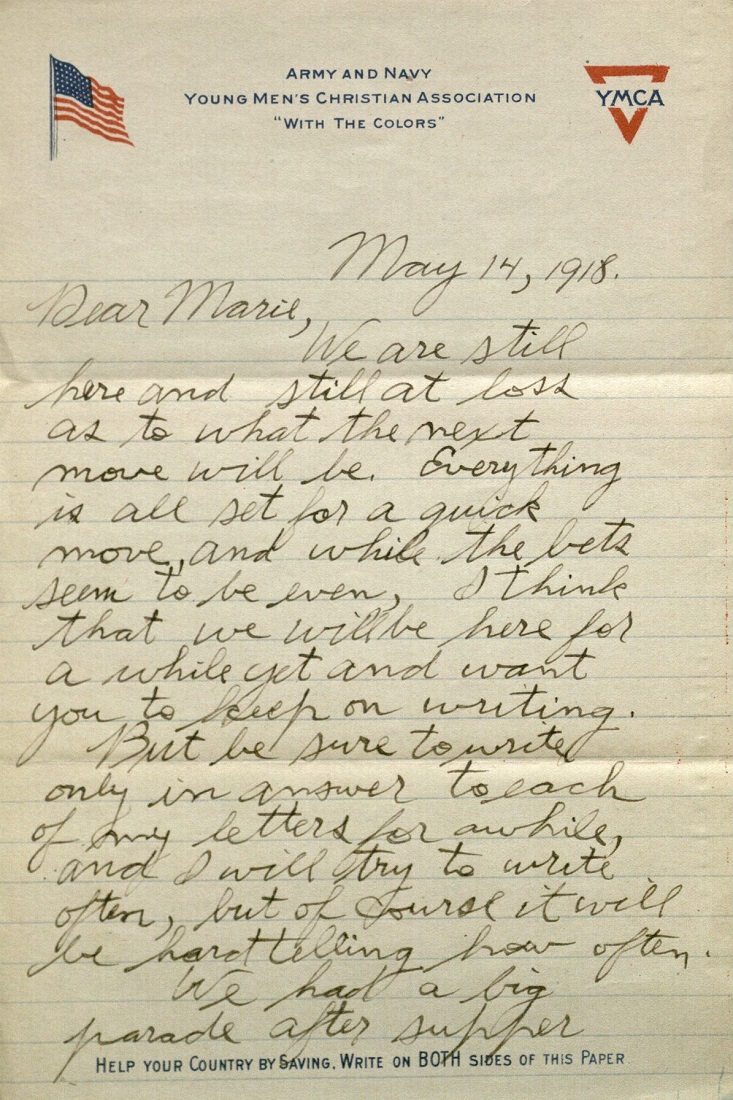
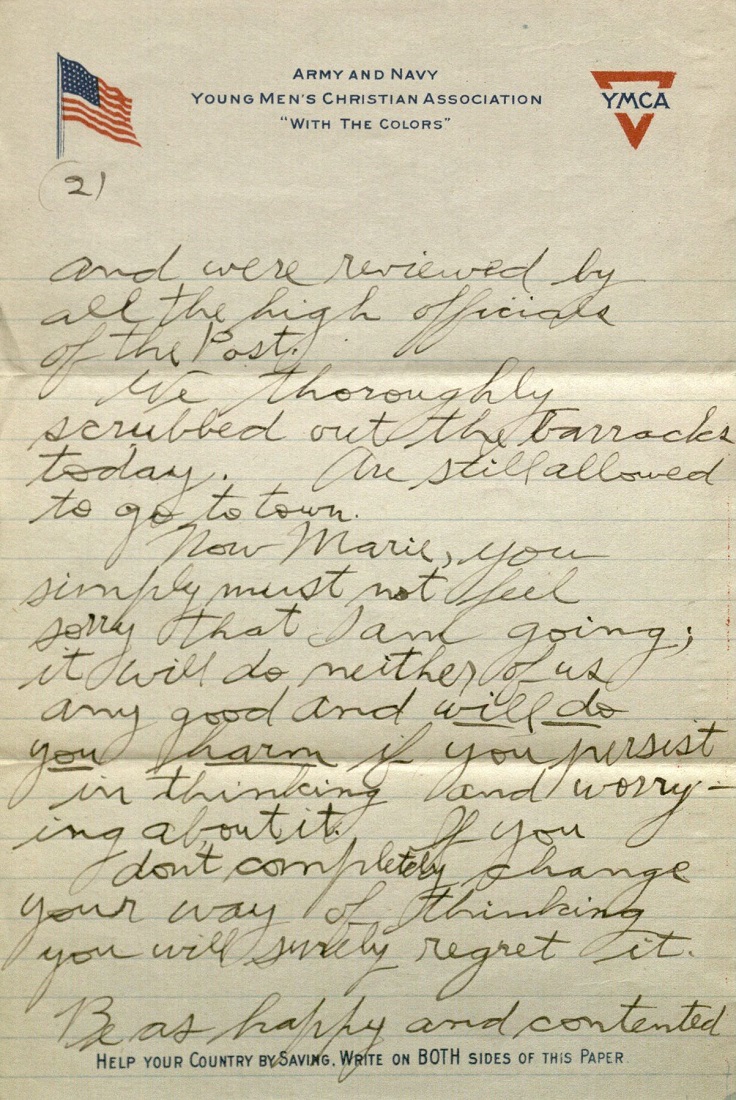
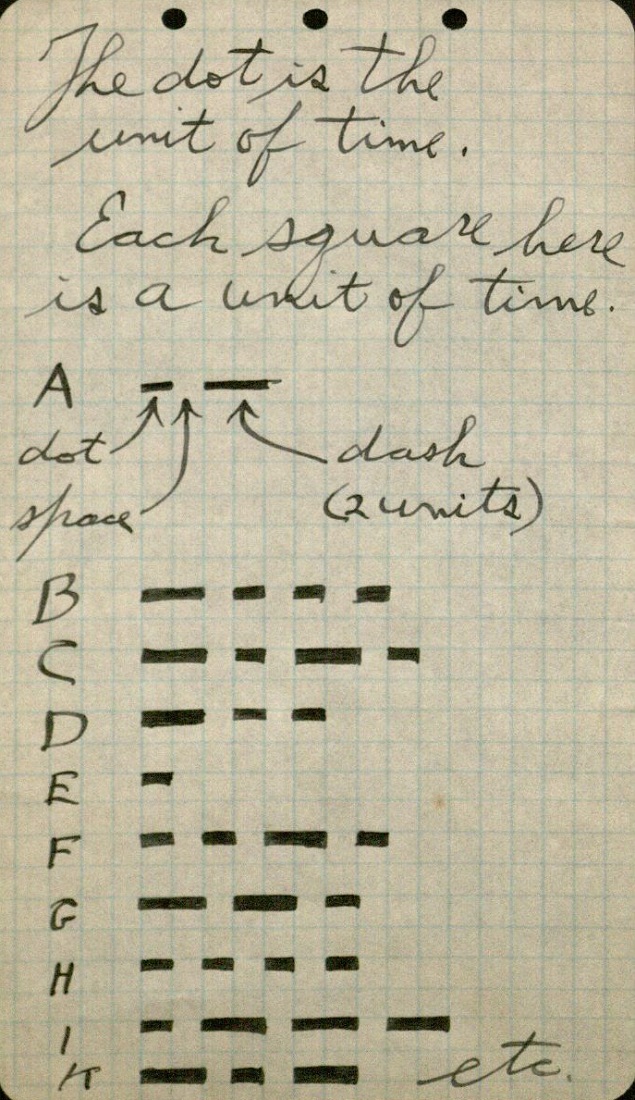
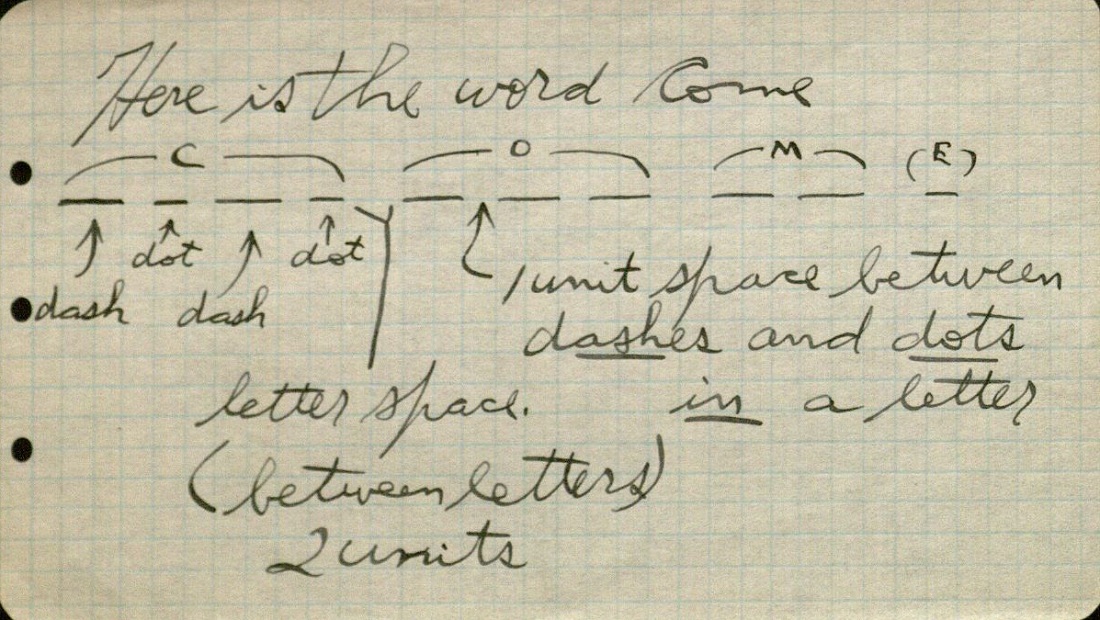
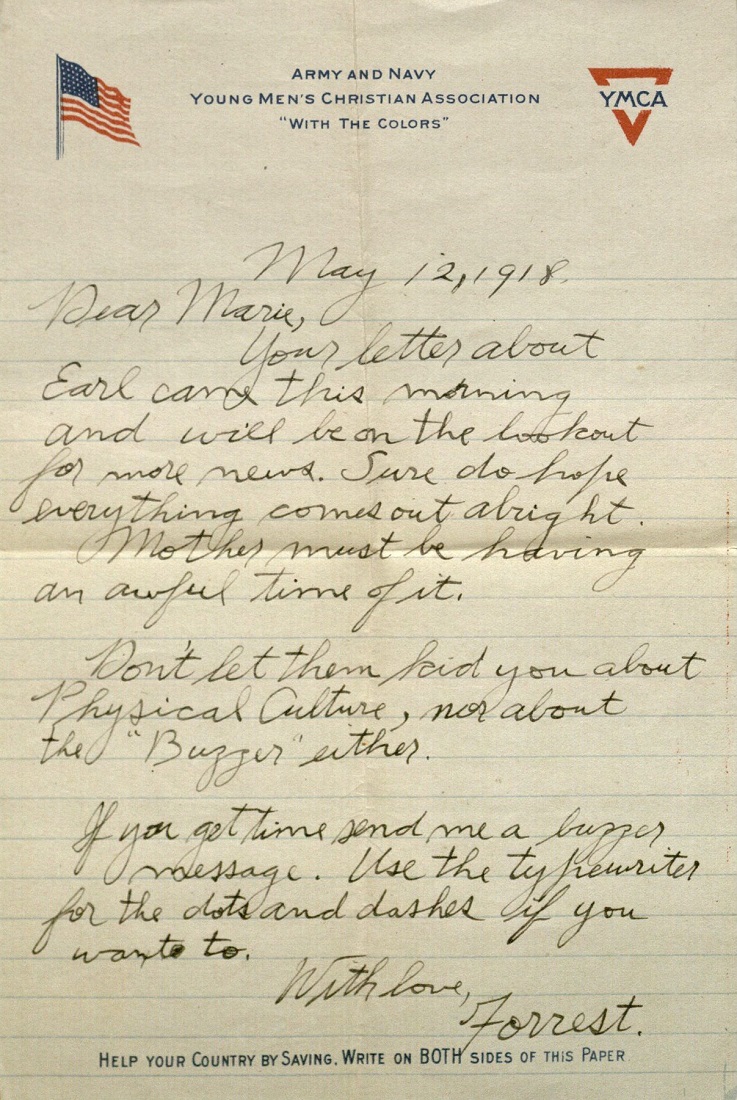
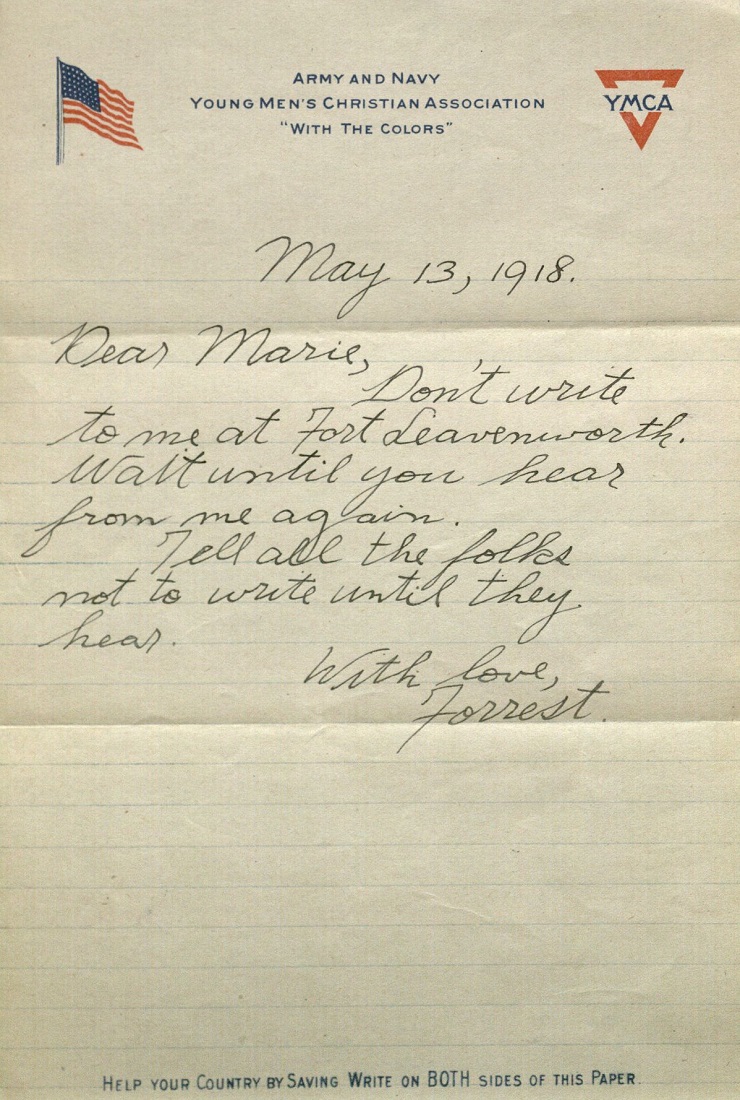
Highlights from this week’s letters include a report on muster day (“all Signal troops were inspected by the Colonel; the first time since I’ve been here. It sure was some big doings alright and I wish you could have seen it”) and a thorough explanation of Morse code and telegraphy (“you say you are crazy to learn but I want to caution you that it takes practice with lots of patience – the same as music or anything else”).

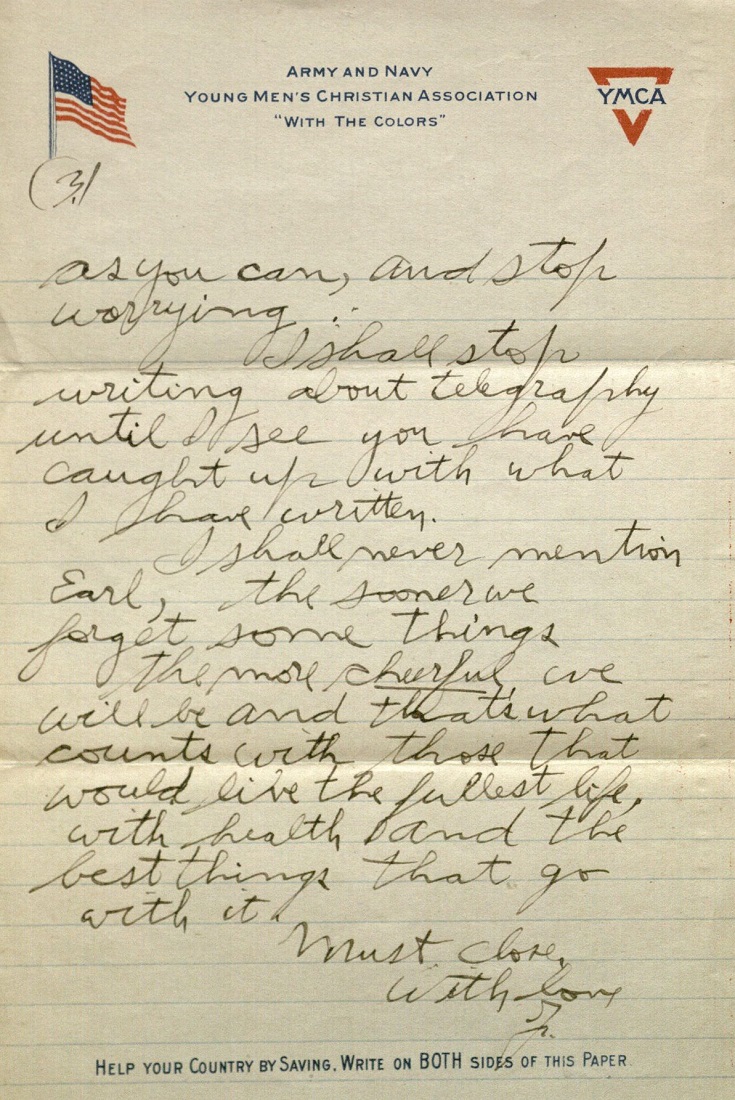
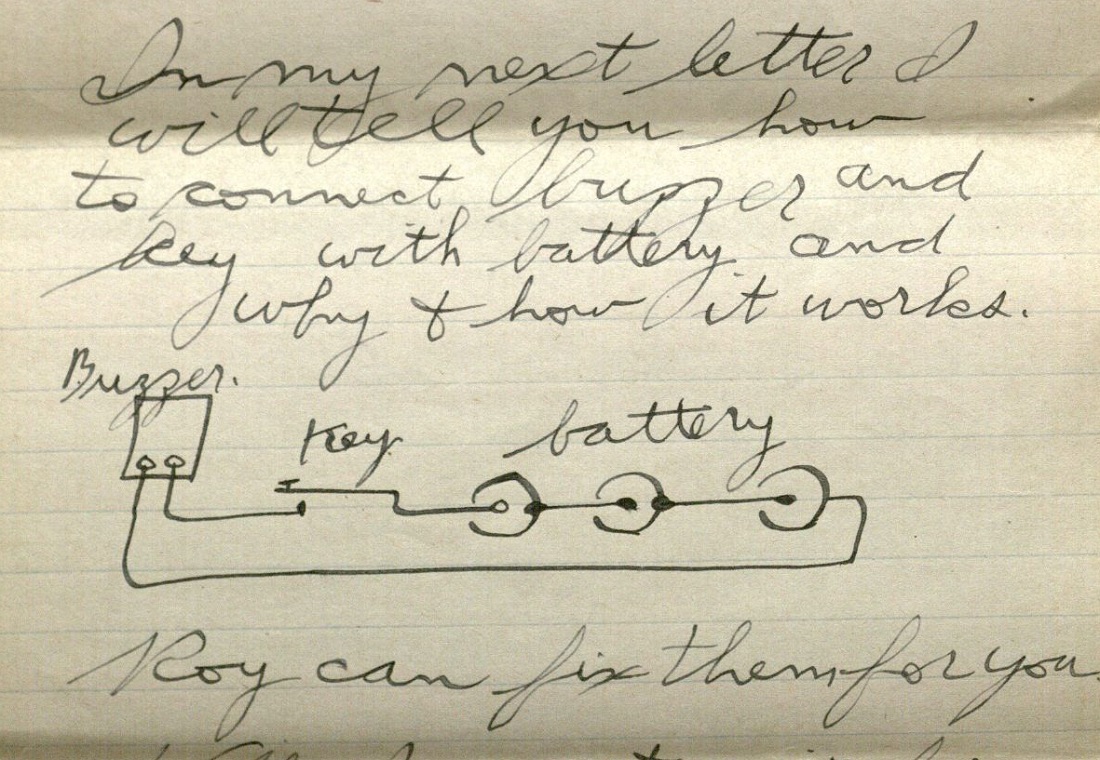
Image of Forrest W. Bassett's letter to Ava Marie Shaw, April 30, 1918 Image of Forrest W. Bassett's letter to Ava Marie Shaw, April 30, 1918

Image of Forrest W. Bassett's letter to Ava Marie Shaw, April 30, 1918 Image of Forrest W. Bassett's letter to Ava Marie Shaw, April 30, 1918

Click images to enlarge.

April 30, 1918.

Dear Marie,

I sure am mighty sorry I didn’t write to you oftener this month, You are one real little sweetheart to continue writing and I will remember that. I wish you could just belong to me, for there isn’t another girl in the world as lovable as you. I am going to do my best to write at least twice a week next month.

Here are a few snapshots of “A”-men. The ones of the Battalion at Retreat are not good because they were taken late in the afternoon, against the sun. The one of M.S.E. McKelvey gives but a glimpse of the elaborate radio equipment on the radio tractor. We are very proud of our band and it has been highly complimented by outsiders.

I am not in the Photographic Section yet and will consider myself lucky if I get there during May. My application has to go to the Chief Signal Officer at Washington, and then a lot more red-tape I’m afraid.

Today is muster day and all Signal troops were inspected by the Colonel; the first time since I’ve been here. It sure was some big doings alright and I wish you could have seen it.

Well I must cut this short or I won’t be able to get in my pictures, but will write again very soon.

With love,
Forrest.

Please tell me if these pictures don’t come in good condition when sent this way.  FWB.

May 3, 1918.

Dear Marie,

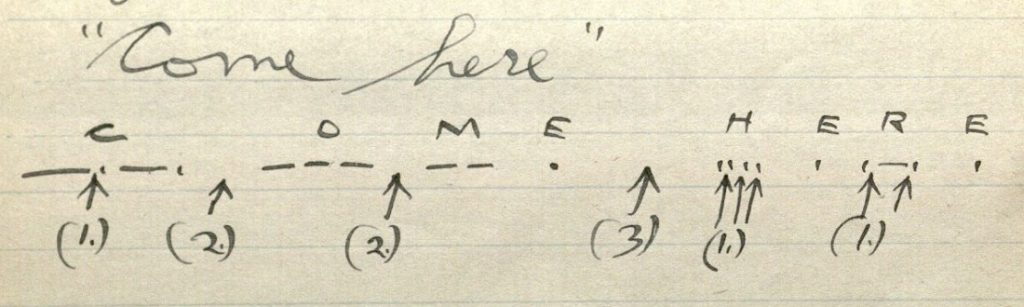
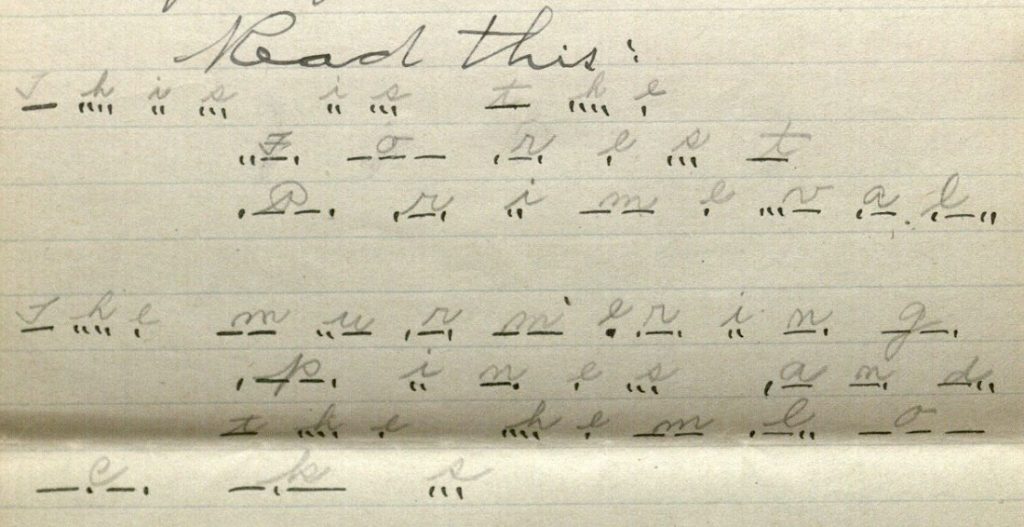
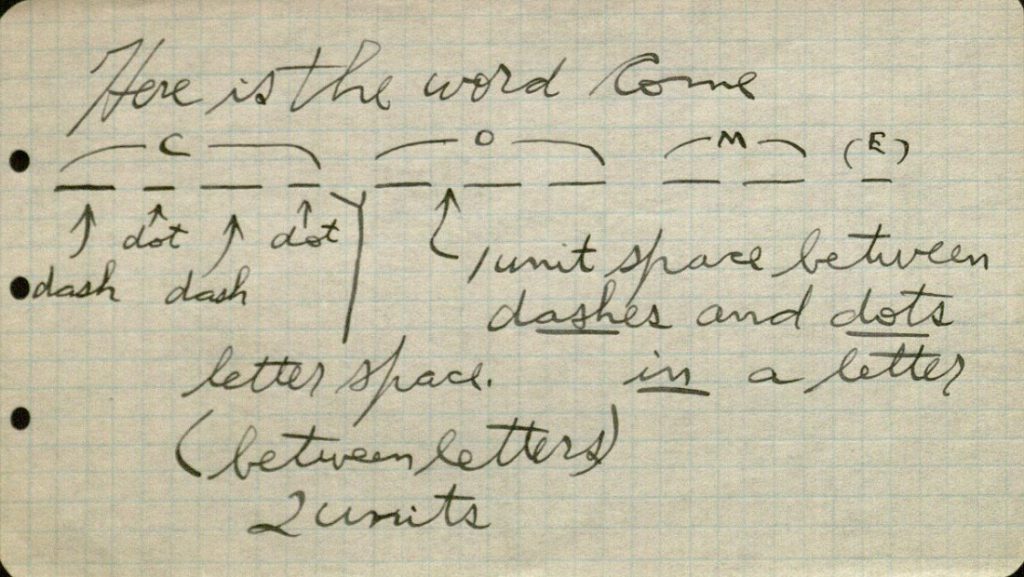
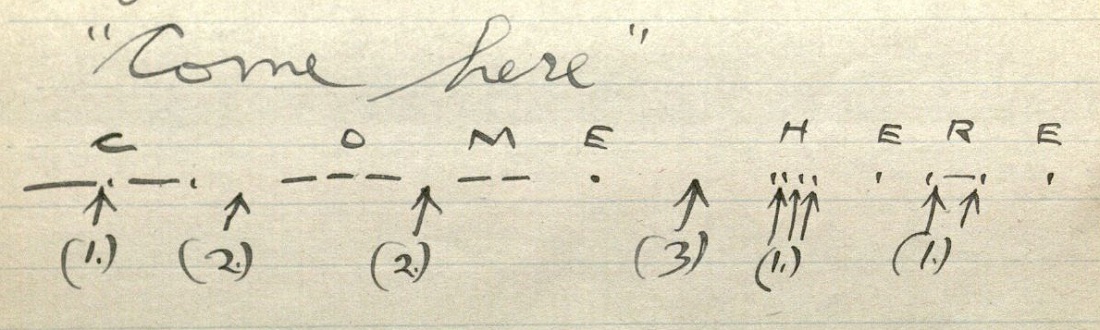
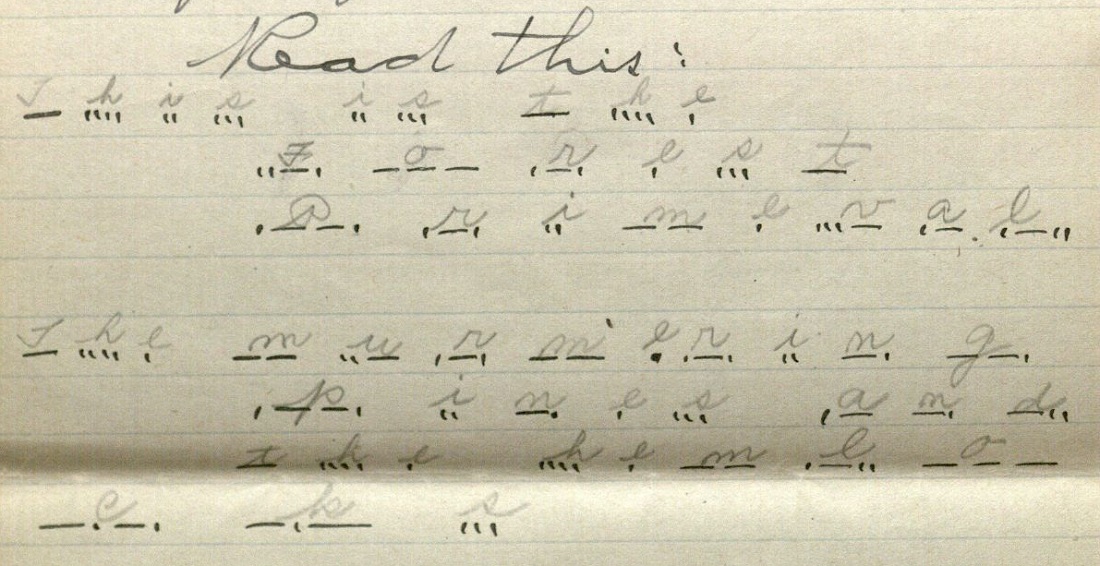
The Company has been digging trenches this afternoon and I am a little tired from the snappy pick swinging, so will only write about telegraphy this time. You say you are crazy to learn but I want to caution you that it takes practice with lots of patience – the same as music or anything else. And here is the point:

If you try it at all do your best – not simply to be able to tap the key like some “ham,” but really strive for some degree of perfection. If you don’t want to go at it seriously the same as you do your elocution, do not waste your time – for no time is so utterly wasted as time spent doing a thing half way.

I don’t want to scare you away from learning to telegraph but simply want to warn you not to start something that you haven’t the interest nor enthusiasm to see through.

So think it over and let me know if you want to learn to be as good an operator as the average commercial radio operator. Girl radio amateurs have shown real ability, and right now the government has women teaching telegraphy to Signal Corps recruits.

And again let me say that you have the “stuff” in you to make a first class operator, not a “Morse butcher,” as we call one who chops out the dots and dashes in ragtime.

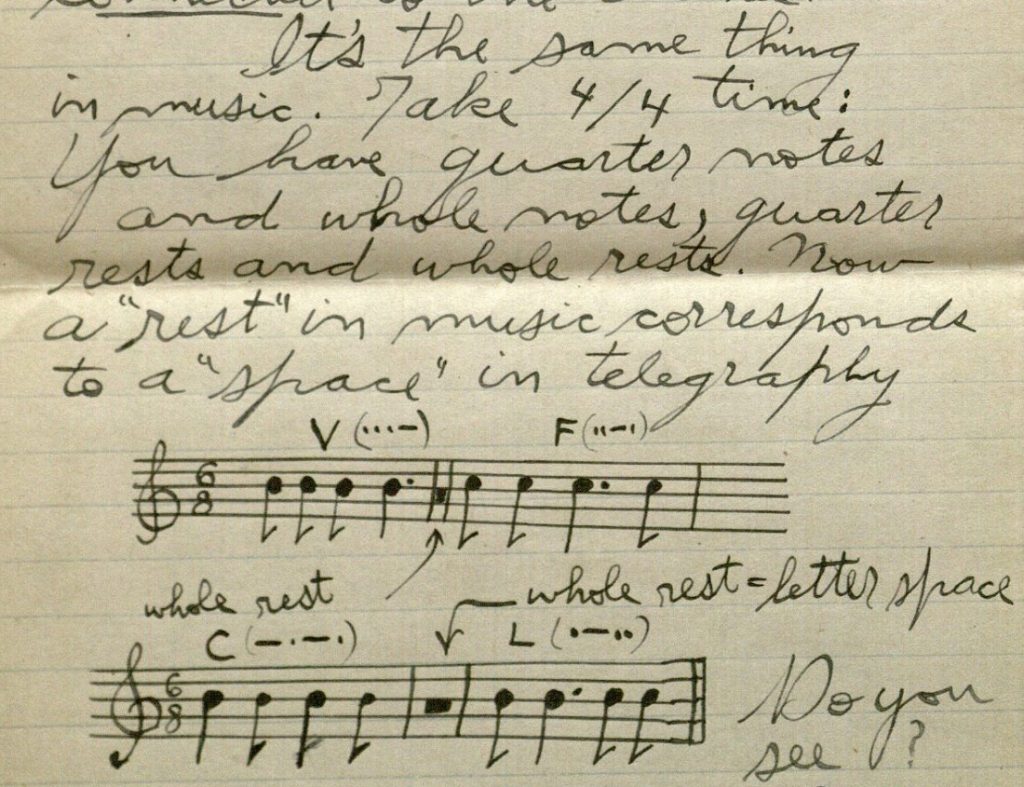
Telegraphy is similar to playing the piano in that one has to consider “time” and rythm, also one must hold the fingers, wrist and forearm correctly to send well with the key. When you hear the clatter of telegraph instruments in an office, did you ever stop to think that every little combination of dots and dashes forms a letter? Take the word “receive” for instance:

R|E|C|E|I|V|E|

Morse =  · ··|·|·· ·|·|··|···-|·

Radio =   ·-·|·|-·-·|·|··|···-|·

The American Morse is a little harder to receive because if the letters are run together an R (· ··) can’t be distinguished from EI (·|··) nor a C (·· ·) from IE (··|·) However the European Morse (radio) is better because there are no spaces between parts of one letter. R is (·-·), C is (-·-·), Y is (-·–) instead of (·· ··).

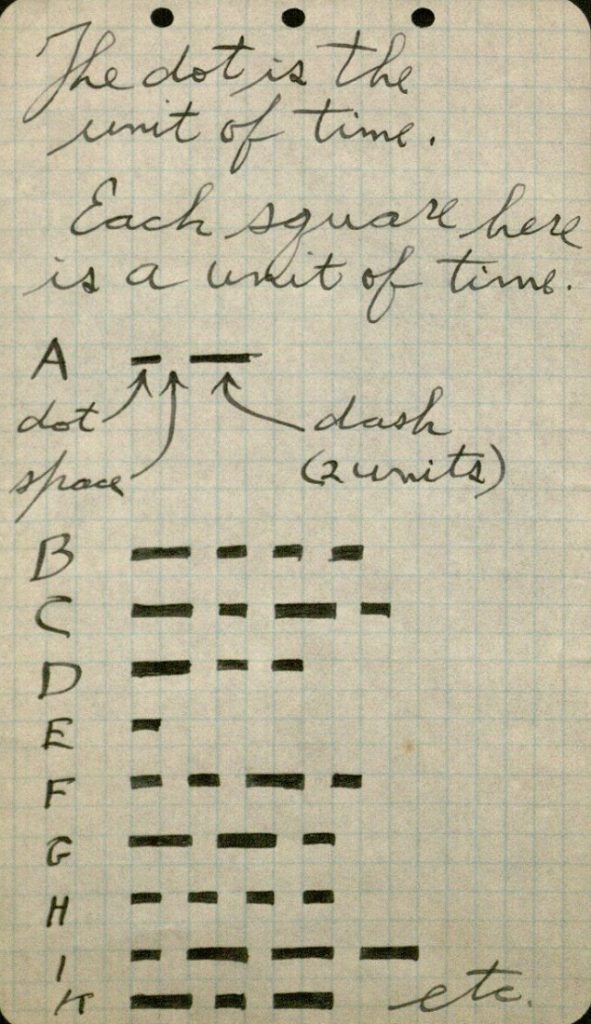
Of course I am taking it for granted that you know what a dot or a dash, or a space is; if you don’t be sure to speak up.

The slightest error in time length of the dots, dashes, and spaces makes one’s best efforts a jumble of unreadable Morse. So you see one must cultivate that sense of time and rythm the same as you do in music. It is easier in telegraphy than in music but at the same time more important

“And” (·-|-·|-··) will sometimes sound like “p’d” (·–·|-··) if it is sent rapidly without proper spacing.

Well you see I am making an awful fuss about accuracy and clearness in transmitting (sending) because anyone with enough practice can read telegraphy at any speed when it is sent properly.

Suppose you were learning to read and write in Greek or any language in which the writing is absolutely different than English. You would first have to learn to draw (not write) each letter, which would be similar to “sending” in radio; and then you would have to learn to recognize each letter, written by another person, which would be similar to “receiving” in radio.

If this is too big a strain on your imagination, then just consider how a 1-B pupil learns to read write.

I am pointing this out to make you see how very simple receiving in radio is.

At first you will think of C as dash, dot, dash, dot (-·-·) but after awhile you will forget the dots and dashes and think of the sound of the combined dots and dashes. For instance when you read you don’t look at each separate letter in a word but you see the whole word at a glance and recognize it without thought of the letters composing it.

I am analyzing these steps in one’s progress in learning telegraphy simply to make you see that it is simply a matter of time and patient practice.

Now for the amount of practice for best results. I wouldn’t advise practising too long at a time – and only when you are “all keyed up” for it. If you feel that you can spare a half an hour or forty minutes each day you will learn fast, and I believe you will like it and find it well worth the effort.

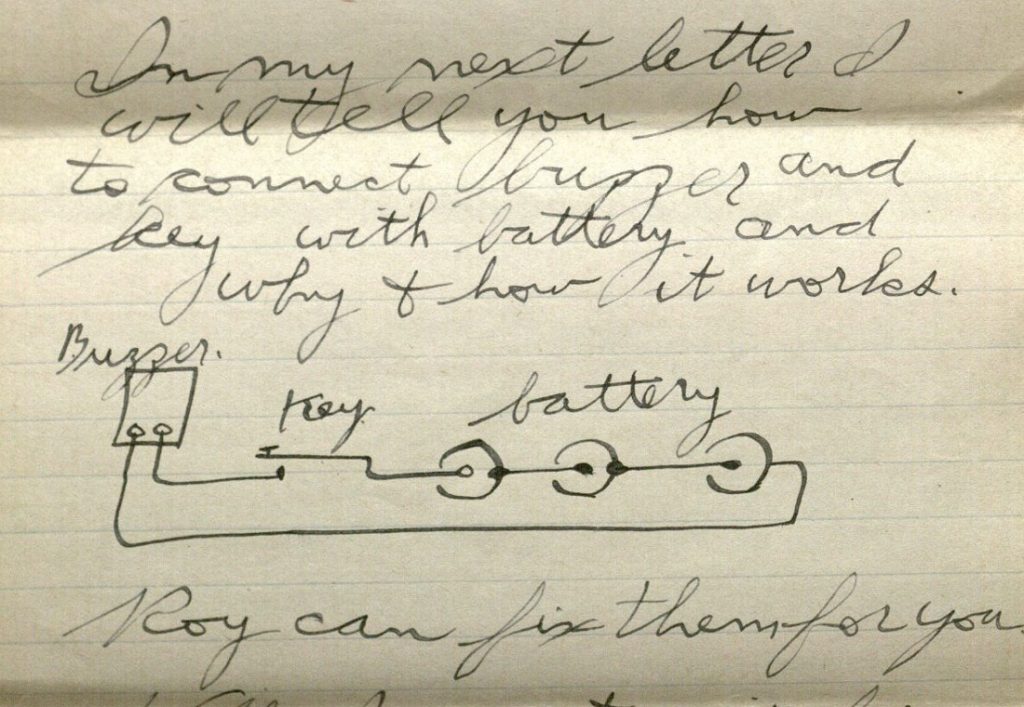
If you decide to try it, I want you to use my telegraph key, as it is a J.H. Bunnell key, which is the best on the market, and is almost “brand new.” Also you may find that sending board of mine useful – do you remember the thing I mean? Well I have a lot more to tell you if you want to go ahead so tell me one way or the other in your next letter.

When you get started, if you do, you will be surprised to find how easy it all is.

Will have to call ten pages enough this time. My next letter will be “nice.”

Forrest.

Meredith Huff
Public Services

Emma Piazza
Public Services Student Assistant

World War I Letters of Forrest W. Bassett: April 23-29, 1918

April 24th, 2018

In honor of the centennial of World War I, we’re going to follow the experiences of one American soldier: nineteen-year-old Forrest W. Bassett, whose letters are held in Spencer’s Kansas Collection. Each Monday we’ll post a new entry, which will feature selected letters from Forrest to thirteen-year-old Ava Marie Shaw from that following week, one hundred years after he wrote them.

Forrest W. Bassett was born in Beloit, Wisconsin, on December 21, 1897 to Daniel F. and Ida V. Bassett. On July 20, 1917 he was sworn into military service at Jefferson Barracks near St. Louis, Missouri. Soon after, he was transferred to Fort Leavenworth, Kansas, for training as a radio operator in Company A of the U. S. Signal Corps’ 6th Field Battalion.

Ava Marie Shaw was born in Chicago, Illinois, on October 12, 1903 to Robert and Esther Shaw. Both of Marie’s parents – and her three older siblings – were born in Wisconsin. By 1910 the family was living in Woodstock, Illinois, northwest of Chicago. By 1917 they were in Beloit.

Frequently mentioned in the letters are Forrest’s older half-sister Blanche Treadway (born 1883), who had married Arthur Poquette in 1904, and Marie’s older sister Ethel (born 1896).

Highlights from this week’s letters include updates on Forrest’s transfer request (“I guess I may hope for a transfer, some day”) and advice to Marie about learning to telegraph (“to an experienced ear, there is as much beauty in good, accurate, clear cut ‘Morse’ as there is in a sheet of fancy writing”). “My life before I came here,” wrote Forrest on April 27, “seems more and more like a dream every day.”

Image of Forrest W. Bassett's letter to Ava Marie Shaw, April 25, 1918 Image of Forrest W. Bassett's letter to Ava Marie Shaw, April 25, 1918

Image of Forrest W. Bassett's letter to Ava Marie Shaw, April 25, 1918 Image of Forrest W. Bassett's letter to Ava Marie Shaw, April 25, 1918

Image of Forrest W. Bassett's letter to Ava Marie Shaw, April 25, 1918 Image of Forrest W. Bassett's letter to Ava Marie Shaw, April 25, 1918

Click images to enlarge.

April 25, 1918.

Dear Marie,

The letter I wrote to you from the City “Y” was returned unstamped – I can’t see how I overlooked it – but anyway that’s why you didn’t get it. Well it wasn’t a nice letter anyway – all about telegraphy.

I don’t think you ought to bother to learn to telegraph unless it really interests you very much. Otherwise it would be a waste of time. The International Code, European Morse Code, and U.S. General Service code all exactly the same. You will find it given in the drill book in the chapter on Wig-Wag. Now if you really want to learn – learn right. The proper way to hold the key knob, the position of the fingers and the movement of the forearm and wrist are all very important. There is as much difference in different operators’ “style” of sending as there is in their writing. Generaly a good penman is a good transmitter, and vice versa. A good arm movement is essential in both “pen pushing” and “key pushing.” To an experienced ear, there is as much beauty in good, accurate, clear cut “Morse” as there is in a sheet of fancy writing. It is usually thought that receiving is much harder than sending, but I’ll always say that the cultivation of a snappy, easily-read style of “cutting out the dots and dashes” is just as hard as learning to play exercises on a piano or learning to typewrite. However I really think you could learn to send perfect “Morse” if you want to. So if you would like to try it let me know so I can tell you more about it.

My application for transfer has at last left the office but Lieut. Kilbury warned me it may be blocked by the Major of the Battalion. Well if it is I sure will be some disappointed. Things have calmed down a little and I will probably have to “mark time” for awhile yet. Last Friday we did some rough weather maneuvers. It rained hard all morning with a cold, chilling north wind. We had to set up two Radio stations in the field – one was the tractor set and the other the old type sets we had last Summer. The 4th & 5th Sections set up the tractor radio & the 1st & 3rd sections operated the pack set.

We (1st & 3rd) had a truck to take us out in the field and the clay was fierce. One hill stalled us and we got out and got behind. Well we set up our station by the Engineers’ trenches – the big tent and all. It sure was an awful morning and I thought my fingers would freeze while we were putting up the antenna. Everything went like clockwork and in record time. When we came in at noon we had the thick yellow clay up to our knees. I had to scrub my shoes, leggins and raincoat and shelter tent.

The visual signaling was not very efficient as the wind would tie up the wet flags about the sticks and it was very hard to see very far in the rain, even with the field glasses.

We just had another “all-around” physical exam yesterday and a couple “one-lungers” found. I guess they will not be discharged though.

Guess I’ll have to call this enough for this time, or I won’t have enough to write about next time.

With love,
Forrest.

April 27, 1918.

Dear Marie,

Your little note came this morning. I don’t blame you a bit for feeling that I ought to write oftener, for I guess I haven’t written much to anyone lately. Please don’t think that I haven’t thought of you much lately. And Marie, whatever you think don’t get the idea in your head that I might think myself too good for you or that I ever tire of your letters.

My life before I came here seems more and more like a dream every day. When I look at those two portraits of you (I have them back again) I can hardly believe that I ever held you close in my arms. It seems as if the days when we were together were years ago, and you seem like a big precious thing, altogether lost to me.

Well I don’t suppose I ought to write to you this way but I love you so much I can’t always hold back the feeling it causes.

Lietenant Kilbury is now a Captain and is our Company Commander. He has been in the Army all his life and has seen considerable active service. He is known all over the Fort as “Hard boiled Willie” and the title fits to a hair, for I don’t believe any officer could be any more rigid in discipline than he is. He sure is just plain “Hard Boiled.” He gave one man in our section five days in the guard house at hard labor for not marking his shoes with initials and Co. number. His favorite theme is absolute unyielding discipline – also that “non-commissioned officers will win the war.” Woe to the private that dares to speak to a non-com without addressing him as either “Corporal” or “Sergeant.”

He made a little speech this morning in which he said that Co-A of the 6th was the crack signal outfit in the Army and that he was going to make it a Company that never need have fear of meeting anything superior. Well there may be some “bunk” in that , but the Personnel Officer from Washington, who examined us for qualification as Signal men, told Captain Murphy that the men of “A”-Company were of the highest class he had worked with yet.

I guess my application for transfer passed the Major alright. Captain Kilbury marked my character “Excellent,” and the Company Clerk told me it was very unusual to get higher than “Very Good.” So I guess I may hope for a transfer, some day. Sergeant Baber, my Section Chief, has been recommended for the Officers traning Camp. Sergeant Williams, who used to be my Section Chief when I was in the 5th Section, went to the Officers training camp last January and is now a lieutenant. Well it’s a gay life and I can’t be worried, and lose my Milwaukee shape.

What kind of work do you intend to do this summer? I wish you would write more fully. I hate to think of you working outside, especially during a vacation.

With love,
Forrest.

Meredith Huff
Public Services

Emma Piazza
Public Services Student Assistant
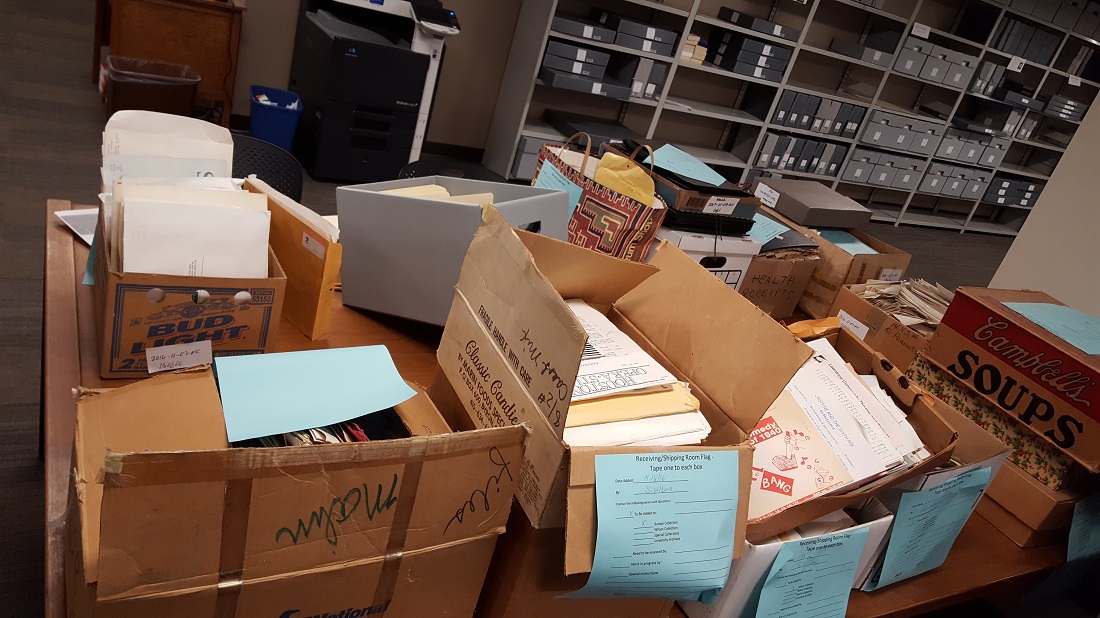
World War I Letters of Forrest W. Bassett: April 2-8, 1918

April 2nd, 2018

In honor of the centennial of World War I, we’re going to follow the experiences of one American soldier: nineteen-year-old Forrest W. Bassett, whose letters are held in Spencer’s Kansas Collection. Each Monday we’ll post a new entry, which will feature selected letters from Forrest to thirteen-year-old Ava Marie Shaw from that following week, one hundred years after he wrote them.

Forrest W. Bassett was born in Beloit, Wisconsin, on December 21, 1897 to Daniel F. and Ida V. Bassett. On July 20, 1917 he was sworn into military service at Jefferson Barracks near St. Louis, Missouri. Soon after, he was transferred to Fort Leavenworth, Kansas, for training as a radio operator in Company A of the U. S. Signal Corps’ 6th Field Battalion.

Ava Marie Shaw was born in Chicago, Illinois, on October 12, 1903 to Robert and Esther Shaw. Both of Marie’s parents – and her three older siblings – were born in Wisconsin. By 1910 the family was living in Woodstock, Illinois, northwest of Chicago. By 1917 they were in Beloit.

Frequently mentioned in the letters are Forrest’s older half-sister Blanche Treadway (born 1883), who had married Arthur Poquette in 1904, and Marie’s older sister Ethel (born 1896).

Highlights from this week’s letters include Forrest arguing for the importance of sleep to good health (“that is one reason why all of us here gain in weight and health”), discussing new service radio equipment (“it is all for use in the trenches, while our training radio apparatus was all for open field service”), and advising Marie about his sister Blanche (“don’t let a few little sharp words hurt your feelings”).

Image of Forrest W. Bassett's letter to Ava Marie Shaw, April 7, 1918 Image of Forrest W. Bassett's letter to Ava Marie Shaw, April 7, 1918

Image of Forrest W. Bassett's letter to Ava Marie Shaw, April 7, 1918 Image of Forrest W. Bassett's letter to Ava Marie Shaw, April 7, 1918

Image of Forrest W. Bassett's letter to Ava Marie Shaw, April 7, 1918 Image of Forrest W. Bassett's letter to Ava Marie Shaw, April 7, 1918

Image of Forrest W. Bassett's letter to Ava Marie Shaw, April 7, 1918 Image of Forrest W. Bassett's letter to Ava Marie Shaw, April 7, 1918

Click images to enlarge.

April 7, 1918.

Dear Marie,

Well, I haven’t written for quite awhile but still I can’t think of much to write about.

I am glad you can have a bed of your own and hope you will stick to that rule of going to bed at 9:00 P:M. Then, if you get too much sleep – why get up earlier. Perfectly simple, isn’t it? That is one reason why all of us here gain in weight and health – we get little rests after breakfast, dinner and supper. Our bunks are right handy in our “parlor” and a half an hours “bunk fatigue” is fine after each meal. (The army name for work is “fatigue.” Overalls are called “fatigue suits.”) Stick to the advice of Doctor Fox. However, I wish you would read every article by Alfred McCann, that you see. There is a good one in April “Physical Culture.” Did you try to read any of “Starving America”?

Well I am waiting for your Easter snapshots now.

I hope you join the “Campfire Girls,” it sounds pretty good to me. Be sure to tell me all about your doings, if you do.

Has Cashus got a key and buzzer like I had? Why don’t you get him to teach you? I sure do wish we could be “fixed” so we could telegraph to eachother. I passed the 20-word per minute test which, in civil life would qualify me for a Gov’t license as a commercial operator. I may set up a long distance receiving set if I ever see Beloit again. Our trip to France has apparently been called off for awhile. We were supposed to get part of our service radio equipment at the Port of Embarkation. It has been shipped to us and it is all for use in the trenches, while our training radio apparatus was all for open field service. The new sets are run by storage batteries and a part is carried on each man’s back. The transmitting sets are not very powerful but the receiving sets are extremely sensitive.

Well this isn’t a very “nice” letter, is it? Guess I’ll have to wait until you write some more nice letters, send a box of stuffed dates, and your pictures. That ought to be enough to make most anyone write a “nice” letter wouldn’t it? Even if it wasn’t to “S.M.A.” Don’t forget all packages are opened by the Captain or the Lieutenant, so don’t enclose any notes.

I am still working in the office doing duty on the typewriter. Friday I wrote a regular book; five copies at a time, using four carbon sheets of course.

Now, about Blanche [Forrest’s older half-sister]. I know positively that Blanche loves you very much, and that my few days home hasn’t changed her a bit. Don’t let a few little sharp words hurt your feelings. That is just her way, and I know she doesn’t realize that they hurt. I understand how you feel, alright, and know Blanche well enough to see just where the trouble is.

Also Blanche hasn’t been in the best of spirits after the trouble she has been having – and you know that makes a little difference. Marie, just act as if you thought Blanche loves you just the same as she always has, and you will soon find out that she really does.

With love,
Forrest.

(Give the enclosed typed letter with note to your Father.)

Please: Tell Lou I received her candy O.K. and will write later.  FWB.

Meredith Huff
Public Services

Emma Piazza
Public Services Student Assistant

On the Research Trail: Blue Books

March 30th, 2018

The diversity of the Spencer Research Library collections is explored through the description of a search process related to a research question or theme.

After having two encounters with items called “blue books” in as many days, I wondered what the origin of the term blue book is. I turned to a resource found in the Reference section of the Spencer Reading Room, i.e., the Webster’s New International Dictionary of the English Language. According to this edition published in 1959, a blue book is defined as follows:

  1. In England, a parliamentary publication, so called from its blue paper covers; in some other countries, any similar official publication. Hence, also, an authoritative report or manual issued by a department, organization, or party.
  2. Colloq., U.S. a A register or directory of persons of social prominence. b In certain colleges, a blue-covered booklet used for writing examinations.
  3. [caps.] Trade-mark for a guidebook entitled Official Automobile Blue Book, showing roads, routes, etc., esp. for automobile tourists; also [sometimes not caps.], the guidebook itself. U.S.

Would it be possible to find an example of each type of blue book described in the dictionary definition by looking solely in the collections available at the Spencer Library? I wanted to find out.

I started with a search online at the KU Libraries website. First, I clicked on the Advanced Search button below the Quick Search box because I wanted to limit my search to the Spencer Research Library.

Screenshot of the Primo search box on the KU Libraries homepage

Click image to enlarge.

I typed in “blue book” (without quotation marks) in the first box to find items that contain those keywords. Next, I selected Library from the dropdown menu and typed in “Spencer” (without quotation marks) in the next box to limit the search to items showing Spencer Research Library as the location.

Screenshot of Primo advanced search page

Click image to enlarge.

This led to 2,476 results. In a quick scan of my first few pages of search results, I did not immediately find irrelevant items, i.e., those that might contain the word blue and the word book somewhere in the catalog record but not together. (Note: selecting is exact from the dropdown menu instead of contains has the same effect as using quotation marks around the words blue book. The system searches for both words together as a phrase, bringing the search results down to 2,370 results.)

Definition 1: Official Publications and Authoritative Reports

As I scanned through my search results, I looked for items that might be examples of official or authoritative publications. Several of the items in the list were from the Little Blue Book series published by the Haldeman-Julius Press from 1919 to 1951.

Image of the cover of a Little Blue Book, "How to Find What You Want in a Library," 1929

Cover of How to Find What You Want in a Library
by Lloyd E. Smith, 1929. Call Number: RH H-J 1473 Little.
You can learn more about Little Blue Books in
Spencer’s North Gallery exhibit. Click image to enlarge.

I decided to filter my search results to remove all or most of the Little Blue Books in order to identify more easily other types of blue books in the list. On the left side of KU Libraries’ page, next to the search results, I found the Narrow My Results heading. As shown in the screenshots below, I clicked on More options under Author/Creator. Then, I selected to “Exclude” the Haldeman-Julius Company and some of the authors who contributed to the Little Blue Book series. After I clicked on Continue, my search results were reduced to 159 items.

Screenshot of the "Author/Creator" option on the KU Libraries advanced search page Screenshot of the "Exclude" function on the KU Libraries advanced search page

Click images to enlarge.

The example shown below is an additional authoritative or official blue book selected from my search results.

Image of the cover of Woman Suffrage: History, Arguments, and Results, 1917 Image of the title page of Woman Suffrage: History, Arguments, and Results, 1917

Cover (left) and title page (right) of “The Blue Book”; Woman Suffrage, History,
Arguments and Results
, 1917. Call Number: Howey B2835. Click images to enlarge.

In an attempt to find a British parliamentary blue book, I went back to the top of the search results page and added the word parliament to my search terms.

Screenshot of Primo advanced search page

Click image to enlarge.

This resulted in four search results including The Parliamentary Register, an eighteenth-century history of the proceedings and debates of the House of Commons and the House of Lords, shown below.

Image of the cover of the Parliamentary Register, 1779 Image of pages of the Parliamentary Register, 1779

Although it has faded, the cover of The Parliamentary Register (1779) is blue.
The KU Libraries catalog record explains that the volumes are “as issued,” i.e., “unopened,
in printed blue paper wrappers.” See in the image above how the pages
have not been cut open at the top. Call Number: Bond C291.

Definition 2a: Directory of Persons of Social Prominence

Having found examples of blue books from the 18th and 20th centuries, I hoped to find a social register from the 19th century. I went back to my list of 159 search results and narrowed my results again, this time by date. I typed in a date range of 1800 to 1899.

Screenshot of the date filter option on the KU Libraries advanced search page

Click image to enlarge.

I found the blue book shown below which was published in 1898.

Image of the cover of The Society Blue Book of Kansas City, Mo., 1898Image of the title page of The Society Blue Book of Kansas City, Mo., 1898

The Society Blue Book of Kansas City, Mo., 1898. Call Number: RH B30. Click image to enlarge.

Definition 2b: Booklet for Exams

I determined that a good place to look for an example of a blue book used for a college exam would be in a collection of unpublished, personal papers. I started my search online using the search interface for finding aids on the Spencer website. I typed “blue book” (with quotation marks to search for both words together as a phrase) into the Search for field. I retrieved nineteen results.

Screenshot of the Spencer Research Library finding aid search page

Click image to enlarge.

The third item in the results list seemed to be the type of blue book I was hoping to find.

Screenshot of a result on the Spencer Research Library finding aid search page

Click image to enlarge.

I clicked on this item and viewed the finding aid which further confirmed that the blue book was from course work in 1937 and identified in which box and folder I would find it.

Screenshot of a portion of the finding aid for the Cowell family papers

Click image to enlarge.

The exam blue book is shown below.

Image of the cover of a blue book from the Ellen Cowell School Papers, 1937

Cover of Pauline Rawlings’s blue examination book, 1937.
Ellen Cowell School Papers. Call Number: RH MS 1337.
Click image to enlarge.

Definition 3: Automobile Guide

Going back to the KU Libraries’ search results list of 159 items, I was able to locate a fascinating example of an automobile blue book, The Official Automobile Blue Book 1923, shown below.

Image of the title page of the Official Automobile Blue Book, Volume 4, 1923

Title page of the Official Automobile Blue Book, Volume 4, 1923.
At the time, not all roads were paved or marked.
Getting from one city to another sometimes meant paying close attention
to the mileage from one turn or fork in the road to the next.
Call Number: C11263. Click image to enlarge.

My search process was a success! In the Spencer Research Library collections, I was able to locate examples of each type of blue book that is described in the dictionary definition. Often, research leads to more questions. I found myself wondering about the choice of blue paper for the covers of the British parliamentary publications. Why blue? Sounds like a great topic for a new search and another blog post!

Stacey Wiens
Reference Specialist
Public Services

World War I Letters of Forrest W. Bassett: March 19-25, 1918

March 19th, 2018

In honor of the centennial of World War I, we’re going to follow the experiences of one American soldier: nineteen-year-old Forrest W. Bassett, whose letters are held in Spencer’s Kansas Collection. Each Monday we’ll post a new entry, which will feature selected letters from Forrest to thirteen-year-old Ava Marie Shaw from that following week, one hundred years after he wrote them.

Forrest W. Bassett was born in Beloit, Wisconsin, on December 21, 1897 to Daniel F. and Ida V. Bassett. On July 20, 1917 he was sworn into military service at Jefferson Barracks near St. Louis, Missouri. Soon after, he was transferred to Fort Leavenworth, Kansas, for training as a radio operator in Company A of the U. S. Signal Corps’ 6th Field Battalion.

Ava Marie Shaw was born in Chicago, Illinois, on October 12, 1903 to Robert and Esther Shaw. Both of Marie’s parents – and her three older siblings – were born in Wisconsin. By 1910 the family was living in Woodstock, Illinois, northwest of Chicago. By 1917 they were in Beloit.

Frequently mentioned in the letters are Forrest’s older half-sister Blanche Treadway (born 1883), who had married Arthur Poquette in 1904, and Marie’s older sister Ethel (born 1896).

In this week’s letter, Forrest gives Ava advice for dealing with boys: “Please believe me there, little sweetheart – be the goodpal sort of girl, a “tomboy” if you like, for all boys love that type, but let them see ‘Hand off,’ and that you mean it. You may think you will have fewer friends, but nothing could be further from the truth.”

Image of Forrest W. Bassett's letter to Ava Marie Shaw, March 21, 1918 Image of Forrest W. Bassett's letter to Ava Marie Shaw, March 21, 1918

Image of Forrest W. Bassett's letter to Ava Marie Shaw, March 21, 1918 Image of Forrest W. Bassett's letter to Ava Marie Shaw, March 21, 1918

Image of Forrest W. Bassett's letter to Ava Marie Shaw, March 21, 1918

Click images to enlarge.

Thursday March 21, 1918.

Dear Marie,

Well what do you think of the hair? I let it grow about as long as the law will allow, and now nearly all of it will come off or the “cooties” will get me if I don’t watch out.

Now Marie don’t judge boys too harshly. You will find that your boy friends will be just what you make them. No matter what a boy may apparently think of you, he will, way down in his heart, respect you all the more for being a sweet, clean-hearted girl. Please believe me there, little sweetheart – be the goodpal sort of girl, a “tomboy” if you like, for all boys love that type, but let them see “Hand off,” and that you mean it. You may think you will have fewer friends, but nothing could be further from the truth.

I am not giving you any purely personal opinion of my own.

For the last eight months I have heard men of different types and character discuss “Girls.” (Lots of times it’s the only thing they talk about). So I believe I know something of what others think, – as well as myself.

The Good Girl is the only kind that any self respecting man loves. She is the kind of Girl that makes the world move.

And take my word for it these are no personal views of mine.

Please dont think that what I’ve said is altogether uncalled for – I just want you to know that allowing too much freedom on the part of the boys you meet, will never win you more real friends. And don’t be too quick to condemn a boy because he seems to expect the things you know are not quite right. Other girls – that didn’t care – let him go just a hair too far, – and he doesn’t know you real good – yet.

So forget it if you think the clean, decent fellows are few and far between. I don’t know what you think of my telling you all this; – most boys don’t write to little girls in this way do they?

But, Girlie, you are my Little Sweetheart and little sister, all in one, and I love and worship you as I never have anyone else. So please believe I am just trying to help you to be the kind of a girl that “makes things move.”

The Y.M.C.A. is about to close so I will have to finish this.

Sincerely,
Forrest.

Meredith Huff
Public Services

Emma Piazza
Public Services Student Assistant