The University of Kansas

Inside Spencer: The KSRL Blog

Books on a shelf

Welcome to the Kenneth Spencer Research Library blog! As the special collections and archives library at the University of Kansas, Spencer is home to remarkable and diverse collections of rare and unique items. Explore the blog to learn about the work we do and the materials we collect.

Charlton Hinman, Optical Collation, and the Big Grey Machine

January 12th, 2026

Charlton Hinman was a looker. Of course, that was true of so many of Fredson Bowers’ students – they tended to be lookers. We won’t make any comment on the relative attractiveness of Charlton Joseph Kadio Hinman or Bowers’ students, but we refer instead to the tradition of close examination and description of books that Bowers codified and Hinman continued here at the University of Kansas. On the north side of the Marilyn Stokstad Reading Room at Kenneth Spencer Research Library is the Hinman Collator, a hulking grey machine that stands as a reminder of (and a tool for) precisely that kind of work. Our colleague Caitlin Klepper wrote a post about the collator previously, but we thought we might delve more in-depth here.
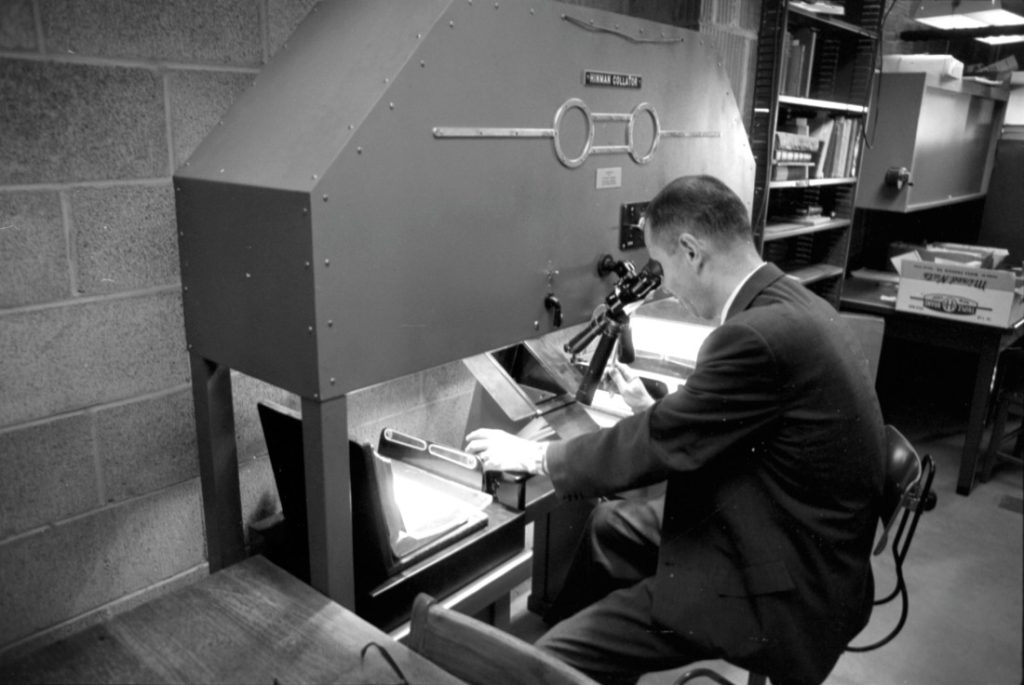
Black-and-white photograph sitting in front of a large piece of equipment and looking through an eyepiece.
Professor Charlton Hinman working at the Hinman Collator, circa 1960-1975. University Archives Photos. Call Number: RG 41/ Faculty and Staff: Hinman, Charlton (Photos). Click image to enlarge (redirect to Spencer’s digital collections).

Modern descriptive bibliography – the close physical examination and description of books – begins with Fredson Bowers’ book Principles of Bibliographical Description (1949). Bowers was a professor of English at the University of Virginia, and Charlton Hinman was Bowers’ first PhD student there. Both Hinman and Bowers had analytical minds with similar bents, which served them well in the Second World War. They were involved in cryptography and code breaking, with Bowers again leading Hinman as his commanding officer. Following their service, Bowers returned to Virginia, publishing the aforementioned Principles.
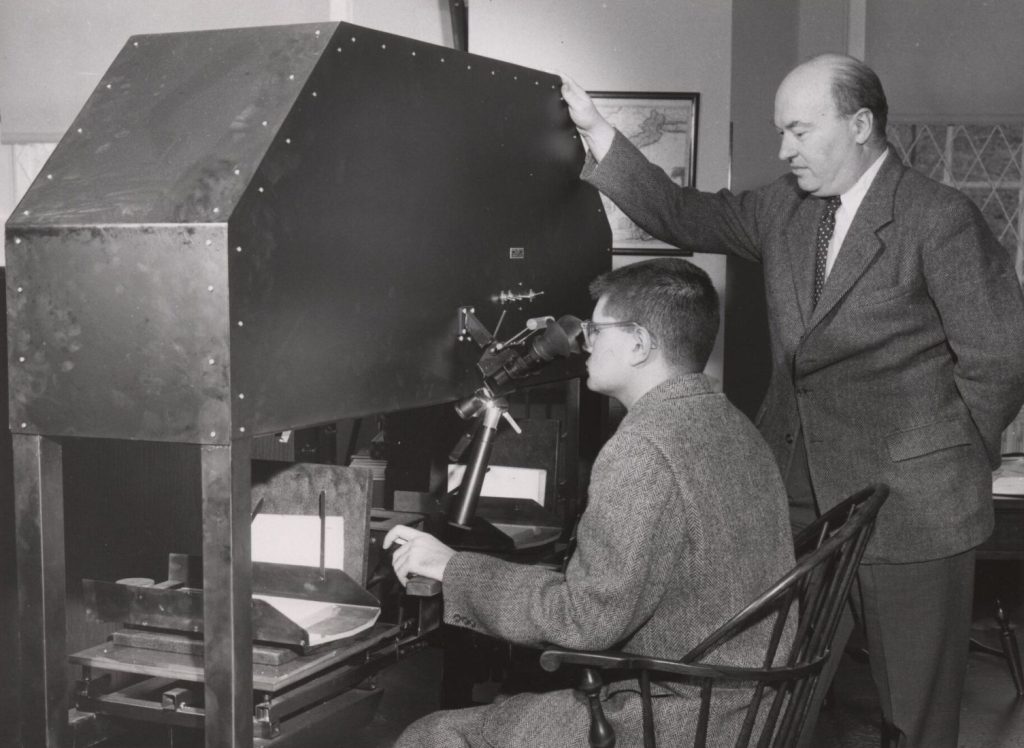
Black-and-white photograph of a man standing in front of a large machine while a second man sits and looks through the eyepiece.
Fredson Bowers supervises a student with the Hinman Collator, undated. Image courtesy of Special Collections, University of Virginia Library. University of Virginia Visual History Collection. Call Number: RG-30/1/10.011. Click image to enlarge (redirect to UVA’s digital collections).

Hinman’s dissertation, The Printing of the First Quarto of Othello, led to his first position as a research fellow at the Folger Shakespeare Library, where he collated copies of the first folio of Othello. It was Hinman’s time as a fellow at the Folger that inspired his creation of the collation machine. Collation – or, the work of examining and describing the physical evidence in a copy of a book – is time consuming. Hinman’s work was even more intensive, as he sought to find all of the different states of the pages down to the most minor corrections or insertions made by the printer in the course of printing the book. Looking at each page of text line by line is an almost impossible task. Hinman hints at this problem in his preliminary essay about the machine, which was titled “Mechanized Collation: A Preliminary Report” and printed in the Papers of the Bibliographical Society of America in 1947.
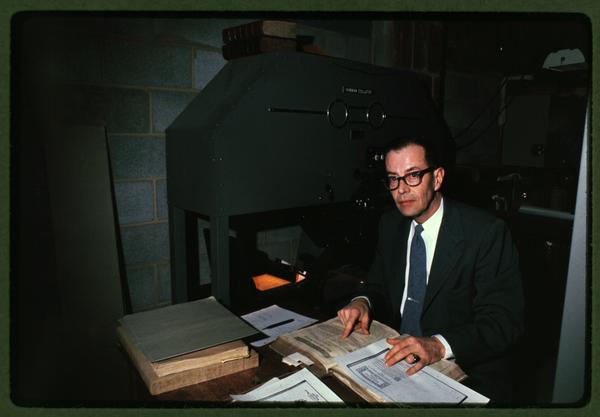
Color photo of a man with glasses sitting at desk covered in books and papers.
Charlton Hinman working at his desk (with the collator behind him), circa 1960-1975. University Archives Photos. Call Number: RG 41/ Faculty and Staff: Hinman, Charlton (Photos). Click image to enlarge (redirect to Spencer’s digital collections).

Hinman’s time in the military helped point the way to a solution, supposedly through military reconnaissance use of photography. He described the idea of taking two pictures of the same area and rapidly alternating them to spot differences. He didn’t claim he had done it as part of his cryptography work; rather, he claimed he heard about it while in the military. However, the process Hinman described was never used for reconnaissance purposes. While the military did use aerial photography, they didn’t use any method that alternated two images in a similar way to the function of the Collator. In his article “‘The Eternal Verities Verified’: Charlton Hinman and the Roots of Mechanical Collation” (Studies in Bibliography, 2000), Steven Escar Smith writes that “using World War II technology, it simply would not have been possible to photograph the same patch of ground twice from exactly the same altitude and position.” According to Smith, Hinman seems to have acknowledged that the story wasn’t entirely true, but it’s not clear whether he actually discouraged its telling.

Arthur M. Johnson, Hinman’s partner who took over building and selling collators around 1956, may have been the one to accurately describe how Hinman got the idea for the collator. Johnson wrote that Hinman had studied something that Johnson called an “astronomer’s microscope.” It used the same principle of “blink comparison” to compare images of the night sky, most famously by Kansan (and KU alumnus) Clyde W. Tombaugh in his observation of Pluto. Although it’s not known whether Hinman ever saw or used a blink comparator, he knew of the one at the observatory at UVA when he was a PhD student there. This was the true technological ancestor of Hinman’s machine.
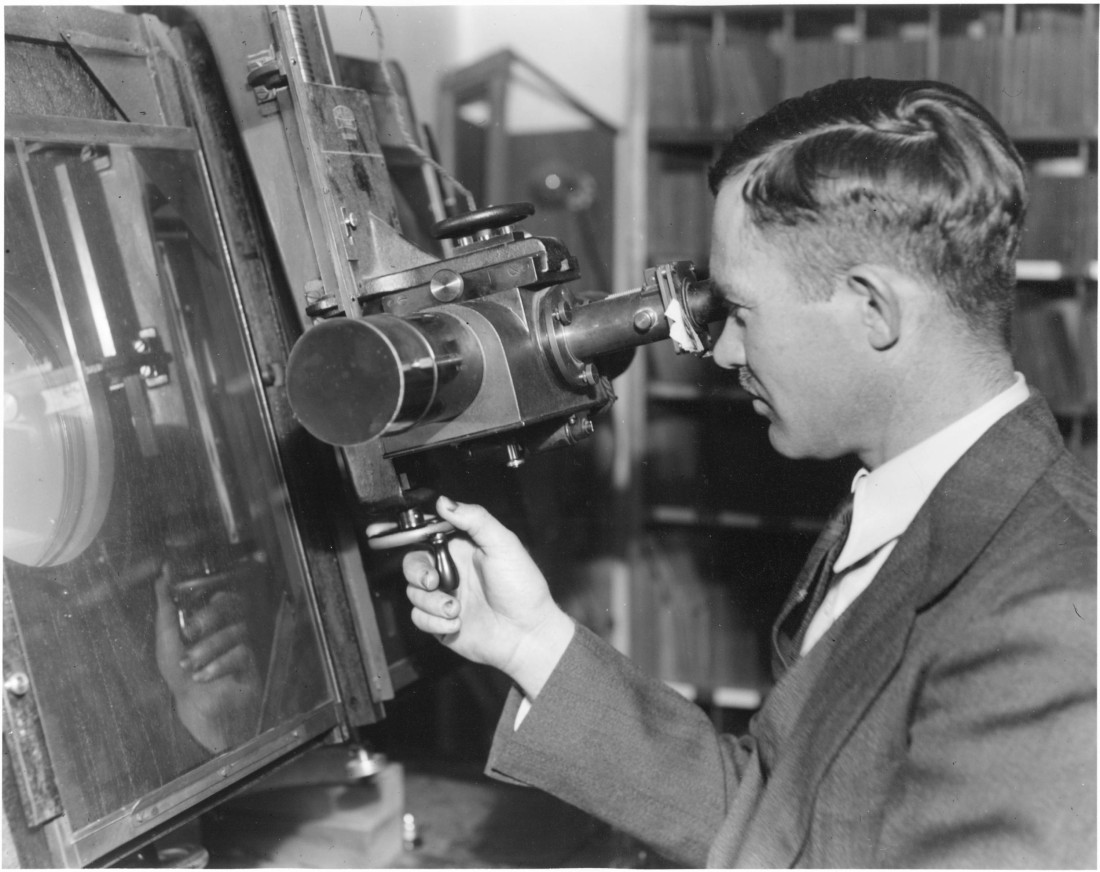
Black-and-white photograph of a man looking through an eyepiece connected to a larger machine.
Clyde W. Tombaugh at a blink comparator, undated. Image courtesy of New Mexico State University Library Archives and Special Collections, Clyde W. Tombaugh papers, image 04070052. Click image to enlarge.

These kinds of devices are simpler than the Hinman Collator in that one can use flat images of similar size – not possible with books. Hinman’s great improvement and contribution, then, was the creation of a machine that could deal with books of different sizes, thicknesses, and even formats. Hinman had a long career as a professor of English, first at Johns Hopkins University (1945-1960) and then at the University of Kansas (1960-1975), where he eventually became a University Distinguished Professor of English. Approximately 50 collators survive. The collator at Spencer (A9 in Steven Escar Smith’s 2002 census of existing Hinman Collators, published in Studies in Bibliography) is one of two that remain that Hinman himself used; the other is at the Folger Library. The effect of the collator is reproduced in this short video by Sam Lemley. Bibliographer J.P. Ascher has also made a good video about how one might use the collator, utilizing the machine at the University of Virginia.

Hoping to actually use Spencer’s machine, we ventured to the Reading Room before opening. We powered it on, and, to our delight, the 400-pound machine came to life. Unfortunately, this was not to be, as we discovered that the “blink” feature, the key function, is not currently working. Thanks to the efforts of our colleague Molly Bauer, we are slowly learning what might be wrong and what the fix might be. Look for a follow-up post in the spring about our efforts, as well as digital alternatives to optical collation that bibliographers can use today.
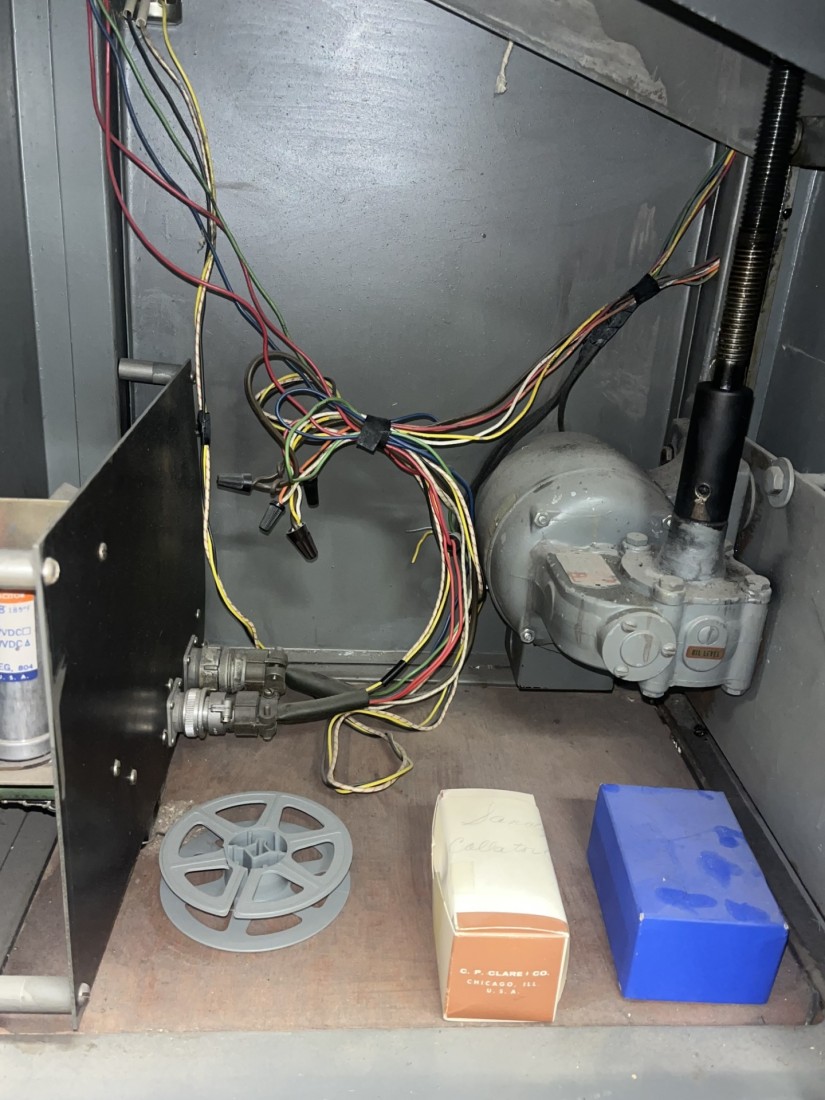
Color photograph of multicolored wires bundled together in a larger metal box.
Wiring inside the Hinman Collator at Spencer Research Library. Click image to enlarge.

The Hinman Collator, for now, stands as a testament to the ongoing work of descriptive an analytical bibliography here at the University of Kansas. Much like its creator, the machine is complicated and devoted to a very specific purpose – close looking at material objects we regularly take for granted.

Jason W. Dean and Adrienne Sanders
Rare Materials Cataloging Librarians
Meet the KSRL Staff: Jason W. Dean

August 22nd, 2025

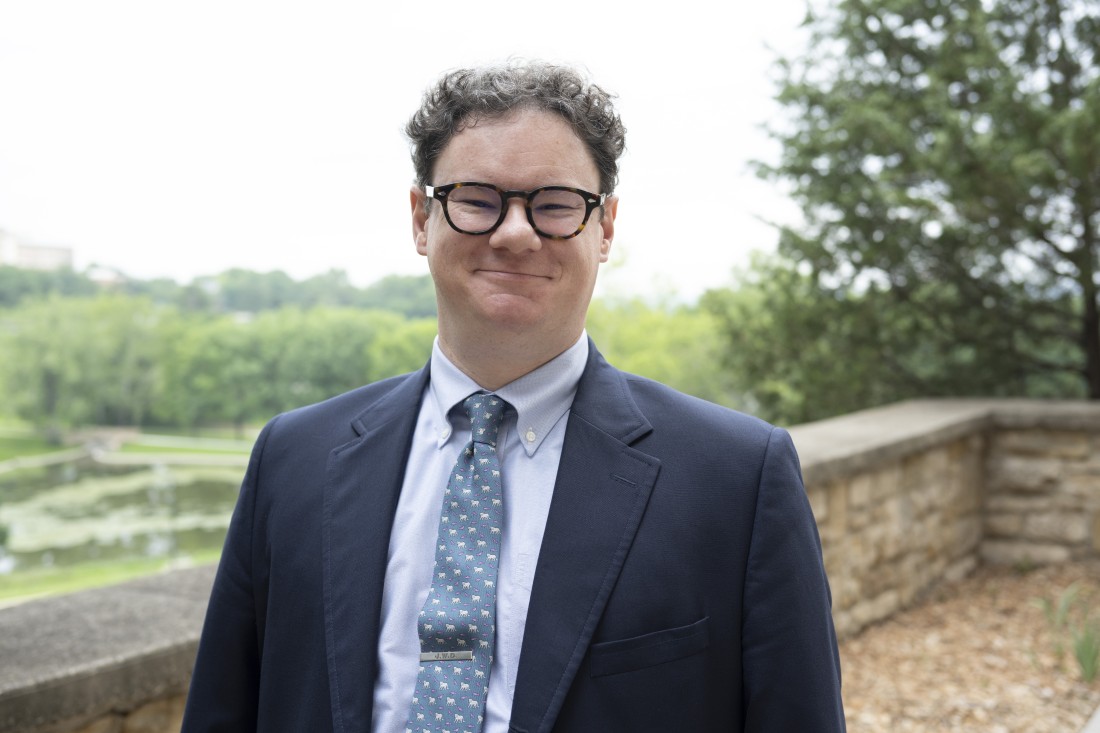
This is the latest installment in a recurring series of posts introducing readers to the staff of Kenneth Spencer Research Library. Today’s profile features Jason W. Dean, who joined Spencer Research Library in June 2025 as a Rare Materials Cataloging Librarian.

Headshot photograph of a man with glasses.
Rare Materials Cataloging Librarian Jason W. Dean. Click image to enlarge.
Where are you from?

I was born in Lubbock, Texas, and raised in Midland – both in what I call far West Texas. I went to college in Abilene at a small liberal arts university there, where much of my family went to college. I then taught and lived in the Dallas-Fort Worth area for a few years before starting my library career. My work has taken me several places: Arkansas, central Texas, Kansas City, and now Lawrence. I appreciate Lawrence and how it feels like it’s just in The West, which reminds me of the big skies of my youth.

How did you come to work at Spencer Research Library?

I’ve had the good fortune to know Spencer Director Beth Whitaker and Special Collections Curator Elspeth Healey for a while. Maybe I met them at the Rare Books and Manuscripts Section (RBMS) conference in Las Vegas in 2014? I learned about Spencer through Beth and Elspeth, but really got to know Spencer when I visited several years ago on a day trip from the Linda Hall Library. Of course, the outstanding collection and staff were well-known to me. I wanted to return to focus on the material, and the faculty position here was the right fit at the right time with the right people.

What does your job at Spencer entail?

I am responsible (along with my colleagues in processing) for the description of printed items acquired by or added to the Spencer collections. In my time here already, I’ve cataloged a number of modern paperback science fiction books from the collection of William F. Wu, some bound manuscripts, and some new acquisitions. My bread and butter are early modern books that I catalog with Descriptive Cataloging of Rare Materials (Books) – or DCRM(B) – but I am branching out (and dusting off my Resource Description and Access (RDA) cobwebs) with the help of my colleagues.

How did you come to work in libraries/archives/special collections?

I started my post-college working life teaching history to high school students in north Dallas, which I discovered was not for me. I really wanted a career that would allow me to learn and be curious as a part of my work, and librarianship really seemed the best fit. My introduction to rare books began at the Amon Carter Museum of American Art and was cemented at Crystal Bridges, where I worked to catalog Bill Reese’s American color plate book collection. I came to bibliography later in my career, when my former colleague Jamie Cumby taught me the fundamentals of collation.

What part of your job do you like best?

Conceptually I like the professional norms we have around access, privacy, and our broad commitment to, well, sharing. Special collections libraries take things that are expensive and precious and make them accessible and (almost) free.

On the micro level, using bibliographical and other tools to help folks learn more about the physical aspects of the items in Spencer’s collections and either use those descriptions in their own work or decide to come and use the item in person.

I also really enjoy writing. There’s some great stuff in the works for publication, and I am so pleased that I can do that as a normal part of my job.

What do you have on your desk?

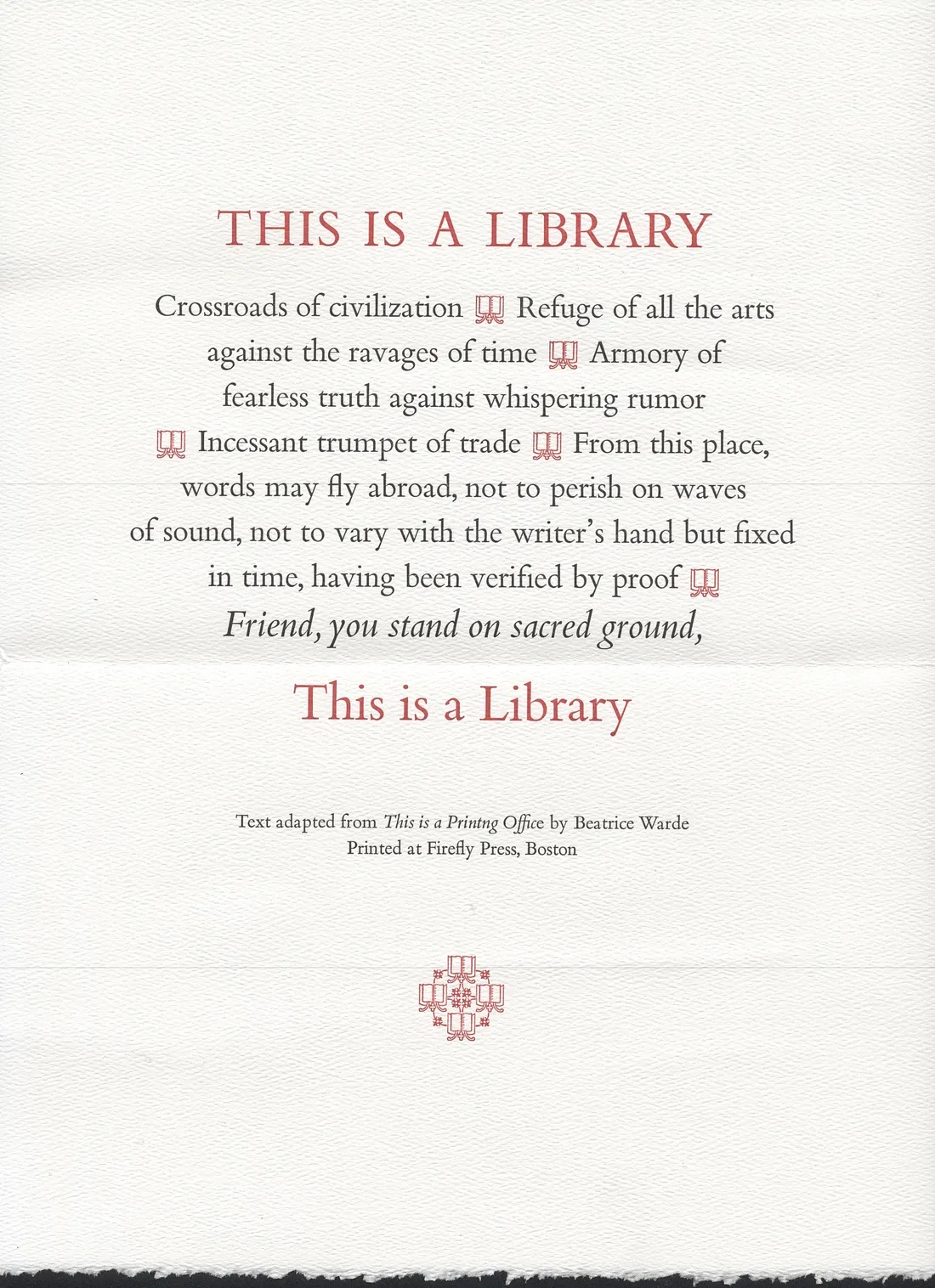
There are some things I keep at my desk I feel like are worthy of sharing here. First, this broadside printed at Firefly Press – an adaptation of Beatrice Warde’s famous lines about a printing office.

This image has text.
Jason’s office broadside. Click image to enlarge.

I also have this retablo of St. Jerome at my desk. A retablo is a two dimensional image of a saint painted by a santero, a maker of this uniquely New Mexican form of folk art. My friend Dr. Charles M. Carrillo made this image of Saint Jerome (a patron saint of librarians and archivists) to watch over me while I work, which he does!

Colorful image of a bearded man sitting and writing with a lion and an angel.
Jason’s retablo of St. Jerome. Click image to enlarge.

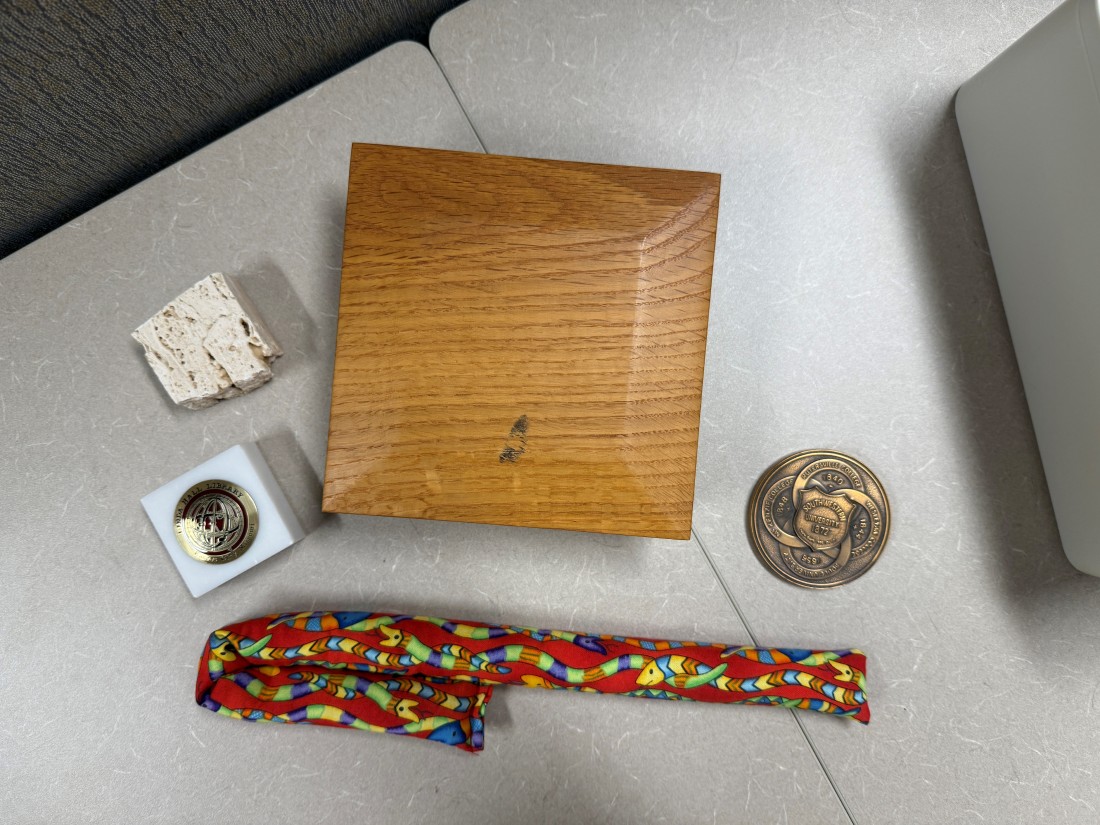
I also keep a book snake on my desk that’s been with me for 15 years. One of my colleagues at the Carter, Maryjane Harbison, made this book snake for me. It’s here with mementos from other workplaces and such: a piece of the Kimbell’s travertine, the box “original staff” at Crystal Bridges were given at opening, and medallions from the Linda Hall Library and Southwestern University.

Photograph of a wooden box and mementos.
Items from Jason’s desk. Click image to enlarge.
What is one of the most interesting items you’ve come across in Spencer’s collections?

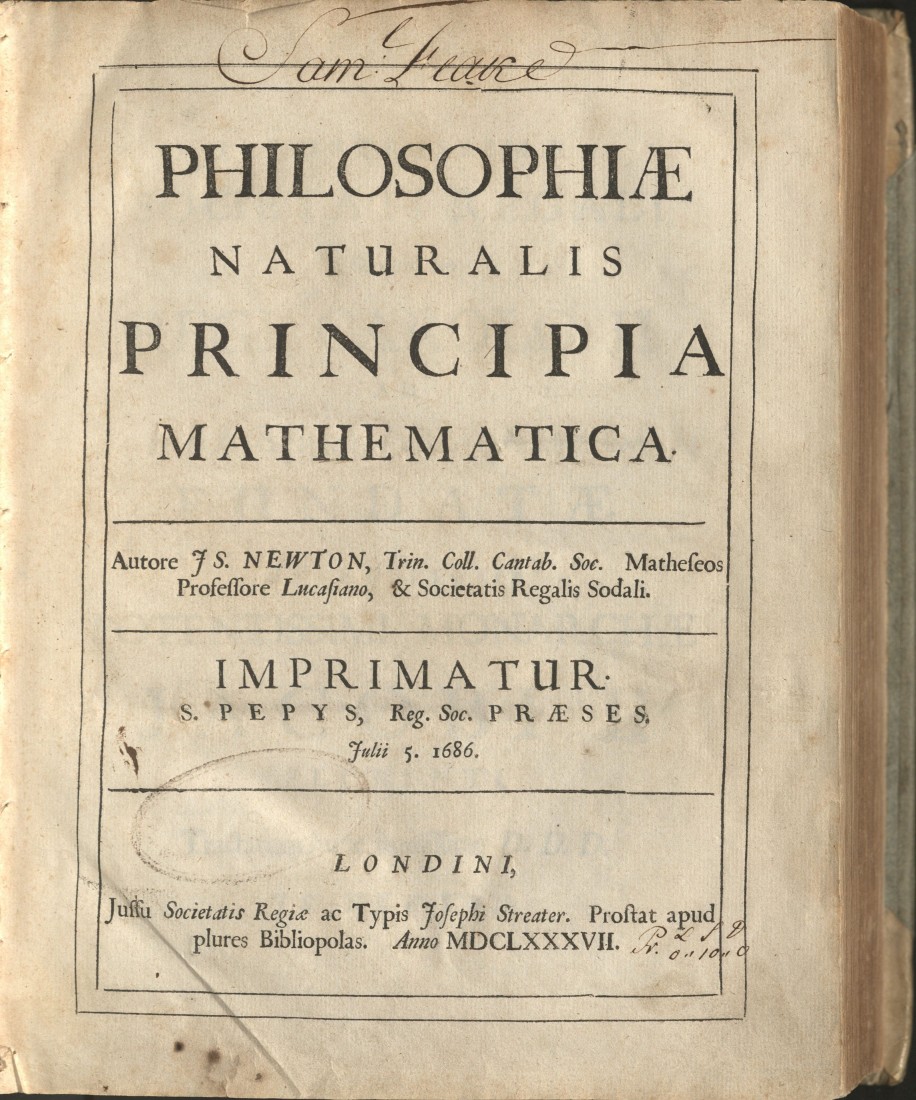
Below is the title page of the Spencer copy of Newton’s Principia Mathematica, which was a focus of some of my scholarship a few years ago. When I look closely at the book, two things are interesting to me: it has the “two line” imprint statement on the title page, not mentioning a distributor, which is the first state of the title page, and uncancelled.

This image has text.
The title page of Spencer’s copy of Isaac Newton’s Principia Mathematica, 1687. Call Number: Pryce D4. Click image to enlarge.

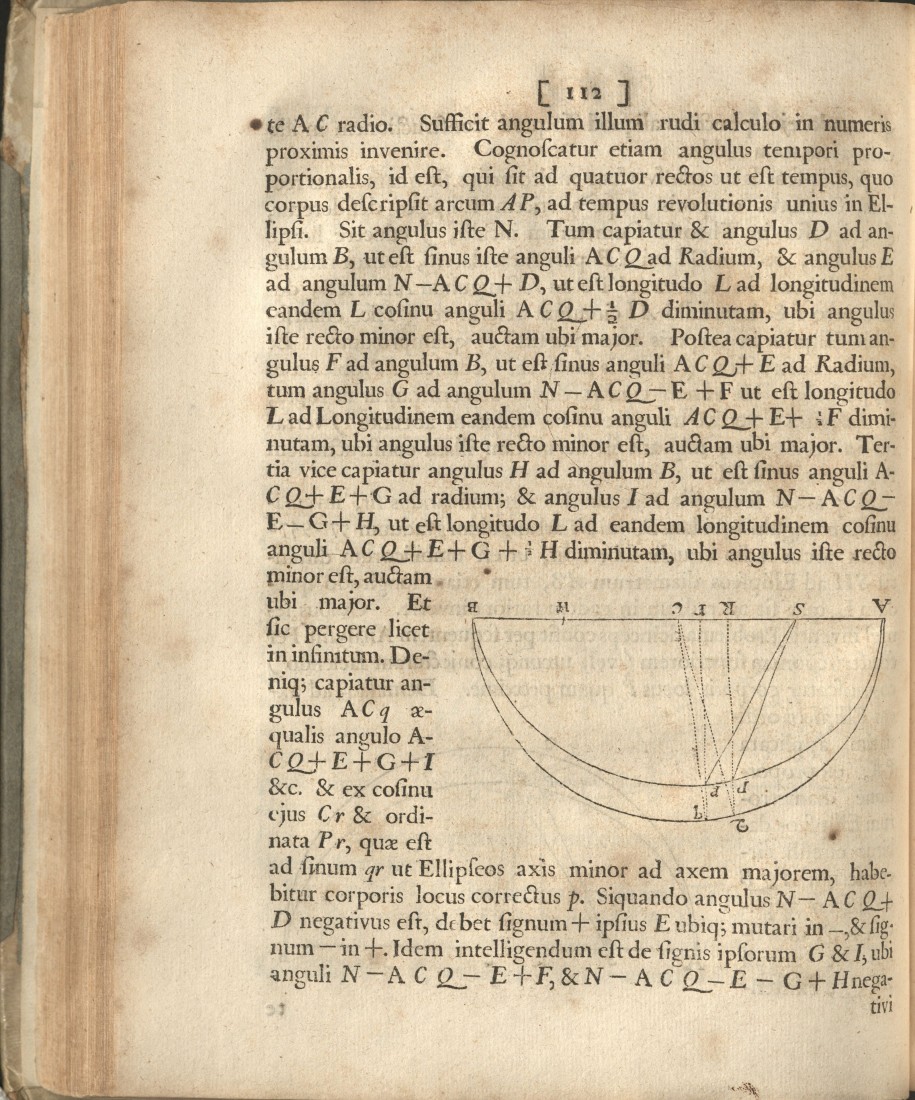
There’s another item which tells us more about this copy: the diagram on page 112 is printed upside down. Other copies of the book have this corrected with a cancel leaf. We can surmise that the Spencer copy is perhaps an early state of the S issue of the book, especially given the rarity of the uncancelled page 112, as noted by Henry Macomber in his census!

This image has text.
Page 112 in Spencer’s copy of Newton’s Principia, 1687. Note the upside down diagram. Call Number: Pryce D4. Click image to enlarge.
What are some of your favorite pastimes outside of work?

As I mentioned above, I collect art (and books, but isn’t that cliché?) – specifically the santero art I talked about, but also katsinas and photography. Photography is my hobby; my grandfather taught me photography as a teenager and it’s a passion we share with my youngest brother.

My reading interests are varied, but there are three mystery series I adore: Tony and Anne Hillerman’s Chee and Leaphorn novels, the Inspector Montalbano books by Andrea Camilleri, and the Bernie Gunter books by Philip Kerr.

I adore classical music, specifically of Bach and Philip Glass. I also serve on the board of Summerfest, so classical music is one of my favorite things.

I also do some very informal bookish writing with my good friend Rhiannon Knol. We write a bibliography and books focused newsletter called Half Sheets to the Wind.

Tadalafilo – principio activo

El medicamento original es “Cialis” (Eli Lilly).

Fue desarrollado por los estadounidenses, y lo inventaron en primer lugar para competir con el único rival existente en ese momento: el sildenafilo, la conocida Viagra de la compañía Pfizer.

Sí, el tadalafilo nació en una lucha competitiva por el mercado. Su principal diferencia para el paciente común respecto al sildenafilo consiste en que el tadalafilo tiene una duración de acción más prolongada —de veinticuatro a cuarenta horas— y además comienza a actuar más rápido, ya a los quince minutos después de la toma. A diferencia del sildenafilo, que empieza a actuar, en el mejor de los casos, a la media hora.

¿Por qué entonces no pasarse todos al tadalafilo y dejar al sildenafilo fuera del mercado, si “no es tan bueno”? Pues porque, en igualdad de condiciones, el tadalafilo resulta bastante más caro. Así que haga su elección según las posibilidades de su bolsillo y las tareas que quiera resolver: una acción romántica puntual o un tratamiento prolongado.

Eficacia del tadalafilo

El tadalafilo es uno de los medicamentos más eficaces para el tratamiento de los trastornos de la erección, es decir, la incapacidad repetida o persistente de lograr y mantener una erección suficiente para una relación sexual satisfactoria.

Así que, si una sola vez “no funcionó” o “se perdió”, no es motivo para correr a la farmacia a comprar tadalafilo, sino más bien para descansar o tomarse unas vacaciones.

Causas de la disfunción eréctil

Las causas de la disfunción eréctil pueden ser variadas:

  • Problemas vasculares u hormonales
  • Efectos de medicamentos
  • Traumatismos (incluso deportivos)
  • Factores psicológicos

Pero sepa que todo esto se puede superar y tratar.

En cualquier caso, recuerde: los eficaces son los medicamentos, no los complementos alimenticios. Los suplementos (BAA) no se recomiendan para tratar la disfunción eréctil. Aunque el tadalafilo sea un medicamento de prescripción, en la práctica casi nunca se exige receta. Esto fomenta la automedicación y, debido a su alto precio, la venta del medicamento genera buenas ganancias a las farmacias. Por eso, como alternativa más económica, muchos compran el genérico del Cialis

Tadalafilo con comida y alcohol

Si su objetivo no es el tratamiento de la disfunción eréctil, sino simplemente una velada romántica, tome tadalafilo no más tarde de 15 minutos antes del acto sexual en dosis de 5 mg, o 20 mg si planea toda la noche.

El tadalafilo se toma por vía oral independientemente de las comidas, con medio vaso de agua a temperatura ambiente. La comida grasa no reduce su eficacia. En cambio, el zumo de pomelo aumenta la concentración del fármaco en la sangre, así que un vaso de zumo recién exprimido viene muy bien.

El tadalafilo se puede tomar junto con alcohol —esto no interfiere en su acción—, pero no se recomienda tragar la pastilla con alcohol, té o café.

El tadalafilo no causa dependencia

Ni en tratamientos cortos ni en tratamientos largos el tadalafilo provoca adicción.

Si se toma para tratar la disfunción eréctil con actividad sexual frecuente (2–3 veces por semana), se recomienda 5 mg una vez al día, siempre a la misma hora.

Si la actividad sexual es poco frecuente (menos de 2 veces por semana), se recomienda 20 mg unos 15 minutos antes del acto sexual.

No se debe tomar más de 20 mg, y la edad no influye —incluso después de los 65 años no se requiere ajustar la dosis.

Duración del tratamiento

La duración del tratamiento debe determinarla el médico. Puede ser de un mes o de varios años.

Interacciones con otros medicamentos

  • Con antibióticos (Claritromicina, Eritromicina), el tadalafilo no presenta conflicto, incluso aumenta la concentración del fármaco.
  • Con antiácidos (Rennie, Almagel, Maalox), la absorción es más lenta, y el efecto aparece más tarde (hasta una hora).
  • ¡Con nitratos (Nitroglicerina y otros) está estrictamente prohibido! La combinación puede provocar una caída crítica de la presión arterial.
  • Con anticoagulantes (Warfarina, Xarelto, Aspirina) —se puede.
  • Con medicamentos para la próstata: con Tamsulosina —se puede; con Doxazosina —no (causa una caída brusca de la presión).

Conclusiones

¿Vale la pena tomar tadalafilo?

Sí, es un medicamento eficaz, que no provoca dependencia ni siquiera en tratamientos prolongados.

No afecta a la espermatogénesis y tiene un mínimo de efectos secundarios.

En mujeres no tiene utilidad: no potencia el orgasmo femenino, a pesar de los mitos publicitarios.

En hombres, el efecto aparece a los 15 minutos y dura hasta 40 horas.

Los especialistas recomiendan el tadalafilo en casos de prostatitis crónica: mejora la microcirculación y elimina la congestión de la próstata.

La principal ventaja es su acción prolongada, que permite mantener la espontaneidad y el romanticismo en las relaciones sexuales.

Jason W. Dean
Rare Materials Cataloging Librarian