The University of Kansas

Inside Spencer: The KSRL Blog

Books on a shelf

Welcome to the Kenneth Spencer Research Library blog! As the special collections and archives library at the University of Kansas, Spencer is home to remarkable and diverse collections of rare and unique items. Explore the blog to learn about the work we do and the materials we collect.

Charlton Hinman, Optical Collation, and the Big Grey Machine

January 12th, 2026

Charlton Hinman was a looker. Of course, that was true of so many of Fredson Bowers’ students – they tended to be lookers. We won’t make any comment on the relative attractiveness of Charlton Joseph Kadio Hinman or Bowers’ students, but we refer instead to the tradition of close examination and description of books that Bowers codified and Hinman continued here at the University of Kansas. On the north side of the Marilyn Stokstad Reading Room at Kenneth Spencer Research Library is the Hinman Collator, a hulking grey machine that stands as a reminder of (and a tool for) precisely that kind of work. Our colleague Caitlin Klepper wrote a post about the collator previously, but we thought we might delve more in-depth here.
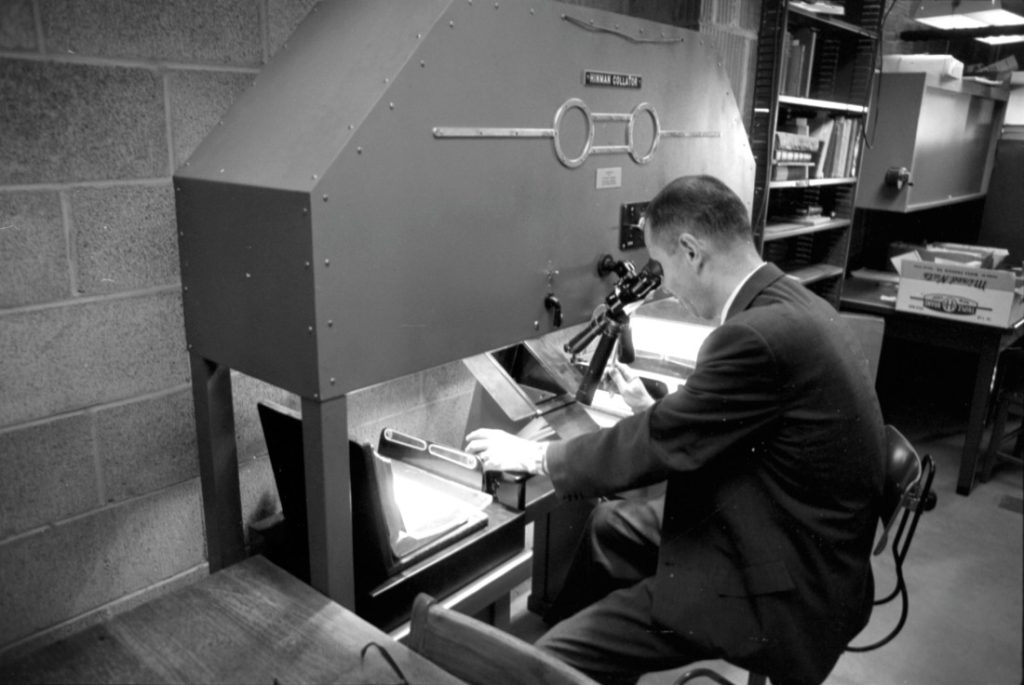
Black-and-white photograph sitting in front of a large piece of equipment and looking through an eyepiece.
Professor Charlton Hinman working at the Hinman Collator, circa 1960-1975. University Archives Photos. Call Number: RG 41/ Faculty and Staff: Hinman, Charlton (Photos). Click image to enlarge (redirect to Spencer’s digital collections).

Modern descriptive bibliography – the close physical examination and description of books – begins with Fredson Bowers’ book Principles of Bibliographical Description (1949). Bowers was a professor of English at the University of Virginia, and Charlton Hinman was Bowers’ first PhD student there. Both Hinman and Bowers had analytical minds with similar bents, which served them well in the Second World War. They were involved in cryptography and code breaking, with Bowers again leading Hinman as his commanding officer. Following their service, Bowers returned to Virginia, publishing the aforementioned Principles.
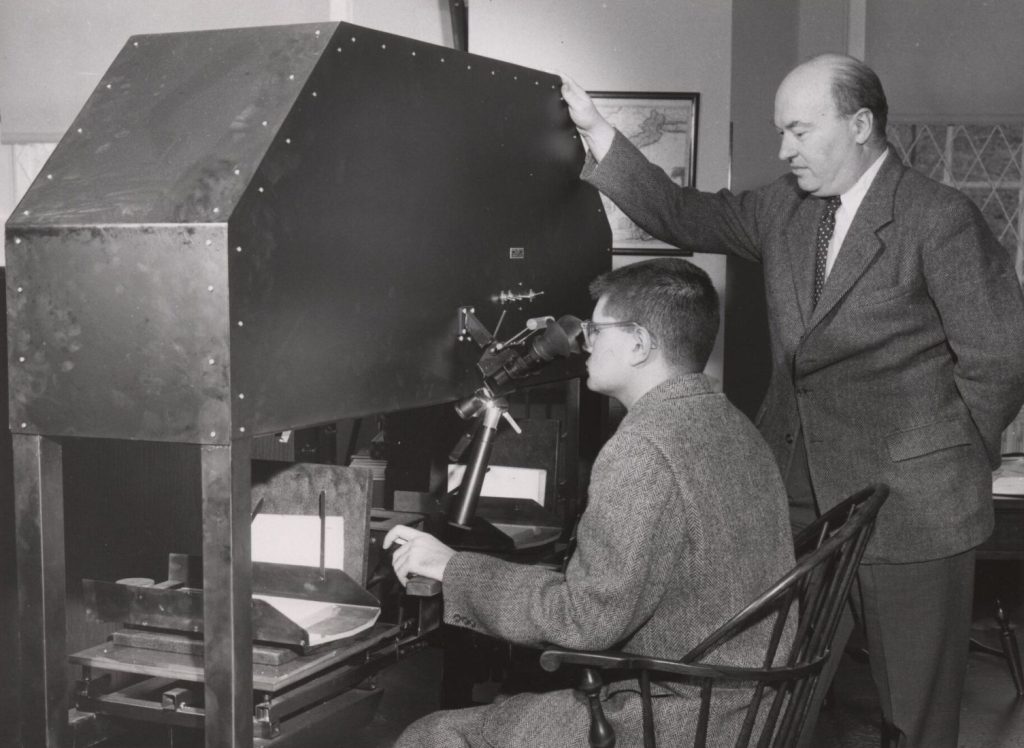
Black-and-white photograph of a man standing in front of a large machine while a second man sits and looks through the eyepiece.
Fredson Bowers supervises a student with the Hinman Collator, undated. Image courtesy of Special Collections, University of Virginia Library. University of Virginia Visual History Collection. Call Number: RG-30/1/10.011. Click image to enlarge (redirect to UVA’s digital collections).

Hinman’s dissertation, The Printing of the First Quarto of Othello, led to his first position as a research fellow at the Folger Shakespeare Library, where he collated copies of the first folio of Othello. It was Hinman’s time as a fellow at the Folger that inspired his creation of the collation machine. Collation – or, the work of examining and describing the physical evidence in a copy of a book – is time consuming. Hinman’s work was even more intensive, as he sought to find all of the different states of the pages down to the most minor corrections or insertions made by the printer in the course of printing the book. Looking at each page of text line by line is an almost impossible task. Hinman hints at this problem in his preliminary essay about the machine, which was titled “Mechanized Collation: A Preliminary Report” and printed in the Papers of the Bibliographical Society of America in 1947.
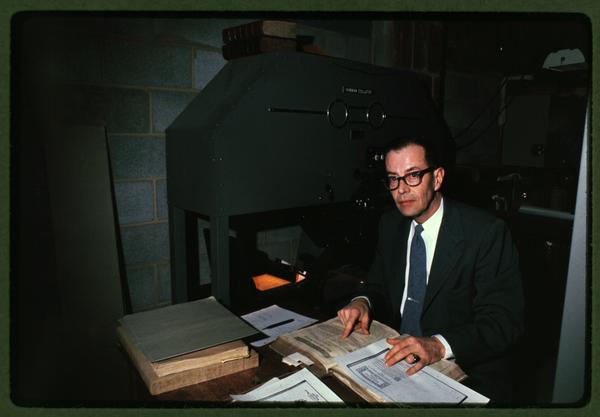
Color photo of a man with glasses sitting at desk covered in books and papers.
Charlton Hinman working at his desk (with the collator behind him), circa 1960-1975. University Archives Photos. Call Number: RG 41/ Faculty and Staff: Hinman, Charlton (Photos). Click image to enlarge (redirect to Spencer’s digital collections).

Hinman’s time in the military helped point the way to a solution, supposedly through military reconnaissance use of photography. He described the idea of taking two pictures of the same area and rapidly alternating them to spot differences. He didn’t claim he had done it as part of his cryptography work; rather, he claimed he heard about it while in the military. However, the process Hinman described was never used for reconnaissance purposes. While the military did use aerial photography, they didn’t use any method that alternated two images in a similar way to the function of the Collator. In his article “‘The Eternal Verities Verified’: Charlton Hinman and the Roots of Mechanical Collation” (Studies in Bibliography, 2000), Steven Escar Smith writes that “using World War II technology, it simply would not have been possible to photograph the same patch of ground twice from exactly the same altitude and position.” According to Smith, Hinman seems to have acknowledged that the story wasn’t entirely true, but it’s not clear whether he actually discouraged its telling.

Arthur M. Johnson, Hinman’s partner who took over building and selling collators around 1956, may have been the one to accurately describe how Hinman got the idea for the collator. Johnson wrote that Hinman had studied something that Johnson called an “astronomer’s microscope.” It used the same principle of “blink comparison” to compare images of the night sky, most famously by Kansan (and KU alumnus) Clyde W. Tombaugh in his observation of Pluto. Although it’s not known whether Hinman ever saw or used a blink comparator, he knew of the one at the observatory at UVA when he was a PhD student there. This was the true technological ancestor of Hinman’s machine.
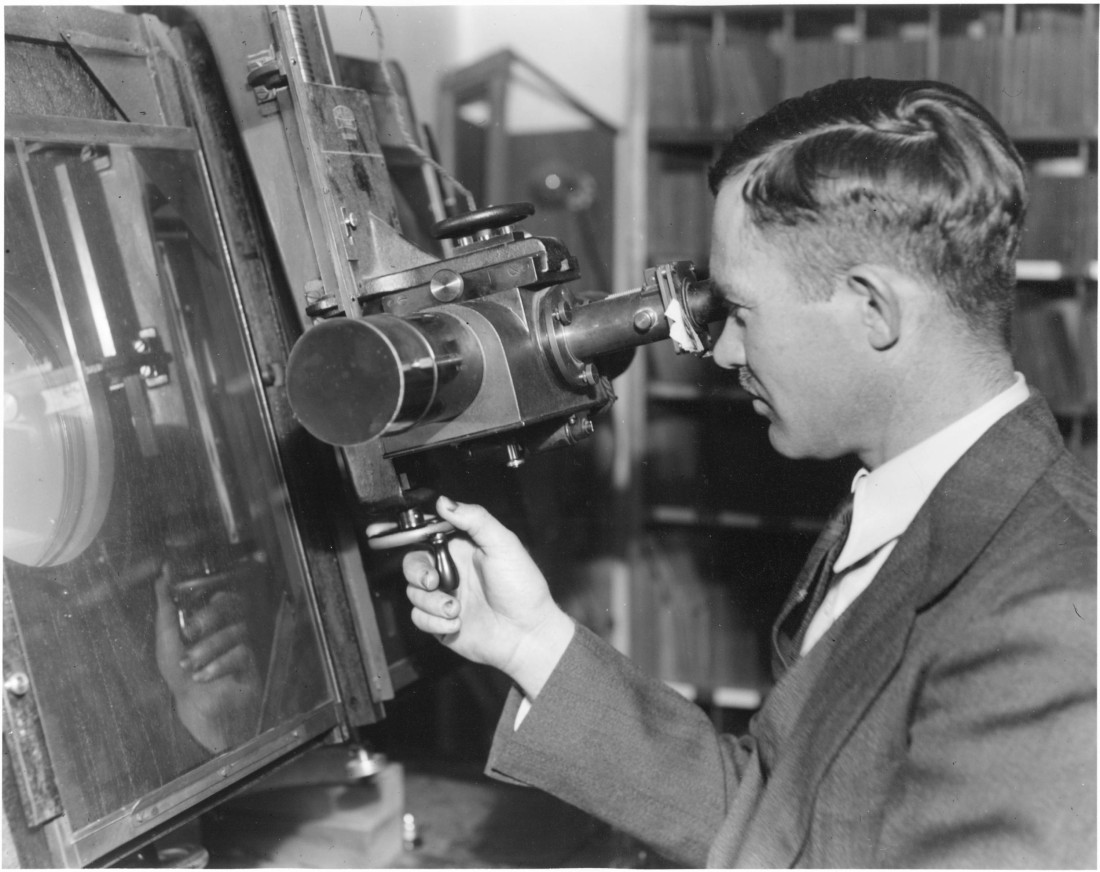
Black-and-white photograph of a man looking through an eyepiece connected to a larger machine.
Clyde W. Tombaugh at a blink comparator, undated. Image courtesy of New Mexico State University Library Archives and Special Collections, Clyde W. Tombaugh papers, image 04070052. Click image to enlarge.

These kinds of devices are simpler than the Hinman Collator in that one can use flat images of similar size – not possible with books. Hinman’s great improvement and contribution, then, was the creation of a machine that could deal with books of different sizes, thicknesses, and even formats. Hinman had a long career as a professor of English, first at Johns Hopkins University (1945-1960) and then at the University of Kansas (1960-1975), where he eventually became a University Distinguished Professor of English. Approximately 50 collators survive. The collator at Spencer (A9 in Steven Escar Smith’s 2002 census of existing Hinman Collators, published in Studies in Bibliography) is one of two that remain that Hinman himself used; the other is at the Folger Library. The effect of the collator is reproduced in this short video by Sam Lemley. Bibliographer J.P. Ascher has also made a good video about how one might use the collator, utilizing the machine at the University of Virginia.

Hoping to actually use Spencer’s machine, we ventured to the Reading Room before opening. We powered it on, and, to our delight, the 400-pound machine came to life. Unfortunately, this was not to be, as we discovered that the “blink” feature, the key function, is not currently working. Thanks to the efforts of our colleague Molly Bauer, we are slowly learning what might be wrong and what the fix might be. Look for a follow-up post in the spring about our efforts, as well as digital alternatives to optical collation that bibliographers can use today.
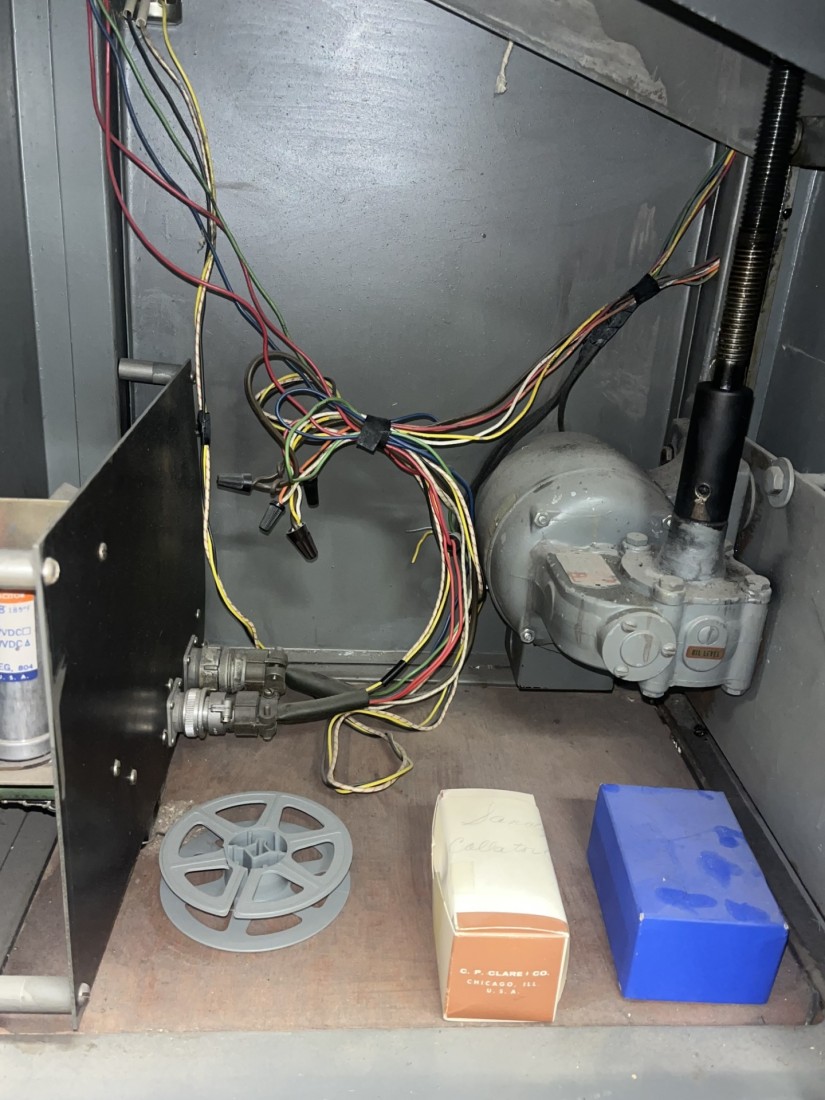
Color photograph of multicolored wires bundled together in a larger metal box.
Wiring inside the Hinman Collator at Spencer Research Library. Click image to enlarge.

The Hinman Collator, for now, stands as a testament to the ongoing work of descriptive an analytical bibliography here at the University of Kansas. Much like its creator, the machine is complicated and devoted to a very specific purpose – close looking at material objects we regularly take for granted.

Jason W. Dean and Adrienne Sanders
Rare Materials Cataloging Librarians

Meet the KSRL Staff: Adrienne Sanders

May 21st, 2024

This is the latest installment in a recurring series of posts introducing readers to the staff of Kenneth Spencer Research Library. Today’s profile features Adrienne Sanders, who joined Spencer Research Library in September 2023 as a Rare Materials Cataloging Librarian.

Photograph of a woman standing in front of a wooden bookshelf. She is holding a book about Robert Burns.
Rare Materials Cataloging Librarian Adrienne Sanders. Click image to enlarge.
Where are you from?

I’ve lived in Lawrence for over 25 years, so I think I’m from here now. I grew up in various places around the greater Kansas City area and went to college in Southern California, then came to Lawrence after getting my undergraduate degree in linguistics. I like it here so I stayed.

How did you come to work at Spencer Research Library?

I didn’t set out to specifically work with rare materials. I worked in Watson Library at KU as a cataloging staff member for many years, and then at Topeka & Shawnee County Public Library for several years. Both positions had me working with rare materials some of the time. I worked with Latin American materials from Spencer’s Griffith collection at KU and with local history materials in Topeka. This position combines my cataloging and rare materials experience, although I’m still learning more all the time.

What does your job at Spencer entail?

Cataloging, in a nutshell, is creating the description of library materials that goes into an online catalog or database, so users can find out what we have. I describe the item physically, and I also assign subject headings that say what the work is about and call numbers that tell where the item is located in the stacks. There are multiple sets of rules that tell me how to compose and structure a bibliographic record, as well as conservation guidelines we follow to physically protect the materials. All of this is so when people search our catalog, they get results that (hopefully) show them what they want and how to access it through the library.

What part of your job do you like best?

I love learning a little bit about lots of things, and this job is perfect for that. Most materials come to me in batches of similar things that were donated or purchased together and are similar in topic or genre. I have to quickly learn what they’re about in order to describe them. It could be anything from 100 books about flying saucers to a dozen zines about political protests in Hong Kong. It keeps me from ever getting bored!

What is one of the most interesting items you’ve come across in Spencer’s collections?

One of the most interesting items I’ve worked with is also one of the oldest items. It’s a document created in Spain in 1570, called a carta executiva de hidalguía (or ejecutiva in modern spelling). These cartas were created to commemorate successfully petitioning the king to become nobility. (One of the benefits of being nobility was not having to pay taxes.) It’s written in gothic script and has a couple of pages of fantastic painted illustration. It turned out to be harder to read than I’d predicted, as I quickly learned that particular type of gothic script didn’t use punctuation marks or spaces between the words. The majority of materials I work with are from the 20th century, so this was both a challenge and a treat to catalog.

Colorful illuminated manuscript page with a block of text in the middle, and illustration of Mary and baby Jesus in the upper left corner, and a large family crest at the bottom.
A page from the Carta executoria de hidalguía de Lazaro de Adarve, 1570. Call Number: MS E289. Click image to enlarge.
What are some of your favorite pastimes outside of work?

I’ve been knitting for many years, and it’s my favorite, but I will dabble in just about any craft involving yarn, fiber, or fabric. I’ve done a little crochet, embroidery, cross stitch, spinning (making yarn on a spindle), yarn dyeing, quilting, sewing, macrame, and probably more I’m forgetting. In stereotypical librarian fashion, I read a lot/listen to audiobooks, mostly literary fiction and science fiction. I also enjoy going to museums and historical sites, especially when traveling to places that are new to me.

Adrienne Sanders
Rare Materials Cataloging Librarian