The University of Kansas

Inside Spencer: The KSRL Blog

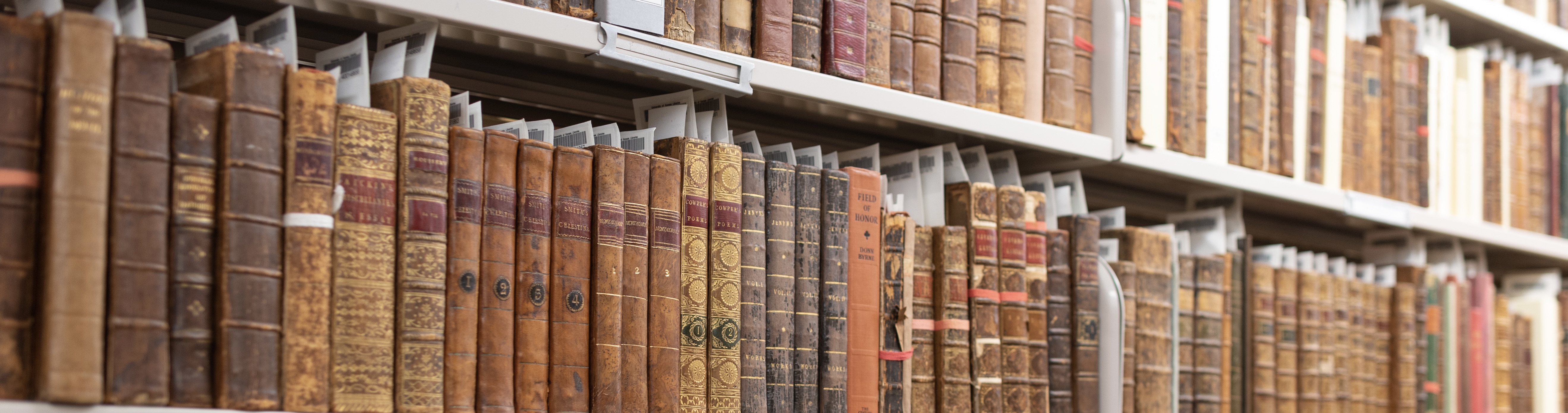
Books on a shelf

Welcome to the Kenneth Spencer Research Library blog! As the special collections and archives library at the University of Kansas, Spencer is home to remarkable and diverse collections of rare and unique items. Explore the blog to learn about the work we do and the materials we collect.

Scroll Box

December 24th, 2013

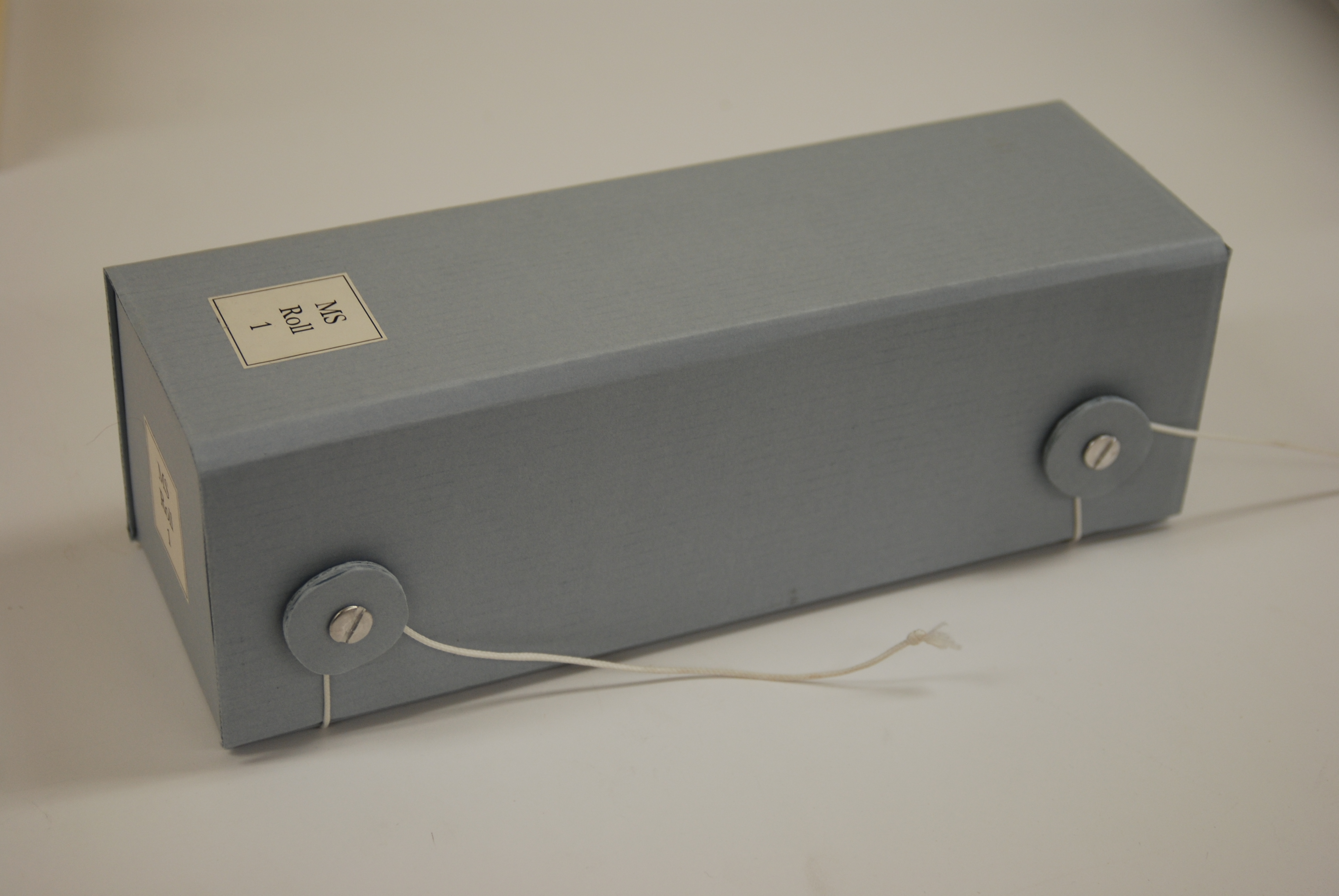
Recently, conservation student assistant, Jordan Key, constructed a series of scroll boxes from scrap materials we had on hand: corrugated board, cord, and posts for post bindings. The directions for these scroll boxes were provided by KU’s Japanese Studies Librarian, who received them in a workshop in Japan. Although we could not read the text in the scroll housing directions, the diagrams were easy to follow.

Box for scroll.   Box containing scroll

Box closed (L) and opened (R). Great Britain. Court of Chancery. Decree rolls. 1726-1728.
Call number: MS Roll 1. Special Collections.

Jordan added foam inserts on the ends for scrolls wound on wooden dowels to prevent these scrolls from being crushed. I was pleased by the final results–quick to make, elegant in appearance, and easy to use. This is a wonderful solution for materials that are too long to store flattened.

Previously, Spencer Library’s scrolls were either stored with many rolled items to a box, or not boxed at all. Now that they are each in their own box, paging these scrolls for patrons will be easier and safer.

Whitney Baker
Head, Conservation Services

If at First You Don’t Succeed…

November 28th, 2013

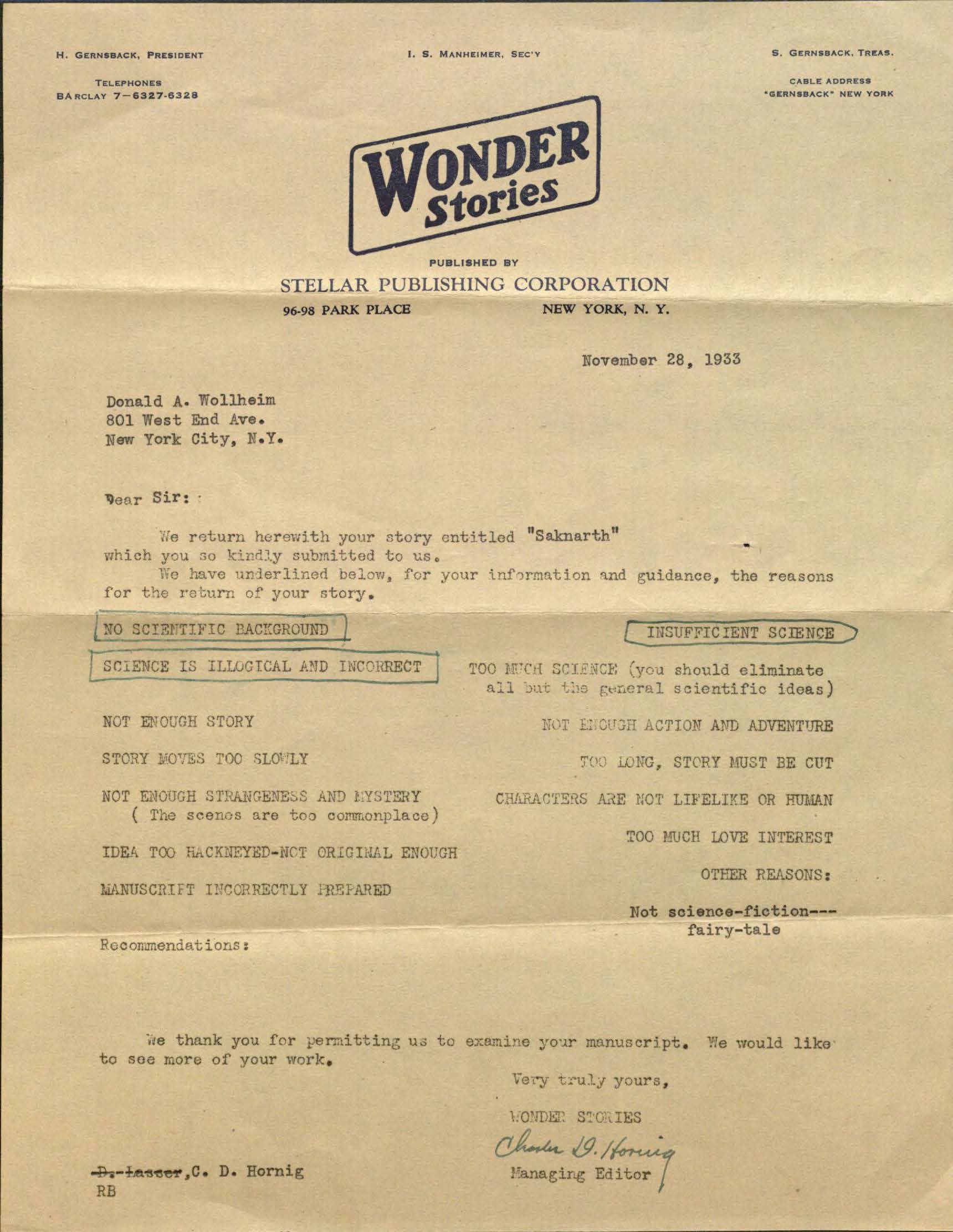
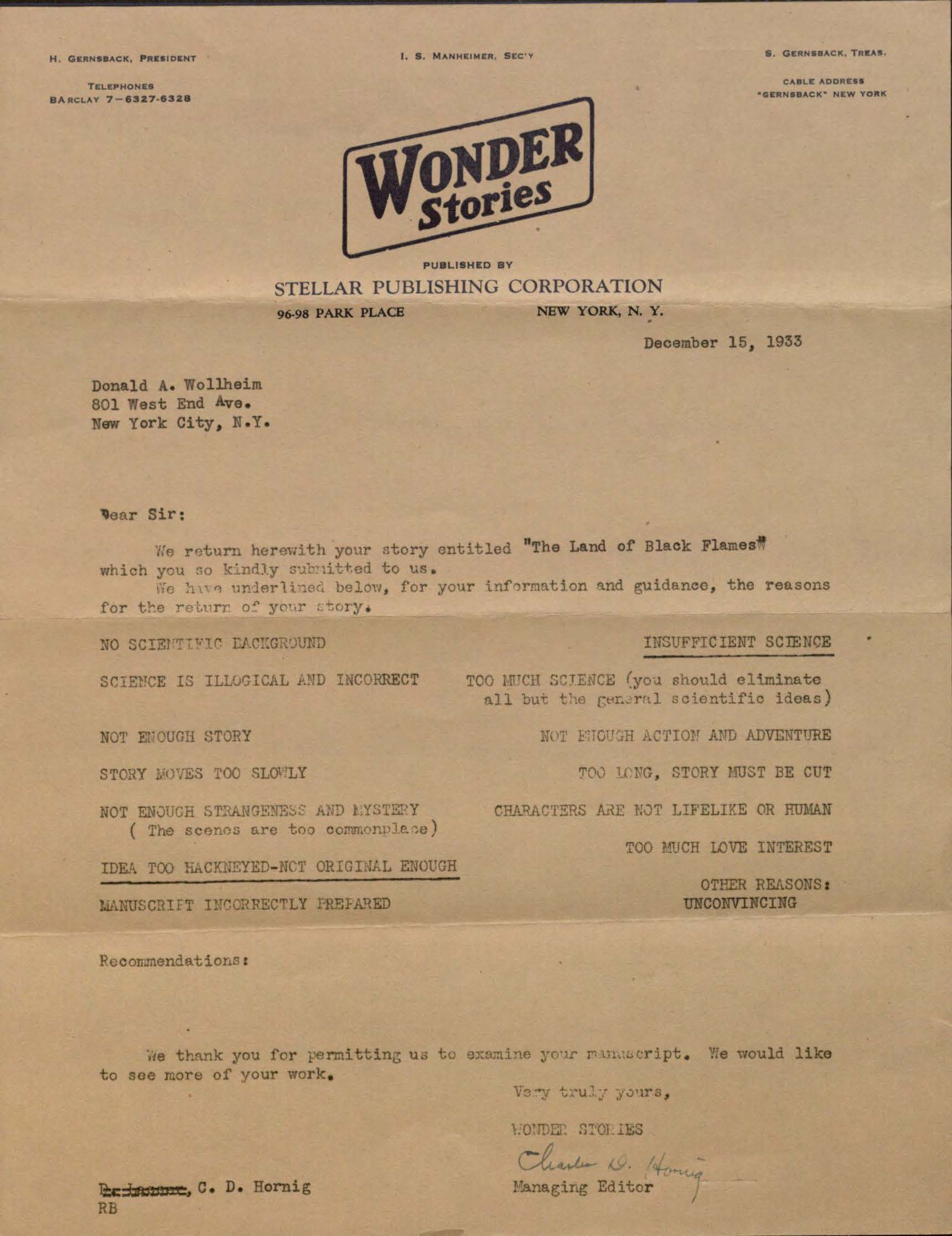
Donald A. Wollheim (1914-1990) is now celebrated for his role as a ground-breaking science fiction editor and publisher. At Ace Books, he launched the Ace Doubles series, and in 1972 he founded his own firm DAW Books, which took its name from his initials.  Wollheim also wrote books of his own, including several under the nom-de-plume David Grinnell.  However, like most writers, he also faced his fair share of rejection.  These form rejection letters from the periodical Wonder Stories offer a fascinating glimpse not only of the young Wollheim’s persistence, but of Science Fiction in the age of pulps.

Image of Wonder Stories' form rejection letter for Wollheim's "The Second Moon", [1933] Image of Wonder Stories' form rejection letter for Wollheim's "The Discovery of the Martians", [1933].
Image of Wonder Stories' form rejection letter for Donald A. Wollheim's "Saknarth," November 28, 1933. Image of Wonder Stories' form rejection letter for Donald A. Wollheim's "The Land of Black Flames," December 15, 1933.

“Insufficient Science!”: Form rejection letters from the managing editor of Wonder Stories, Charles D. Hornig, to
Donald A. Wollheim, circa 1933, for “The Second Moon,” “The Discovery of the Martians,” “Saknarth,” and
“The Land of Black Flames.” Donald A. Wollheim Papers. Call Number: MS 250, Box 4, Folder 8.
Click images to enlarge and read.

Wonder Stories‘  managing editor, Charles D. Hornig, had only to circle or underline one or more of a set list of common faults to reject a submission.  Stories might be dismissed for the following flaws:

  • No Scientific Background
  • Insufficient Science
  • Science is Illogical and Incorrect
  • Too Much Science (you should eliminate all but the general scientific ideas)
  • Not Enough Story
  • Not Enough Action and Adventure
  • Story Moves Too Slowly
  • Too Long, Story Must Be Cut
  • Not Enough Strangeness and Mystery (The scenes are too commonplace)
  • Characters Are Not Lifelike or Human
  • Idea Too Hackneyed–Not Original Enough
  • Too Much Love Interest
  • Manuscript Incorrectly Prepared
  • Other

In the four form rejection letters in Wollheim’s papers, the young writer was regularly dinged for failures of science, as in the rejection for his story “Saknarth,” dated exactly 80 years ago today (November 28, 1933). Interestingly, the rejection for Wollheim’s “The Second Moon” required a hand-alteration of the form–the story suffering from being “too short” rather than the more common flaw of being “too long” (see below).

Detail from Wonder Stories' form rejection letter for Donald A. Wollheim's Story "The Second Moon,"  [ca. 1933]

Detail from Wonder Stories‘ form rejection letter for Wollheim’s “The Second Moon.” Donald A. Wollheim Papers. Call Number: MS 250, Box 4, Folder 8.

Would it have discouraged or further inspired the nineteen-year-old Wollheim to learn that these rejections came from an editor two years his junior? Hornig of Wonder Stories was indeed himself a “Wunderkind” — just seventeen in 1933 when he began editing the magazine that SF pioneer Hugo Gernsback had founded. In addition to the form rejections, Wollheim also earned several more personalized “no”s. In October of 1933, Hornig hailed Wollheim’s “Trans-Uranus” as “very interesting and unique in its theme,” but rejected it for its scientific failings. “The ship, traveling through the planet at the speed in the story,” the precocious Hornig explained, “would be volatilized instantly, and as the Moon-men had a bodily temperature of almost absolute zero, they would melt even sooner. As this is the redeeming factor in the story, and is incorrect, it ruins the tale entirely.”

Wollheim’s efforts did, ultimately, pay off as he succeeded in publishing his first story, “The Man From Ariel,” in the January 1934 issue of the magazine (though perhaps “pay off” is the wrong phrase since Gernsback, Wonder Storiesowner, failed to pay him until Wollheim and several fellow writers threatened to sue).

By 1940, Wollheim was himself an editor–of Stirring Science Stories–and aspiring writers were turning to him. He never did quite escape that criticism of scientific error, as his papers show. When a twenty-year-old Isaac Asimov wrote to Wollheim on December 18, 1940, to congratulate him on the first issue of Stirring Science Stories, he also couldn’t resist pointing out “a few flaws in science” in two of the issue’s tales, “Bones” and “Strange Return.” Asimov playfully concedes that such nitpicking from fans must be an editor’s pet peeve, but quips “That’s all right. Right now, I feel sore at editors (yes, you guessed it, I got me a rejection today).”

It does offer some solace to the rest of us that “The Greats” must survive rejection too!

Elspeth Healey
Special Collections Librarian

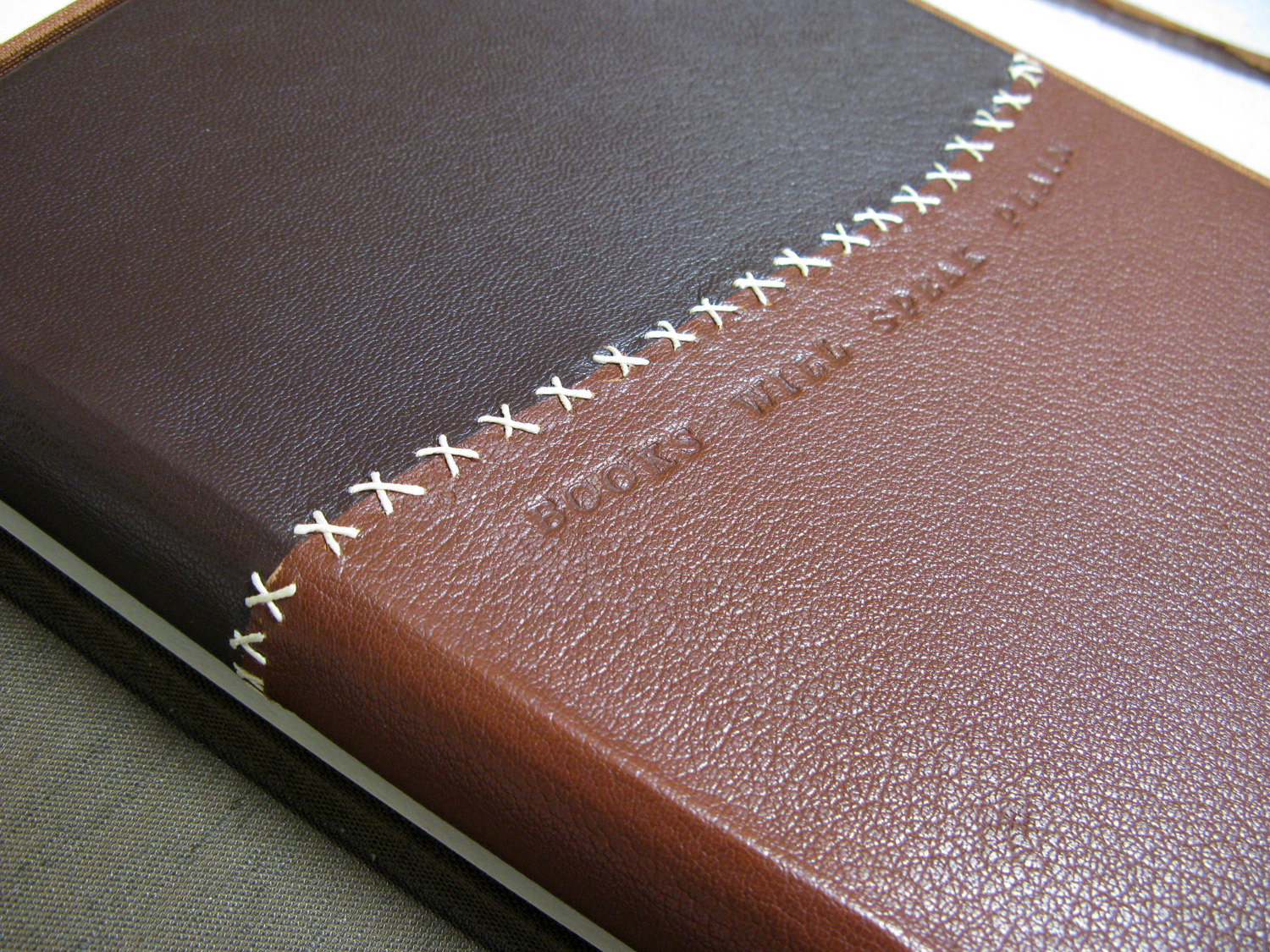
Books Will Speak Plain: Creating a Design Binding

November 15th, 2013

The Guild of Book Workers (GBW) is a national organization whose members are bookbinders, book artists, book conservators, calligraphers, and other book enthusiasts. The Midwest Chapter of GBW recently hosted a jurying of design bindings for a traveling exhibition, which opened at Spencer Library on Monday, November 11. Entrants were required to bind a copy of Julia Miller’s Books Will Speak Plain: A Handbook for Identifying and Describing Historical Bindings (Legacy Press, 2010).

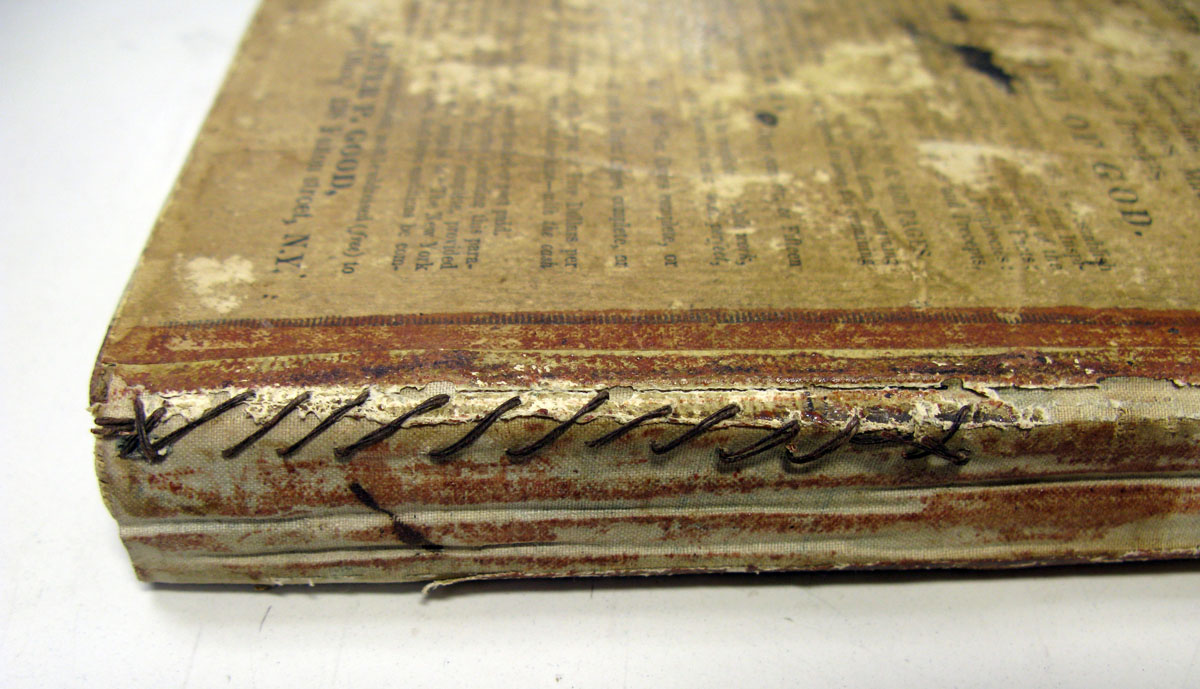
What follows is a description of how I bound my copy of Books Will Speak Plain. I gained inspiration for my binding by examining historic bookbindings from Special Collections at Spencer Library. Because Miller’s book covers the history of bookbinding, it seemed logical to create a book that touched on book history in some fashion. In my role as conservator, I am fortunate to have the chance to closely examine books and have long been interested in evidence of past repair. I found various examples in Spencer’s stacks of books that had been repaired by sewing on loose parts, such as a detaching spine or cover board. I decided to use this concept as the driving force in the design of my book.
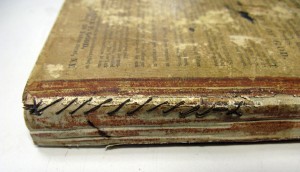
Detail of sewing repair on Sunderland, La Roy. Pathetism; with practical instructions. New York, 1843. Call number B6443. Special Collections, Kenneth Spencer Research Library, University of Kansas.

Detail of sewing repair on Sunderland, La Roy. Pathetism; with practical instructions. New York, 1843. Call number B6443. Click image to enlarge.

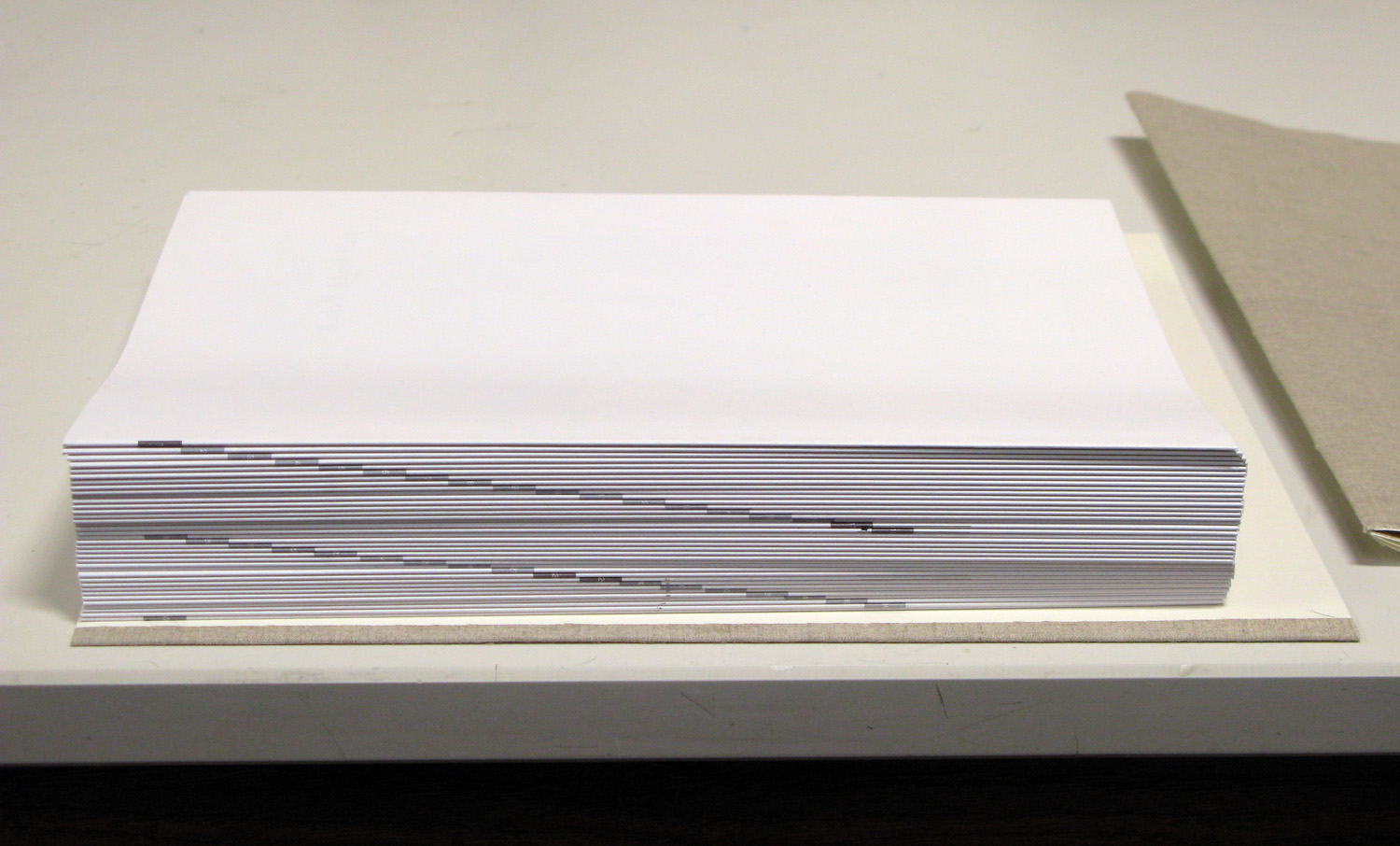
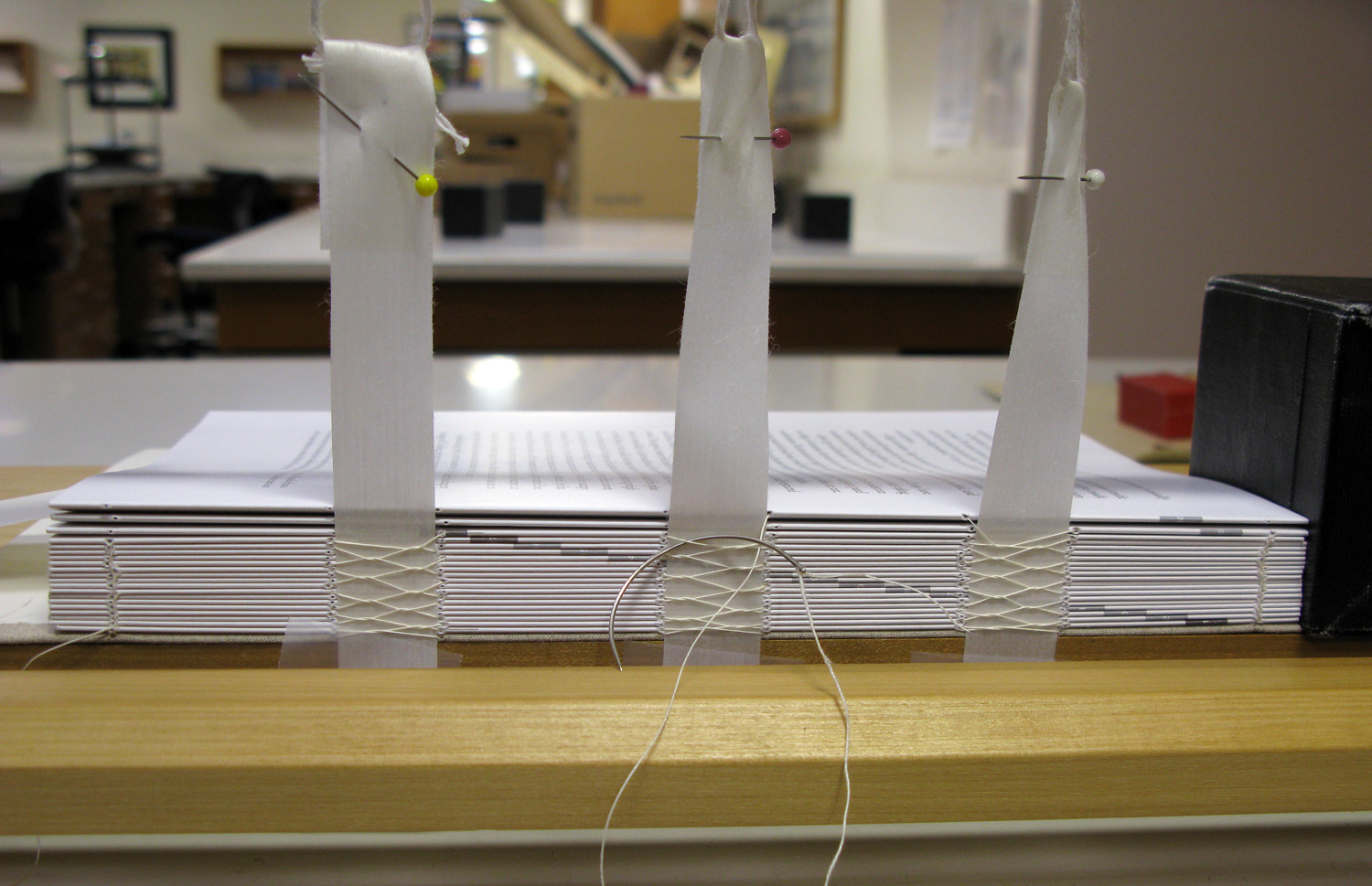
The 500-page book arrived in folded sheets of paper. The textblock paper was dense, which ruled out certain styles of bookbinding that could not support the weight of such heavy paper. The book was sewn on three sewing supports made out of the fiber ramie. The book was sewn on a sewing frame, using a link stitch.
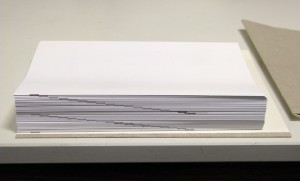
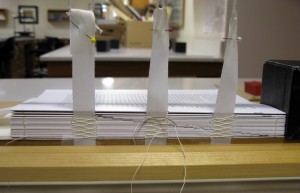
Image of folded gatherings of paper, copy of Julia Miller's Books Will Speak Plain (Legacy Press, 2010).    Whitney Baker's design binding of Books Will Speak Plain (Legacy Press, 2010).

Left: Book in sheets. Right: Sewing book on a sewing frame. Click images to enlarge.

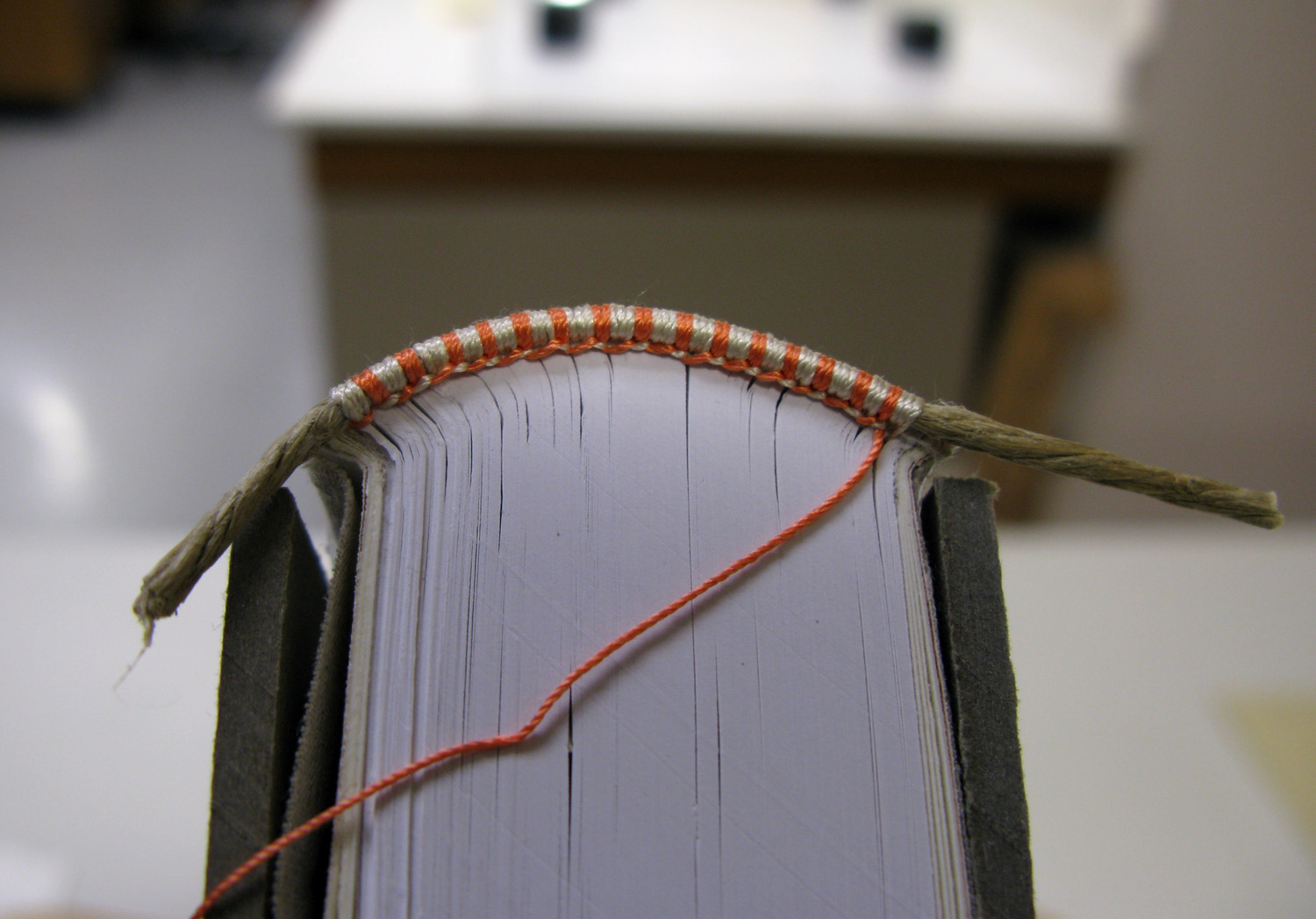
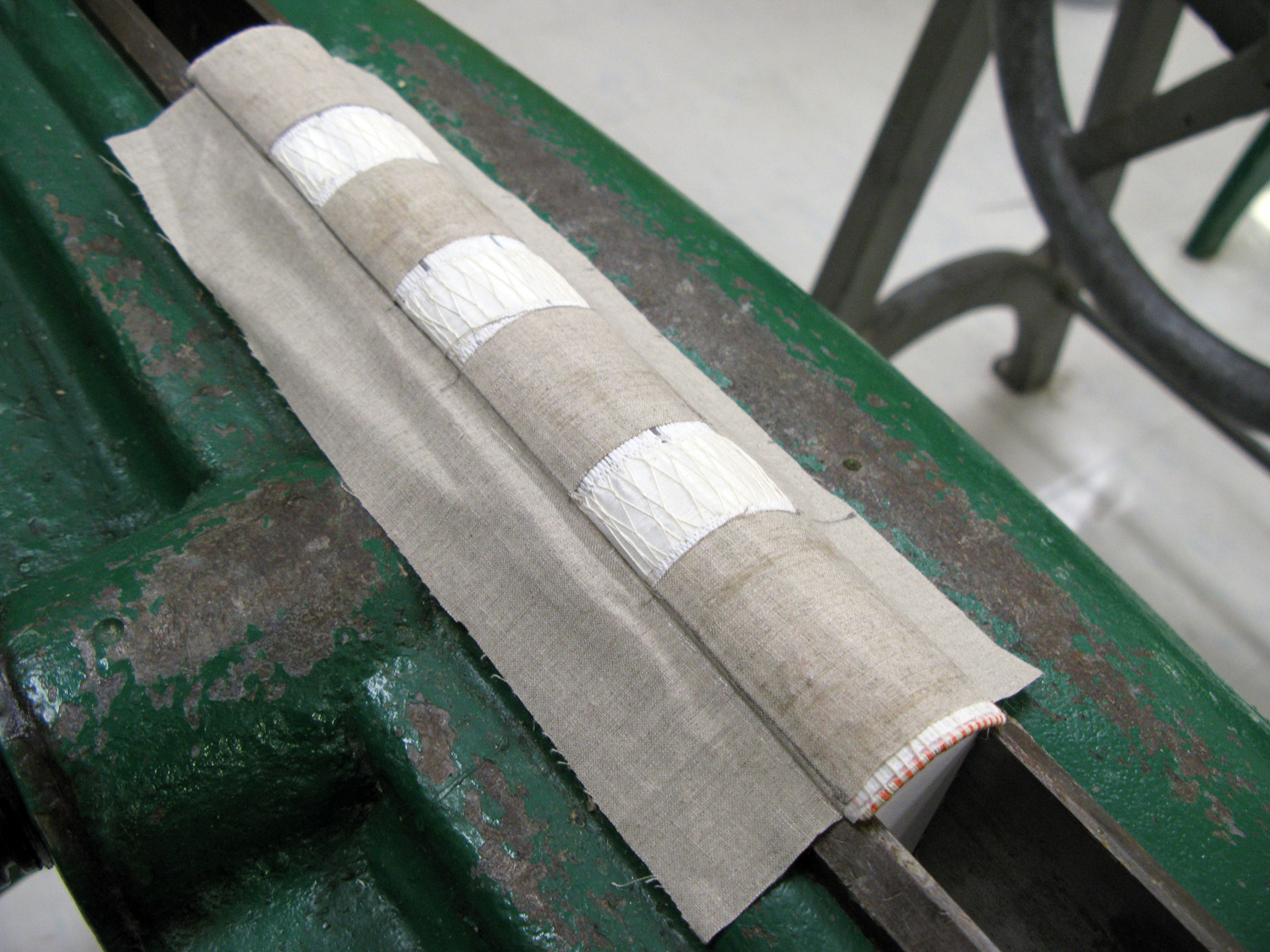
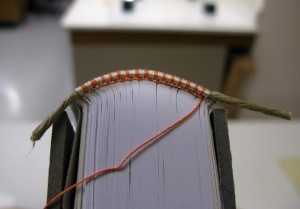
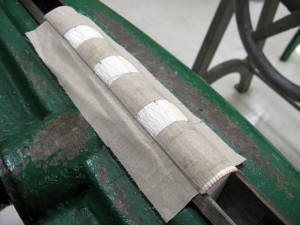
I sewed silk endbands in cream and orange. The silk bands were sewn around a core of linen thread. Next the book’s spine was lined to provide some rigidity and set the round spine shape. I first applied a layer of Japanese paper with wheat starch paste, then a layer of Western paper, and finally airplane linen.
Whitney Baker's design binding of Books Will Speak Plain (Legacy Press, 2010).   Whitney Baker's design binding of Books Will Speak Plain (Legacy Press, 2010).

Left: Sewing endbands with orange and cream thread. Right: Spine linings of paper and airplane linen. Click images to enlarge.

Next the ramie bands, around which book was sewn, were frayed out and adhered to the book boards.
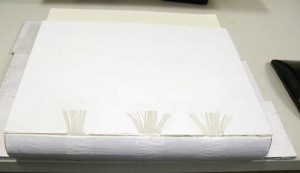
Sewing supports attached to board of book

Boards attached to textblock via frayed-out ramieband sewing supports. Click image to enlarge.

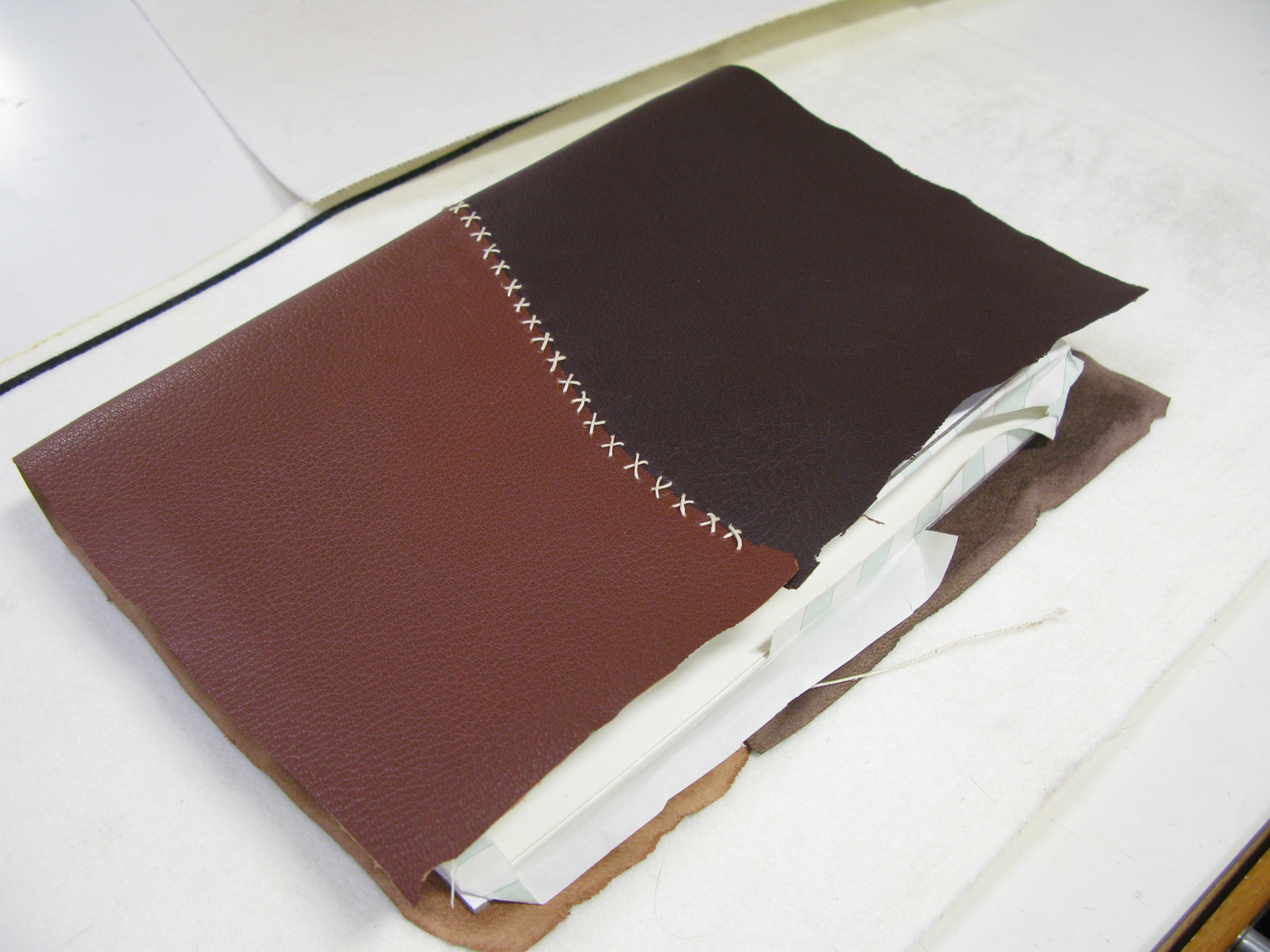
Once the boards were on, it was time to cover the book. I decided to use two contrasting colors of morocco (goatskin) leather, sewed together with coarse thread.

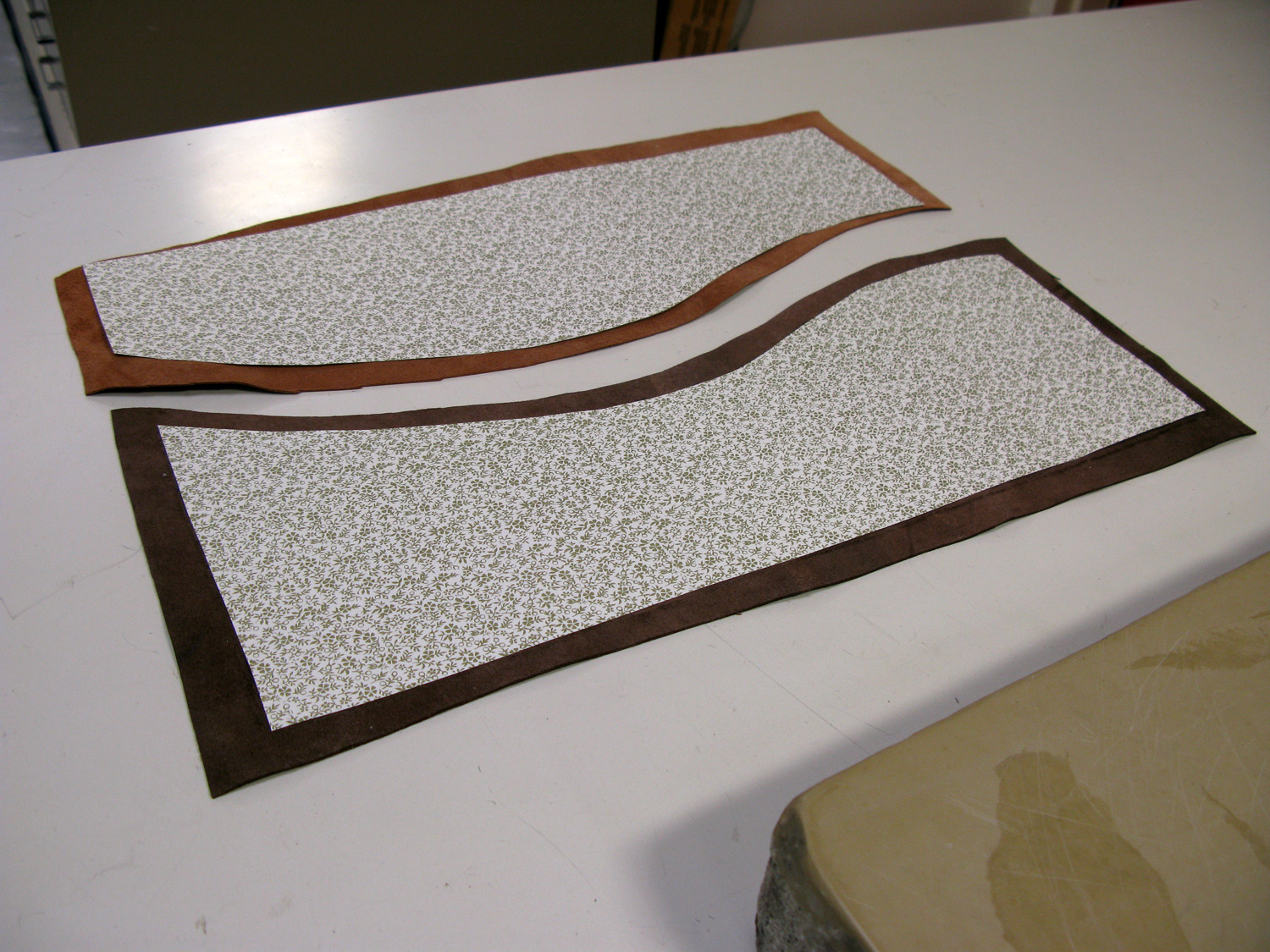
First I cut out templates for the leather pieces. The edges of the leather were pared to a thin edge, especially where the two pieces overlapped in the middle of the book.
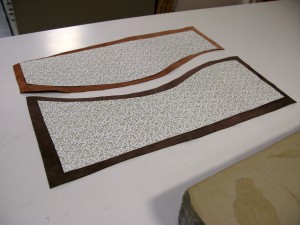
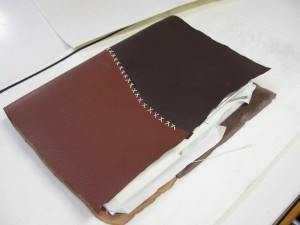
Cut out pieces of leather   Whitney Baker's design binding of Books Will Speak Plain (Legacy Press, 2010).

Left: Cut leather pieces with templates. Right: Joined leather pieces wrapped around textblock. Click images to enlarge.

The leather was attached with wheat starch paste.  Here you see the headcap tied up with thread in a finishing press to help give the leather a good shape where the boards and spine meet.
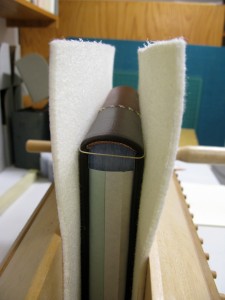
Whitney Baker's design binding of Books Will Speak Plain (Legacy Press, 2010).

Book covered with leather, with headcap tied up with thread. Click image to enlarge.

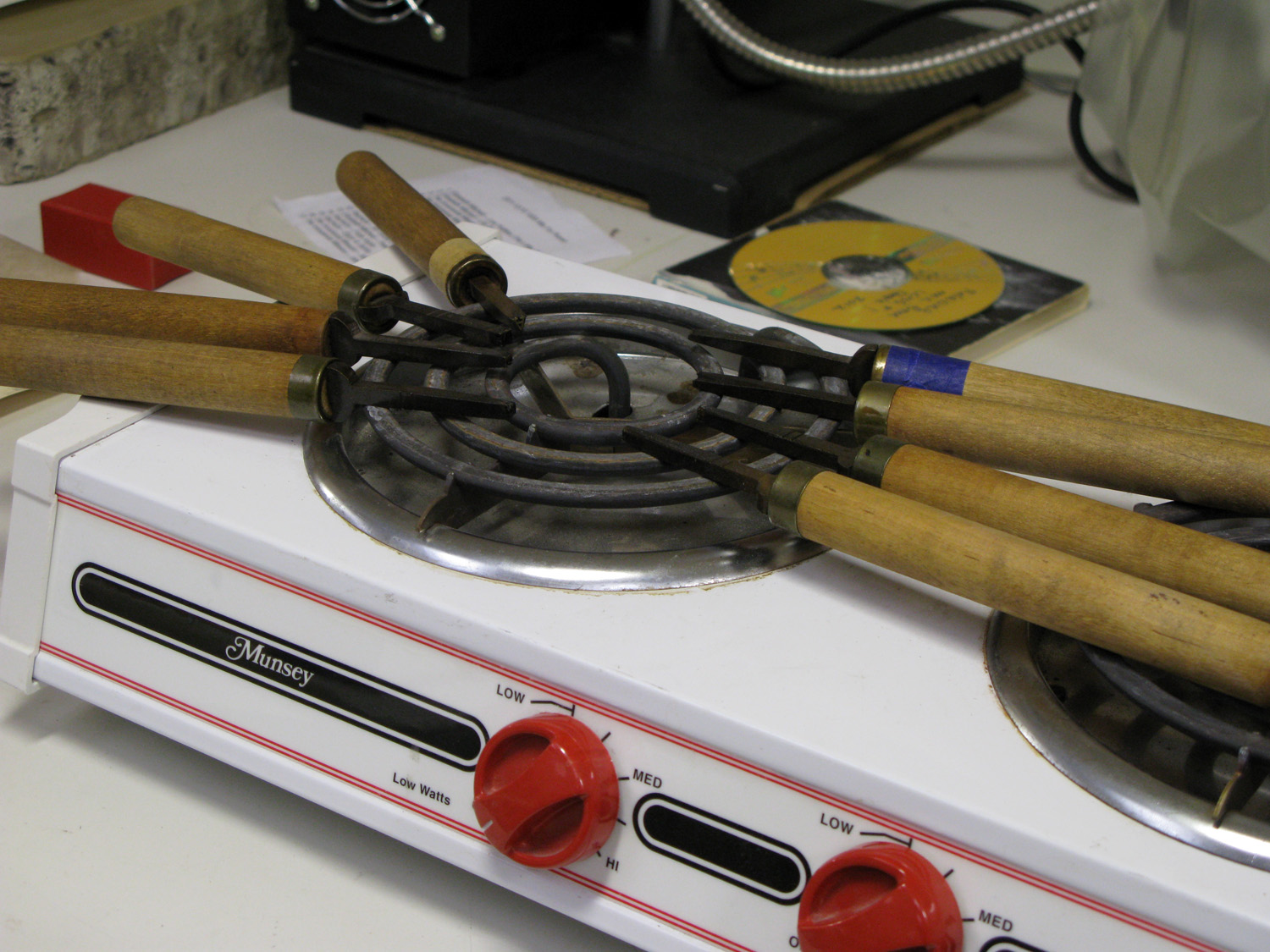
Once the leather was applied to the book, next came labeling. I used individual brass letter tools, heated on a hotplate. (A stove designed for the purpose is preferable, but I didn’t have one at my disposal.) Each letter is “branded” individually in the leather. When it is left like that, with no gold leaf or foil applied over it, it is called “blind” tooling.
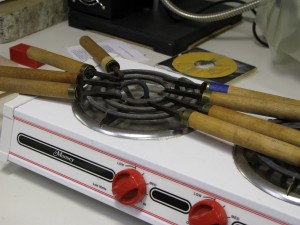
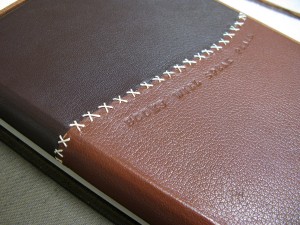
W. Baker Plainly Spoken Exhibit entry: heated tools on stove   Whitney Baker's design binding of Books Will Speak Plain (Legacy Press, 2010).

Left: Tools resting on hot plate. Right: Detail of finished book with blind tooling. Click images to enlarge.

This book was accepted into the blind juried show. You can see it and other fine bindings in the Plainly Spoken exhibit at Spencer Library through January 6, 2014. If you are near Lawrence, please come to the Gallery Talk on November 21, from 3-4 PM. The Spencer exhibit features both the design bindings as well as historical examples from Special Collection that complement them.

Whitney Baker
Head, Conservation Services
First Impressions

November 9th, 2013

Setting type may not be as easy as it looks, but it is good fun! Throughout October intrepid students in the History of the Book (English 520 / History 500) made several trips to the press room in Spencer’s basement to execute a printing project using the library’s historic presses. Reading about printing during the hand press era offers some insight, but it is easy for the process to remain shrouded in mystery until you try it out yourself. As you stand in front of a case of type, the logistical considerations involved in producing a book–such as format, imposition, line length, and style and size of type–quickly take on a new reality.

Students hand-inking the type using a brayer. Photograph of student lowering the frisket, October 2013

Photograph of printing on a hand press, Kenneth Spencer Research Library

Image of the History of the Book class printing in the Spencer Research Library's basement, October 2013.

Students from The History of the Book  (ENGL 520 / HIST 500) operate the press with
the assistance of printer Tim O’Brien (in the blue apron and striped shirt).

Since Spencer houses wonderful Irish Collections, we elected to print W. B. Yeats’s poem “The Wild Swans at Coole,” which has an appropriately autumnal theme. Each student set two lines of the poem, picking type, letter by letter, from the case and depositing it in a composing stick held in the opposite hand. (If you are right-handed, you would hold the composing stick in your left hand and pick with the right.) The set lines were then transferred to a tray called a “galley” for assembly as a page.  Wooden furniture and metal quoins were used to lock the composed pages into a metal chase, which was then positioned in the press.

As an early proof of the poem quickly revealed, setting type is a skill that requires practice and concentration.  Some speculate that the caution to “mind one’s p’s and q’s” originates in printing, since these two pieces of type are easily confused.  In examining our proof, it seems it was our b’s and d’s that needed minding.  Though excessive errors could lead to docked wages in an eighteenth-century print shop, for us, making (and correcting) mistakes was an instructive part of the process.

Image of an initial proof of the poem lying on a case of type.

“If at first you don’t succeed…”:  proofing and correcting our mistakes.

The project was printed in “folio” format, each printed sheet folded once to create two leaves (or four pages). First, the class printed the “outer forme” (containing the title page and the colophon). Then, after some drying time, we “perfected” the sheets by printing the “inner forme” (containing the poem’s text) on the verso.

Title page and colophon locked in the chase

Outer Forme: the title page and colophon locked in the chase.  Wooden “furniture” and
metal “quoins” provide the pressure needed to keep everything wedged tightly in place.

In the early days, printing usually involved two pressman–one to insert the paper and work the press, and the second to ink the type. Under the guidance of printer Tim O’Brien, the students each took a turn at both roles.  As the class discovered, there is definitely a genuine satisfaction that comes from operating a hand press.  Of course, the best part is that it produces such wonderfully tangible mementos!

Image of the completed leaflet (copies folded and unfolded): The Wild Swans at Coole Image of the printed text of the poem "The Image of the printed text of Yeats's poem, "The Wild Swans at Coole."

Ta-dah! The finished product. To read the full text of “The Wild Swans at Coole” click the image on the right to enlarge.

Elspeth Healey
Special Collections Librarian

The Young Poisoner’s Handbook

October 18th, 2013

Sir Joseph Fayrer’s account of the Thanatophidia is important as a classic, systematic account of the venomous snakes of India. This second edition (the first was in 1872) was improved with the addition of text, even though the 31 lithographs (including 28 chromolithos) are identical in both editions.

Fayrer conducted extensive studies of the poison apparatus in Indian snakes and was responsible for many advances in the treatment of snakebite, including the use of potassium permanganate, of which he was the originator.

Image of a cobra, Ophiophagus Elaps (plate 8) from Fayrer's the Thanatophidia of India

Above:  Plate 8 (Ophiophagus Elaps) from Joseph Fayrer’s The Thanatophidia of India,  second edition. London: J. and A. Churchill, 1874. Call Number: H199. Click image to enlarge.

The venomous snakes, and by extension all snakes, get a bad rap for what is primarily an extremely efficient food-getting mechanism, only secondarily defensive.  Unless they are themselves attached, they kill other animals only for food.  How else to get supper without either arms or legs?  For a snake, there’s constriction or there’s fangs, although the spitting cobras of Africa send their poison by air-mail, blinding their victim.  There is some question among herpetologists about whether the black mamba (the largest venomous snake in Africa) or the cobra, shown here in a very striking pose, will actually attack a human.  Most snakes will try to escape a predator. In the United States, some species, such as the cottonmouth, will stand their ground and strike if the unwary come to close.

Sally Haines
Rare Books Cataloger
Adapted from her Spencer Research Library exhibit and catalog, Slithy Toves: Illustrated Classic Herpetological Books at the University of Kansas in Pictures and Conservations