
Remembering Sam Adams and his Highways to Hope
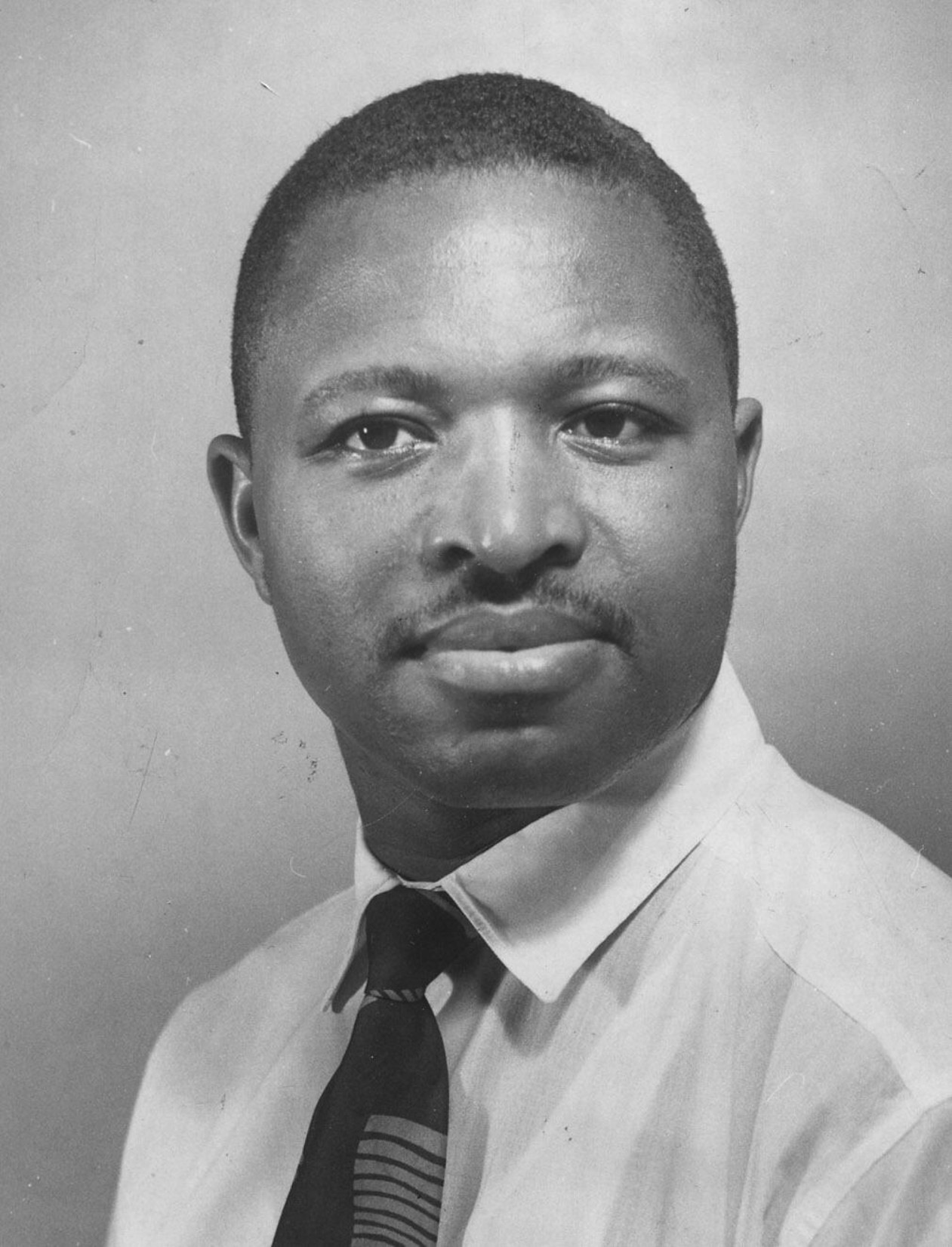
For 25 years, Sam Adams was an associate professor of journalism at the University of Kansas. That followed a career during which he worked as a reporter or editor at half a dozen newspapers, most notably the St. Petersburg Times.
Adams died in 2019 at the age of 93. In 2025, his daughter, Carol Adams Smith, donated his personal papers to KU’s Kenneth Spencer Research Library.
Ken Stephens, a retired journalist and member of the Board of Advocates for KU Libraries, has since sifted through Adams’ papers and other sources for this report.
In June 1964, Newsweek wrote that “the race beat” was “the most dangerous domestic assignment in U.S. journalism.”
Among a handful of reporters, Newsweek’s story cited Sam Adams of the St. Petersburg Times. As a black reporter covering the civil rights struggle for a white-owned southern newspaper, Adams was exceptionally rare, the magazine noted.[i]
By the time of Newsweek’s 1964 report, Adams, at 38, had already faced the hostility of southern police officers and white crowds while covering racial unrest in Birmingham, Ala., Albany, Ga., and Jacksonville and St. Augustine, Fla.
For Adams, it began on Feb. 18, 1956, when the Atlanta Daily World sent him to Columbus, Ga., to cover the slaying of Dr. Thomas H. Brewer, a physician and president of the local NAACP. “It was a harbinger of my career, trials and triumphs covering the struggle, the violence and killings that characterized the civil rights years,” Adams wrote in a speech prepared for delivery at Emory University on Nov. 8, 1997.[ii]
Working for the St. Petersburg Times, Adams covered Gov. George Wallace’s stand in the schoolhouse door in a failed attempt to block integration of the University of Alabama in June 1963. He also reported on the March on Washington for Jobs and Freedom in August 1963, when Martin Luther King Jr. delivered his “I have a dream” speech.
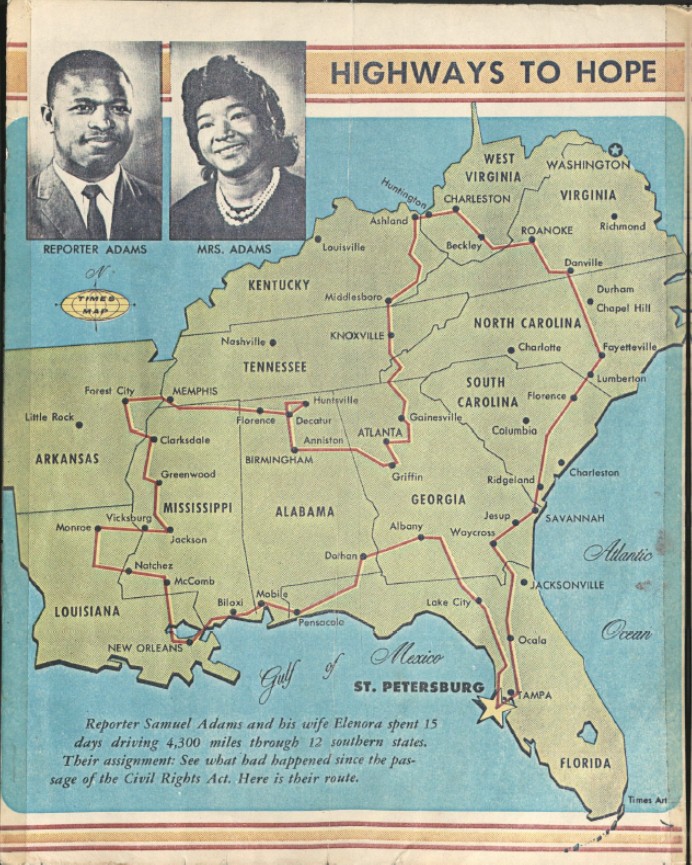
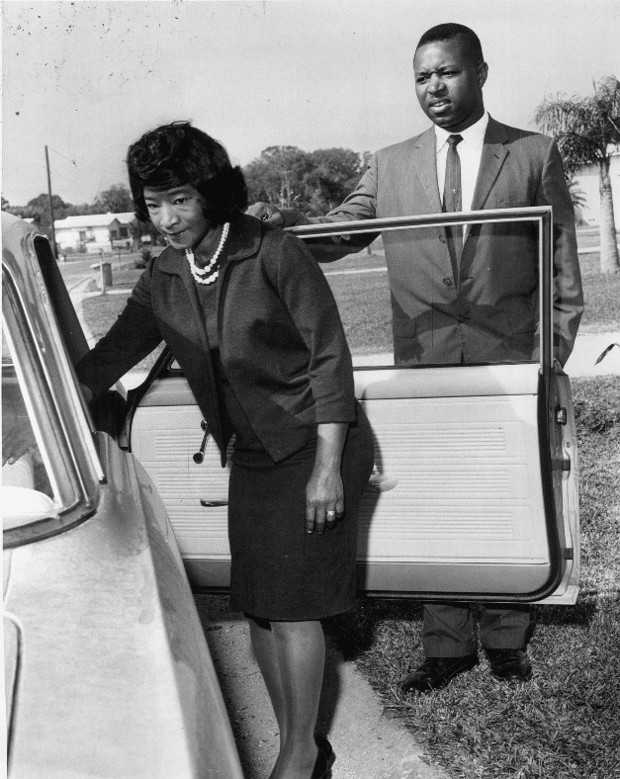
Then, in October 1964, not quite four months after the Civil Rights Act became law, The St. Petersburg Times sent Adams and his wife, Elenora, on a 15-day, 4,300-mile driving tour across 12 southern states to see if the new law had changed anything in the South. They were to seemingly be just two middle-class black tourists.[iii]
“We were to forget, if we could, our color,” Adams wrote. “We were to report what happened to us, but to precipitate no trouble.”
Concerned friends had suggested that Adams shouldn’t embark on the trip without something to protect the two, and they offered to loan him a gun. Adams turned them down. A white friend had convinced Elenora to accept a tear gas pistol, but Sam vetoed that too.
“I have lived with fear so long I am hardly aware it’s there,” Adams wrote in the conclusion to his seven-part series.
They left their two young children, Carol, then 14, and Sam Jr., then 4, in the care of a young woman from Adams’ hometown who was staying with them while attending junior college.[iv]
Carol Adams Smith said she didn’t recall her parents telling them much about the planned trip.
“I think it was vaguely expressed to, to me, and so I don’t think at that time that I understood the seriousness of the journey that they were about to embark on,” she said.
The couple found that in many places discrimination remained unrepentant and undisguised, as when, just 50 miles into their journey, they were turned away at Hillsborough River State Park. “It’s my understanding I’m not to admit colored. I’m sorry,” the park attendant said.
At a gas station in Belleview, Fla., restrooms were still designated Ladies, Gentlemen and Colored. In other places, they were told that the restrooms were out of order or locked and the key was missing. In one place they were told simply that the restrooms were “not for y’all.”
At two motels in Waterboro, S.C., they were refused a room because they were only two people and the only room available was for bigger families. Sam offered to pay the family rate, but the Adamses were sent on down the highway.
At a restaurant in Hinesville, Ga., they were met at the door by a waitress who announced “we’re closing.” It was the middle of the afternoon, and the restaurant did not close. A restaurant in St. George, S.C., served them breakfast, but at twice the cost to white customers. At a truck stop in Liberty County, Ga., they were not seated in the large restaurant but taken to an area at the rear of the building near the colored restrooms.
However, they found other places where they were welcomed, enough such places to give the title “Highways to Hope” to Adams’ 7-part series in The St. Petersburg Times.
They were given a room at the Ware Hotel in Waycross, Ga., Adams’ hometown, “without question.” Some white guests looked on curiously, but the black maids and porters looked on with pride.
Five years earlier, at a gas station in Jackson, Ga., Sam, Elenora and Carol, then 9, had been chased off by an attendant with a handgun because Carol had walked into the ladies restroom instead of the colored restroom.
“I remember seeing that gun pointing at my dad and him actually coming to escort me back to the car after going into that restroom,” Carol said. “But I don’t know whether or not I actually understood the intensity of that situation, being at the age that I was at that time. But I remember my parents saying that I was crying and scared.”
Sam and Elenora returned to the gas station on their 1964 tour and were treated with respect by a different attendant and allowed to use the restrooms.
In Danville, Va., Elenora froze when they walked into honky tonk full of white beer drinkers listening to hillbilly songs on the juke box. Just a year earlier, she had been on a bus headed to the March on Washington, when a police officer stepped aboard and warned that they were not to sing any Freedom Songs while passing through Danville.
In the honky tonk in 1964, they seated themselves at the only empty table, ordered coffee and were pleasantly surprised when a burly shuffleboard player leaned over to politely ask if he could rest his beer glass on their table while he took his turn.
In Huntington, W.Va., they were refused service at a small restaurant, aptly named the White Pantry. “Sorry, no colored,” a man in chef’s whites said. “We don’t serve colored.”
In Cumberland, Ky., they were denied a hotel room by a clerk employing one of the ruses used to try to get around the law: “This here is a club.”
But in Andrews, Tenn., they received a “warm and friendly welcome” at a small restaurant and a Western Auto store where they stopped to buy batteries for their radio.
In Mobile, Ala., Elenora spotted a message in a hotel clerk’s area that said, in part: “Every penny of Negro trade forced on this establishment will be donated to the White Citizens Council. If you want Negroes in the next door flat, vote Democrat.”
In Monroe, La., a hotel clerk found their reservation but turned them away because “we didn’t know you was colored when we took it.” The clerk insisted they go elsewhere “for your safety and mine.”
In Clarksdale, Miss., when they stopped at a pharmacy owned by a black doctor and his wife, a police officer repeatedly drove past, peering into the store. The doctor’s wife assured them there was nothing to fear during daylight but rattled off a list of don’ts for when the sun went down. “They do their dirt at night,” she said.
They registered at a nearby Holiday Inn but were frightened when it became clear they were being watched closely. At Elenora’s insistence, they left the hotel and accepted an offer from the doctor’s wife to spend the night at her home. The next day, they were followed well out of town by a police officer.
Carol Adams Smith said that after her parents returned home, they shared “a little bit” about their journey. “But I still am not sure how much that registered for me in terms of the danger,” she said. “I don’t think I really explored that until I was a little older and thought. ‘Oh my gosh, we could have lost our parents.’ This was a very serious journey.”
Adams’ Highways to Hope stories were reprinted by other papers from Miami to New York to Denver and nominated for a Pulitzer Prize. A year later, Adams, along with a fellow reporter, was again nominated for a Pulitzer for a series on fraud and financial irregularities in student loans at what was then Gibbs Junior College in St. Petersburg.
Adams also wrote a series of stories on working and living conditions for migrant farm workers in Florida. That series won the Green Eyeshades Award from a regional branch of the Society of Professional Journalists.
Adams left daily newspapers in 1969. He would teach or consult at three universities. He served as director of the minorities division and assistant director of communications at the Democratic National Committee at the time of the Watergate break-in. His earlier reporting on hunger in the South led to an invitation to serve as a consultant to a congressional committee whose work eventually led to food stamp legislation.
As a teacher, his passion was to attract more black students to journalism, often through summer workshops for high school students, and to impress upon students the importance of writing stories that otherwise weren’t being written. That’s how he came to KU in 1973, recruited by Ed Bassett, then dean of the William Allen White School of Journalism and Mass Communications. He remained at KU until retiring in 1998 and returning to live in his native Waycross, Ga., where he died.
Current KU journalism professor Pat Gaston met Adams in 1976, when she was a student at Kansas City’s Schlagle High School and attended one of his urban journalism workshops.[v]
Though she never actually took a class from Adams, he became her advisor at KU and “my mentor until he died.”
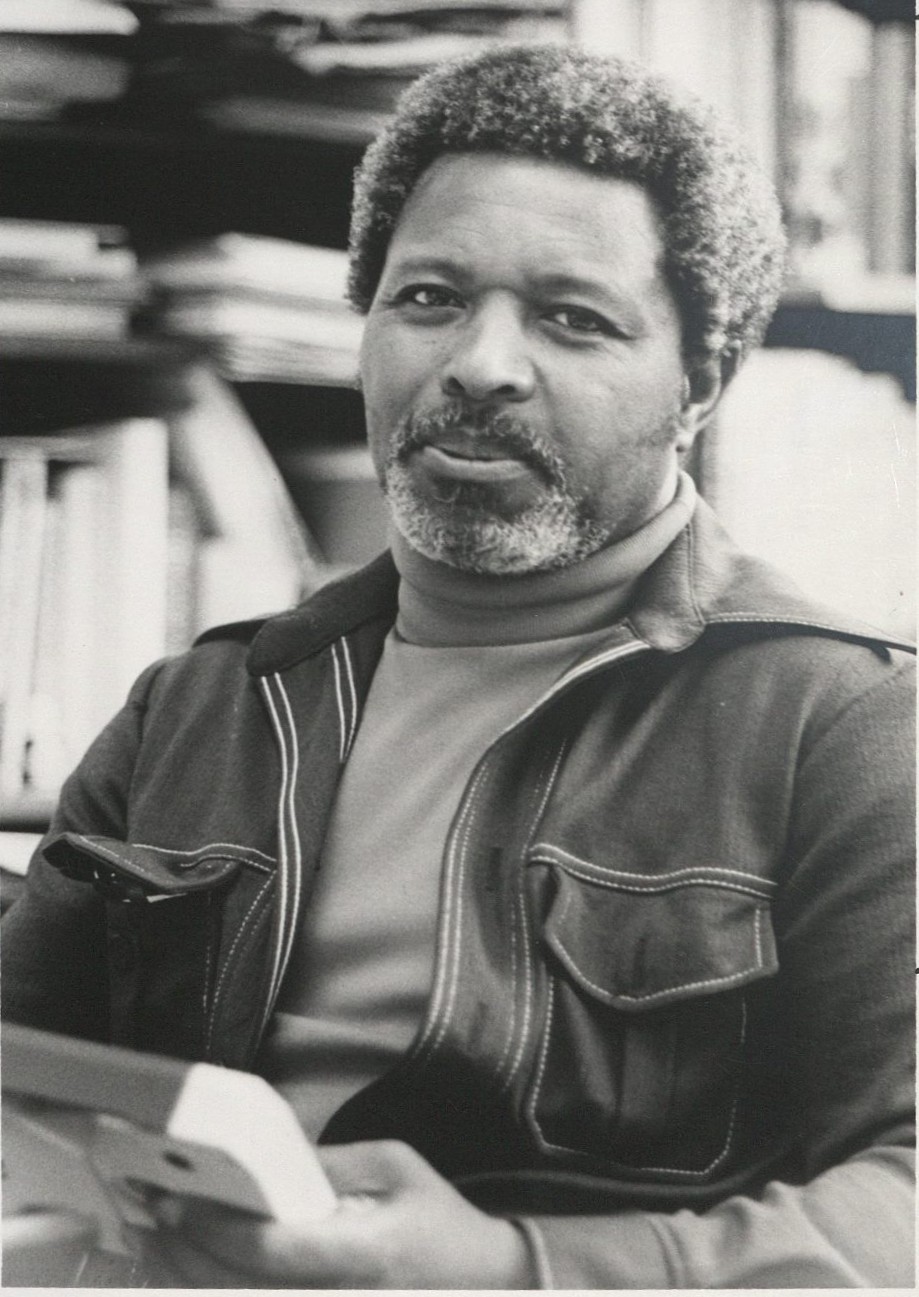
It was in the summer workshop that she learned of Highways to Hope. “As a youngster, 16 or 17 years old, you’re not thinking about what that really meant,” Gaston said. “But by the time I got to be a 20-something year old and was about to graduate college, I knew what that really meant and who he and Miss Eleanor, his wife, were, and why that was so important that they did that in the ‘60s.”
She has a picture of her, Adams and a group of workshop students in her office, and sometimes she will show it to her students and tell them about Adams. With the Trump administration’s rollback on diversity, equity and inclusion, she said that today Adams would never be hired for the role that brought him to KU, growing the number of students of color in journalism.
“I don’t know everybody out there in the business,” Gaston said, “but there’s a lot of us out there who knew him, who were mentored by him, who were encouraged by him. I don’t think we have any idea how many of us are out there, and I’m talking about black and brown. I’m not just talking about black students. I’m talking about all kinds of colors. So it’s hard to know, but he made some inroads. And he was the man for the time. He really was. Really was.”
Carol Adams Smith, who obtained a master’s degree in social work from KU, said Adams was like a father to many of his former students, including Mark McCormick, a journalist and executive director of the Kansas Black Leadership Council, who called Adams “Daddy Sam.”
“I consulted with Pat and Mark,” Adams Smith said, “and they helped me come to some final decision that (Spencer Research Library) is where the paperwork needed to (be); this is where his legacy needed to be.”
The Adams papers at Spencer include a couple of scrapbooks prepared by the St. Petersburg Times for national and regional reporting contests, including the Pulitzer Prize, several award plaques and a letter of congratulations from President Bill Clinton when Adams received the National Association of Black Journalists’ Lifetime Achievement Award in 1997.
There also are illuminating biographical insights from a speech Adams gave in 1997, an essay he called “Random Notes on My Teaching Philosophy,” chapters from books in which he was a subject and three examples of racist hate mail he received in 1965.
Kenneth Stephens
KU alumnus, j’75, and immediate past chair of the KU Libraries Board of Advocates
Ken Stephens discusses Sam Adams among items from his papers at the Kenneth Spencer Research Library
[i] Newsweek Magazine, June 15, 1964, pp. 88-90.
[ii] Draft speech, Samuel L. Adams, Univ. of Kansas, Prepared for Delivery Nov. 8, 1997, Emory University, Atlanta, Ga. Personal Papers of Samuel L. Adams, call # yet to be assigned. Kenneth Spencer Research Library, University of Kansas.
[iii] All details of the Adams’s 1964 driving tour across the South are drawn from “Highways to Hope,” a seven-part series written by Adams and published by the St. Petersburg Times Nov. 8-14, 1964. Found in the Personal Papers of Samuel L. Adams, call # yet to be assigned. Kenneth Spencer Research Library, University of Kansas. Also available in the on-line archives of the Tampa Bay Times, as the St. Petersburg Times is now known, and on Newspapers.com.
[iv] Carol Adams Smith, interviewed by Ken Stephens Oct. 12, 2026.
[v] Pat Gaston, interviewed by Ken Stephens July 27, 2026.
Tags: Civil Rights, Highways to Hope, Journalism, Kenneth Stephens, Sam Adams, Samuel L. Adams, School of Journalism