The University of Kansas

Inside Spencer: The KSRL Blog

Books on a shelf

Welcome to the Kenneth Spencer Research Library blog! As the special collections and archives library at the University of Kansas, Spencer is home to remarkable and diverse collections of rare and unique items. Explore the blog to learn about the work we do and the materials we collect.

Happy Birthday, Charles Darwin!

February 11th, 2015

Tomorrow, February 12, marks Charles Darwin’s 206th birthday. To mark this anniversary, we’re sharing a letter that Darwin wrote to James E. Todd in April 1882. At the time, Todd was a professor of natural science at Tabor College, a Christian college in Tabor, Iowa, that operated from 1853 to 1927. He went on to teach geology at KU from 1907 until his death in 1922.

Image of the first page of a letter, Charles Darwin to James E. Todd, 1882

Image of the second and third pages of a letter, Charles Darwin to James E. Todd, 1882

Image of the fourth page of a letter, Charles Darwin to James E. Todd, 1882

Letter, Charles Darwin to James E. Todd, 1882.
Call Number: MS C78. Click images to enlarge.

An article about this letter in Transactions of the Kansas Academy of Science (Vol. 48, No. 3, December 1945) describes the circumstances in which it was written, although the author’s speculation that the document was “Darwin’s last letter” appears to be erroneous.

In April 1882, James E. Todd…published in the American Naturalist (volume 16, pages 281-287) a paper, “On the Flowers of Solanum Rostratum and Cassia Chamaecrista.” The paper soon came to the attention of Charles Darwin, then in his seventy-fourth year. Almost immediately Darwin wrote the letter to Professor Todd [shown here]…

The most extraordinary feature of the letter is its date, written nine days before Darwin’s death on April 19, 1882. Darwin had been in poor health for some time and beginning in December 1881 underwent a series of heart attacks. He rallied from these attacks and, as the letter indicates, by April was still mentally active and planning work for the future. Five days after writing the letter his final illness began…

Dr. Fritz Müller, referred to by Darwin in the letter [above], carried on an extensive correspondence with Darwin for many years, although the two naturalists never met (317).

Charles Darwin spent decades gathering evidence for evolution before publishing his groundbreaking book, On the Origin of the Species by Means of Natural Selection, in 1859. As demonstrated by his letter to Professor Todd, he remained active in scientific research until the end of his life.

Want to learn more about Charles Darwin? Spencer Research Library holds copies of many of his published writings, including a first edition copy of On the Origin of Species. You can find these sources by searching the KU Libraries online catalog. Spencer’s collections also contain two additional letters from Darwin; transcriptions of both documents are available online (letter to Emma Gärtner and Charles Lyell). As always, however, anyone interested in seeing these materials in their original physical form are welcome to do so at Spencer!

Digital copies of many sources by and about Darwin are also available; see the Darwin Correspondence Project and Darwin Online.

A transcription of Darwin’s letter to Professor Todd, also from the Transactions of the Kansas Academy of Science article quoted above, follows.

April 10 1882.

Down,
Beckenham, Kent.
Railway Station
Orpington. S. E. R.

Dear Sir

I hope that you will excuse the liberty which as a stranger I take in begging a favor of you. I have read with unusual interest your very interesting paper in the American Naturalist on the structure of the flowers of Solanum rostratum, & I shd. [should] be grateful if you would send me some seed in a small box (telling me whether to plant in as annual, so that I may know when to sow the seeds), in order that I may have the pleasure of seeing the flowers & experimenting on them. But if you intend to experiment on them, of course you will not send me the seeds, as I shd. be very unwilling to interfere in any way with your work. I shd. also rather like to look at the flowers of Cassia chamaecrista.

Many years ago I tried some experiments in a remotely analogous case & this year am trying others. I described what I was doing to Dr. Fritz Müller (Blumenau, St. Catharina, Brazil) & he has told me that he believes that in certain plants producing 2 sets of anthers of a different colour, the bees collect the pollen from one of the sets alone. He wd. [would] therefore be much interested in your paper, if you have a spare copy that you could send him. I think, but my memory now often fails me, that he has published on the subject in Kosmos.

Hoping that you will excuse me, I remain, Dear Sir
Yours faithfully
Ch. Darwin

P. S. In my little book on the Fertilization of Orchids, you will find under Mormodes ignea, an account of a flower laterally asymmetrical, & what I think that I called right-handed or left-handed flowers.

Caitlin Donnelly
Head of Public Services

Once Upon a Time…In Spencer

January 26th, 2015

Last week you met Mindy Babarskis, now she highlights some illustrations from one of the volumes in Spencer’s Children’s Books Collection.

Spencer Research Library houses around 7,000 children’s books,  and many of these are folk tales and fairy tales. This immediately brings the Grimm Brothers’ European tales to mind, but did you know that A.L. Grimm also published tales from the Middle East and Asia? Here’s a beautifully bound and illustrated edition of Tales from the Eastern-Land by A.L. Grimm, translated from the German by H.V.

Cover of Tales from the Eastern-Land (1852), featuring an image of a gold Buddha Table of Contents of Grimm's Tales from the Eastern-Land

Gold stamped Buddha image on the front cover and the table of contents (with an old and lonely flower petal) in Spencer Research Library’s copy of A. L. Grimm’s Tales from the Eastern-Land,  Illustrated by J.B. Sonderland. London: H.G. Bohn, 1852. Call Number: Children 6035. Click images to enlarge.

Illustration of a Djinn from Grimm's Tales from the Eastern-Land.

I bet you’ve never seen a djinn portrayed quite like this; not the friendly big blue spirit depicted by Disney. Illustration by J. B. Sonderland in A. L. Grimm’s Tales from the Eastern-Land, 1852. Call Number: Children 6035. Click image to enlarge.

Illustration of a fainting woman in Grimm's Tales from the Eastern-Land

It wouldn’t be a book from the 1800’s without a fainting woman. Sadly, she forgot her smelling salts. Tales from the Eastern-Land, 1852. Call Number: Children 6035. Click image to enlarge.

Interesting architecture in an illustration from Tales from the Eastern-Land.

The architectural details in this image are wonderful; take some time and study the background of Sonderland’s illustration. Tales from the Eastern-Land, 1852. Call Number: Children 6035. Click image to enlarge.

Illustration from "The Three Trials" in Tales from the Eastern-Land

Here’s an emotional moment from “The Three Trials” in Tales from the Eastern-Land, 1852. Call Number: Children 6035. Click image to enlarge.

Mindy Babarskis
Public Services Library Assistant

Appellation Spring

January 13th, 2015

Linnnaeus (whose citation at the end of a binomial is simply “L.”) invented a practical system for the classification of plants and animals; more importantly, he established a uniform method of referring to species by two Latin words–a reform that led eventually to binomial nomenclature. Although his classification system was superseded, his principles of nomenclature continue to provide the rules for application of names to thousands of species of animals and plants newly identified every year. Volume 1, Animalia, of the tenth edition of the Systema Naturae (1758), is one of the most important books in the history of science, for it marks the beginning of the modern zoological nomenclature and systematics. In it, Linnaeus first consistently applied binomial nomenclature to the whole animal kingdom.

Linneana B65 v.6:146

Image from Siren lacertina, 1766. Linneana B65 v.6:146, Special Collections

Unfortunately the great Linnaeus had little love for herps, thought them “disgusting,” and would have done well to adopt the classifcation system of John Ray. We quote, in rough translation, from the Systema: “Amphibia are loathsome because of their cool and colorless skin, cartilaginous skeleton, despicable appearance, evil eye, awful stench, harsh sound, filthy habitat, and deadly venom; and so God has not seen fit to create many of them.” Many of Linnaeus’s descriptions were based on those in books by Aldrovandus, Seba, Catesby, Jonstonus, and others. His use of the word “Amphibia” denoted not only all reptiles and amphibians, but also the cartilaginous fishes.

This work is the doctoral dissertation of one of Linnaeus’s students; it was the tradition of the day for a professor to write the thesis, but the student “respondent” had to defend it and pay for its publication.

Sally Haines
Rare Books Cataloger
Adapted from her Spencer Research Library exhibit and catalog, Slithy Toves: Illustrated Classic Herpetological Books at the University of Kansas in Pictures and Conservations

Collection Snapshot: Diet and Digestion Advice from the Late 1600s

January 5th, 2015

It’s that time of year when you may hear your friends and family vowing to eat better for 2015.  But who needs trendy “paleo” diets or post-indulgence rounds of pepto-bismol when you can consult a seventeenth-century manuscript instead?  Among the Spencer Research Library’s collections is a volume labelled “Elizabeth Dyke her Booke of Recaits 1668,” which contains approximately 725 medicinal and culinary recipes (or “receipts”).  There you’ll find these two succinct lists of things “good” and “ille” for the stomach:

List of "Things good" and "ille" for "the stomack" from a seventeenth century book of receipts.

Parsley and sage advice?: Dyke, Elizabeth. “Things good for the Stomack” and “Things Ille for the Stomack.”
Booke of Recaits [Receipts]. Great Britain, circa 1668. Call Number: MS D157. Click image to enlarge.

According to the manuscript, calamint, sage, and standing after eating meat are all beneficial, while “all sweet things,” “fryed meats,” eating “meat upon meat” (pace Dr. Atkins), and eating “to[o] many dishes at one time” can lead to digestive disorder.

Of course, some of the volume’s recipes are acquired tastes (see the instructions for black sheep’s pudding below), so you may want to take its advice with a grain of salt!

Opening in the Booke of Recaits featuring a recipe for Black Sheep's Pudding

“To make black sheeps pudings.” Book of Recaits [Receipts]. Great Britain, circa 1668. MS D157. Click image to enlarge.

Elspeth Healey
Special Collections Librarian

A 15th-Century Nativity

December 22nd, 2014

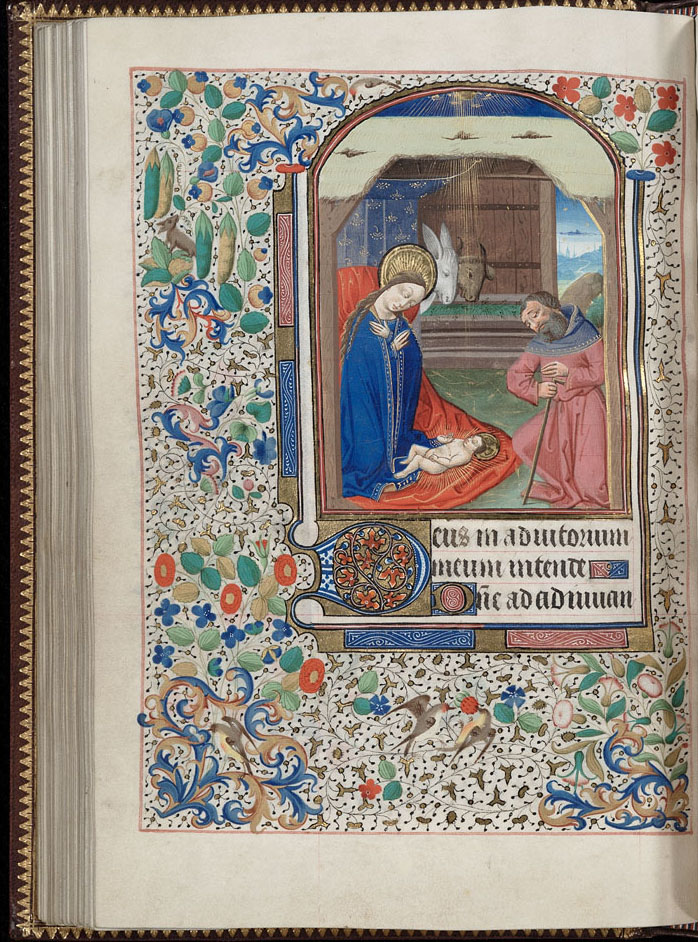
Enjoy a breathtaking image from the Vosper Hours (MS Pryce C1) during this week of Christmas. This highly decorated manuscript was created in 15th-century France as a book of hours, or Christian devotional book.

MS Pryce C1. Vosper Hours. Nativity Scene.

Vosper Hours. Nativity Scene. MS Pryce C1. Click image to enlarge.

For more information on this beautiful book, see Sharon L. Foster’s 1965 master’s thesis, “The Kansas University Hours of the Virgin”.

Whitney Baker
Head, Conservation Services