The University of Kansas

Inside Spencer: The KSRL Blog

Books on a shelf

Welcome to the Kenneth Spencer Research Library blog! As the special collections and archives library at the University of Kansas, Spencer is home to remarkable and diverse collections of rare and unique items. Explore the blog to learn about the work we do and the materials we collect.

Cherry Ames (Now) at Spencer

August 22nd, 2013

People of a certain age may recall reading tales of intrepid nurse Cherry Ames, a young woman from Illinois who travels the world in wartime as a nurse, then transitions into peace-time service. In her career, Cherry works in many situations, from nursing and veterans’ homes to department stores, jungles, cruise chips and dude ranches. Always plucky and resourceful, Cherry meets each challenge with humor, grace, and smarts.

Cover of Cherry Ames at Spencer, by Julie Tatham, 1949.

Cherry Ames at Spencer, 1949. Call number Children B2641. Click image to enlarge.

The Cherry Ames series (written mainly for an audience of young girls) was penned by two authors: first Helen Wells, then Julie Tatham, and finally Helen Wells again. The twenty-seven books (as well as annuals and many other spin-off products) were written between 1943 and 1968. At a time when there were not many viable career options for girls, Cherry provided a window into the exciting life of a working woman. Cherry traveled to exciting locales and met handsome doctors, yet her dedication to her patients always came first.

Cover of Cherry Ames: Flight Nurse, by Helen Wells, 1945.  Cover of Cherry Ames: Veterans' Nurse, by Helen Wells, 1946.

Left: Cherry Ames, Flight Nurse, 1945. Call number: Children B2643.
Right: Cherry Ames, Veterans’ Nurse, 1946. Call number: Children B2647. Click images to enlarge.

Cover of Cherry Ames: Chief Nurse, by Helen Wells, 1944.  Cover of Cherry Ames: Rest Home Nurse, by Julie Tatham.

Left: Cherry Ames, Chief Nurse, 1944. Call number: Children B2644.
Right: Cherry Ames, Rest Home Nurse, 1954. Call number: Children B2638. Click images to enlarge.

Spencer Library recently acquired a group of twelve Cherry Ames books. Given that Cherry Ames once worked at a place called Spencer (although in her case it was a hospital), we are sure she will feel right at home in ours. For more information on all things Cherry, see the Cherry Ames Page.

Whitney Baker
Head, Conservation Services

16th-Century Medicine for the Fascination of 21st-Century Audiences

July 19th, 2013

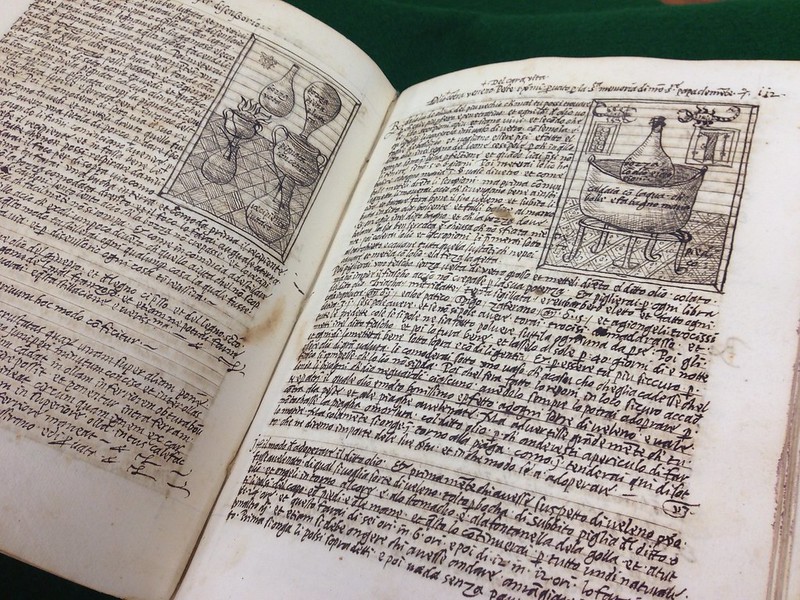
Yesterday, KU announced a magnificent gift to the libraries and the KU Medical Campus from the estate of the late KUMC Dean Stata Norton Ringle and her husband David Ringle. One of the projects that tied Stata Norton Ringle to the Kenneth Spencer Research Library was her translation of a manuscript from our collections.  Produced circa 1562, Libro de i secretti & ricette, also known as the Jesuatti Book of Remedies (MS Pryce E1), is a collection of remedies used by the friars of the Order of Saint Jerome in Lucca, Italy to treat an array of ailments. These range from the common (digestive problems, colds, wounds and sores) to the cosmetic (baldness) to the strange (“For the crust that comes on the head of little children“) to the most dire (the plague, malaria). The remedies recorded in the manuscript are a variety of galenical mixtures of herbs, alchemical distillates, prayers, and incantations.

Page spread from the Jesuatti Book of Remedies featuring distillation diagrams
Jesuatti Book of Remedies. Lucca, Italy, circa 1562. Call number: MS Pryce E1. Click image to enlarge.
Image courtesy of KU Libraries Flickr Photostream.

This volume so captivated Professor Ringle that she taught herself Renaissance-era Italian to undertake its translation. The result was a digital edition, published in collaboration with KU Libraries’ Center for Digital Scholarship, that combines her annotated English translation with manuscript page images.

Browsing the digital edition, it’s easy to see why a professor of pharmacology, toxicology and therapeutics, like Dr. Ringle, would want to share this fascinating manuscript with scholars and the public at large. We have it on good authority from our web gurus that the most scatological, blush-inducing, and comically bizarre search terms driving internet traffic to the KU Libraries website tend to be page hits for the Jesuatti Book of Remedies. (I won’t list those search terms here, but this passage should give you a sense of some of the more sensitive topics the remedies address).

To celebrate the late Professor Ringle and her work, we reproduce three remedies from her translation and encourage you to continue on and peruse the entire volume online.  In her  preface, she wisely cautions that the translation is for “historical information only.”  We hope you enjoy reading these remedies, but please don’t try them at home!

Best remedy for headache. [From folio 13 verso]

Take 1 handful each of good marjoram and rosemary and make fine powder of them. In the morning take half a glass of good white wine and put therein a tablespoon of this powder, heat it and drink this early in the morning and soon you will be cured. This is also powerful to save the teeth so they will not decay and it will give you a good breath. It is the thing used by gentlemen. […]

To make gray hair dark. [From folio 19 recto]

Take equal amounts of soft dark soap and quicklime and yellow litharge and incorporate them in the form of an unguent and with this rub the gray hair several times and it will become dark. Continue this rubbing according to how you see the need as it turns from being white to dark.

Another for the aforesaid and also good. Take the juice of beets mixed with ashes made of chicken feathers and boil them together a while. Rub yourself with this in the evening when you go to sleep. […]

To remove redness from the face and make it the way one wants. [From folio 162 verso].

Take 1 ounce of native sulfur, 1 dram each of white incense and myrrh and ½ ounce of camphor. Powder everything very finely and mix it with ½ lb. of rose water and distill it in a little glass still. Preserve this water well-closed and bathe the face in the evening and morning with a sponge, rubbing well. Soon the redness of the face will disappear. This has been tested by many persons. [...]

Image of the Jesuatti Book of Remedies, folio 13v: Best remedy for headache Image of page of Jesuatti Book of Remedies giving remedy for making gray hair dar. A page from the Jesuatti Book of Remedies:

From the Jesuatti Book of Remedies digital edition: (left) “Best remedy for headache” folio 13v; (center) “To make gray hair dark” folio 19r; and (right) “To remove redness from the face and make it the way one wants,” folio 162v. Translated with notes by Stata Norton. Electronic edition published by the Center for Digital Scholarship, University of Kansas Libraries, 2010. http://etext.ku.edu/view?docId=jesuatti/jesuatti.xml. Click images to enlarge.

And the Oldest Item in Kenneth Spencer Research Library is…

July 12th, 2013

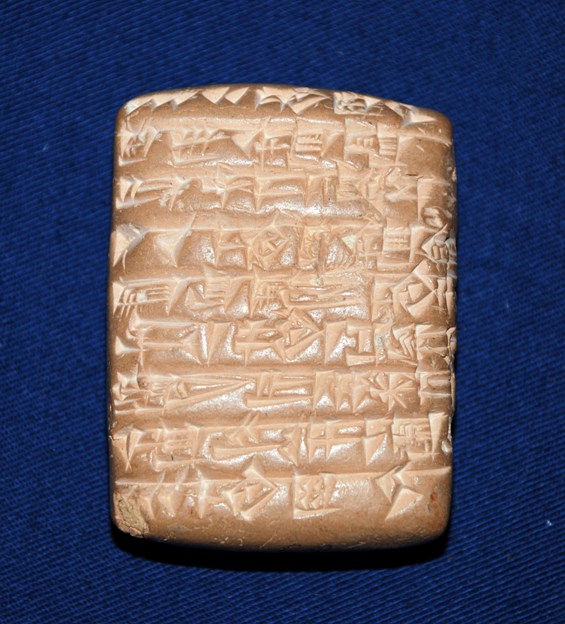
…a cuneiform clay tablet a little over 4000 years old!

Photograph of Cuneiform clay tablet (MS Q4:4)

Ancient History: Cuneiform clay tablet, Umma, ca. 2055 BCE.
Call number: MS Q4:4. Click to enlarge.

This small baked clay tablet dates from ca. 2055 BCE in Umma in southern Mesopotamia (the location of modern-day Iraq).  Like many cuneiform tablets, it is an administrative document: in this case, an inventory of materials — such as asphalt, bitumen, and fish-oil — used in caulking the ship Ur-Gilgamesh.

Cuneiform is among the earliest systems of writing. It involves pressing signs into soft clay with a wedge-shaped tool. The tablet pictured above is in the Sumerian language; however, the library also holds later tablets in Akkadian.

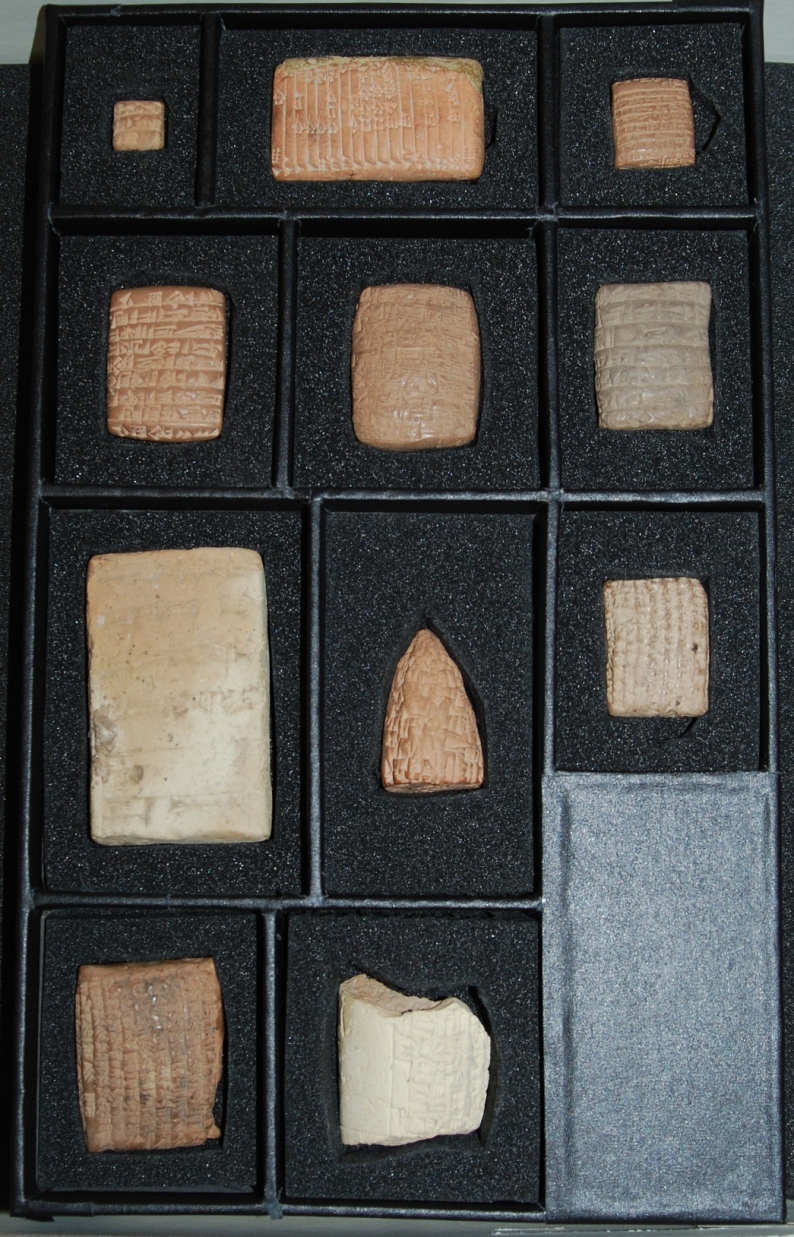
Image of box containing Spencer Library's Cuneiform Tablets

Spencer’s cuneiform tablets, ca. 2112-529 BCE. Call Number: MS Q4. Click image to enlarge.

In all, Spencer houses eleven cuneiform tablets. The smallest of these (MS Q4:1, the top left tablet in the box) may possibly be even older than the ship caulking inventory. However, since it lacks a date of rule, its age can only be narrowed to likely sometime during the Third Dynasty of Ur, ca. 2112-2004 BCE. Interestingly, this tiny tablet is itself a receipt for something small: one dead lamb. Other tablets in the collection include votive inscriptions praising King Singashid of Uruk and Amnanum (MS Q:7-8) and a court record concerning a missing servant (MS Q4:10).

Since the ability to read Sumerian and Akkadian is a fairly specialized skill (we’re guessing you didn’t learn it in grade school either), Spencer has been fortunate enough to benefit from the expertise of its researchers.  Thanks to scholars and KU faculty members, such as Professor Paul Mirecki in the Department of Religious Studies, we are able to give a much better answer to the frequently asked question, “What’s the oldest thing in the library?”

Karen S. Cook and Elspeth Healey
Special Collections Librarians

Bloomsday 2013: Buck Mulligan / Oliver Gogarty Edition

June 16th, 2013

Each June 16th, fans of James Joyce’s Ulysses celebrate “Bloomsday” in commemoration of the day on which the novel is set.  The annual fête (often marked by marathon readings) takes its name from the modernist classic’s central character, Leopold Bloom.

Though the novel belongs primarily to Bloom, Stephen Dedalus, or (in the last episode) Molly Bloom, it is another character who graces its famous first sentence: “Stately, plump Buck Mulligan came from the stairhead, bearing a bowl of lather on which a mirror and a razor lay crossed.”
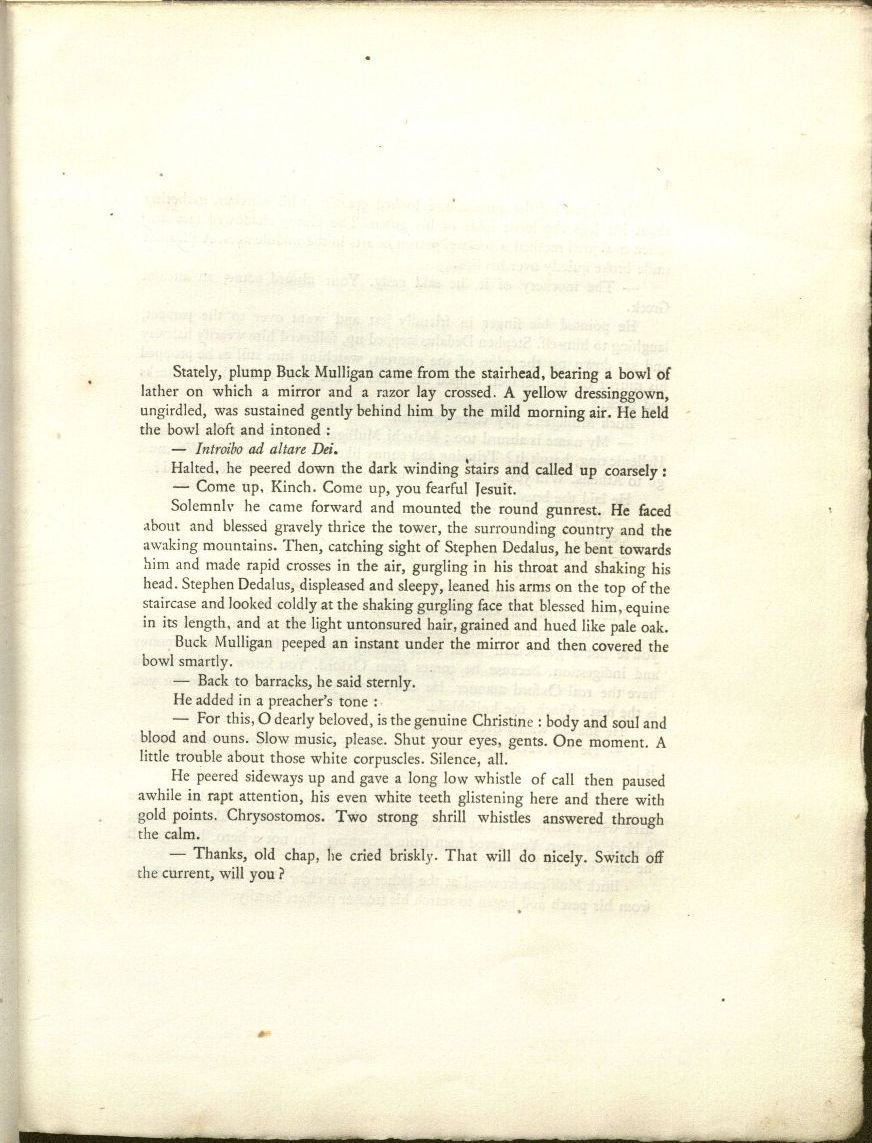
Picture of the first page of the first episode of Ulysses (1922)

First page of the first episode of Ulysses by James Joyce. Paris: Shakespeare and Company, 1922.
Call Number: Joyce Y116. Click image to enlarge.

Buck Mulligan, the flippant friend of Stephen Dedalus, was in part modeled after a friend from Joyce’s younger days, Oliver St. John Gogarty.  According to Joyce’s biographer, Richard Ellmann, the two young men met at the National Library of Ireland when Joyce was approximately twenty.  Both had medical aspirations and wrote poetry, though only Gogarty would go on to become a doctor.   While Gogarty admired Joyce’s writing, Joyce was less enthusiastic about his new friend’s, which he felt lacked weight and depth.  Joyce did, however, appreciate the satire and bawdiness of Gogarty’s more humorous poems, and he incorporated this into Mulligan’s verse in Ulysses.

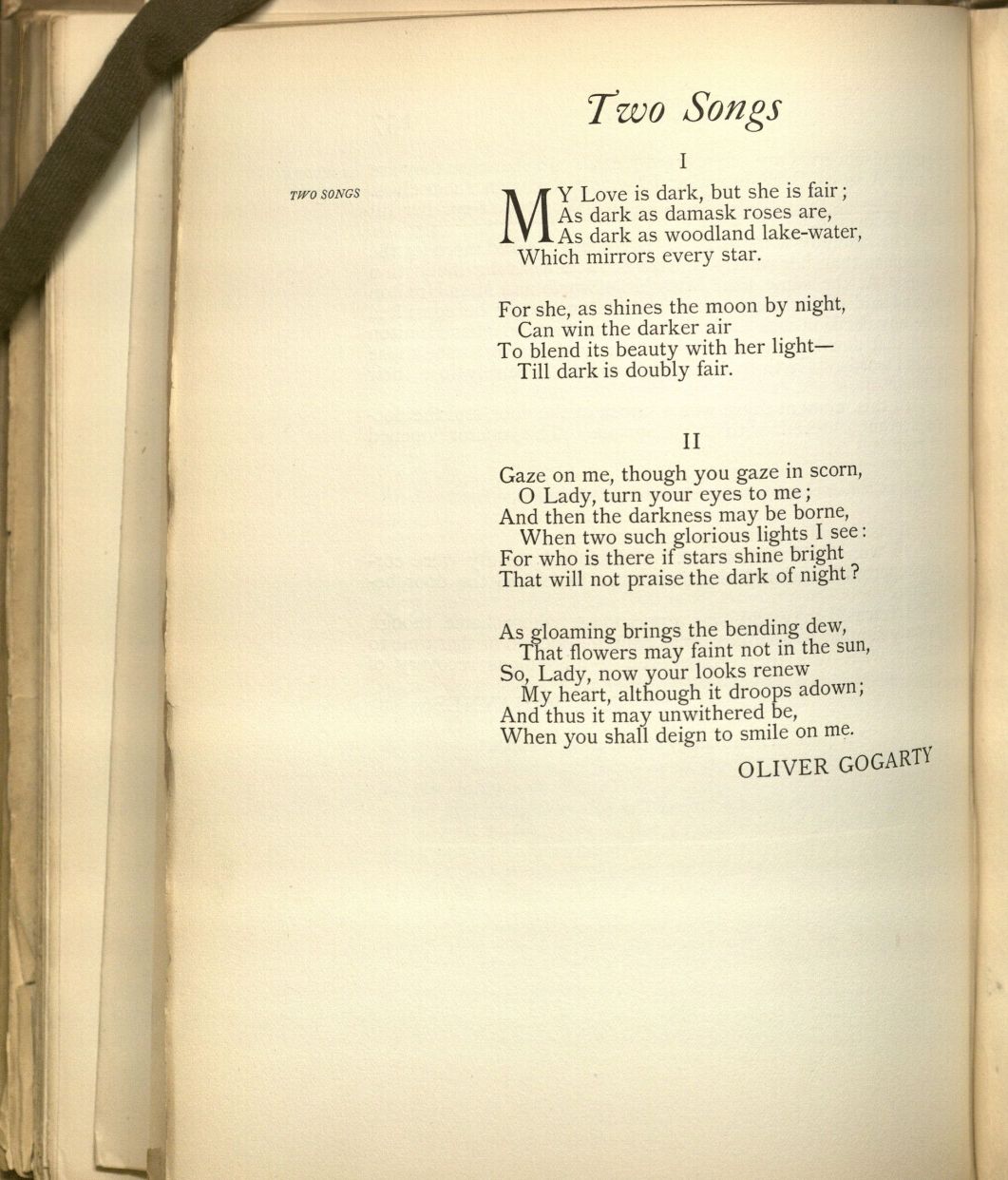
Perhaps somewhat to his chagrin, Joyce found himself in Gogarty’s company in his first book appearance. Both men had poems titled “Two Songs” published in the annual anthology The Venture (1905). By this time, Joyce and Gogarty had already fallen out.  Ellmann notes that from the outset the friendship between the two would-be writers was also a rivalry. The character of Buck Mulligan in Ulysses is entertaining in his wit and pleasure-seeking, but he is also depicted as insensitive and disloyal.
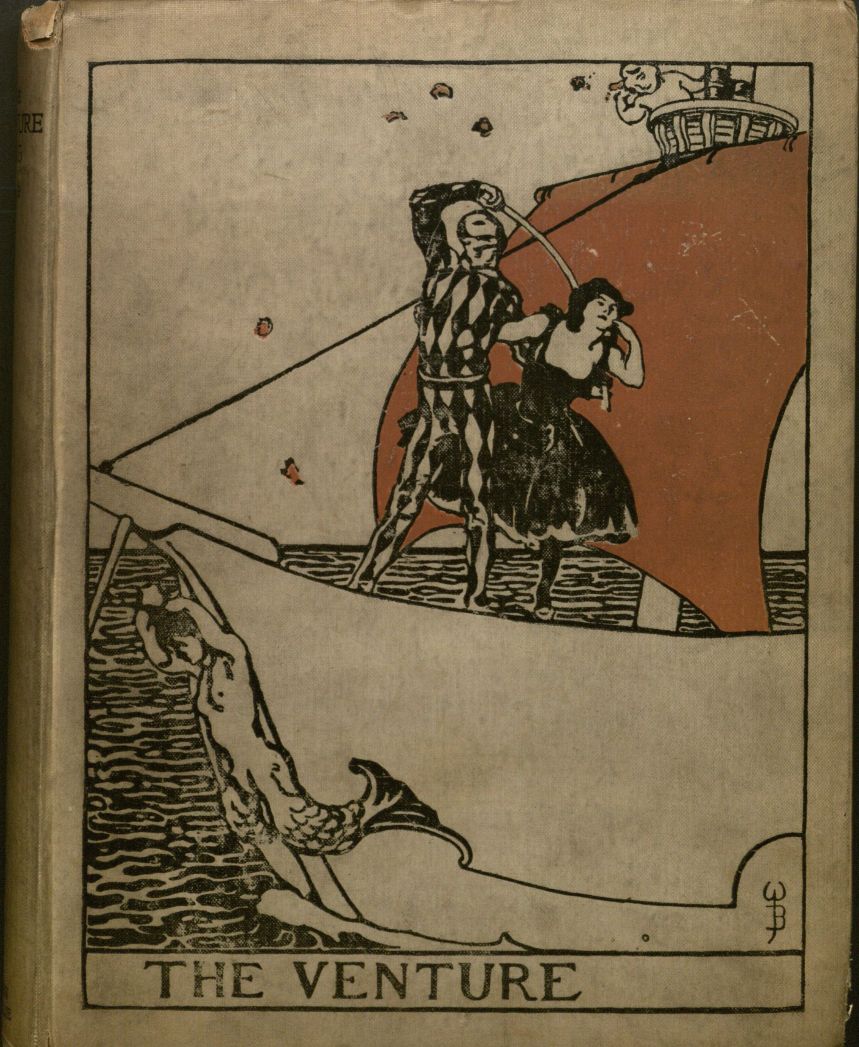
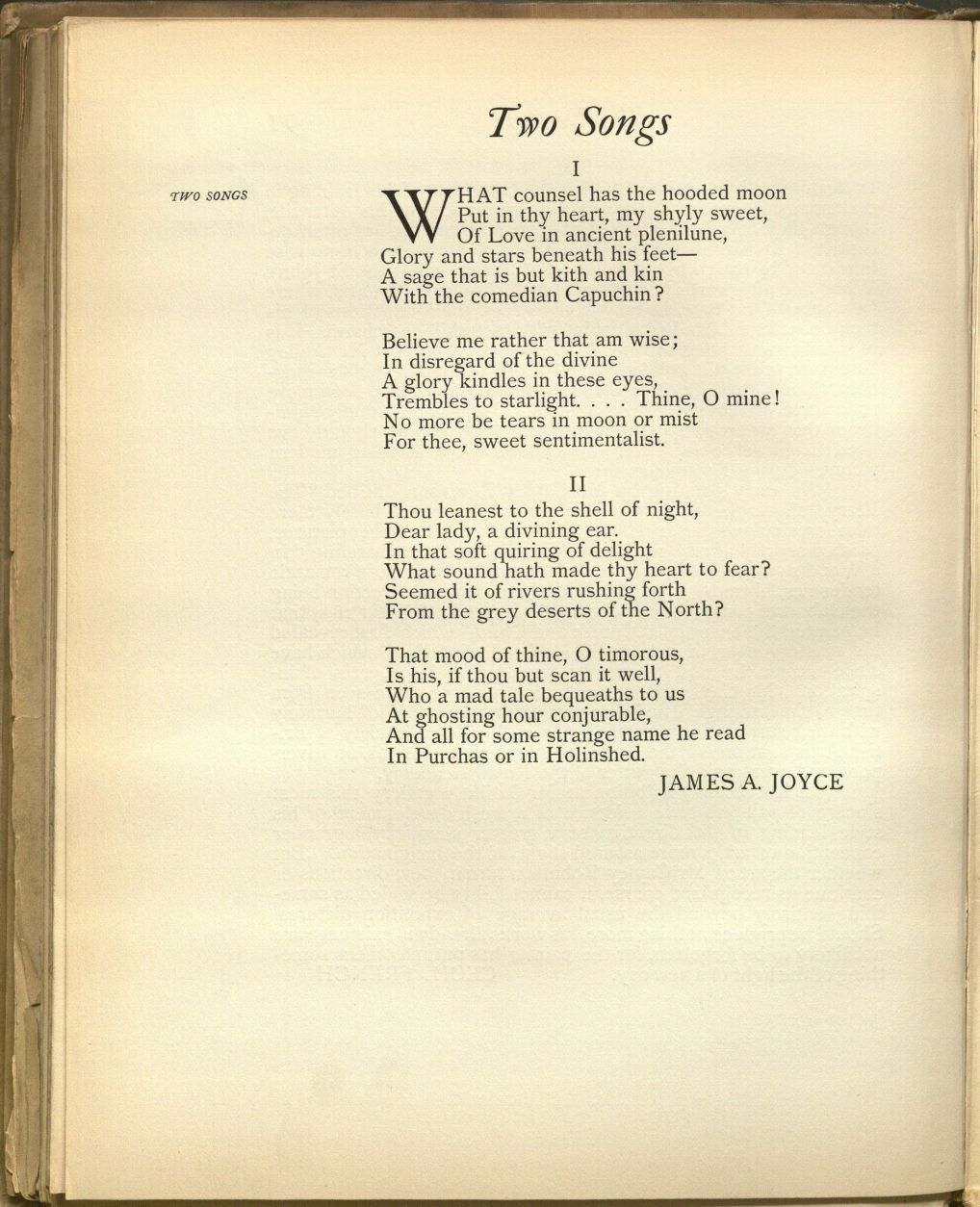
Image of the cover of The Venture, 1904

Image of Two Songs by James Joyce, published in The Venture (1905)  Image of "Two Songs" by Oliver St. John Gogarty

Which young writer’s poems are more to your taste?: “Two Songs” by James Joyce and “Two Songs” by Oliver
St. John Gogarty from The Venture; An Annual of Art and Literature. London: John Baillie, 1905, p. 92, p. 138.
Call Number: Joyce Y243. Click images to enlarge and read poems.

Readers curious to investigate Gogarty through his own words will find plenty to peruse in Spencer’s collections. Gogarty published verse, plays, novels, and memoirs. His book, As I Was Going Down Sackville Street: A Phantasy in Fact (1937), offers depictions of writers he knew, including Joyce, Yeats, and George Moore, as well as the politicians with whom he associated, such as Arthur Griffith and Michael Collins (Gogarty performed the autopsies on both of these men and subsequently served as a Free State senator).

For those eager to delve into Gogarty’s more obscure writings, Spencer Research Library holds a copy of his play Blight the Tragedy of Dublin: An Exposition in 3 Acts (1917), published under the pseudonym “Alpha and Omega.” Even scarcer is Gogarty’s eight-page pamphlet, “A Suggested Operation for Turbinal Catarrh” (1921), which provides insight into his work as a doctor.
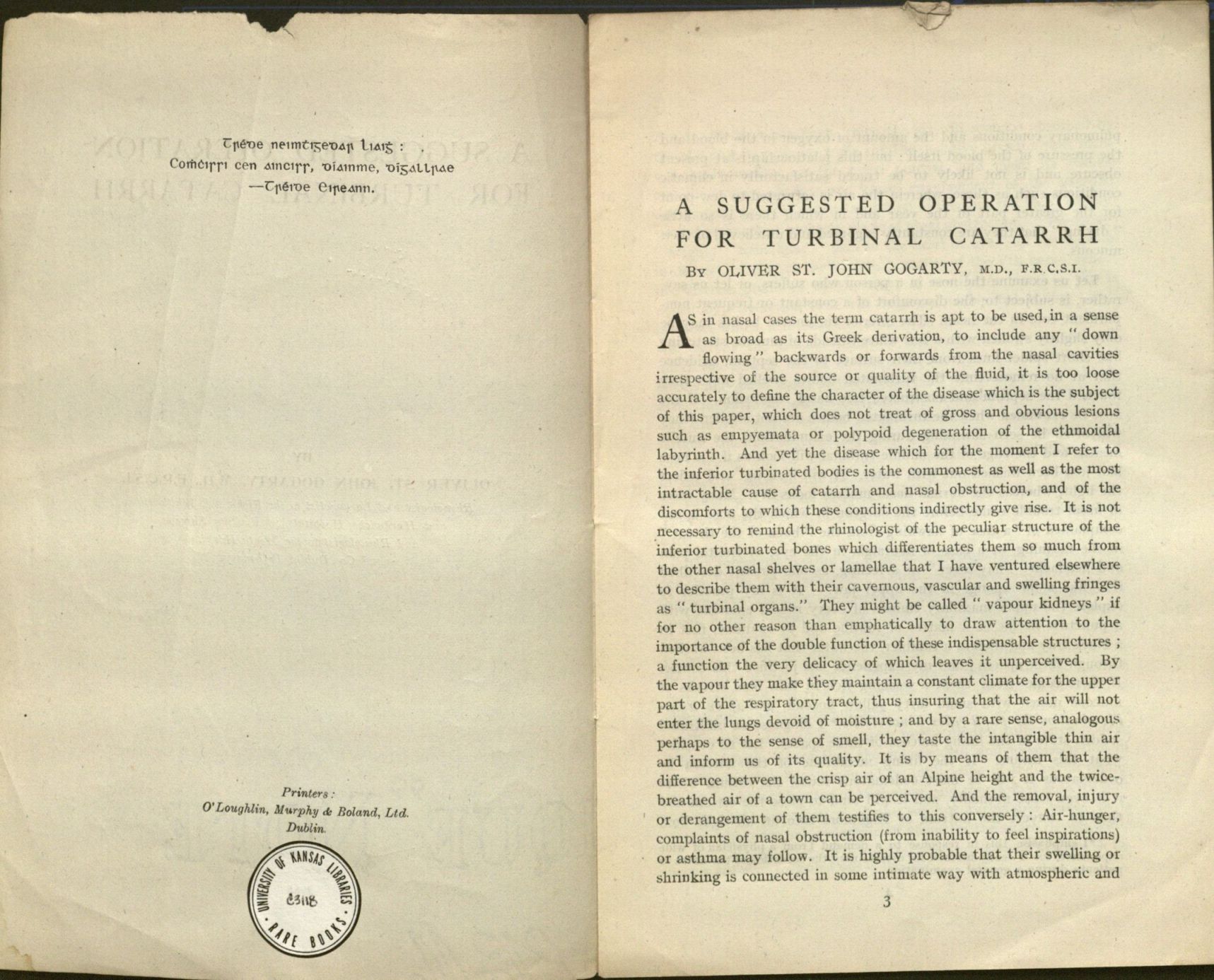
Image of the medical pamphlet, "A Suggested Operation for Turbinal Catarrh" by Oliver St. John Gogarty

“A Suggested Operation for Turbinal Catarrh” by Oliver St. John Gogarty. Dublin: pr. for the author, 1921.
Call Number: C3118. Click image to enlarge.

Since this medical pamphlet is indeed rare (the only other copy recorded in WorldCat is housed at the National Library of Ireland) we’ve scanned it and posted it in its entirety here.  So this is what “Buck Mulligan” was up to when he wasn’t composing ribald rhymes!
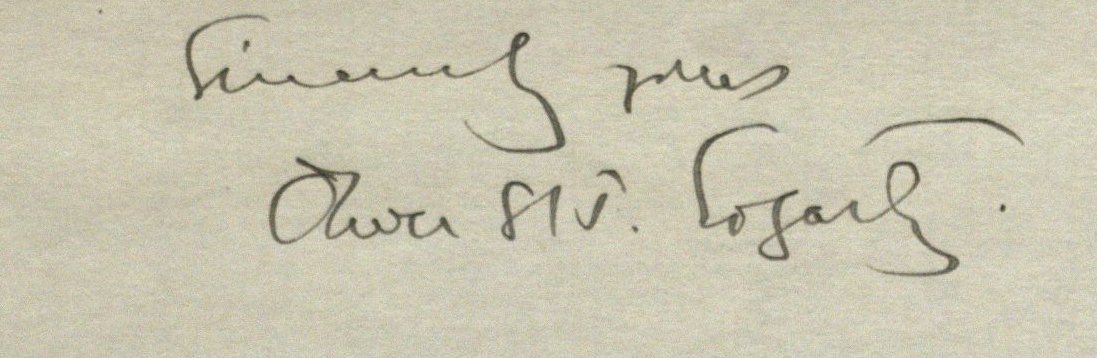
Photograph of Oliver St. John Gogarty's signature from a 1924 letter to P. S. O'Hegarty.

Signature of Oliver St. John Gogarty, taken from a letter to P. S. O’Hegarty,
17 September, 1924. Call Number: MS P415:1a.

Searching for more Bloomsday fun?  For a list of Ulysses “firsts,” check out last year’s Bloomsday post.

Elspeth Healey
Special Collections Librarian

Representing the Countess: Constance Markievicz in the Poetry of Eva Gore-Booth & W. B. Yeats

April 25th, 2013

This week’s post comes from undergraduate public services student Meaghan Moody, who during this last week of National Poetry Month examines poetic depictions of Irish nationalist Countess Constance Markievicz.

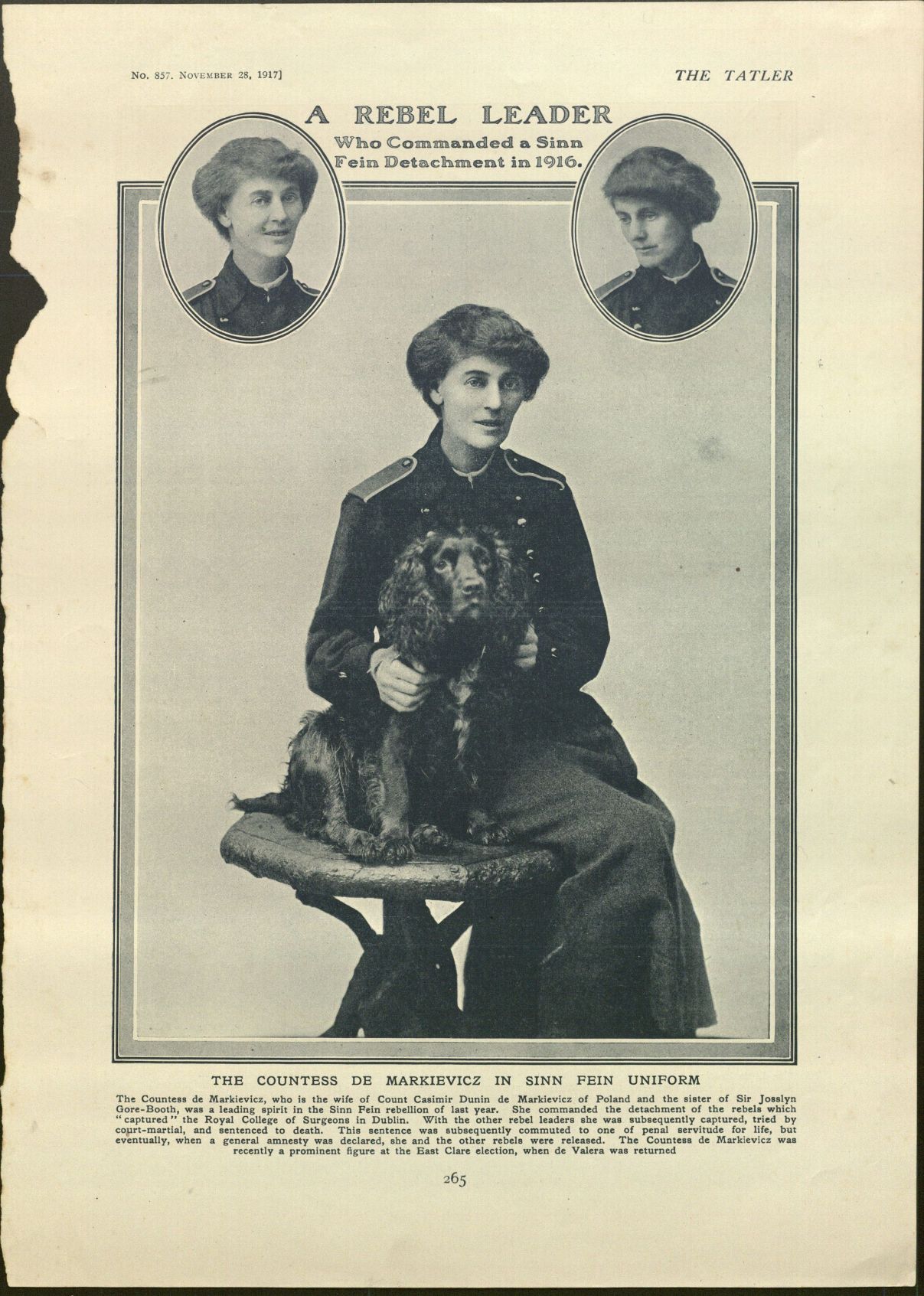
On Monday, April 24th, 1916, Irish nationalists seized strategic infrastructure in Dublin to expel the British and establish an independent Irish Republic. Among these insurgents was Constance Markievicz (1868-1927), who served as second in command under Michael Mallin of the Citizen Army force in St. Stephen’s Green.  Markievicz was sentenced to death for her involvement in what became known as the “Easter Rising,” but the sentence was later commuted to life in prison based solely upon her sex. Markievicz is remembered and celebrated for her fearlessness, her intrepid nature, and her radical military dress. In the image below, you can see her in her full military regalia.

Image of Constance Markievicz excized from the Tatler, Nov. 28, 1917.

“A Rebel Leader” (Constance Markievicz) [image excised from the Tatler, Nov. 28, 1917]. Call Number: O’Hegarty Q38.

While conducting research for my English 530 course, Irish Renaissance Literature, I came across two strikingly similar depictions of the Countess by two Irish writers with diverging political beliefs. W.B. Yeats, a cultural nationalist, and Eva Gore-Booth, a pacifist suffragist and Constance’s sister, both fundamentally condemned the Rising and its resulting violence. They both also depict Markievicz and her subsequent imprisonment in their poetry.

W.B. Yeats knew Markievicz in her youth. He preferred his memory of her innocent beauty and rejected her involvement in politics.

Cover of  Yeat's Michael Robartes and the Dancer  Image of Yeats's poem "On A Political Prisoner"

Cover and “On A Political Prisoner” from W. B. Yeats’s Michael Robartes and the Dancer. Churchtown, Dundrum: The Cuala Press, 1920. Call Number: Yeats Y45. Click images to enlarge.

Eva Gore-Booth, too, disapproved of her sister’s involvement, but, unlike Yeats, depicted Constance as an ethereal, spiritual being, as seen in this poem that she sent the imprisoned Constance for Christmas.

Image of Cover of Eva f Gore-Booth's Broken Glory  Image of Eva Gore-Booth's poem "To Constance--In Prison"

Cover and “To Constance–In Prison” from Eva Gore-Booth’s Broken Glory. Dublin; London: Maunsel, 1918. Call Number: B11104. Click images to enlarge.

In her prison letters, Markievicz reflected on herself as a poetical inspiration, remarking, “I love being in poetry and feel so important!”

Though she recognized her sister’s aversion to violence, Markievicz took pride in the role she played in the Easter Rising and felt a sense of honor in her subsequent incarceration. She wrote to Eva, “Don’t worry about me. I am quite happy. It is in nobody’s power to make me unhappy. I am not afraid, either of the future or of myself.”

Meaghan Moody
Public Services Student Assistant

Source consulted: Weihman, Lisa. “Doing My Bit for Ireland: Transgressing Gender in the Easter Rising.”  Éire-Ireland 39.3&4 (2004) 228-249.