The University of Kansas

Inside Spencer: The KSRL Blog

Books on a shelf

Welcome to the Kenneth Spencer Research Library blog! As the special collections and archives library at the University of Kansas, Spencer is home to remarkable and diverse collections of rare and unique items. Explore the blog to learn about the work we do and the materials we collect.

Deconstructed Book

January 4th, 2013

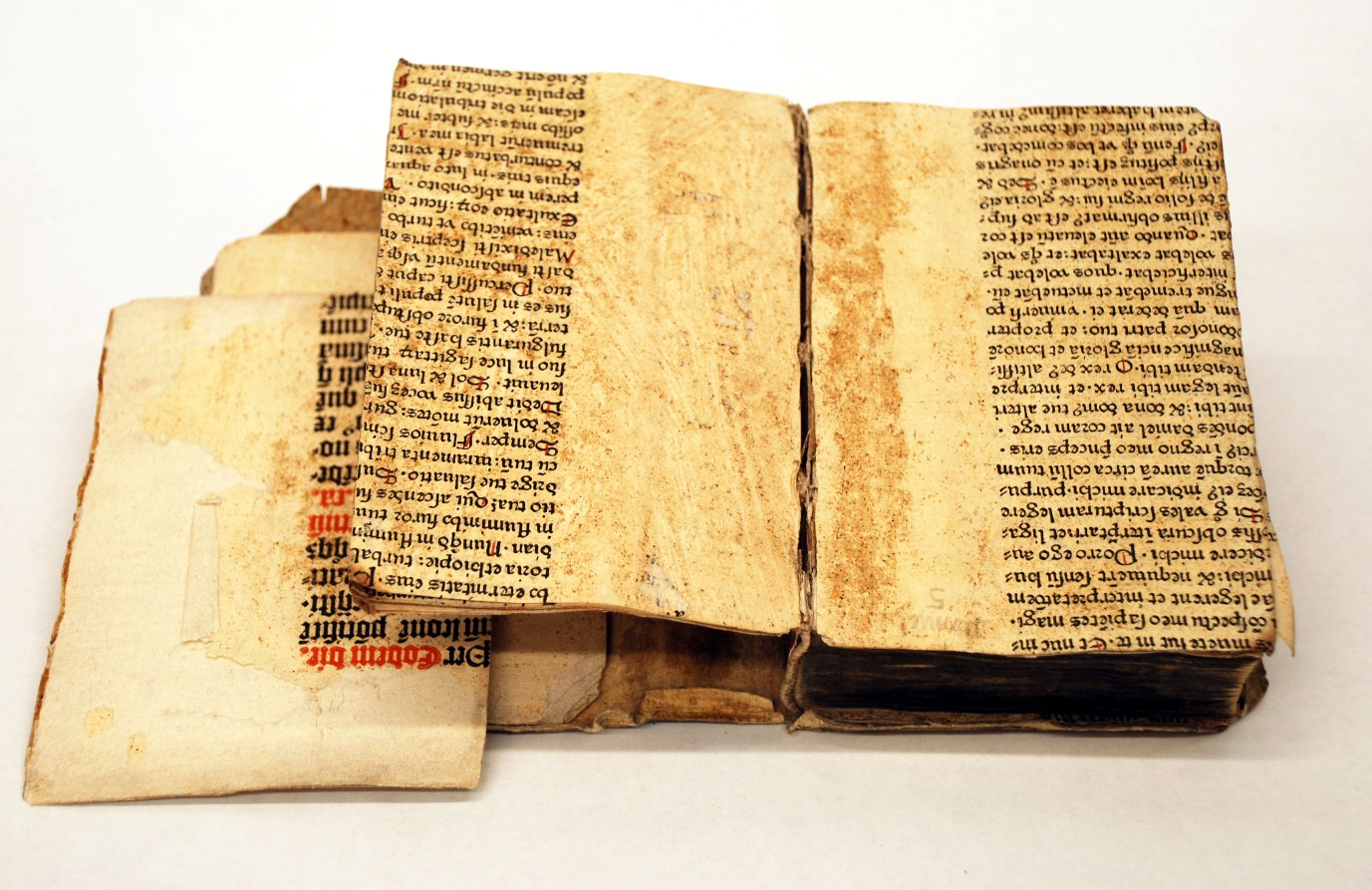
Sometimes deterioration can be a useful tool for discovering how a book was made. This example, in poor condition, allows us to see how the book’s boards were constructed. Rather than one piece of wood or paperboard, the boards are made from layers of stiff paper glued together with starch paste. Each board is comprised of twelve layers of “printer’s waste,” or discarded pages from other books available for use by the bookbinder. The printed pages used were printed in both black and red ink, probably dating from a 15th century bible.

Image of MS B38: open to see insides Photograph of MS B38: (later) title page for manuscript

Photograph of MS B38: open to show layers of board

Andreas Fabricius. Chemnicensis. [Germany?, 1549?]. [Bound with printed work: Joachim Camerius, 1500-1574 . Capita pietatis et religionis Christianae versibus Graecis comprehensa ad institutionem puerilem […], Lipsiae: V. Papa, 1547]. Call number: MS B38. Left: binding open to see the book’s insides; Right: title page for the manuscript; Bottom: book open to show the layers of board.  Click images to enlarge.

The tooled pigskin cover is detached, allowing us to see how the book was sewn on three pairs of linen cords. The cord ends were frayed out and glued to the outside of the “boards.” Linen cords were used as a core to sew on decorative endbands at the head and tail (top and bottom) of the spine.

Photograph of MS B38: tooled pigskin binding Photograph of MS 38: detail of frayed cords

Left: the book’s tooled pigskin cover; Right: detail of frayed cords.  Click images to enlarge.

The text of this book is a combination of printed and manuscript pages. The subject appears to be a handbook of logic, grammar, and rhetoric. It is a true composite object!

Click on the thumbnails below for additional  images:

Photograph of MS B38: detail of paper for board Photograph of MS B38: close-up open to see the spine

Whitney Baker
Head, Conservation Services

Note: For more detailed information regarding the contents of this volume, please see entry M115 in A Checklist of Medieval Manuscripts in the Department of Special Collections at the Kenneth Spencer Research Library (Revised edition, 1996), which is available in the library’s reading room.

St. Petersburg High…

December 27th, 2012

The only image of St. Petersburg more plentiful in western books about 19th century Russia than the bronze horseman, is the ice hill, or “flying mountain,” a peculiarly Russian entertainment that may have something to do with the fact that Petersburgers are flatlanders. Paris, Rome, Athens, and Lawrence have their high points, hogbacks, and hills, but at no point on the delta on which Peter built his city is there a spot over thirty feet above sea-level. Of all the ailments that have plagued that city – typhoid fever, typhus, cholera, giardia, influenza, malaria, diphtheria, syphilis, smallpox, and the common cold – altitude sickness has not been one of them, and actually the hill provides some relief from high barometric pressure if not from a queasy stomach.

Image of title page and frontispiece of Scenes in Russia [...], 1814 (Call number: Children A933)

Scenes in Russia; Describing the Manners, Customs, Diversions, Modes of traveling, &c. of the Inhabitants of that Country. London: printed for J. And E. Wallis, 1814. Call Number: Children 5310  (click image to enlarge).

Image of Scenes in Russia Frontispiece

This contraption seems to be a combination of ski-jump and roller coaster: each person climbs into a small 4-wheeled shallow sided box at the top of a platform and careens downhill on a track. Sometimes ridges (moguls?) are added to increase velocity coming down enough to send them up the other side. When the River Neva is frozen the flying mountains are erected on the ice.

Adapted from the Spencer Research Library exhibit, Frosted Windows: 300 Years of St. Petersburg Through Western Eyes.

Sally Haines
Rare Books Cataloger

Lastest Finding Aids and Additions to Finding Aids

December 20th, 2012

Trying to decide what you would like to do over the winter holidays?  Why not get a head start on your research?  Here is a list of the newest finding aids and additions to finding aids available at the Kenneth Spencer Research Library.  Please scroll down for images from three of these collections.

Image of "Free the KU Twelve" buttons

Image of Letter from Jennie Johnson to Will Johnson, January 26, 1886  Image of Letter from Ernest Boyd to Kenneth Reddin, October 14, 1936.

Top: “Free the KU Twelve” buttons. Gail J. Hamilton Collection. Call Number: PP 497: Box 1, Folder 26; Left: Letter from Jennie Johnson to Will Johnson, January 26, 1886. Jennie Johnson Collection. Call Number: RH MS P909: Folder 1; Right: Letter from Ernest Boyd to Kenneth Reddin, October, 14, 1936. Kenneth Reddin Collection. Call Number: MS 14: Box 3, Item C1. Click images to enlarge.

November Scene, Circa 1520

November 30th, 2012

How better to end November than with a manuscript leaf depicting swineherds knocking acorns off trees for pigs to eat, a typical November activity in late medieval France? The leaf is from a calendar of feast days that was formerly part of a book of hours (a volume of devotional readings). The Latin text was copied onto vellum (treated calfskin) by a scribe and then richly decorated with colored and gold pigments. This particular leaf dates from approximately 1520. It demonstrates the persistence of manuscript book production more than half a century after the Gutenberg Bible was printed using moveable type (circa 1455) in neighboring Germany.

Image of Leaf from Calendar for November. France, vellum, ca. 1520?
Leaf from Calendar for November (likely from a Book of Hours). France, vellum, ca. 1520?
Call number: MS A28. Click image to enlarge!

Karen S. Cook
Special Collections Librarian

No Taste for Innocent Pleasures: L. E. L. and the Nineteenth Century

November 15th, 2012

Student Manuscripts Processor and Museum Studies Graduate Student Sarah Adams revises her ideas about the nineteenth century after working on the collection of British poet L. E. L.

When we think of English society in the nineteenth century, we often associate it with what we’ve read in classic novels. British literature and culture of that era seemed to me to lean heavily on polite social decorum and chaste modesty. With such stringent moral codes, people from these periods can at times appear dull compared to modern society. However, after working on a certain nineteenth-century collection in the processing department, I have a hard time believing this to be the case.

Image of Portrait of L. E. L. (1)  Image of portrait of L. E. L. with text

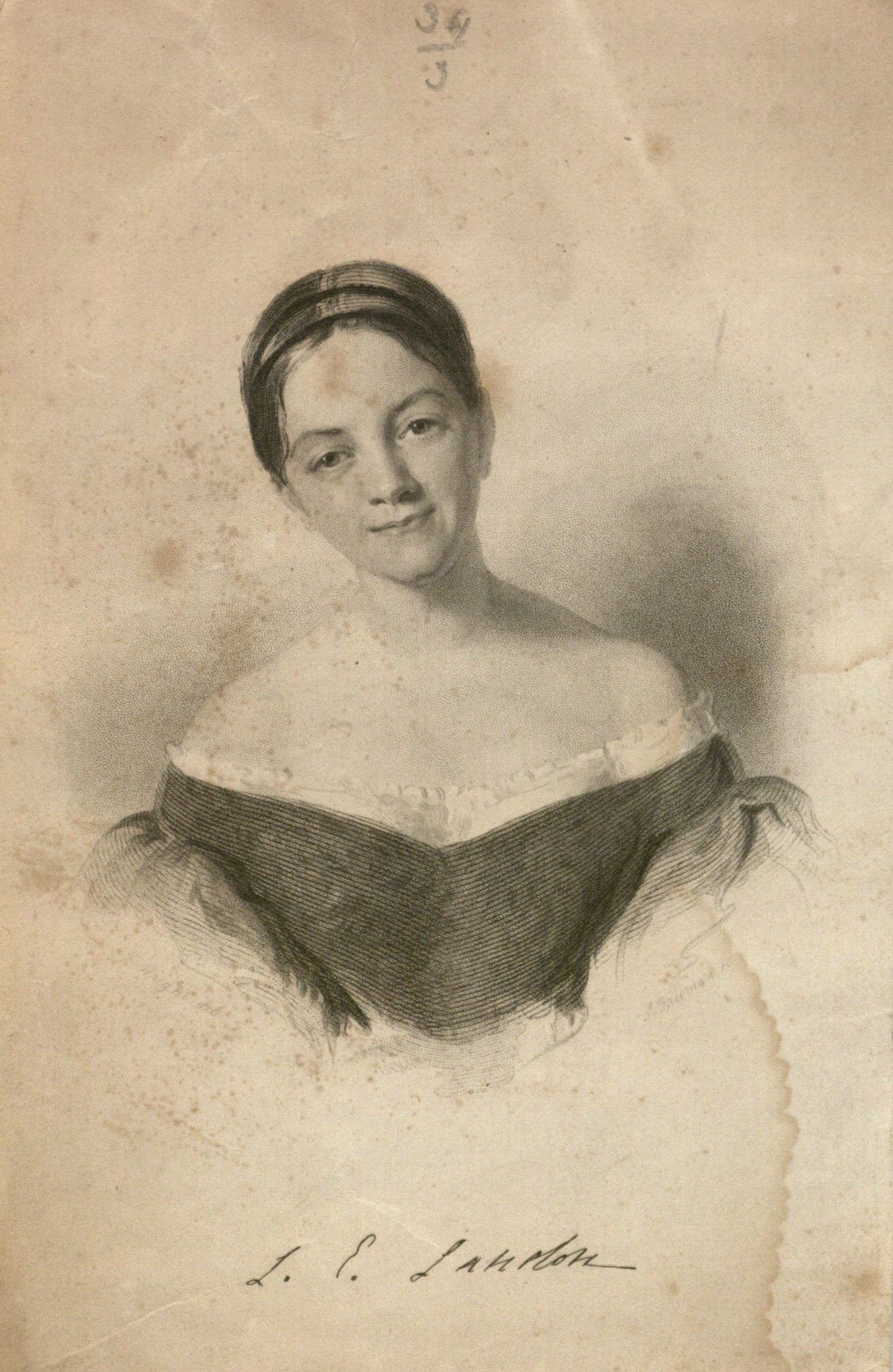
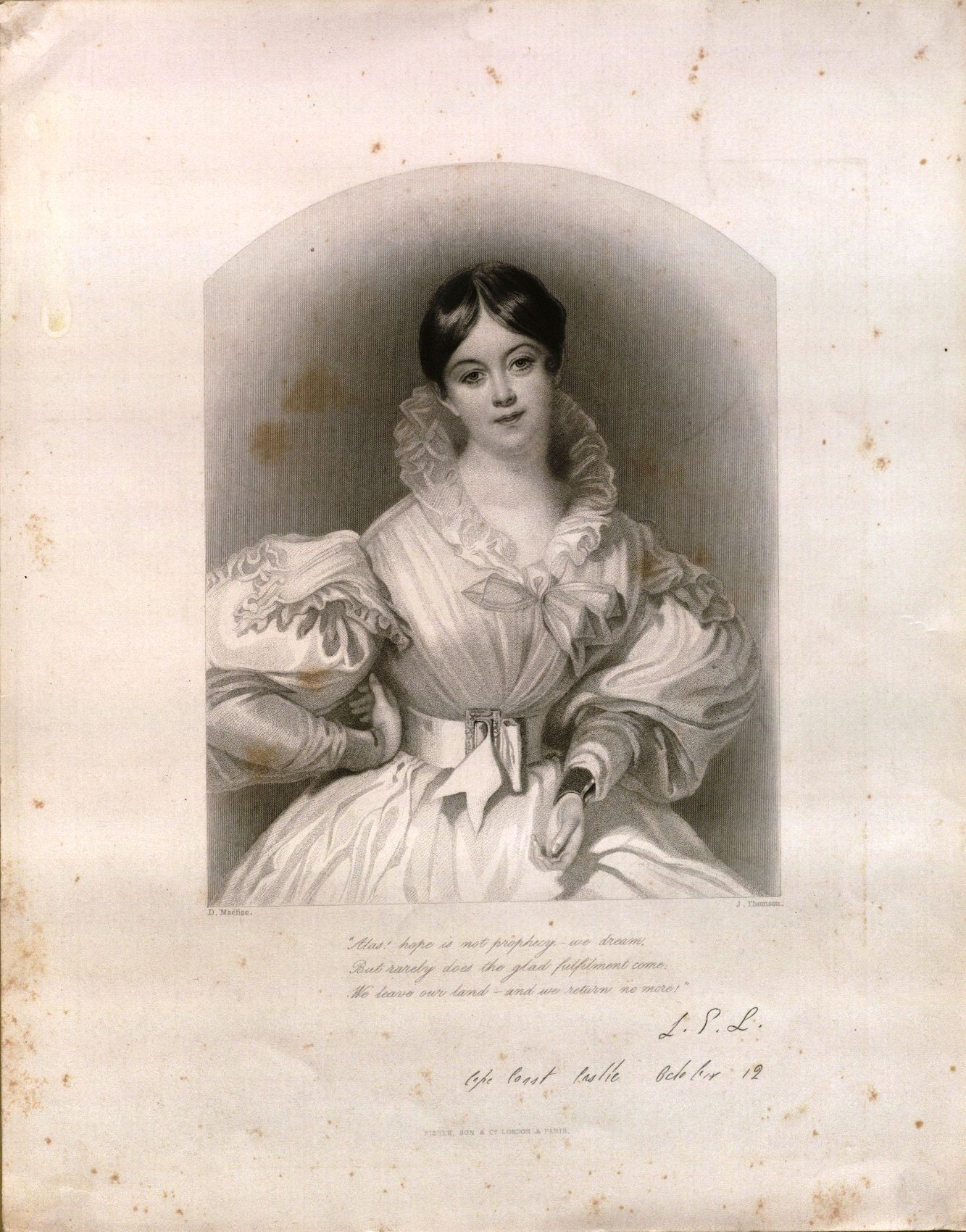
Two portraits of Letitia Elizabeth Landon (L. E. L.). Left: by S. Wright del; S. Freeman sc.; Right: by D. Maclise ; J. Thomson. Letitia Elizabeth Landon (L. E. L.) Collection. Call Numbers: MS 223 E1 (left) and MS 223 E2 (right). Click images to enlarge.

Letitia Elizabeth Landon (1802-1838), or L.E.L., was an English poet and novelist in the early nineteenth century.  She was controversial in her time due to rumored inappropriate relations with a man, a broken engagement, and her suspicious death (perhaps by suicide). Her small collection at the Spencer Research Library (MS 223) includes some of her poetry as well as personal correspondence. In her letters, L.E.L. displays a certain frankness that I was surprised to see in that time period. She could be quite harsh on those she felt were unexciting or uninspired.

In one passage from a letter to Mrs. E. Lytton Bulwer [1834?], she said this of her cousin Caroline:
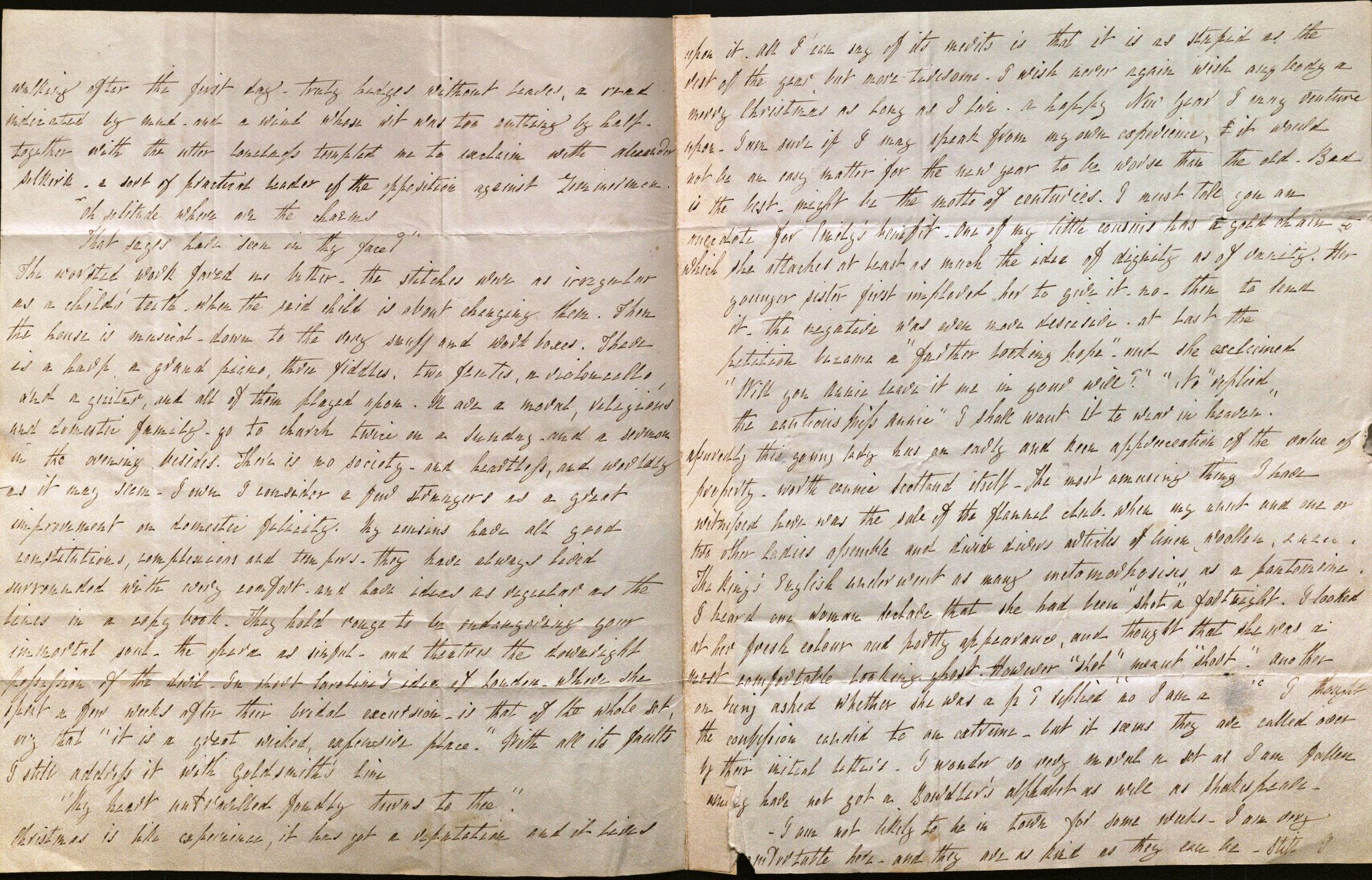
“My cousins have all good constitutions, complexions, and tempers. They have always lived surrounded with every comfort and have ideas as regular as the lines in a copy book. They hold rouge to be endangering your immortal soul, the opera as sinful, and theaters the downright profession of the devil. In short, Caroline’s idea of London, where she spent a few weeks after their bridal excursion, is that of the whole set, my that ‘it is a great, wicked, expensive place.’”

In another passage, she writes regarding her cousins’ ideas of recreation:
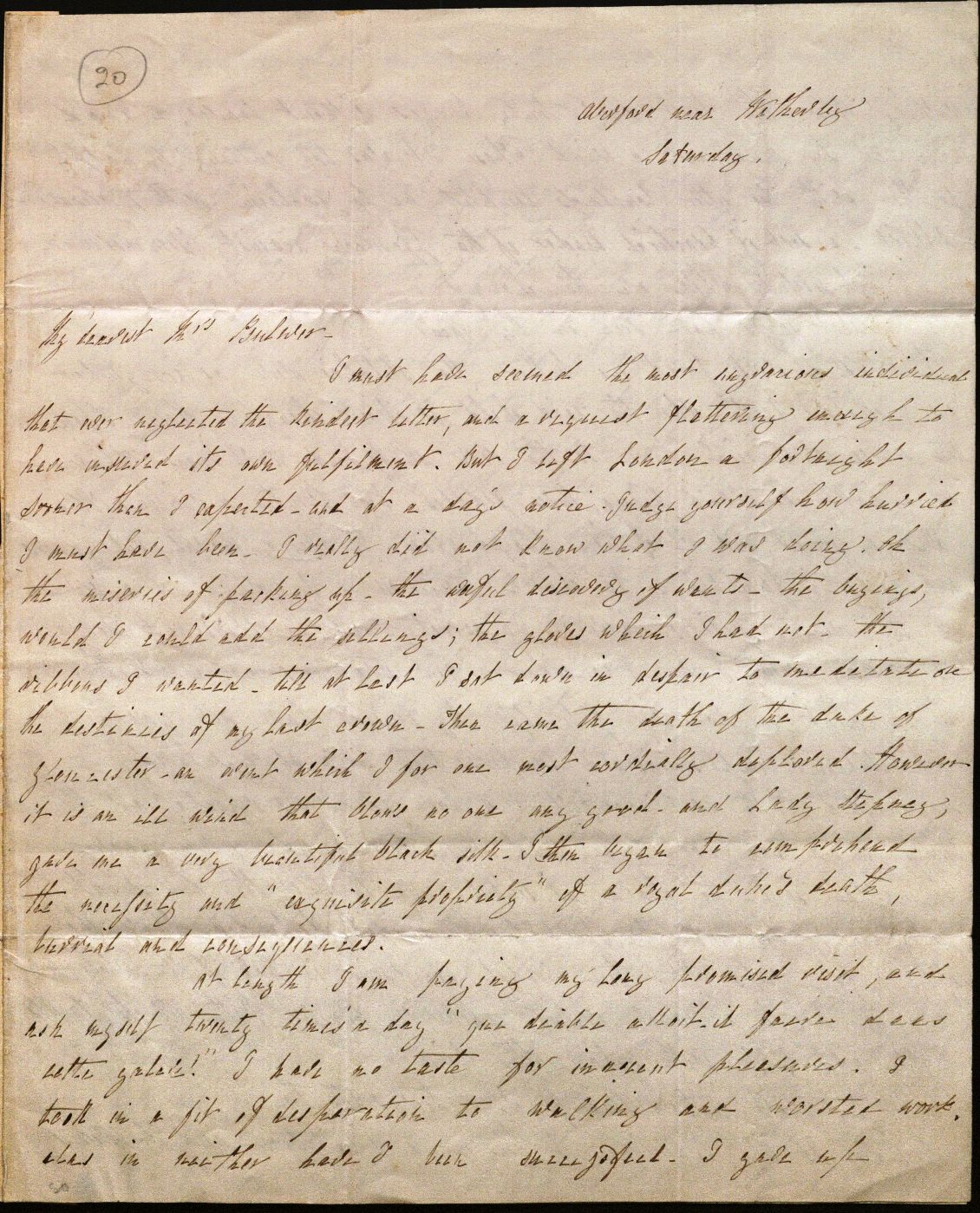
“I have no taste for innocent pleasures.”

Image of a detail from the first page a letter from L. E. L. to Mrs. Bulwer.

 Detail from the first page a letter from L. E. L. to Mrs. Bulwer.  Letitia Elizabeth Landon (L. E. L.) Collection.
Call Number: MS 223 Bc2.  Click image to enlarge

And further:
“One of my little cousins has a gold chain to which she attached at least as much the idea of dignity as of vanity. Her younger sister first implored her to give it – no – then to lend it. The negative nod even more decided. At last the petition became a ‘farther looking hope’ and she exclaimed, ‘Will you Annie leave it me in your will?’ ‘No,’ replied the cautious Miss Annie, ‘I shall want it to wear in Heaven.’”

This attitude toward her cousins likens L.E.L. to one of the many “villains” of Victorian literature. Perhaps, though, there was another side to nineteenth-century English society that some modern readers choose to ignore in the interest of romantic ideals we’ve grown to love in our favorite classics.  I, for one, find it much more exciting to imagine this slightly wicked side in our beloved heroes and heroines.

Curious about L.E.L.’s work? Click here for a link to one of her poems, “Revenge.”

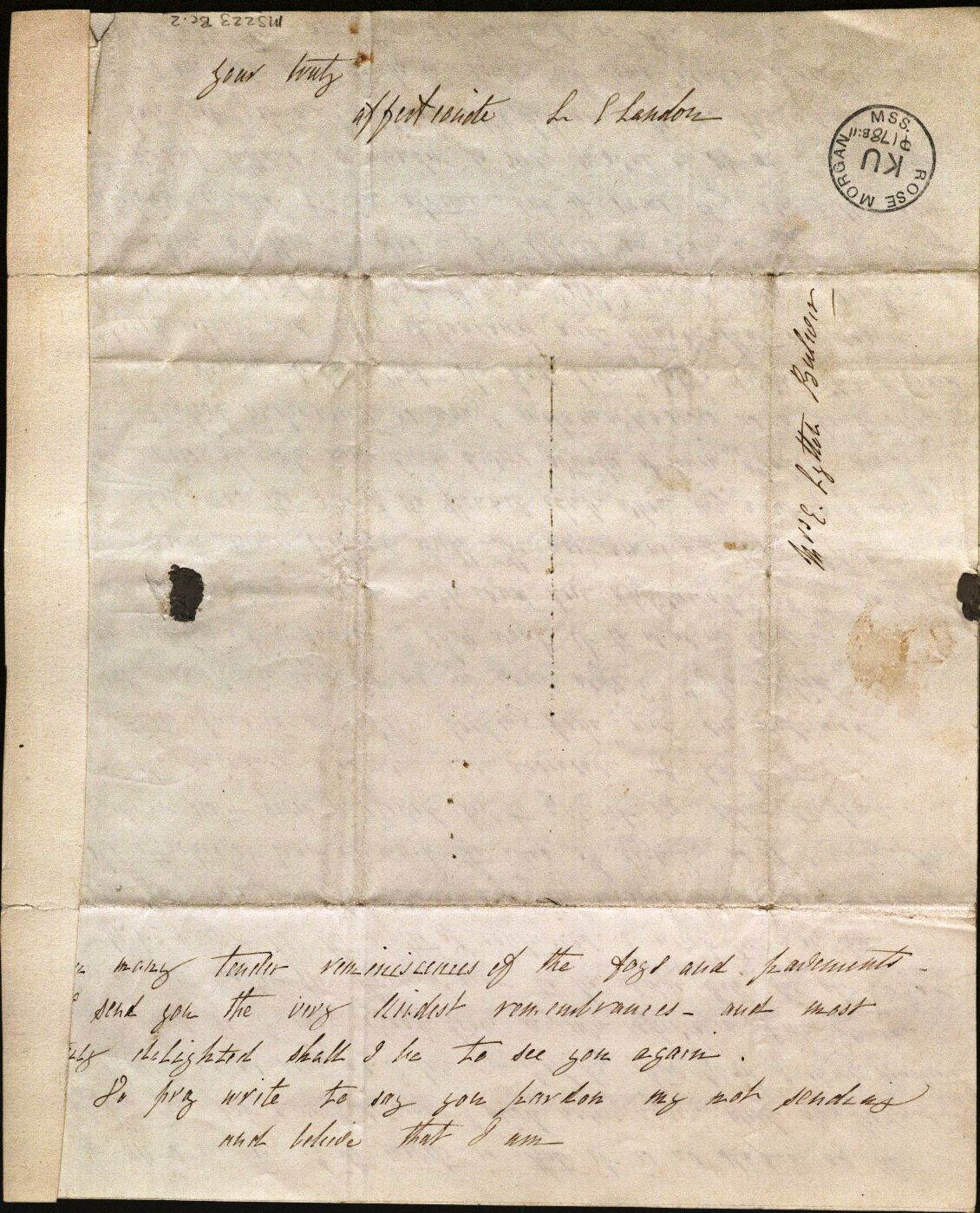
To read the entirety of the letter from  L. E. L. to Mrs. E. Lytton Bulwer discussed in this post (MS 223: Bc.2), please click on the thumbnails below.

Image of Letter from L. E. L. to Mrs. Bulwer, page 1  Image of Letter from L. E. L. to Mrs. Bulwer, pages 2-3.  Image of Letter from L. E. L.  to Mrs. Bulwer, page 4

Sarah Adams
Student Manuscripts Processor and Museum Studies Graduate Student

Editor’s Note: An online finding aid for the Spencer Library’s Letitia Elizabeth Landon (L. E. L.) Collection will be available through our finding aids search portal in the coming weeks.