The University of Kansas

Inside Spencer: The KSRL Blog

Books on a shelf

Welcome to the Kenneth Spencer Research Library blog! As the special collections and archives library at the University of Kansas, Spencer is home to remarkable and diverse collections of rare and unique items. Explore the blog to learn about the work we do and the materials we collect.

Item Feature: La Sfera, A 15th Century Schoolbook

October 19th, 2015

La Sfera, a 15th-century schoolbook, opens with basic concepts of cosmography and geography and ends with an itinerary of seaports of the southern Mediterranean and Black Seas. This manuscript poem in Italian is illustrated with astronomical and geographical diagrams, a drawing of the Tower of Babel, and miniature extracts from sea charts showing the coasts described.

Special Collections, Spencer Research Library, Call number Pryce MS P4.

Fig. 1. Diagrams showing celestial bodies and the division of the Earth into zones according to classical tradition appear near the beginning of La Sfera (ff.2v-3r). Special Collections, call number Pryce MS P4. Click image to enlarge.

Portolan charts, a type of sea chart that originated in the Mediterranean and was used in navigation from circa 1300 until the late 1600s, formed the model for the map illustrations in La Sfera.

Special Collections, Spencer Research Library, Call number Pryce MS P4.

Fig. 2. The portolan-style map illustrations exaggerate the shape of the seacoast and emphasize coastal place names and major cities (here Tripoli and Tunis), as well as giving approximate distances (f. 21v). Special Collections, call number Pryce MS P4. Click image to enlarge.

Some have attributed its authorship to Leonardo Dati (1362-1425), but, as a leader of the Dominican order, he was unlikely to have written a textbook in Italian. Boys destined for the law and Holy Orders were taught in Latin, while education for commercial careers took place in vernacular lay schools.
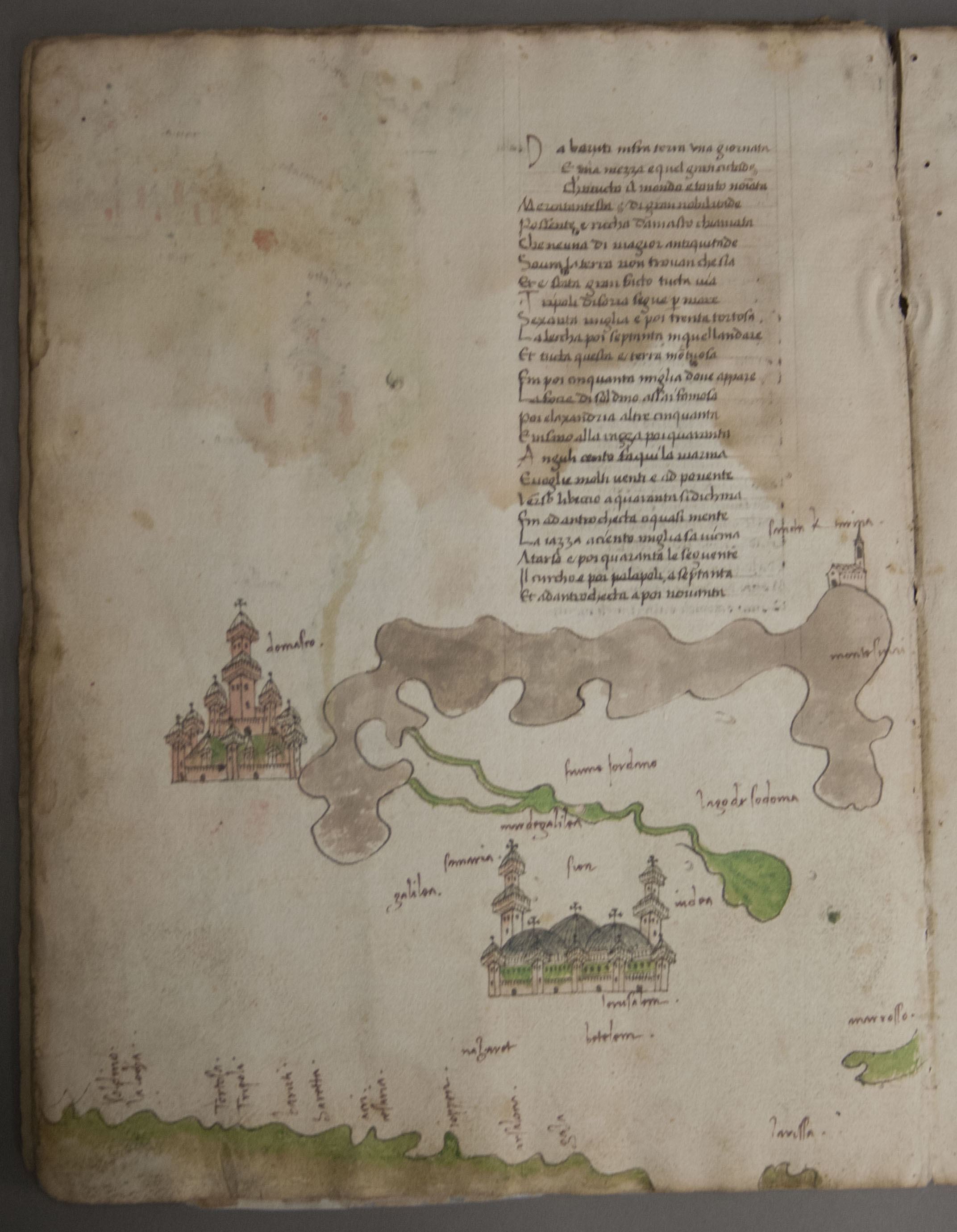
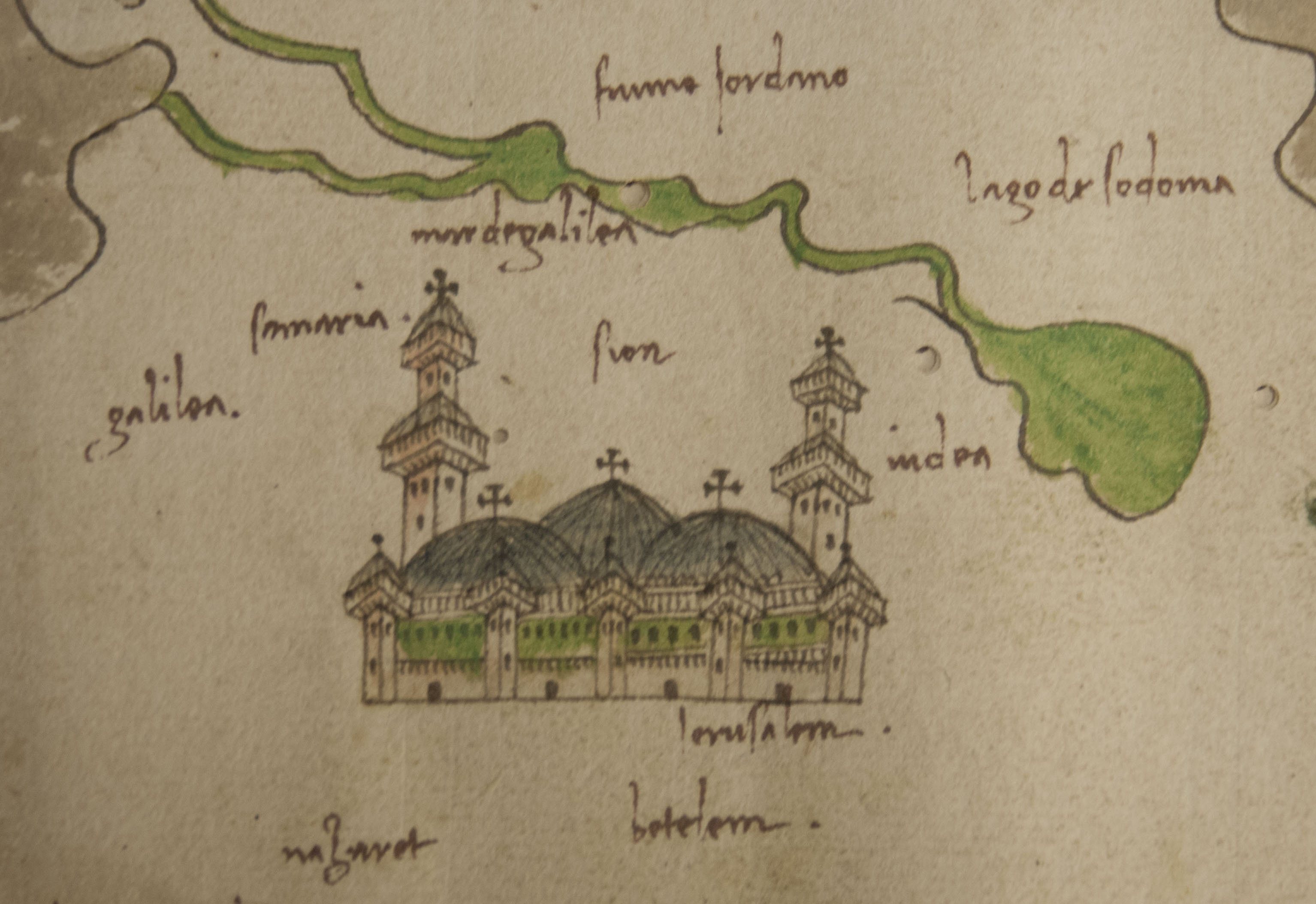
Special Collections, Spencer Research Library, Call number Pryce MS P4.  Special Collections, Spencer Research Library, Call number Pryce MS P4.

Figs. 3a-b. The text and place names are in Italian. The pen-and-ink drawings of mountains, water features, and the cities of Damascus and Jerusalem have been colored with watercolor washes (f. 22v). Left: overall view, right: detail of Jerusalem. Special Collections, call number Pryce MS P4. Click images to enlarge.

The confusion about authorship arose, because La Sfera’s author was Leonardo’s elder brother, Gregorio (Goro) Dati (1362-1435), a Florentine silk merchant whose 20 children (by a succession of four wives) doubtless provided the inspiration for writing La Sfera. The survival of more than 150 manuscript copies and several printed editions from the 15th and 16th centuries attests to La Sfera’s popularity. Goro Dati knew the Mediterranean Sea firsthand from trading voyages on merchant vessels, but he left La Sfera’s circuit of the Mediterranean coasts unfinished, perhaps because he died while writing it. In 1514 Giovanni Maria Tolosani completed and published the itinerary as a printed book.

La Sfera is written in ottava rima, a form of poetry employing stanzas of eight lines. It belongs to an Italian tradition of vernacular geographical poetry, known as geografie metriche. A later example was Francesco Berlingieri’s publication in 1482 of Geographia of the ancient Greek geographer, Claudius Ptolemy, re-written in Italian verse. Also dating from the 1480s were Bartolomeo dalli Sonetti (Zamberti)’s sonnets in Venetian dialect about the Greek islands. The ease of memorizing poetry may account for its use in textbooks published elsewhere in 16th-century Europe, such as the 2nd edition Johannes Honter’s Rudimenta Cosmographia published in Latin verse in Kronstadt (now Brasnow, Romania). Based on its script and paper watermarks, Kenneth Spencer Research Library’s manuscript copy dates from circa 1450. As well as annotations, the dirty outer leaves, stains left by spilled liquid, and the remains of a snakeskin used as a bookmark attest to its use.

Special Collections, Spencer Research Library, Call number Pryce MS P4.  Pryce MS P4 ff. 11r detail finger

Figs. 4a-b. The leaves in this opening have added marginal notes and a passage marked by a pointing finger (ff. 10v-11r). Left: overall view, right: detail of pointing finger. Special Collections, call number Pryce MS P4. Click images to enlarge.

This manuscript was probably used first as a textbook, without a cover, and later bound in a codex with other texts, from which it had been separated before its acquisition in 1966.

Karen Severud Cook
Special Collections Librarian
Quixotic in Any Language: Don Quixote at Spencer

September 28th, 2015

Over four-hundred years ago, Miguel de Cervantes Saavedra conceived of one of the most enduring characters of western literature: a gentleman who, upon reading too many chivalric romances, determined to go into the world as Don Quixote and practice the art of chivalry.

The first volume of El Ingenioso Hidalgo Don Quixote de la Mancha was published in 1605, to immediate success. The book was quickly translated into many languages; Spencer Library houses many translations of this seminal work.

After the success of Don Quixote, Cervantes turned his attention to writing other works, particularly Novelas ejemplares and Viaje al Parnaso. However, in 1614, a spurious sequel to El Ingenioso Hidalgo Don Quixote de la Mancha appeared in print, by a rival writing under the assumed name of Alonso Fernández de Avellaneda. In response, Cervantes penned the authorized Don Quixote sequel, Segunda Parte del Ingenioso Cavallero Don Quixote de la Mancha, which appeared in print in late 1615. In honor of the four-hundredth anniversary of the publication of the second and final volume featuring Don Quixote and Sancho Panza, please enjoy some images of the gentleman knight as depicted through the ages and in different translations.

Image of Don Quixote, Kenneth Spencer Research Library, University of Kansas Libraries.

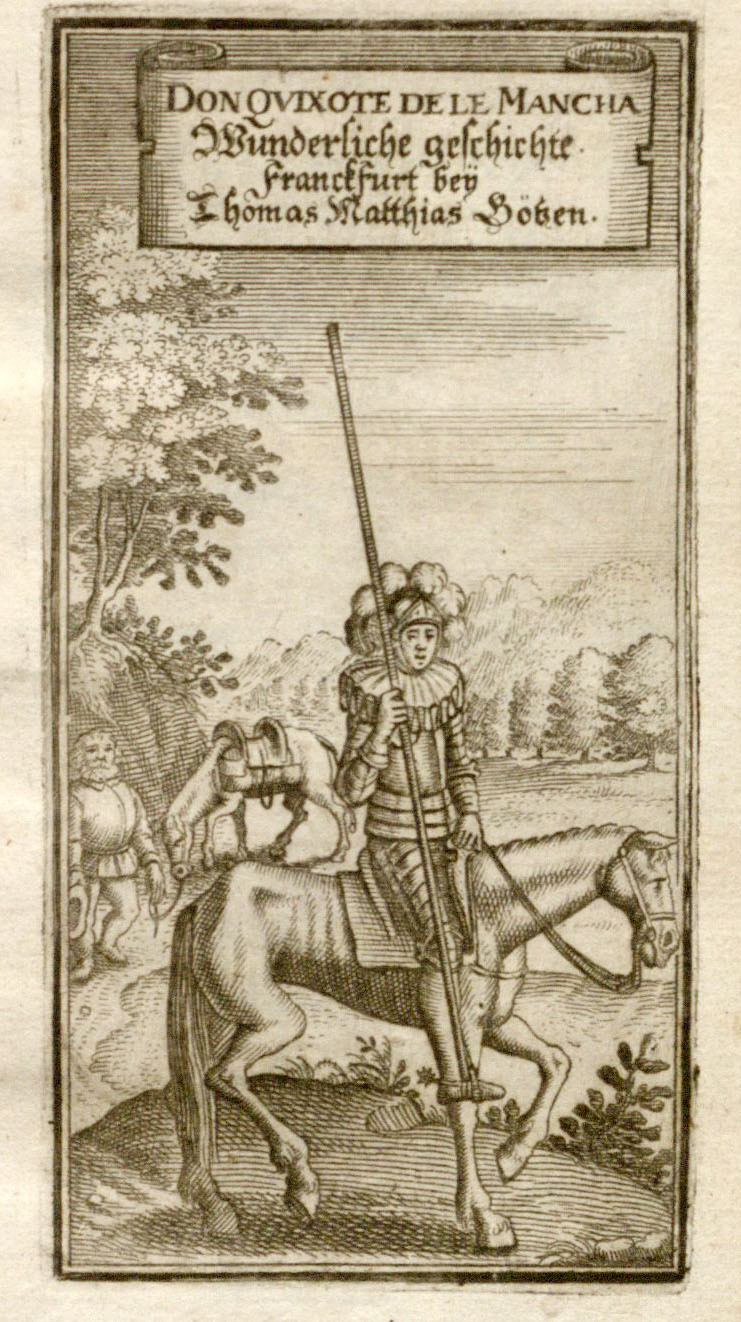
The knight errant: Frontispiece of Don Kichote de la Mantscha (Frankfurt, 1669). Special Collections, Call Number Cervantes X6. Click image to enlarge.

Image of Don Quixote, Kenneth Spencer Research Library, University of Kansas Libraries.

The dreaming hidalgo: Frontispiece and title page of The history of the renowned Don Quixote de la Mancha (London, 1749). Special Collections, Call Number Cervantes X3 v. 1. Click image to enlarge.

Image of Don Quixote, Kenneth Spencer Research Library, University of Kansas Libraries.

Acting chivalrously: Frontispiece and title page of Leben und Thaten des weisen Junkers Don Quixote von la Mancha (Leipzig, 1780). Special Collections, Call Number Cervantes Y110 v. 3. Click image to enlarge.

Image of Don Quixote, Kenneth Spencer Research Library, University of Kansas Libraries.

Fighting windmills: Frontispiece and title page of Den Tappre och Snillrike Riddaren Don Quixotes af Mancha Lefverne och Bedrifter (Stockholm, 1818). Special Collections, Call Number Cervantes Y49 v. 1-2. Click image to enlarge.

Image of Don Quixote, Kenneth Spencer Research Library, University of Kansas Libraries.

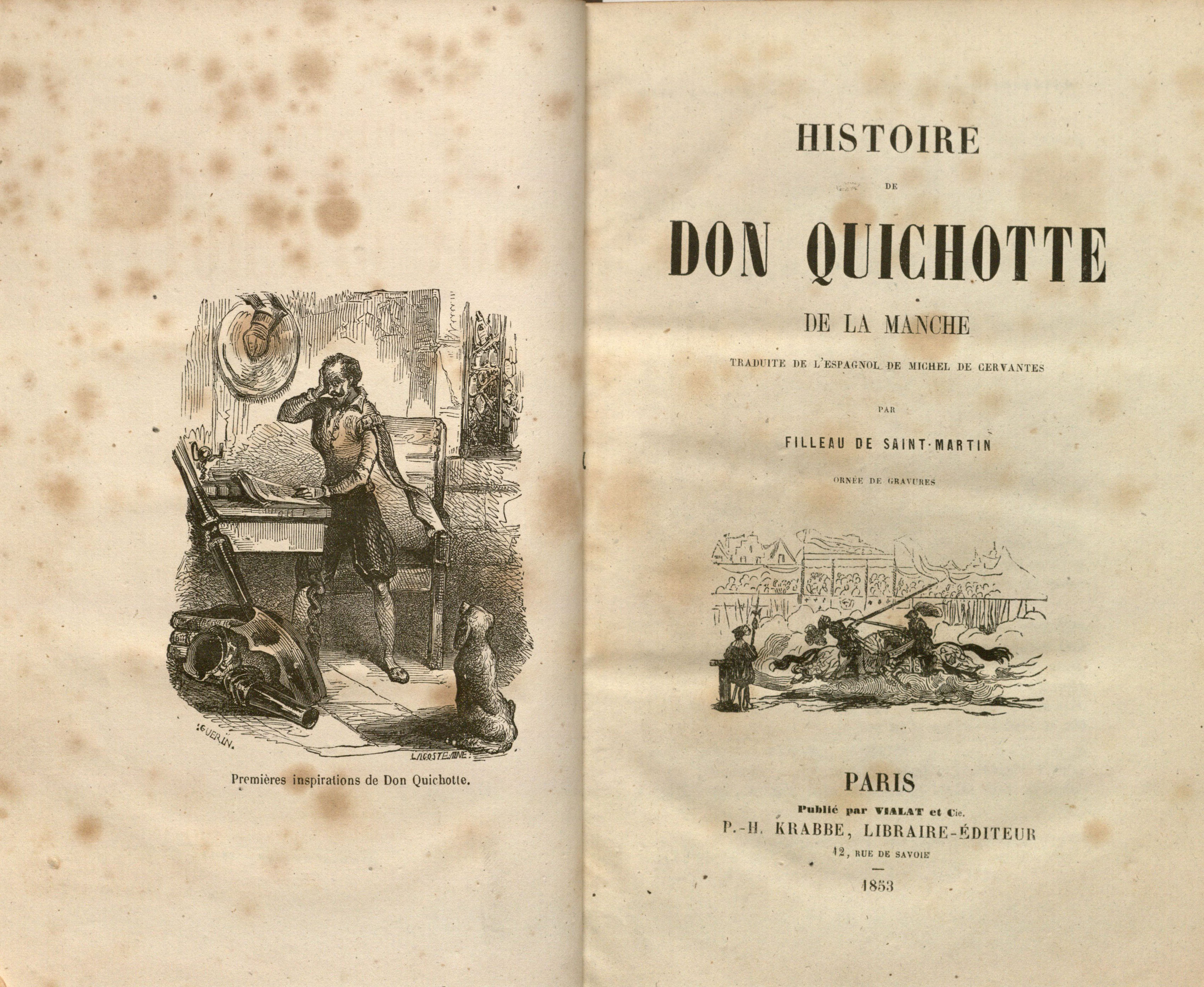
Reading chivalric romances: Frontispiece and title page of Histoire de Don Quichotte de la Manche (Paris, 1853). Special Collections, Call Number Cervantes Y45. Click image to enlarge.

Whitney Baker
Head, Conservation Services

Yeats at KC Irish Fest

September 8th, 2015

The Irish collections from Special Collections at Spencer Library were represented at the Kansas City Irish Fest this past Labor Day weekend. We were asked by Irish Fest organizers to exhibit some items from our W. B. Yeats Collection to celebrate the sesquicentennial of his birth. Featured here are a few of the items selected by Special Collections Librarian Elspeth Healey.

KCIrishFest

Whitney Baker and Elspeth Healey at KC Irish Fest


Letter from W. B. Yeats to A. H. Bullen. March 28, [1909].

In this letter, we see Yeats’s generosity to other writers as he encourages his publisher, A. H. Bullen, to read the manuscript of a young poet that he had met in London. “There may be some fire in the flax,” he comments to Bullen. Though the letter’s dateline does not include a year, Yeats’s opening reference to the death of Irish writer J. M. Synge fixes the date as 1909. Just two years earlier, Synge’s The Playboy of the Western World had sparked audience protests when it was first performed at the Abbey Theatre. Some nationalist viewers objected the play’s language and what they saw as its unflattering portrayal of Irish peasant society.

MS_25_Wa_2_57

Letter from W. B. Yeats to A. H. Bullen. March 28, [1909]. Special Collections, call number MS 25 Wa 2.57. Click image to enlarge.


Yeats, W. B. “Tom O’ Roughley,” typescript with manuscript emendations. ca. 1918.

This typescript copy of “Tom O’Roughley” is signed and revised in manuscript by Yeats, with additional markings in pencil by the printer. It appeared in Nine Poems (1918), a collection printed privately by Yeats’s friend Clement Shorter. Shorter also printed for private circulation the first edition of Yeats’s poem “Easter 1916.” The “Tom O’Roughley” of this poem shares much with the figure of the “fool” outlined by Yeats in Phase 28 of A Vision (1925, 1937). There Yeats writes, “his thoughts are an aimless reverie; his acts are aimless like his thoughts, and it is in his aimlessness that he finds joy.”

MS_25_Wd.1.3_TomORoughley

Yeats, W. B. “Tom O’ Roughley,” typescript with manuscript emendations. ca. 1918. Special Collections, call number MS 25 Wd.1.3 Tom O’Roughley. Click image to enlarge.


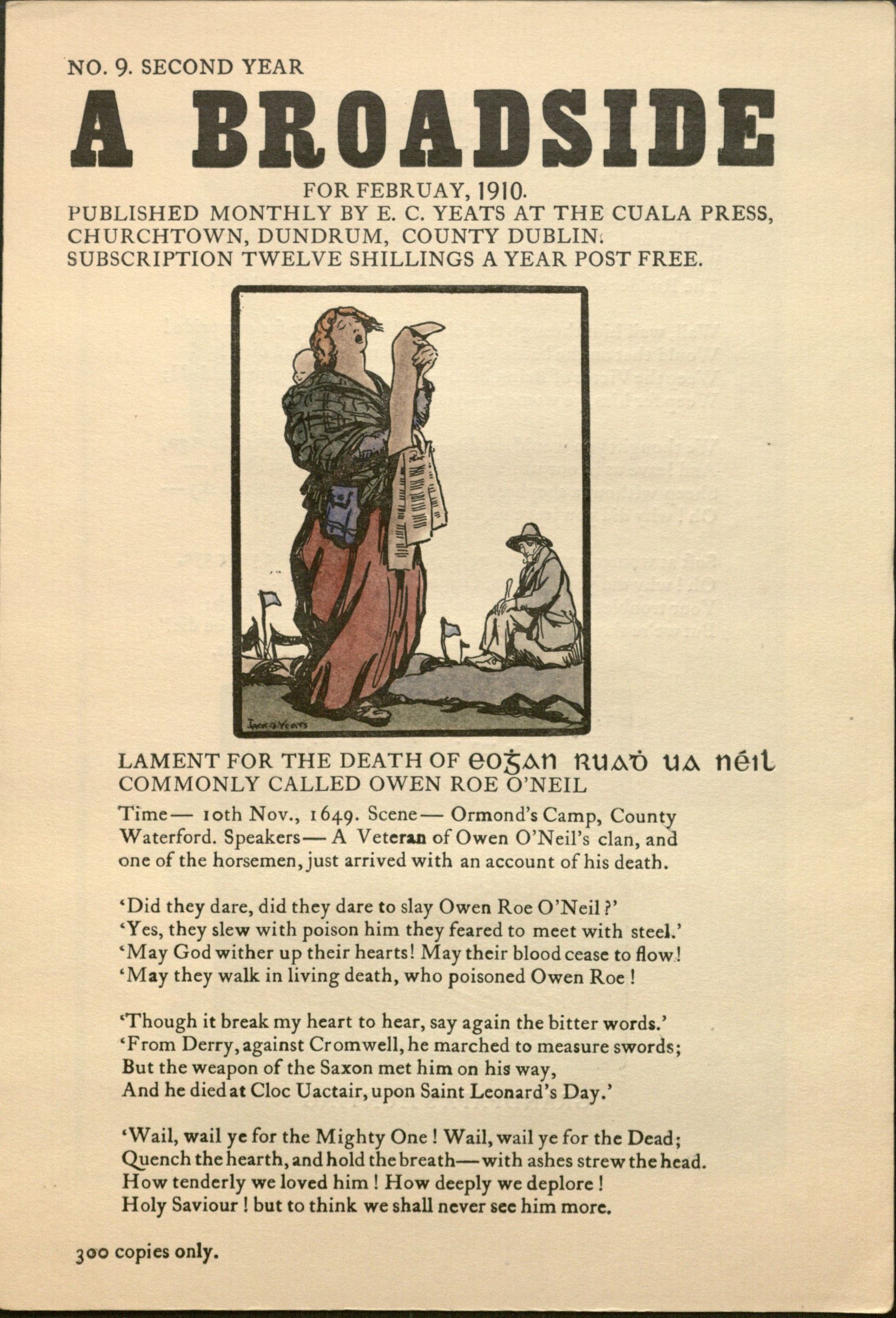
A Broadside. Dundrum, Ireland: E.C. Yeats, The Cuala Press. No. 9, Second Year (February 1910)

W. B. Yeats’s sisters Susan (Lily) and Elizabeth (Lolly) founded Cuala Industries in 1908, following an earlier printing and craft venture, Dun Emer Industries. Lily produced embroidery, and Lolly oversaw the Cuala Press, which brought out titles by primarily Irish writers, including many by W. B. Yeats himself. Below is an issue of A Broadside, a series that featured both contemporary and traditional poems and ballads. Each issue was printed in folio format—a single sheet folded once—and was illustrated with hand-colored woodcuts by Yeats’s brother, the artist Jack B. Yeats, who also edited the first series (1908-1915).

YeatsY339_No9Year2 _Page_1

A Broadside. Dundrum, Ireland: E.C. Yeats, The Cuala Press. No. 9, Second Year (February 1910). Special Collections, call number Yeats Y339, No. 9, Year 2. Click image to enlarge.


Whitney Baker
Head, Conservation Services

50 Shades of Yellowback: A Conservation Internship

August 3rd, 2015

Captain Dangerous, A Brother to Dragons, Romance of the Seas, and Somebody Else’s Wife: The History of a Heartless Woman! Where can one find such gripping book titles? Why at the Spencer Research Library, of course! Deep within the Spencer’s stacks is a series of shelves filled with a set of 459 volumes with eye-catching bindings of a style of book called the yellowback.

What are yellowbacks? They were a type of book printed from the 1840s through the early 1900s. They were often sold at railway stations. Much like the paperbacks we buy in the airport today, these mass-produced books were purchased by those boarding trains seeking entertainment during their travels. This cheap literature for the masses was produced in an equally cheap manner. Straw boards were covered in a glazed paper—usually, though not always, yellow in color—and the textblock constructed of roughly sewn or stapled, lower-quality paper. Although inexpensive in production, these books were not lacking in decorative creativity. Publishing companies hired artists to create tri-colored wood-block printed covers that correlated to the stories’ subject matter, and boy, are these covers spectacular. The back cover, and front and back endpapers, were often printed with advertisements, including some for the bath product Pears Soap, featuring a somewhat disturbed looking baby as the spokesmodel.

front_cover_B1505, Special Collections    back_cover_B1577, Special Collections, Spencer Research Library

Left: Front Cover, From Jest to Earnest, B1505.
Right: Back cover (featuring disturbed baby), Behind Closed Doors, B1577, Special Collections

The inexpensive production methods of yellowbacks might have proved profitable for publishing companies, but in terms of longevity for the books such poor construction came at a cost. After years of use, it was determined that the majority of the yellowback collection was in need of treatment. Many had loose or detached boards and spines, split hinges, abraded and flaking covers, and detached corners. It also appeared that some of the books had undergone previous conservation treatment involving a nasty hide-glue to reattach boards and spines. Over time, this treatment had proven to be more injurious than helpful. Luckily for the books, the conservation department had just the right summer intern up for the challenge of these little fixer-uppers.

B1346 before treatment, Special Collections, Spencer Library

Example of detached board and extra adhesive in hinge area, Tancred, B1346, Special Collections.

After conducting an in-depth survey of the entire collection, thirty-five books were determined to be the most in need of treatment. Once treatment options were discussed with the collection’s curator, work commenced. To remedy the failing hinges, a strip of kozo Japanese tissue was adhered using wheat starch paste and then dried beneath a weight. In more severe cases where the boards and spines were detached, the textblock was cleaned of any previous lining and glue using a methylcellulose poultice. If needed, the textblock was shaped with a backing hammer to create a rounder spine. A new spine lining was adhered using kizukishi Japanese paper and wheat starch paste, cut to allow for two one-inch flanges on either side of the spine. The boards were then attached using the flanges, adhering them to the interior of the cover.

B1481 before treatment, Special Collections, Spencer Library      B1481 during treatment, Special Collections, Spencer Library

Left: Spine before cleaning, Moths, B1481
Right: Spine after cleaning and lining with kizukishi paper, Moths, B1481, Special Collections.

If the spine was also missing, a modified hollow was created from a rectangular piece of tinted moriki Japanese paper, cut to the length of the book, folded three times in accordance with the book’s spine width, creating a tube-like hollow. This allows for both strength and flex in the book when patrons wish to comb through the pages. The treatments performed were minimally invasive. It was important to keep in mind that the “cure” could not be more than the book could handle, and also that the treatments not be visually distracting. After treatment, a custom-fitted Mylar wrapper was made for each volume for added protection. During my internship, thirty-five books were treated in four weeks.

B1481 before treatment, Special Collections, Spencer Library  B1481_Moths_after treatment

Left: Example of detached spine.
Right: Same book after spine reattachment. Moths, B1481, Special Collections.

These simple but sturdy fixes extend the life span of these books and allow for easier patron use. I implore you to go visit the Spencer Research Library, not only to view my handiwork, but to admire, and also find humor, in these wonderful books.

B1433 before treatment, Special Collections, Spencer Library   pic 10 B1433_AT

Left: Before treatment image featuring previously repaired spine, The Mariner’s Compass: a Novel, B1433.
Right: After treatment, with newly repaired spine, The Mariner’s Compass: a Novel, B1433, Special Collections.

Allison Brewer
2015 Ringle Conservation Intern
Conservation Services

Collection Snapshot: Campront Family Cartulary

July 27th, 2015

When I am asked about my favorite item in the Spencer collection, in addition to praising the glorious Vosper Book of Hours, I always mention a much more humble item, the Campront family cartulary, known by its call number, MS D47. A cartulary is a collection of charters, especially a book holding copies of the charters and title deeds of an estate.

Image of the first page of the Campront (de) family papers, La Manche, 1268-1438

First page of the Campront family papers,
La Manche, 1268-1438. Transcript of legal instruments. France,
copied after 1438. Call Number: MS D47. Click image to enlarge.

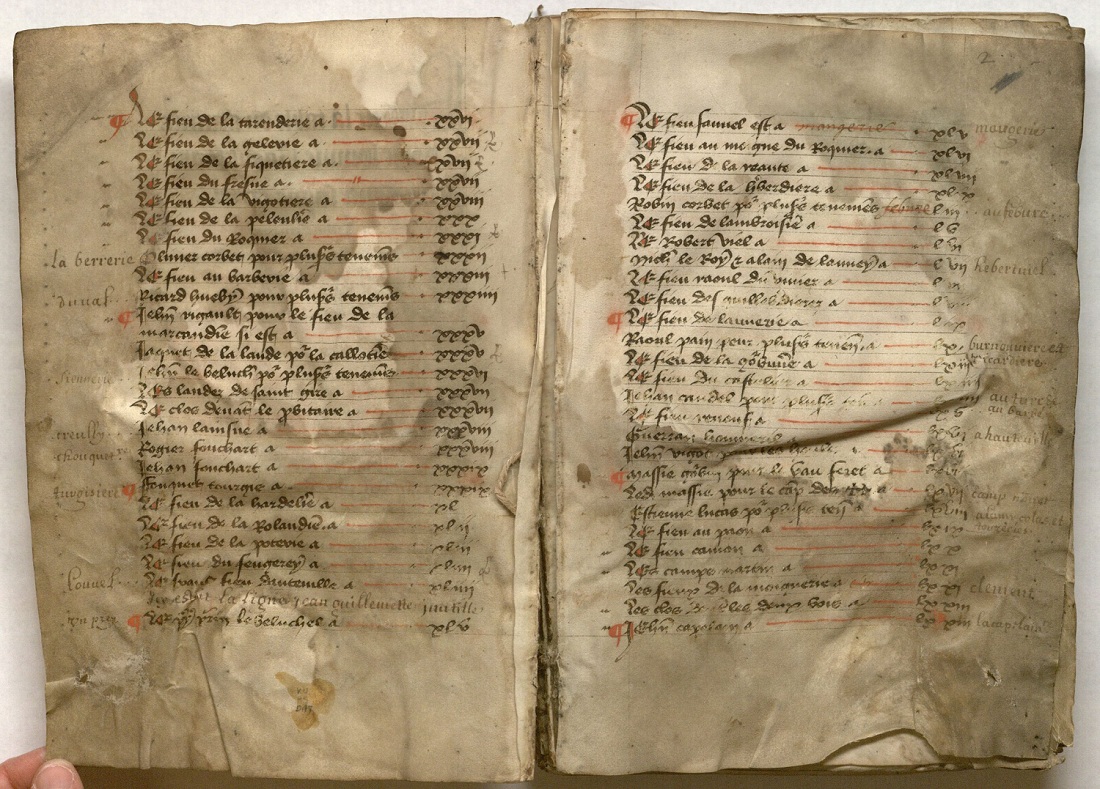
This small (23 x 16 cm), rather worn, manuscript contains copies of thirty-nine legal documents related to the Campront family of Normandy, France. Most date from the tumultuous years of the Hundred Years’ War (1337-1453), a series of conflicts between the rulers of England and France – with their allies – for control of the latter kingdom, the largest in Western Europe at the time. Land transactions, marriage settlements, and documents detailing contested claims were copied in a clear, functional hand. This was a volume designed not for show, but for its content, or, as we would say now, its “informational value.”

Image of a selected page from the Campront (de) family papers, La Manche, 1268-1438

Selected page from the Campront family cartulary. Call Number: MS D47. Click image to enlarge.

I encountered this document as a student at KU. I was thrilled to be able to work with an original manuscript and, although deciphering the old French was a challenge, I excitedly pored over each page, transcribing nearly the entire volume by hand in the days before laptop computers were widespread. I relied heavily on the preliminary work done by the late Ann Hyde, whose exhaustive description was just one example of the legacy she left behind to the Spencer Library. I learned quickly that while I could discover much about the family from this source, it was never intended to be a comprehensive document about the family’s affairs, and I was left wanting to know more about the generations of people mentioned in its pages.

Flash forward many years: I had deposited an electronic copy of my master’s thesis in the open access repository at The Ohio State University, where I then worked. (It’s also available at KU’s ScholarWorks, as is the preliminary research that formed my senior thesis.) Through the magic of Google, the current owner of the property in Normandy where the Campront family lived for hundreds of years came across my research while searching for information about his home. The historical documentation I had uncovered was personally exciting to him and, like many people, he wondered how the document ended up in Lawrence, Kansas. This gave me a chance to explain Kenneth Spencer Library and its amazing collections of early manuscripts, preserved here and made available to both amateur and professional scholars.

Image of a selected page from the Campront (de) family papers, La Manche, 1268-1438

Selected page from the Campront family cartulary.
Call Number: MS D47. Click image to enlarge.

The estate owner placed a copy of a translation of my work into the official archives of La Manche in Lower Normandy, thereby physically and linguistically extending the reach of my work even further. Finally, he offered to host me at this amazing property, parts of which appear not to have changed much from the sixteenth century, should I ever have the chance to visit.

For me, this one humble, centuries-old document, is not only a major signpost along my journey to becoming a librarian. It also captures so richly the power of the written word and the connections we make as human beings.

Beth M. Whittaker
Assistant Dean for Distinctive Collections
Director of Spencer Research Library