Welcome to the Kenneth Spencer Research Library blog! As the special collections and archives library at the University of Kansas, Spencer is home to remarkable and diverse collections of rare and unique items. Explore the blog to learn about the work we do and the materials we collect.
This blog may contain archived web content. This blog may link to catalog records which no longer exist as of a software change in 2026.
Check the blog each Friday for a new “That’s Distinctive!” post. I created the series because I genuinely believe there is something in our collections for everyone, whether you’re writing a paper or just want to have a look. “That’s Distinctive!” will provide a more lighthearted glimpse into the diverse and unique materials at Spencer – including items that many people may not realize the library holds. If you have suggested topics for a future item feature or questions about the collections, feel free to leave a comment at the bottom of this page.
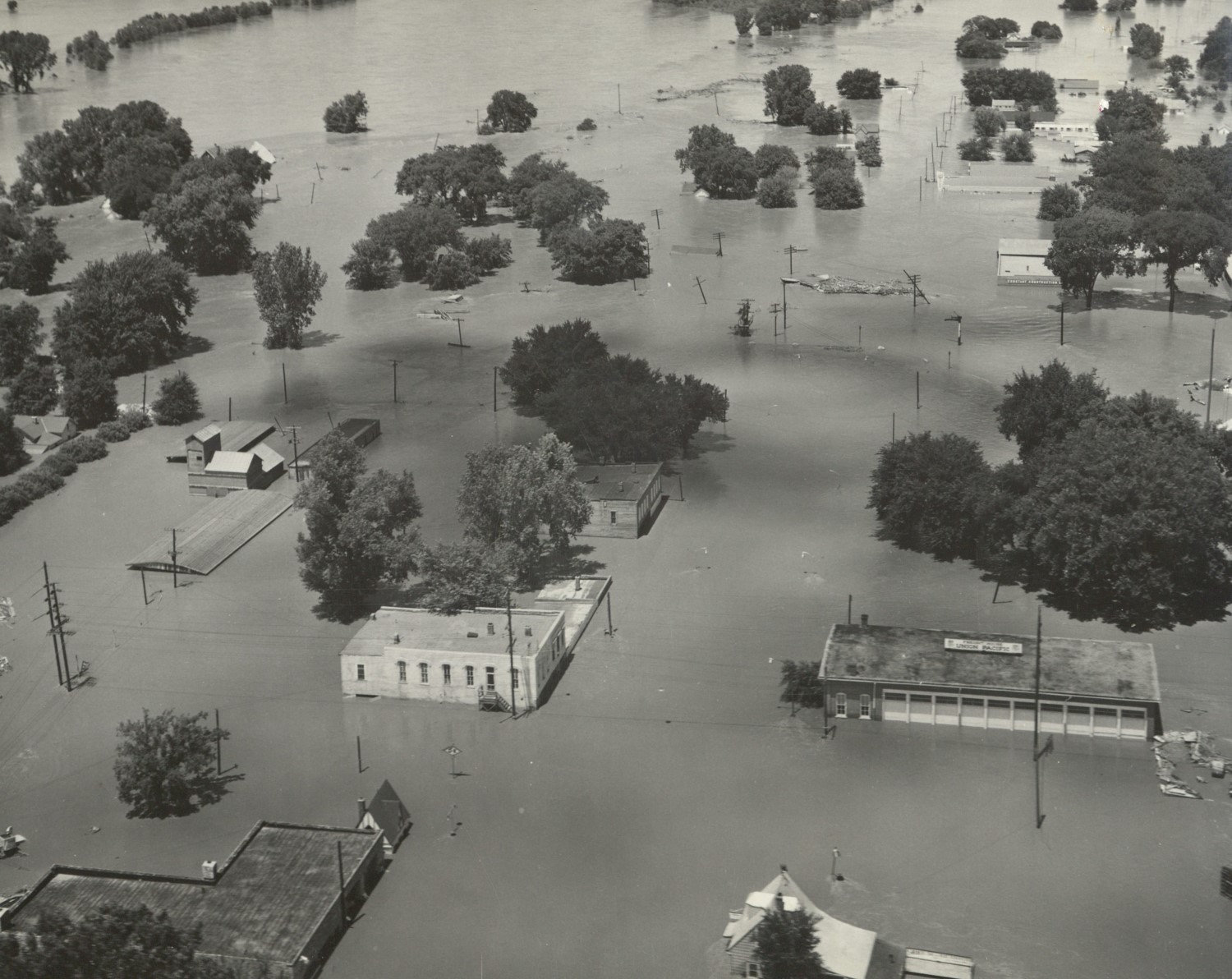
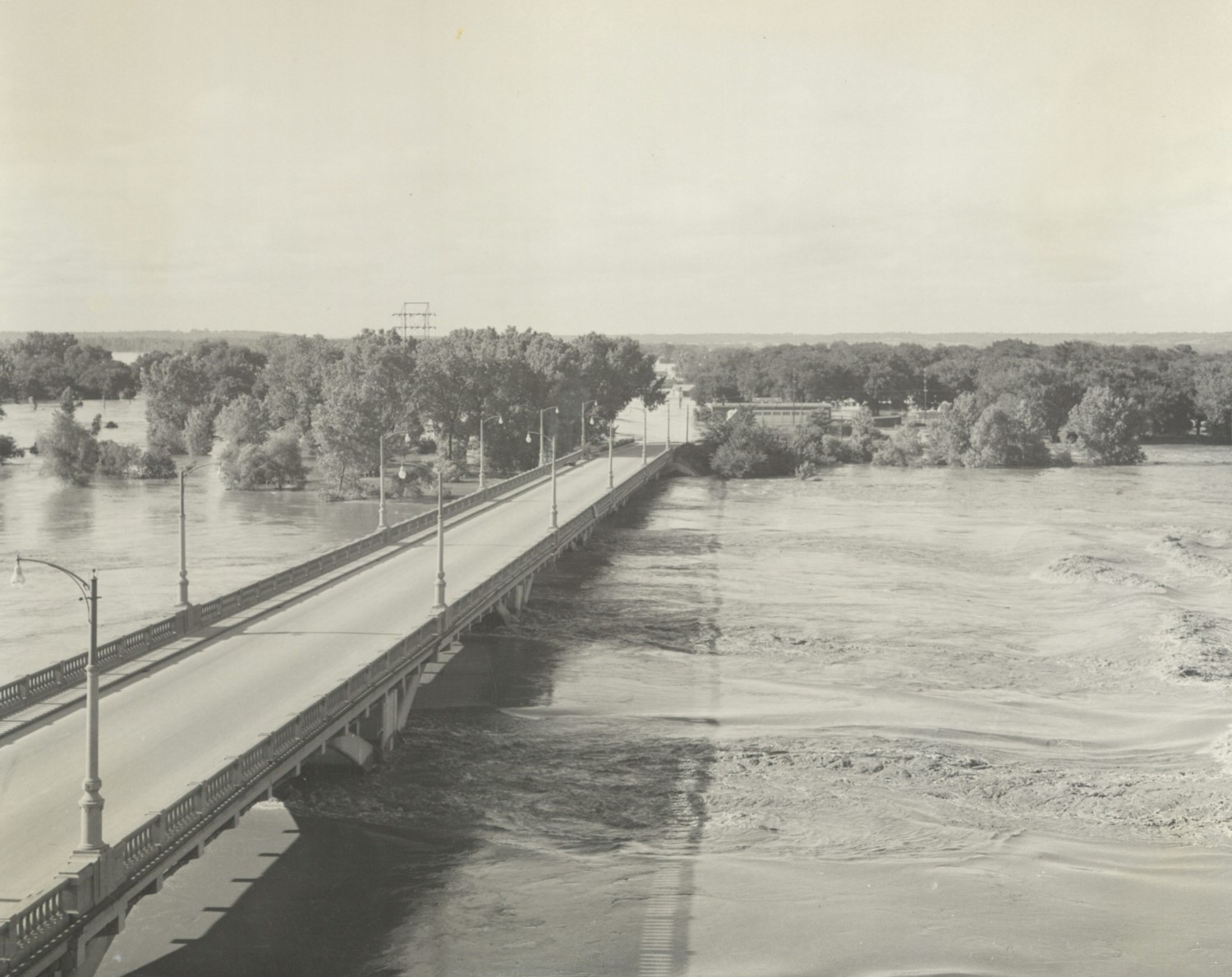
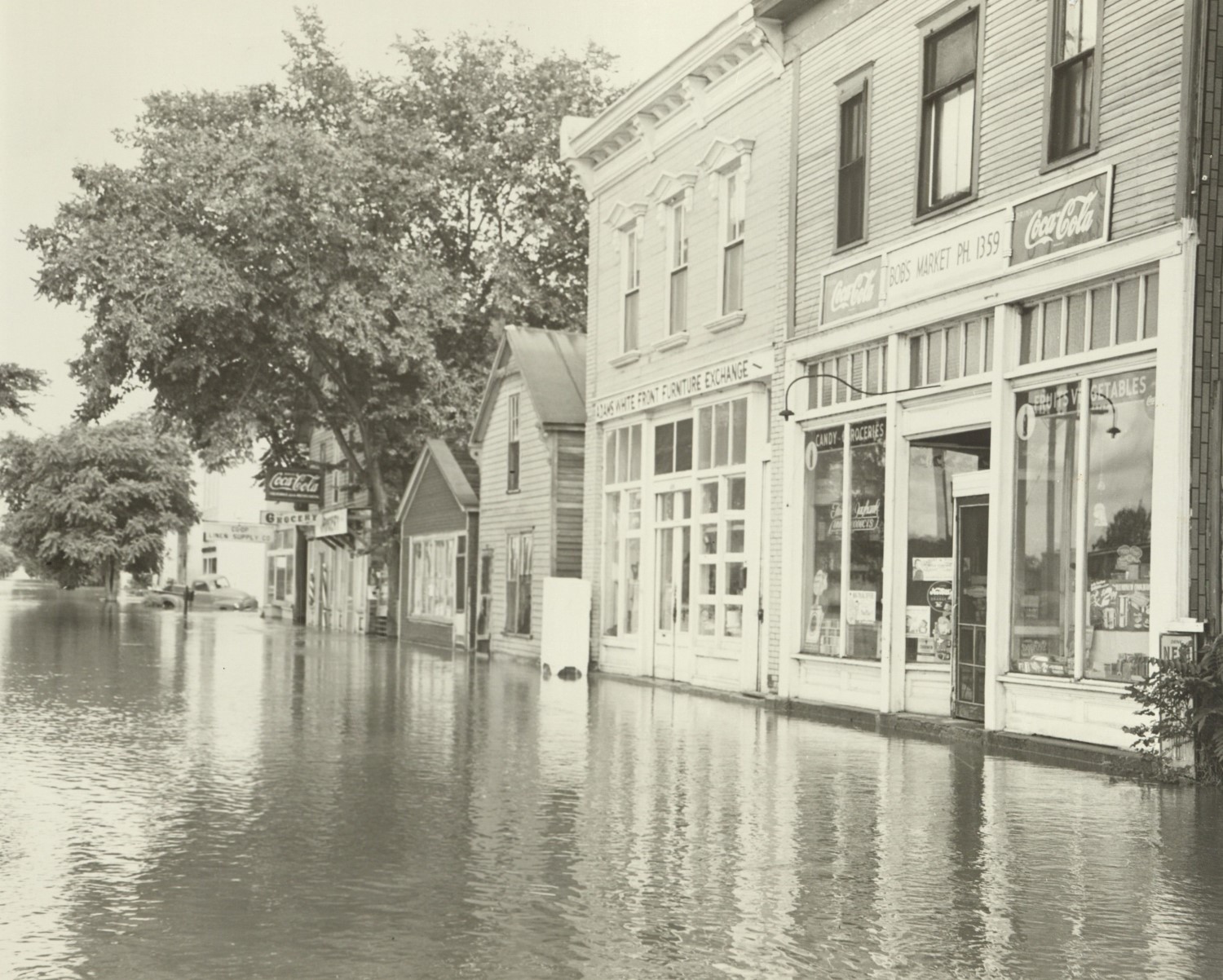
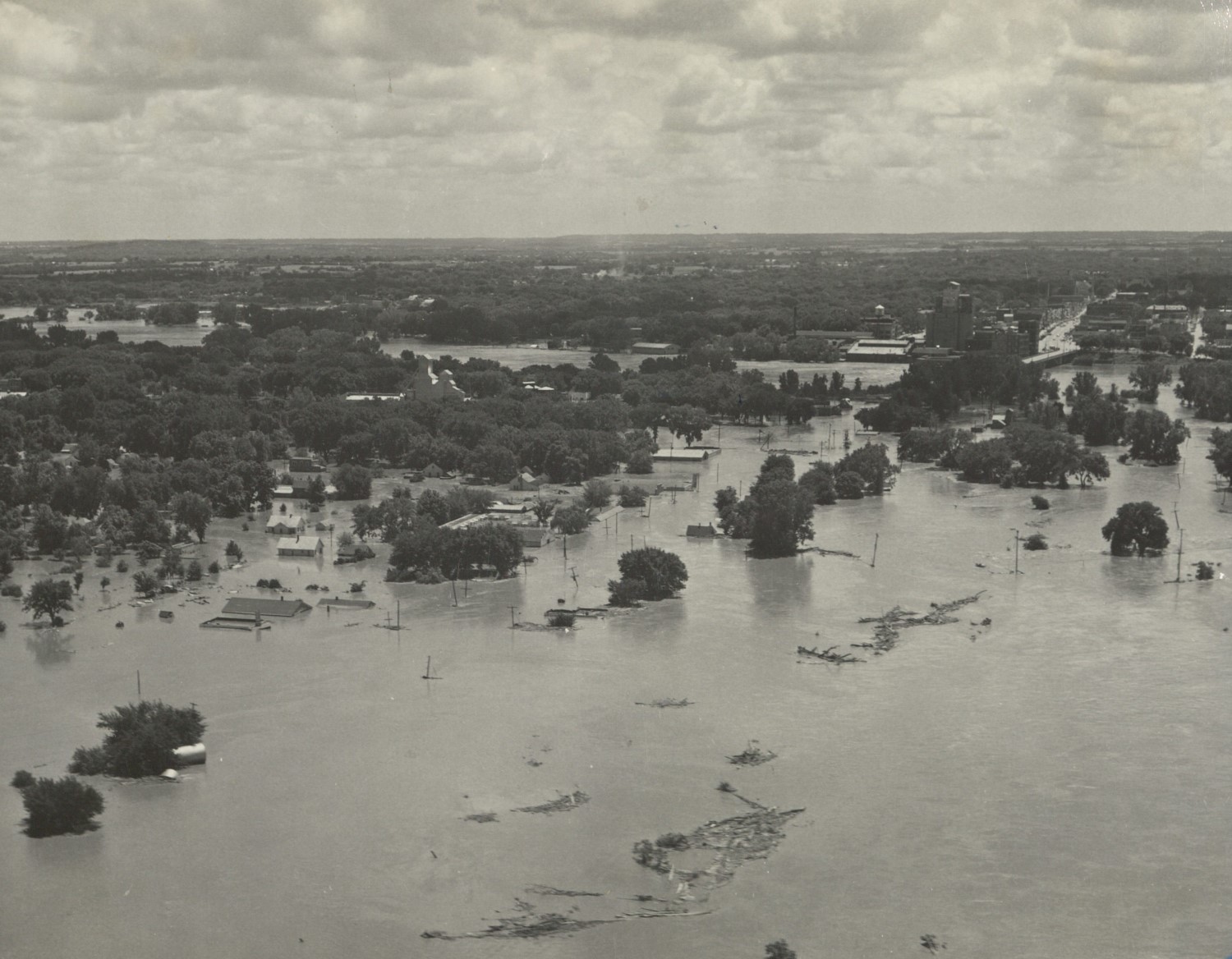
This week on That’s Distinctive! we share a photo collection from the flood of 1951. The photographs were taken by U.S. Naval Air Station Olathe personnel, unit NA87-2098-7-51 (Call Number: RH PH 172). According to Kansapedia, “July 13, 1951, has been called by some Black Friday.” This is the day that historic floods swept through the Kansas River Valley. Flooding began in Manhattan and continued down to Topeka, Lawrence, and Kansas City. The Kansas River crested in Lawrence at 29.90 feet, which was 11.90 feet above flood stage. In the end, 116 towns and cities were affected with 85,000 people evacuating homes and 10,000 farms suffering damage. According to the National Weather Service, damage was estimated to cost $760 million, which would be over $5 billion today.
North Lawrence in the vicinity of the Union Pacific Railway station at the height of the flood, 1951. 1951 Flood – Lawrence and Kansas City, Kansas, Photographs. Call Number: RH PH 172. Click image to enlarge.
The bridge over the Kansas (Kaw) River looking toward North Lawrence at the height of the flood, 1951. 1951 Flood – Lawrence and Kansas City, Kansas, Photographs. Call Number: RH PH 172. Click image to enlarge.
Locust Street in North Lawrence, 1951. 1951 Flood – Lawrence and Kansas City, Kansas, Photographs. Call Number: RH PH 172. Click image to enlarge.
North Lawrence, looking south, at the crest of the flood, 1951. 1951 Flood – Lawrence and Kansas City, Kansas, Photographs. Call Number: RH PH 172. Click image to enlarge.
The library houses many collections that share local history. Search our finding aids to see what we have.
More images of the flood can be found in person within other collections at Spencer or online through the Watkins Museum of History website.
In 1970, the United States was deeply divided along social, racial, economic, generational, and political lines. Young people across the country were protesting in favor of civil rights action and against the Vietnam War and military recruiting on college campuses. That spring the National Guard killed four student protesters at Kent State University. While the incident at Kent State holds a place in the national consciousness, many are unaware that there were two shootings near the University of Kansas (KU) that summer.
Later dubbed the Days of Rage, pipe bombs, dumpster fires, and sniper fire were not uncommon in Lawrence, Kansas, during the summer of 1970. Arsonists burned the KU Union in the spring. The lethal violence began when Lawrence Police Officer William Garrett killed former KU student and Black Student Union activist Rick “Tiger” Dowdell on July 16, 1970. During protests in response to the police shooting, police shot and killed KU student Nick Rice on July 20.
Photograph of Harry Nicholas “Nick” Rice, undated. Esther Christianson Rice Papers. Call Number: RH MS P617. Click image to enlarge.
According to a newspaper interview of a fellow member of the Zeta Beta Tau Fraternity, Nick Rice supported civil rights and was against the war, but he was not a protestor. He was one of the students who helped to put out the fire in the Union and received a commendation from the city of Lawrence for his bravery.
The night that a city officer shot him, Rice was with his girlfriend and friends playing pinball at the Rock Chalk Cafe while protesters gathered outside. Officers were throwing teargas as Rice and his friends were leaving. One protester tried to start a car on fire but was unsuccessful. Police fired at the short, long-haired, would-be arsonist and hit tall, clean-cut Rice in the back of the head. Officers continued to throw teargas as bystanders attempted first aid.
No one was ever charged for killing Nick Rice or Tiger Dowdell. An all-white coroner’s inquest found that Lawrence Police Officer William Garrett did not have felonious intent when he killed Tiger Dowdell. The official statements released by the Kansas Bureau of Investigation (KBI) and at Rice’s inquest claimed “insufficient evidence” of wrongdoing in the shooting of Nick Rice. However, the KBI files in the newly-processed Personal Papers of Harry Nicholas Rice (Call Number: PP 647) tell a different story.
The Lawrence Times had access to the lightly redacted KBI Nick Rice case files before they were donated to Spencer. In 2021, they published a series of articles on the Nick Rice case based on these files, suggesting an intentional cover up of the evidence.
The KBI summary of the incident, submitted in August 1970, makes it clear that Officer Jimmy Joe Stroud thought he shot someone and Lawrence Police Officer Virgil Foust found a bullet from Officer Stroud’s gun near the site where Nick Rice fell. Foust gave the bullet to Police Captain Merle McClure, who put the evidence in his pocket and took it home, breaking the legal chain of custody and causing the “insufficient evidence” of wrongdoing. Captain McClure did not turn over the evidence until the KBI investigators asked him specifically if he had the bullet. Neither the KBI nor the Lawrence Police Department shared this information with the public or with Rice’s family.
Nick’s mother, Esther Rice, was a supporter of President Richard Nixon. She wrote to the President, asking him to end the kind of violence that caused the death of her son, an innocent bystander at a protest.
Esther Rice’s letter to President Nixon, August 4, 1970. Personal Papers of Harry Nicholas Rice. Call Number: PP 647. Click image to enlarge.
Nixon responded to the national situation with the President’s Commission on Campus Unrest. Mrs. Rice wrote to the head of the Commission, former Pennsylvania Governor William Scranton. She describes the inquest that seemed to implicate her son rather than the police and her hope that the Commission’s report would set the record straight.
|
Esther Rice’s letter to William Scranton, head of the President’s Commission on Campus Unrest, November 11, 1970. Personal Papers of Harry Nicholas Rice. Call Number: PP 647. Click images to enlarge.
While the Commission admonished law enforcement for responding to mostly peaceful protests with violence and advised the U.S. President that ending the war in Vietnam would lead to more peace domestically, it did not go into the details of the Nick Rice shooting. In a social and media environment that blamed their son and the protesters for the violence, the Rice family filed a suit against the city of Lawrence for damages in the wrongful death of their son. After years of litigation, including fighting the KBI for access to their full investigation, the family decided to drop the case.
Esther Rice wrote of the experience in a manuscript called “Who Killed Our Son? An Account of the Circumstances and Subsequent Investigation of the Death of Harry Nicholas Rice” (Call Number: RH MS P617) that is also available at the Spencer Research Library. Over the years she continued to respond to news outlets that reinforced common narratives misrepresenting the case, such as the Kansas Alumni Magazine. While the files don’t include a copy of her letter, the editor’s response to her objection is included, along with the magazine in question.
The Kansas Alumni Magazine response to Esther Rice’s objection, April 17, 1985. Personal Papers of Harry Nicholas Rice. Call Number: PP 647. Click image to enlarge.
In absence of hard evidence, many newspapers reported that the overturned car burned that night, and some suggested that Rice was shot by sniper fire. It is unclear what “eye-witness accounts” the Alumni editor is referring to, but the KBI files include nearly one hundred eyewitness accounts. These files are the basis for this summary of the events, and they make it clear that the Volkswagen was turned over, but never burned. The files also show the statement “no proof existed that (the police) had fired the fatal shots,” to be untrue. The proof existed; it just wasn’t released to the public.
According to The Lawrence Times, Nick’s brother Chris Rice paid thousands in legal and copying fees to gain access to the files from the KBI. More than fifty years after the shooting, Chris finally learned the truth. Rice donated the files to the Spencer Research Library, and they are now ready for viewing in the Reading Room.
The Personal Papers of Harry Nicholas Rice include those photocopies of the KBI investigation, as well as Mrs. Rice’s correspondence with federal officials and personal papers dealing with the case against the city of Lawrence. Also included are magazines, newspaper clippings, and correspondence kept by the family. Spencer Research Library is honored to preserve these papers and to make the facts of the police shooting of Nick Rice available to the public for the first time.
Check the blog each Friday for a new “That’s Distinctive!” post. I created the series because I genuinely believe there is something in our collections for everyone, whether you’re writing a paper or just want to have a look. “That’s Distinctive!” will provide a more lighthearted glimpse into the diverse and unique materials at Spencer – including items that many people may not realize the library holds. If you have suggested topics for a future item feature or questions about the collections, feel free to leave a comment at the bottom of this page.
This week on That’s Distinctive! we share the matchbook collection of Richard Olmstead. Born in Lawrence in 1921, Olmstead collected matchbooks from Lawrence and the surrounding areas during the 1920s, 1930s, and 1940s. The images shown today cover Lawrence, Kansas, with notable businesses such as Round Corner Drug, which used to occupy Massachusetts Street.
Why share matchbooks? This collection shows that Spencer houses so much more than books. The collections contain many unique and interesting items from throughout history.
|
|
|
Selected pages of matchbooks from Lawrence, Kansas, circa 1920-1947. Richard Olmstead Matchbook Collection. Call Number: RH MS D301. Click images to enlarge.
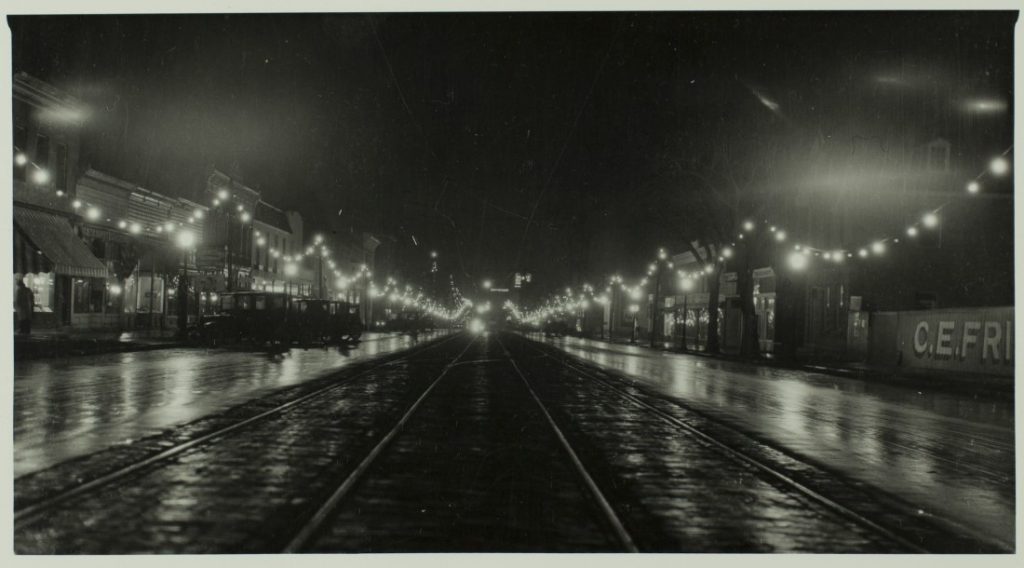
Massachusetts Street in Lawrence, Kansas, at Christmas, 1920s. Research indicates that this photo was taken at Eleventh Street – roughly in front of the Watkins Museum of History – looking north. Duke D’Ambra Photograph Collection. Call Number: RH PH 69. Click image to enlarge (redirect to Spencer’s digital collections).
Spencer Research Library will be closed from December 23rd through January 2nd. We will reopen on January 3rd and look forward to sharing more stories from our collections in the new year!
Visit the KU Libraries website for more information on winter recess across the libraries, including hours and options for accessing to online resources services available when buildings are closed.
Each week we’ll be posting a photograph from University Archives that shows a scene from KU’s past. We’ve also scanned more than 34,800 images from KU’s University Archives and made them available online; be sure to check them out!
Information about KU’s past can be found in Spencer collections beyond University Archives. This week’s photo, for example, comes from our Kansas Collection.
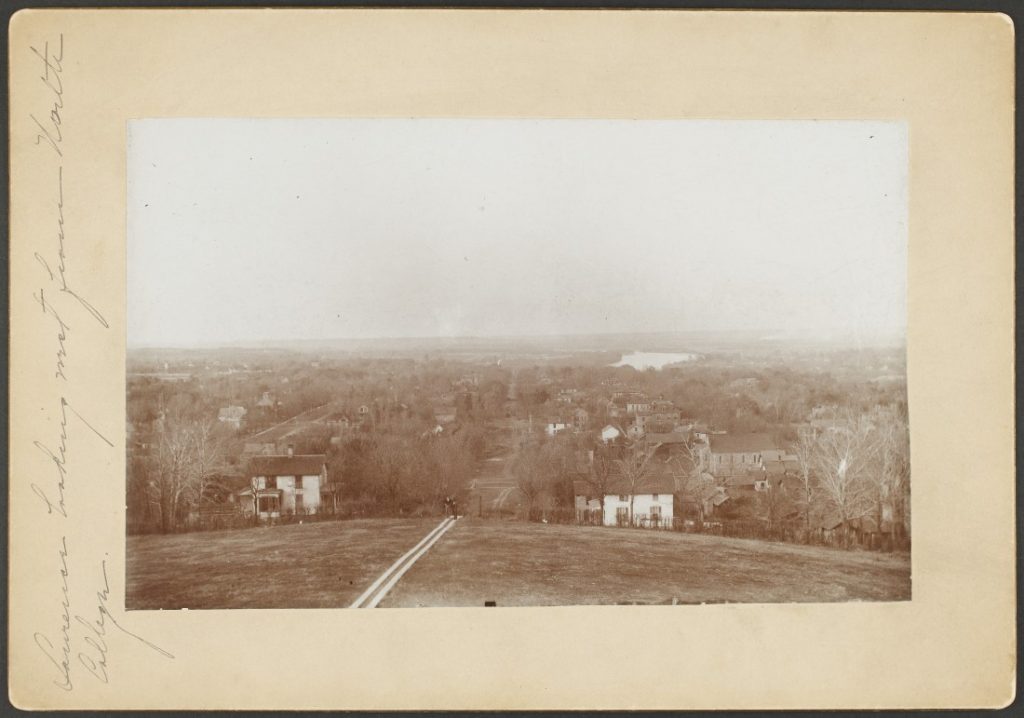
A view of Lawrence from KU’s North College, 1886. Note the two people, possibly students, standing on the walkway up to the building. Lawrence, Kansas, Photographs Collection. Call Number: RH PH 18, Box 8, Folder G:6. Click image to enlarge (redirect to Spencer’s digital collections).
North College was located roughly where Corbin Hall now stands, between Tenth and Eleventh streets. The notation on this photograph states that it shows the view looking west from North College. However, a cursory exploration of maps and other photos – plus a portion of the Kansas River in the background – suggests that the view might actually be looking north from the building, likely up Louisiana Street.