The University of Kansas

Inside Spencer: The KSRL Blog

Books on a shelf

Welcome to the Kenneth Spencer Research Library blog! As the special collections and archives library at the University of Kansas, Spencer is home to remarkable and diverse collections of rare and unique items. Explore the blog to learn about the work we do and the materials we collect.

Ringle Conservation Internship: Cornish Studio Collection

May 23rd, 2023

Becoming the Ringle Conservation Intern has been an incredible learning experience both on its own and as an expansion of the work I have been fortunate enough to do during my two years as a student employee at the Kenneth Spencer Research Library Conservation Lab. Since September of 2022, I have assessed, lightly cleaned, and re-housed over 900 individual glass plate negatives, and at least 100 flexible negatives, taken by the George Cornish Studio (based in Arkansas City, Kansas) between 1890 and 1945. With the guidance of Marcella Huggard, Charissa Pincock, Whitney Baker, and Roberta Woodrick, I have contributed 833 entries to the ongoing finding aid that include the subject of the photo (if identifiable) and the condition of each plate. My hope is that, when the collection is complete with its partner collection (the Hannah Scott Collection), history and photo enthusiasts will be able to enjoy the wide range of portraiture, landscape, and urban life photography contained within the collection.
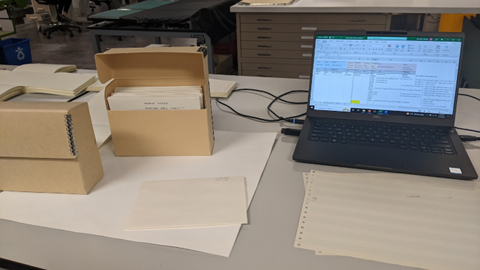
Inventorying the Cornish Studios Collection, RH MS 1342, Kenneth Spencer Research Library, University of Kansas Libraries.
Creating a spreadsheet with information about the negatives in the Cornish Studio collection.

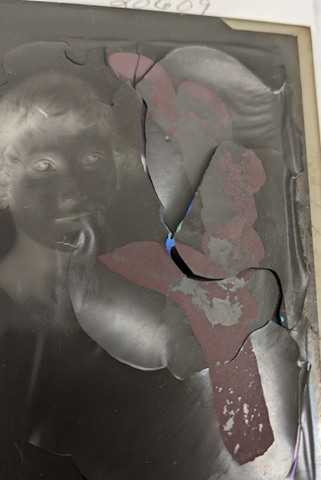
The Ringle project began with a massive shifting project. Roberta Woodrick, Grace Awbrey, Hannah Johnson, Rory Sweedler, Sarah Jane Dahms, and I moved the Cornish, Scott, and several other glass plate negative collections in advance of the heating, ventilation, and air conditioning (HVAC) updates in the stacks. During this shifting, we saw how both age and the heat from the old furnace, located under the floor where the glass plates had been held, had affected the collections. There were clear indicators that re-housing these collections was necessary. On some glass plates there was flaking emulsion and discoloration, and some flexible negatives were experiencing “vinegar syndrome” (the strong smell of deteriorating acetate film) and leaving liquid residue on the shelves (from the chemical separation of the emulsion on the plastic).
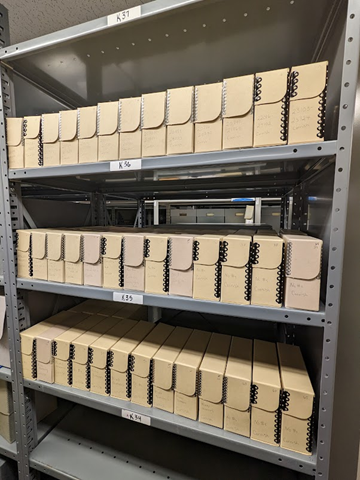
Boxes of glass plate negatives in the stacks of Kenneth Spencer Research Library, University of Kansas Libraries.
Glass plate negatives from the Cornish Studio collection housed in boxes in the stacks.
Damage to a glass plate negative. Cornish Studios Collection, RH MS 1342, Kenneth Spencer Research Library, University of Kansas Libraries.
Flaking emulsion on one glass plate negative in the Cornish Studio Collection.

The Cornish Studio was located in Arkansas City, Kansas, 8 miles north of Chilocco, Oklahoma, where the Chilocco Indian School operated, and about 200 miles southwest of Lawrence. The studio was opened by George Cornish in 1905 and was run jointly from 1912 onward by Cornish and his assistant Edith Berrouth (to whom he would leave the practice in 1946 after his death.) In 1993, attorney Otis Morrow, whose practice was in the building that had once been Cornish’s studio, donated the 8 boxes of glass plates, photo registrars, and even George Cornish’s autobiography of running the studio (called “My Life on Fifth Avenue”) to the Kenneth Spencer Research Library. (More about the history of the collection can be found at the Collections Overview.)

Many of the glass plates in the Cornish collection have some degree of damage – they’ve existed through a wide range of temperature and humidity fluctuations – but at over 100 years old for many of them, they generally look remarkably good. The subjects in the photos are almost all visible, and the excitement on their faces in these century old photographs endures. It’s clear that the people who went to the Cornish Studio for their portraits, or for the portraits of their young children (babies make up a significant portion of the plates from the 1910s-20s), were happy to have the opportunity to have their photos taken. They couldn’t have known that their likeness would be preserved for longer than them, but I like to think it would make them happy to know their investment in a photograph might provide returns to scholars today.
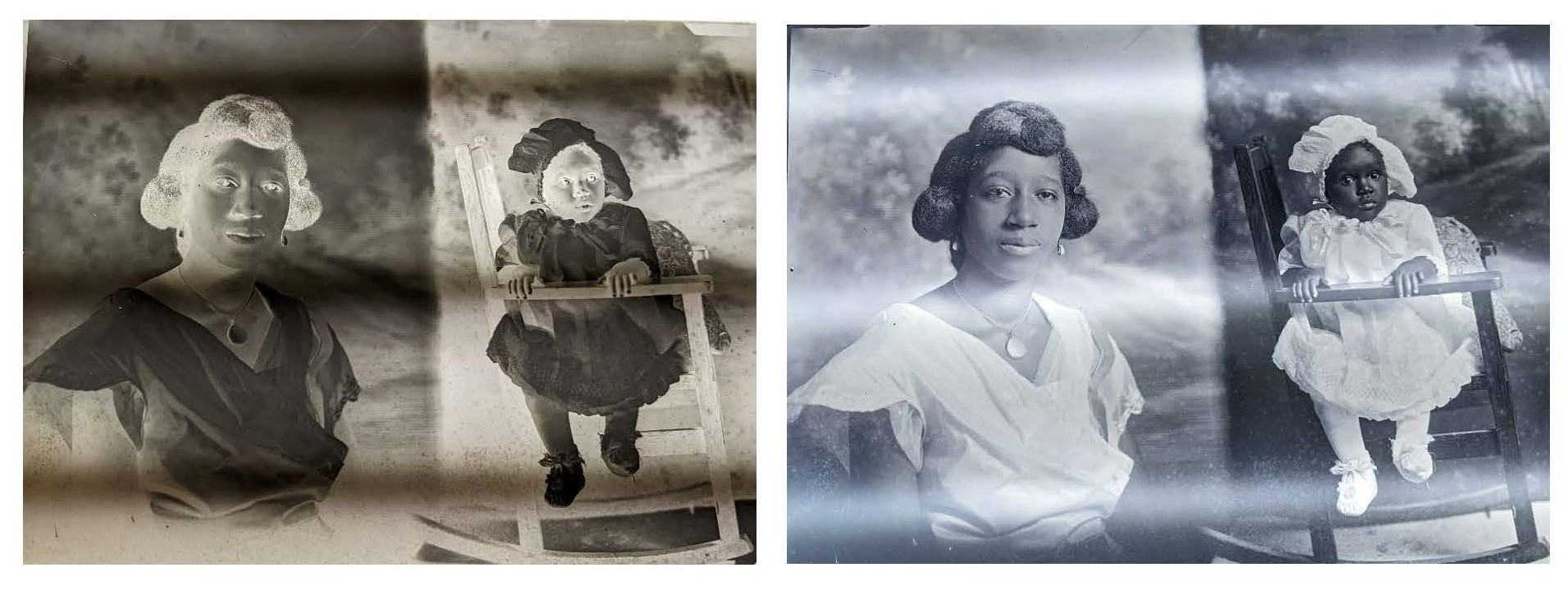
Negative and positive images of Letha Thomas and baby, Cornish Studio Collection, Kenneth Spencer Library, University of Kansas Libraries.
Negative and reversed positive image of Letha Thomas and baby, circa 1919, Cornish Studio Collection.

Before me, several Ringle interns worked on an impressive collection of projects over timespans of six weeks to three months. So far, I have been working with the Cornish Collection for nine months and will continue to do so for another two. Having almost a full year has been immensely valuable – each plate must be placed individually into a four-fold wrapper before being re-housed in boxes, and many plates between 1917 and 1930 have subjects that could be researched (which I did, especially when there might be the opportunity to identify the women in couples’ portraits who were usually identified as Mrs. (Man’s Name.)). Having now completed the 5 x 7 plates, I continue to work on the 8 x 10 plates which represent a shift from traditional studio portraiture and into street scenes in Ark City and the surrounding area. These images, and this collection, offer a valuable slice-of-life view of Southwest Kansas across a period of American history with rapid changes.   
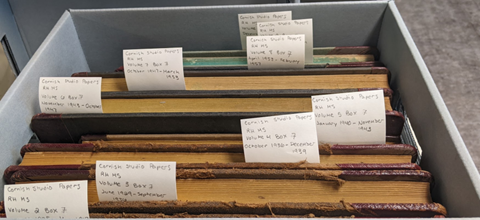
Registers from the Cornish Studios Collection, RH MS 1342, Kenneth Spencer Research Library, University of Kansas Libraries.
Cornish Studio ledgers that record information about some of the subjects featured on the negatives in the collection.

Brendan Williams-Childs
2022-2023 Ringle Conservation Intern
Conservation Services
That’s Distinctive!: Kansas Postcards

April 21st, 2023

Check the blog each Friday for a new “That’s Distinctive!” post. I created the series because I genuinely believe there is something in our collections for everyone, whether you’re writing a paper or just want to have a look. “That’s Distinctive!” will provide a more lighthearted glimpse into the diverse and unique materials at Spencer – including items that many people may not realize the library holds. If you have suggested topics for a future item feature or questions about the collections, feel free to leave a comment at the bottom of this page.

This week on That’s Distinctive! I am sharing some items from our collection of Kansas Postcard Company postcards. The postcards date from around 1990-1991. The Kansas Postcard Company was based in Lawrence, Kansas, in the early 1990s and was involved in an effort to send card to soldiers oversees. The collection houses an array of postcards with photos of scenery from all over the state. The captions below include the text on the back of each postcard.

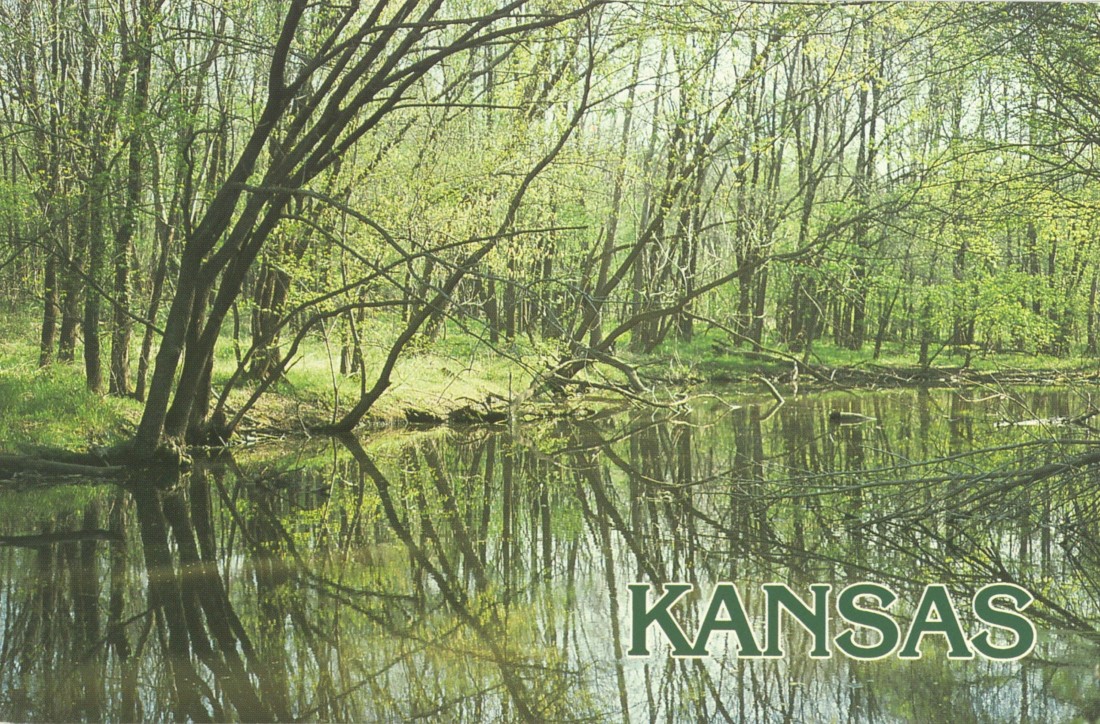
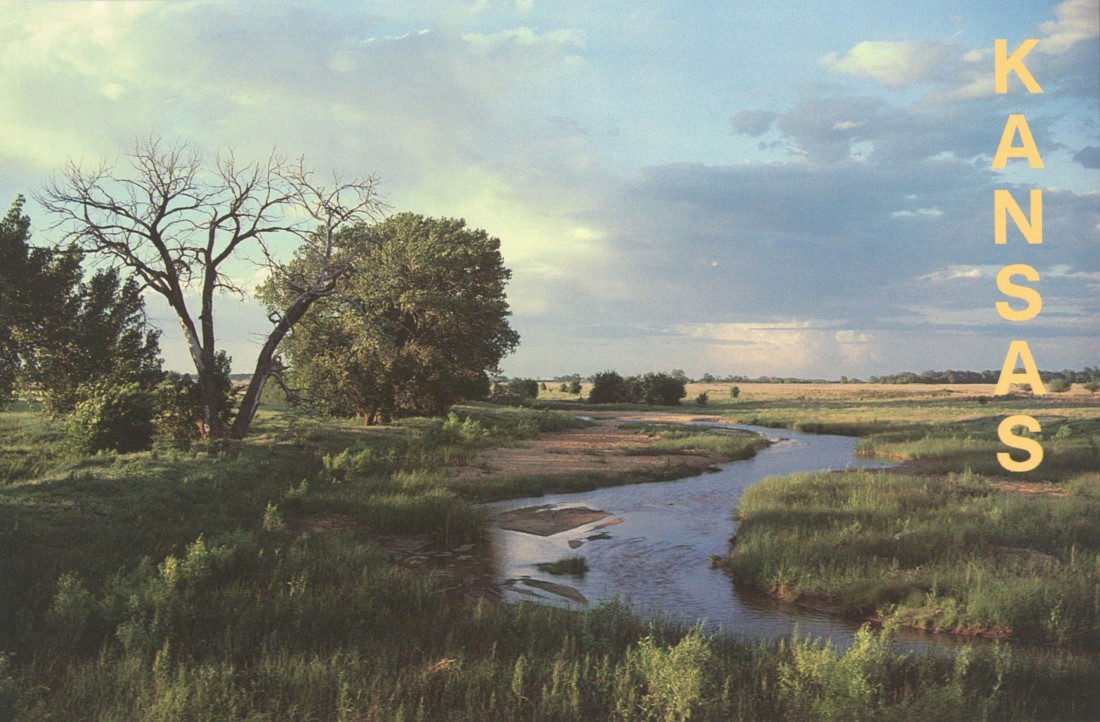
Color postcard of a stream winding through green fields speckled with trees.
“There are hundreds of small prairie streams like this one located in southern Kansas. Spring rains cause these small streams to flow with clean clear water. Many species of wildlife can be observed near such streams, and wildflowers are often abundant along these streams.” Kansas Postcard Company Postcards. Call Number: RH PH 522. Click image to enlarge.
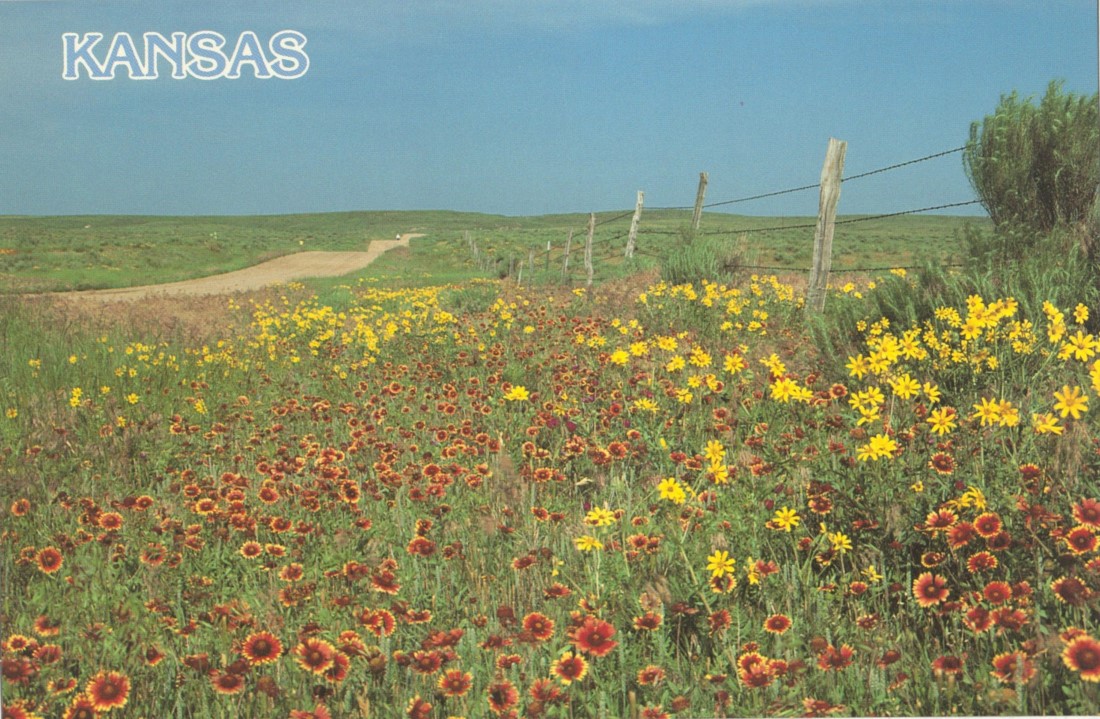
Color postcard of red and yellow flowers along a barbed wire fence.
“Wildflowers blanket the prairie along a quiet country road in Meade County, Kansas.” Kansas Postcard Company Postcards. Call Number: RH PH 522. Click image to enlarge.
Color postcard of trees along a river.
“A lush backwater swamp of the Spring River in Cherokee County gives life to plants and animals.” Kansas Postcard Company Postcards. Call Number: RH PH 522. Click image to enlarge.
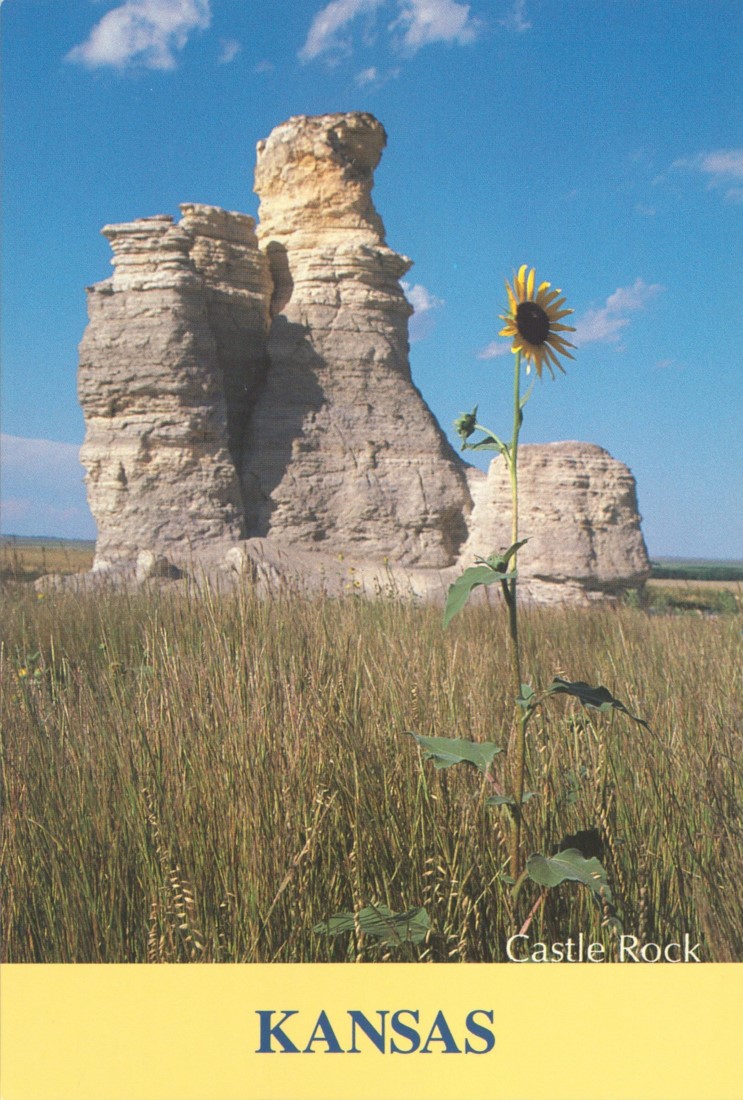
Color postcard of a large rock formation surrounded by prairie grasses.
Castle Rock, located in Gove County, was used as a landmark in northwestern Kansas before Kansas became a state. The sunflower in the foreground is the official state flower of Kansas.” Kansas Postcard Company Postcards. Call Number: RH PH 522. Click image to enlarge.

Tiffany McIntosh
Public Services

That’s Distinctive!: Campus Aerials

February 17th, 2023

Check the blog each Friday for a new “That’s Distinctive!” post. I created the series because I genuinely believe there is something in our collections for everyone, whether you’re writing a paper or just want to have a look. “That’s Distinctive!” will provide a more lighthearted glimpse into the diverse and unique materials at Spencer – including items that many people may not realize the library holds. If you have suggested topics for a future item feature or questions about the collections, feel free to leave a comment at the bottom of this page.

This week on “That’s Distinctive!” we will be highlighting photos from University Archives that show views of campus throughout the years. The University Archives houses over a million photographs along with departmental records, personal papers, university publications, and much more. Over 35,000 photos within University Archives have been digitized and can be browsed online. Many more photos of campus over the years can be found by using the search term “campus.”

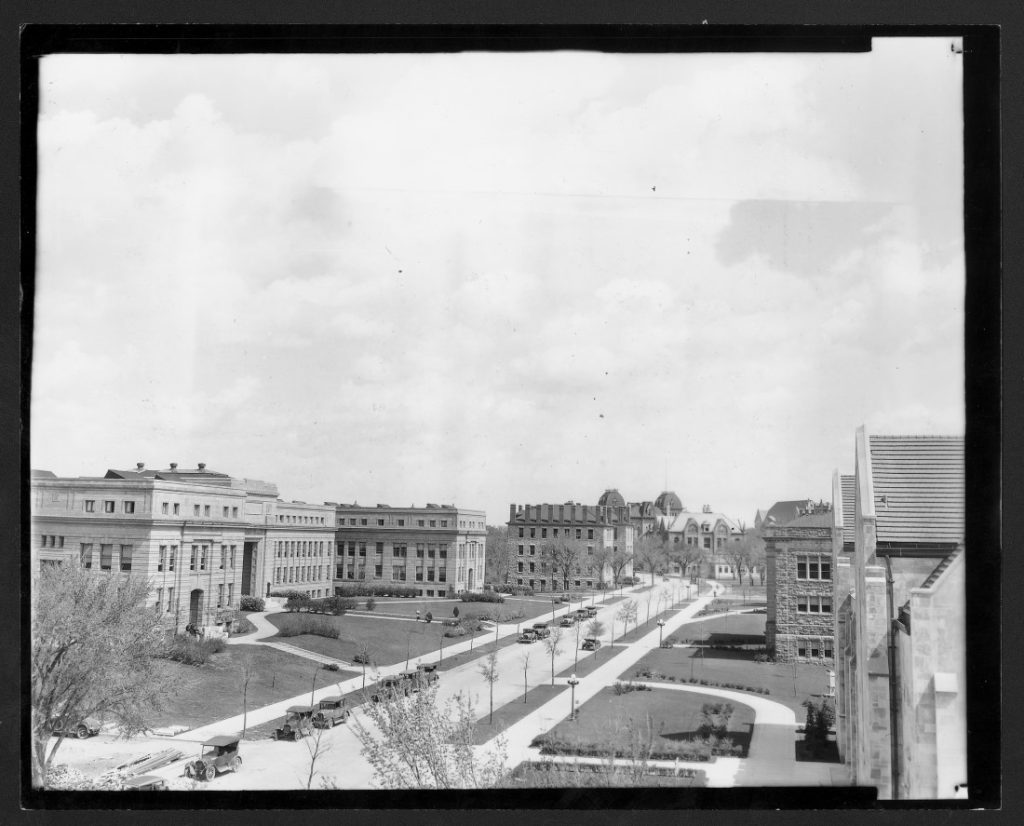
Black-and-white photograph of large buildings on both sides of a wide street.
Jayhawk Boulevard looking east, circa 1927. On the left (from left to right) is Strong Hall, Bailey Hall, Old Fraser Hall, Old Snow Hall. On the right (from right to left) is Hoch Auditorium and Old Haworth Hall, with the roofs of Robinson Gymnasium and Watson Library visible in the background. University Archives Photos. Call Number: RG 0/24/P 1925 Prints: Campus: Panoramas (Photos). Click image to enlarge (redirect to Spencer’s digital collections).
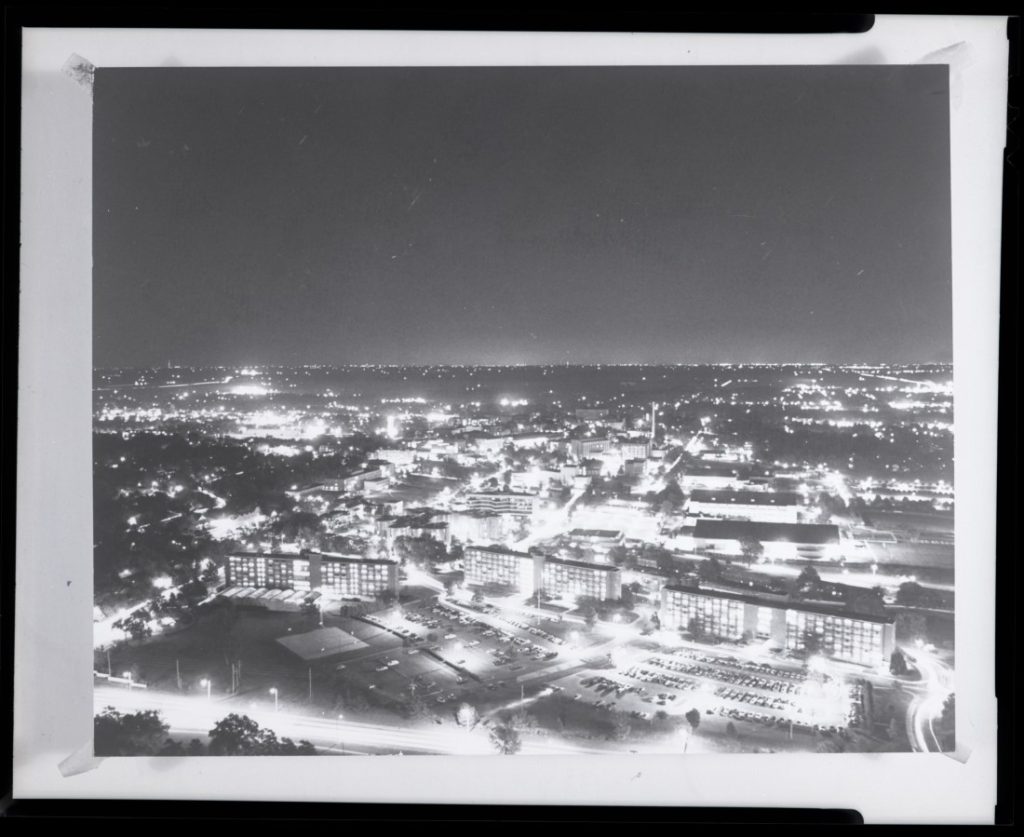
Black-and-white photograph of streets and buildings lit by bright lights.
Aerial of campus at night, 1987. The photo appears to have been taken from Iowa Street just south of Fifteenth/Bob Billings; the Daisy Hill residence halls are in the foreground. University Archives Photos. Call Number: RG 0/24/A 1987 Prints: University General: Campus: Campus Aerials (Photos). Click image to enlarge (redirect to Spencer’s digital collections).
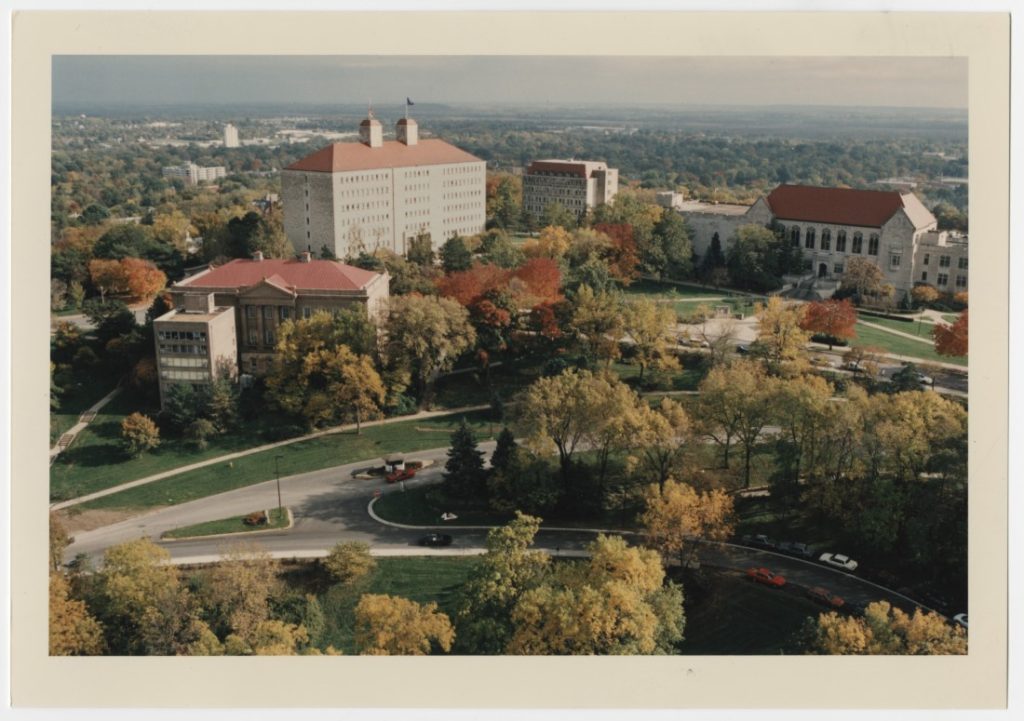
Color photograph of the KU campus with fall foliage.
Campus aerial, 1994. From left to right are Lippincott (Old Green) Hall, Fraser Hall, Blake Hall, and Watson Library. University Archives Photos. Call Number: RG 0/24/A 1994 Prints: University General: Campus: Campus Aerials (Photos). Click image to enlarge (redirect to Spencer’s digital collections).

If you are following the holidays we have correlated with previously and are still in the Valentine’s Day mood, check out our 2013 “Civil War Valentine” post by Whitney Baker, Head of Conservation Services at KU Libraries. It focuses on a handwritten poem titled “A Valentine” from one of Spencer’s regional history collections.

These items are meant to show that the library houses many things that many people may not realize. From books, to manuscripts, to maps and ephemera, if you can think of a topic, we likely have something related. Have a topic in mind? I have three unplanned weeks between March and April so please feel free to leave ideas/interests in the comment box below and I will see what items we may hold.

Tiffany McIntosh
Public Services

Happy Holidays!

December 20th, 2022
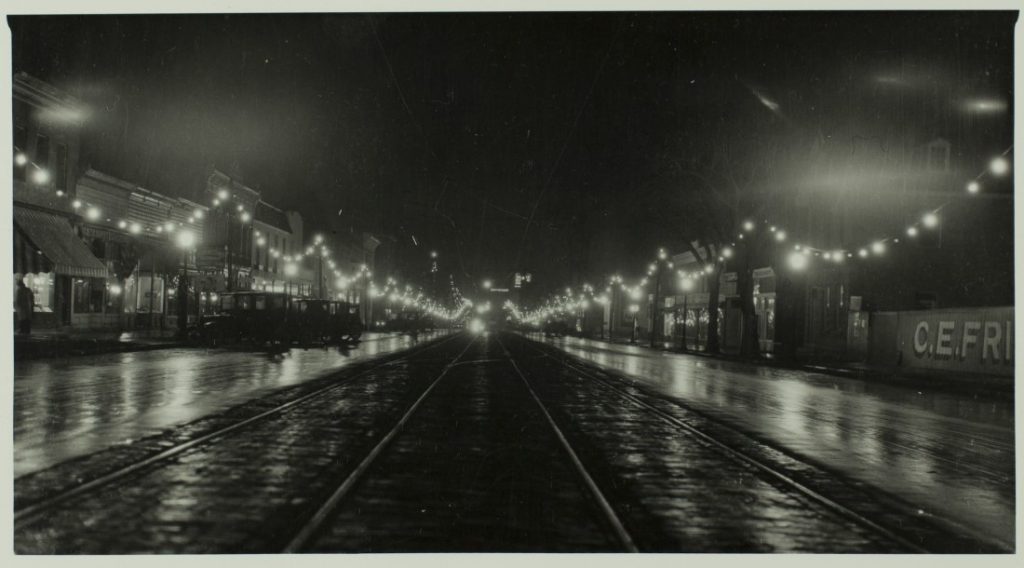
Black-and-white photograph taken at night. Buildings and Christmas lights line both sides of the street; trolley tracks run down the middle.
Massachusetts Street in Lawrence, Kansas, at Christmas, 1920s. Research indicates that this photo was taken at Eleventh Street – roughly in front of the Watkins Museum of History – looking north. Duke D’Ambra Photograph Collection. Call Number: RH PH 69. Click image to enlarge (redirect to Spencer’s digital collections).

Spencer Research Library will be closed from December 23rd through January 2nd. We will reopen on January 3rd and look forward to sharing more stories from our collections in the new year!

Visit the KU Libraries website for more information on winter recess across the libraries, including hours and options for accessing to online resources services available when buildings are closed.

Caitlin Klepper
Head of Public Services

Flag Day, 2022

June 14th, 2022
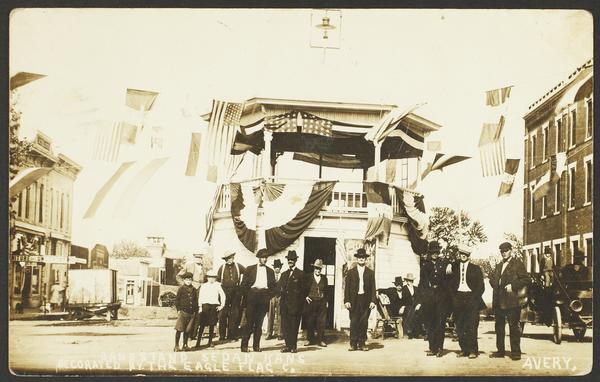
Bandstand decorated by the Eagle Flag Co. in Sedan, Kansas, 1913. Kansas Collection Photos. Call Number: RH MS P2178. Click image to enlarge (redirect to Spencer’s digital collections).

Not a federal holiday, but a celebration and a remembrance. In 1916, President Woodrow Wilson proclaimed June 14th as Flag Day, celebrating the adoption of the flag of the United States on June 14, 1777. Flags are a particular manifestation of symbols. A flag can indicate an idea, a group, a place, or an area. With the adoption of an official flag for the United States of America, there was a unified way to signal the influence of the USA. With that noted, maybe we can look at how it and a few other flags have been used through the years!

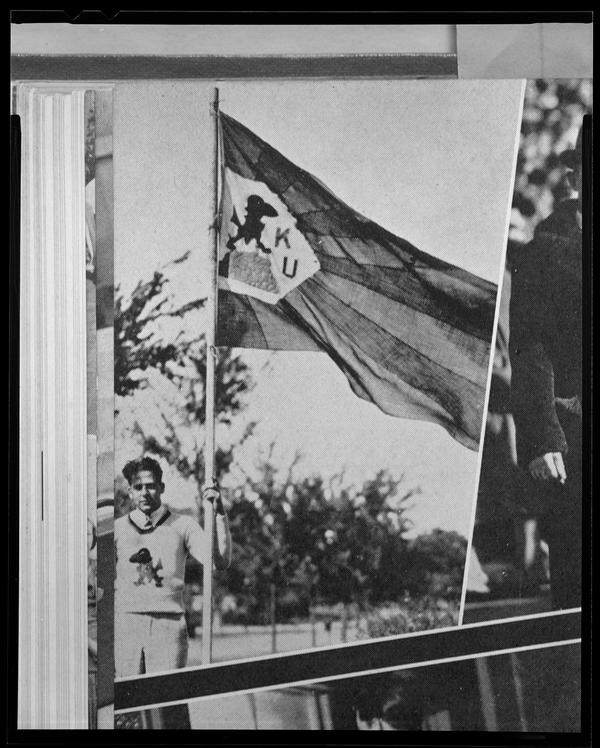
Here we have one of several KU flags, this one a 1928 design. Used in this manner, it is very similar to a national flag, showing identification and support for the University of Kansas.

University of Kansas flag designed in 1928; photo taken in 1933. University Archives Photos. Call Number: RG 0/49: General Records: Flags and Banners (Photos). Click image to enlarge (redirect to Spencer’s digital collections).

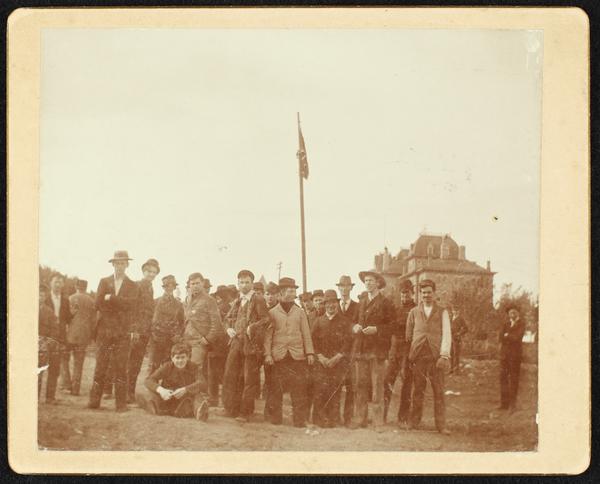
Flags sometimes come with the hint of violence. Here we have a photo of students around their flag to fight for on May Day in 1895. Having your flag captured was quite the sign of disgrace!

May Day Scrap, 1895. University Archives Photos. Call Number: RG 71/10: Student Activities: May Day (Photos). Click image to enlarge (redirect to Spencer’s digital collections).

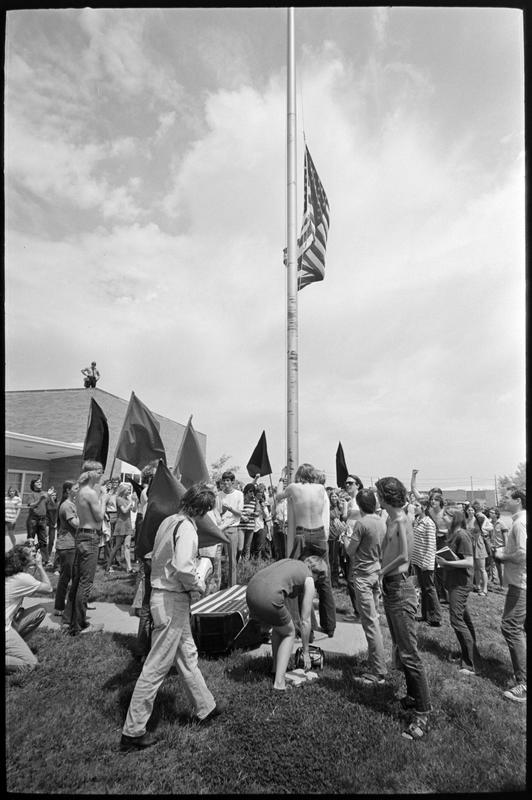
While flags can be used as positive symbols – representing enthusiasm, identification, etc. – flags can also be used as negative symbols. Here at a KU an anti-Vietnam war Student protest in May 1970, black flags are displayed along with a U.S. flag on a coffin near a U.S. flag at half-mast. The same flags used for celebration here demonstrate shame and loss.

KU anti-Vietnam student protests on May 3-9, 1970. University Archives Photos. Call Number: RG 71/18: Student Protests (Photos). Click image to enlarge (redirect to Spencer’s digital collections).

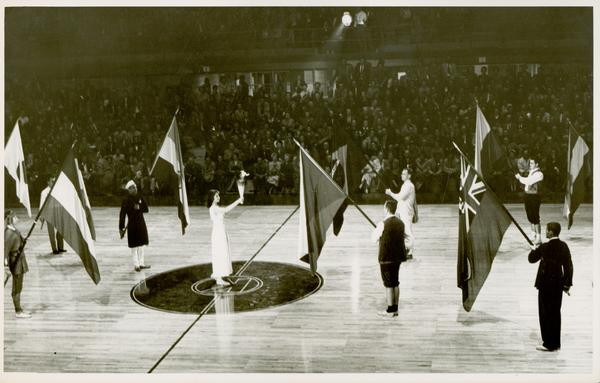
And while a flag can be used to isolate and claim dominion, flags can be used to show hope, alliance, and gathering together as in the dedication ceremony for Allen Fieldhouse in 1955.

The Allen Fieldhouse dedication ceremony, 1955. University Archives Photos. Call Number: RG 0/22/1: Campus: Buildings: Allen Fieldhouse (Photos). Click image to enlarge (redirect to Spencer’s digital collections).

Flags have been and are used in many different ways in many different circumstances: in humor, in celebration, in victory, in defeat, in shame, and in pride. Flag Day may specifically celebrate the adoption of a United States flag, but isn’t a bad day to think of all the flags we fly!

Shelby Schellenger
Reference Coordinator